
What topics and trends defined most-cited T-cell and B-cell Immunology research in the Class of 2026?
T-cell and B-cell immunology in 2024 is led by tumor microenvironment dynamics, T cell exhaustion, and regulatory T cell biology. CAR T cell therapies and spatial transcriptomics achieved major gains, while broad single-cell sequencing and CD8+ T cell profiling contracted as research pivoted toward targeted synthetic constructs and immune synapse mechanics.
At a glance
- Field
- T-cell and B-cell Immunology
- Cohort label
- Class of 2026 (2024 publications)
- Papers analyzed
- 4,834
- Papers ranked
- 20
- Top topics in ranked papers
- Tumor microenvironment, T cell exhaustion, Regulatory T cells, Immune checkpoint blockade, Spatial transcriptomics
- Publication window
- Jan 1, 2024 – Dec 31, 2024
- Eligibility
- Research articles; reviews excluded
- Citation window
- 18 months post-publication
- 18m citation range
- 70–133
- Data source
- OpenAlex · Retrieved Jul 2026
- License
- CC BY 4.0
Rankings
20 papers ranked by 18-month citation count
Xist ribonucleoproteins promote female sex-biased autoimmunity
Cell202410.1016/j.cell.2023.12.037
Dysfunction of exhausted T cells is enforced by MCT11-mediated lactate metabolism
Nature Immunology202410.1038/s41590-024-01999-3
Open-ST: High-resolution spatial transcriptomics in 3D
Cell202410.1016/j.cell.2024.05.055
IL-10-expressing CAR T cells resist dysfunction and mediate durable clearance of solid tumors and metastases
Nature Biotechnology202410.1038/s41587-023-02060-8
BCMA-CD19 compound CAR T cells for systemic lupus erythematosus: a phase 1 open-label clinical trial
Annals of the Rheumatic Diseases202410.1136/ard-2024-225785
Circadian tumor infiltration and function of CD8+ T cells dictate immunotherapy efficacy
Cell202410.1016/j.cell.2024.04.015
Smoking changes adaptive immunity with persistent effects
Nature202410.1038/s41586-023-06968-8
Spatiotemporal single-cell analysis decodes cellular dynamics underlying different responses to immunotherapy in colorectal cancer
Cancer Cell202410.1016/j.ccell.2024.06.009
Unlocking the full potential of memory T cells in adoptive T cell therapy for hematologic malignancies
International Immunopharmacology202410.1016/j.intimp.2024.113392
The type 2 cytokine Fc–IL-4 revitalizes exhausted CD8+ T cells against cancer
Nature202410.1038/s41586-024-07962-4
FOXO1 is a master regulator of memory programming in CAR T cells
Nature202410.1038/s41586-024-07300-8
Immune system adaptation during gender-affirming testosterone treatment
Nature202410.1038/s41586-024-07789-z
Osr2 functions as a biomechanical checkpoint to aggravate CD8+ T cell exhaustion in tumor
Cell202410.1016/j.cell.2024.04.023
BCMA-Targeted T-Cell–Engager Therapy for Autoimmune Disease
New England Journal of Medicine202410.1056/nejmc2408786
PGE2 limits effector expansion of tumour-infiltrating stem-like CD8+ T cells
Nature202410.1038/s41586-024-07254-x
Lymphatic-localized Treg-mregDC crosstalk limits antigen trafficking and restrains anti-tumor immunity
Cancer Cell202410.1016/j.ccell.2024.06.014
GLUT1 overexpression in CAR-T cells induces metabolic reprogramming and enhances potency
Nature Communications202410.1038/s41467-024-52666-y
Programming tissue-sensing T cells that deliver therapies to the brain
Science202410.1126/science.adl4237
A spatial human thymus cell atlas mapped to a continuous tissue axis
Nature202410.1038/s41586-024-07944-6
The transcription factor ZEB2 drives the formation of age-associated B cells
Science202410.1126/science.adf8531
Topic trends
Dominant research themes and year-over-year shifts in T-cell and B-cell Immunology
What Topics Define the Class of 2026?
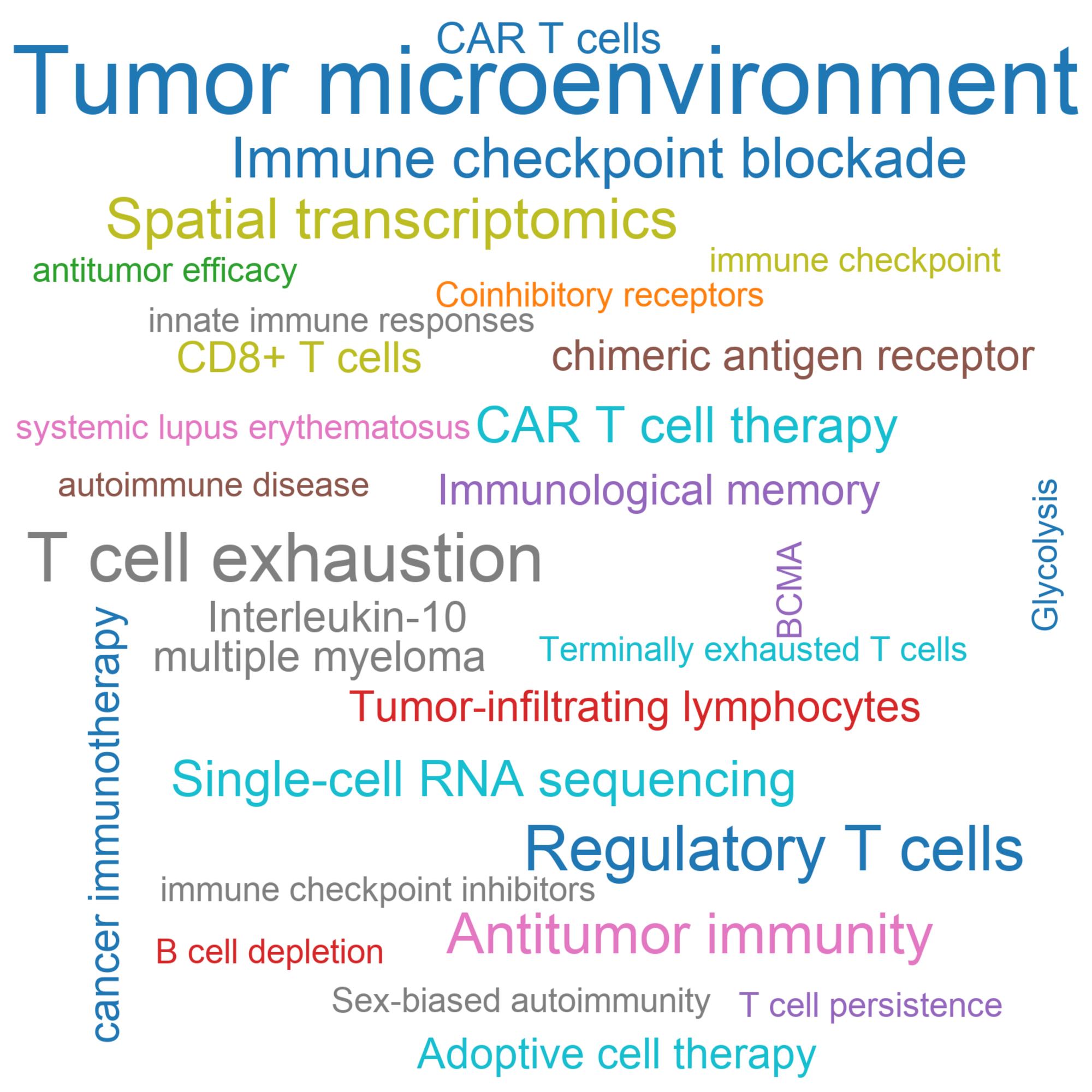
In the Class of 2026 cohort for T-cell and B-cell immunology, research is heavily anchored around the tumor microenvironment (normalized frequency 0.26, 13 papers) and mechanisms of immunotherapeutic response and resistance. T cell exhaustion (0.14, 7 papers) and regulatory T cells (0.12, 6 papers) emerge as primary functional axes, highlighting ongoing efforts to understand transcriptional and metabolic dysfunction within immune cells exposed to chronic antigen stimulation. Concurrent focus on antitumor immunity (0.10, 5 papers) and immune checkpoint blockade (0.10, 5 papers) underscores a field-wide transition toward dissecting resistance mechanisms and optimizing therapeutic combinations. Methodologically, spatial transcriptomics (0.10, 5 papers) and single-cell RNA sequencing (0.08, 4 papers) dominate high-impact investigation, enabling researchers to map cell-cell crosstalk, cellular niches, and spatial heterogeneity within tissues. Furthermore, engineered cellular therapies such as CAR T cell therapy (0.08, 4 papers) and chimeric antigen receptor constructs (0.06, 3 papers) represent pivotal translational hubs. Clinical applications in hematologic malignancies like multiple myeloma (0.06, 3 papers), paired with fundamental studies on Interleukin-10 (0.06, 3 papers) and immunological memory (0.06, 3 papers), reflect an integrated paradigm spanning mechanistic discovery and targeted synthetic immunology.
How Did Topics Shift from the Class of 2025 to the Class of 2026?
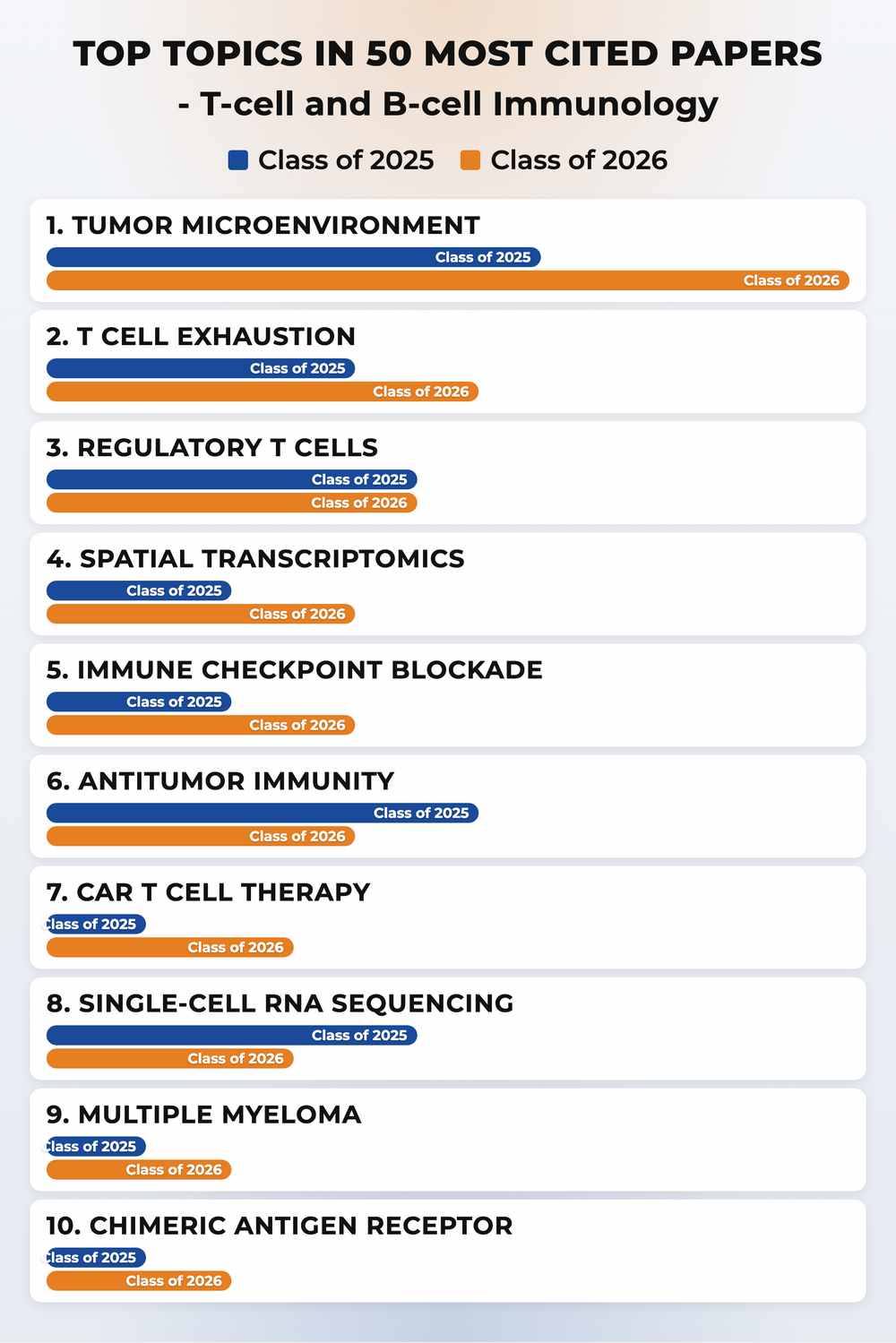
Comparing the Class of 2025 and Class of 2026 cohorts reveals a distinct shift from generalized immune profiling toward actionable synthetic immunology and therapeutic engineering. The most prominent rise is seen in CAR T cell therapy, which surged 4-fold from a normalized frequency of 0.02 (1 paper) to 0.08 (4 papers), alongside a parallel emergence of specific target platforms including BCMA, bispecific antibodies, CTLA-4 blockade, and synthetic Notch receptors. Spatial transcriptomics also accelerated significantly from 0.06 (3 papers) to 0.10 (5 papers), reflecting rapid adoption of spatial multi-omics over unstructured single-cell suspensions. Conversely, foundational broad descriptors experienced noticeable relative declines. CD8+ T cells dropped from 0.14 (7 papers) to 0.06 (3 papers), single-cell RNA sequencing decreased from 0.12 (6 papers) to 0.08 (4 papers), and general antitumor immunity shifted from 0.14 (7 papers) to 0.10 (5 papers). Rather than indicating waning interest, this contraction signals a maturation of the literature: researchers have moved past broad cellular surveys toward specific, high-resolution mechanistic sub-phenotypes such as terminally exhausted T cells, immune synapses, and metabolic reprogramming (glycolysis and oxidative phosphorylation).
Methodology
PRI identifies high-impact research using a transparent, topic-agnostic framework applied consistently across scientific domains. Bibliographic records are drawn from OpenAlex, including publication dates, citation relationships, and document types.
This ranking covers the Class of 2026 cohort: journal articles published in 2024. Reviews and other non-article document types are excluded to ensure comparability.
Research impact is quantified with an 18-month post-publication citation window—the number of citing works published within 18 months of each paper's publication date. This metric captures early impact while controlling for publication age.
An LLM-based relevance classifier then reviews each candidate's title and abstract to confirm substantive alignment with the target domain. Only papers classified as relevant appear in the final ranking.
Zheng Su, Tinsley Li, Thematic Shifts in Early-High-Impact Cancer Genomics and Diagnostics Research: A Bibliometric and Semantic Analysis. bioRxiv 2026.07.04.736459; doi: https://doi.org/10.64898/2026.07.04.736459
Cite this ranking
Pepkio Research Index (PRI). Topics and Trends in Most Cited T-cell and B-cell Immunology Papers, Class of 2026. https://pri.pepkio.com/top-papers/t-cell-and-b-cell-immunology/2026. Accessed 2026-10-16.

Methodology
Zheng Su, Tinsley Li, Thematic Shifts in Early-High-Impact Cancer Genomics and Diagnostics Research: A Bibliometric and Semantic Analysis. bioRxiv 2026.07.04.736459; doi: https://doi.org/10.64898/2026.07.04.736459