
What topics and trends defined most-cited Monoclonal and Polyclonal Antibodies Research research in the Class of 2026?
The 2026 cohort demonstrates a marked shift toward AI-guided antibody discovery, with protein and antibody language models gaining substantial traction. While traditional mainstays like antibody-drug conjugates (ADCs) remain central, we observe a surge in fundamental B-cell immunology topics such as somatic hypermutation and memory B cells.
At a glance
- Field
- Monoclonal and Polyclonal Antibodies Research
- Cohort label
- Class of 2026 (2024 publications)
- Papers analyzed
- 8,711
- Papers ranked
- 20
- Top topics in ranked papers
- Antibody-drug conjugates, somatic hypermutation, protein language models
- Publication window
- Jan 1, 2024 – Dec 31, 2024
- Eligibility
- Research articles; reviews excluded
- Citation window
- 18 months post-publication
- 18m citation range
- 42–129
- Data source
- OpenAlex · Retrieved Jul 2026
- License
- CC BY 4.0
Rankings
20 papers ranked by 18-month citation count
Evolving antibody response to SARS-CoV-2 antigenic shift from XBB to JN.1
Nature202410.1038/s41586-024-08315-x
Bispecific T cell engager therapy for refractory rheumatoid arthritis
Nature Medicine202410.1038/s41591-024-02964-1
Mirror-image protein and peptide drug discovery through mirror-image phage display
Chem202410.1016/j.chempr.2024.06.004
BL-B01D1, a first-in-class EGFR–HER3 bispecific antibody–drug conjugate, in patients with locally advanced or metastatic solid tumours: a first-in-human, open-label, multicentre, phase 1 study
The Lancet Oncology202410.1016/s1470-2045(24)00159-1
Long-term 3-year follow-up of mosunetuzumab in relapsed or refractory follicular lymphoma after ≥2 prior therapies
Blood202410.1182/blood.2024025454
Real-world analysis of teclistamab in 123 RRMM patients from Germany
Leukemia202410.1038/s41375-024-02154-5
CD23 <sup>+</sup> IgG1 <sup>+</sup> memory B cells are poised to switch to pathogenic IgE production in food allergy
Science Translational Medicine202410.1126/scitranslmed.adi0673
Impact of soluble BCMA and non–T-cell factors on refractoriness to BCMA-targeting T-cell engagers in multiple myeloma
Blood202410.1182/blood.2024026212
Large scale paired antibody language models
PLoS Computational Biology202410.1371/journal.pcbi.1012646
mRNA-LNP HIV-1 trimer boosters elicit precursors to broad neutralizing antibodies
Science202410.1126/science.adk0582
An autoantibody signature predictive for multiple sclerosis
Nature Medicine202410.1038/s41591-024-02938-3
De novo generation of SARS-CoV-2 antibody CDRH3 with a pre-trained generative large language model
Nature Communications202410.1038/s41467-024-50903-y
Addressing the antibody germline bias and its effect on language models for improved antibody design
Bioinformatics202410.1093/bioinformatics/btae618
Exo-Cleavable Linkers: Enhanced Stability and Therapeutic Efficacy in Antibody–Drug Conjugates
Journal of Medicinal Chemistry202410.1021/acs.jmedchem.4c01251
Assessing antibody and nanobody nativeness for hit selection and humanization with AbNatiV
Nature Machine Intelligence202410.1038/s42256-023-00778-3
Durable Responses With Mosunetuzumab in Relapsed/Refractory Indolent and Aggressive B-Cell Non-Hodgkin Lymphomas: Extended Follow-Up of a Phase I/II Study
Journal of Clinical Oncology202410.1200/jco.23.02329
A unique serum IgG glycosylation signature predicts development of Crohn’s disease and is associated with pathogenic antibodies to mannose glycan
Nature Immunology202410.1038/s41590-024-01916-8
Conjugation Chemistry Markedly Impacts Toxicity and Biodistribution of Targeted Nanoparticles, Mediated by Complement Activation
Advanced Materials202410.1002/adma.202409945
A humanized mouse that mounts mature class-switched, hypermutated and neutralizing antibody responses
Nature Immunology202410.1038/s41590-024-01880-3
Spike structures, receptor binding, and immune escape of recently circulating SARS-CoV-2 Omicron BA.2.86, JN.1, EG.5, EG.5.1, and HV.1 sub-variants
Structure202410.1016/j.str.2024.06.012
Topic trends
Dominant research themes and year-over-year shifts in Monoclonal and Polyclonal Antibodies Research
What Topics Define the Class of 2026?
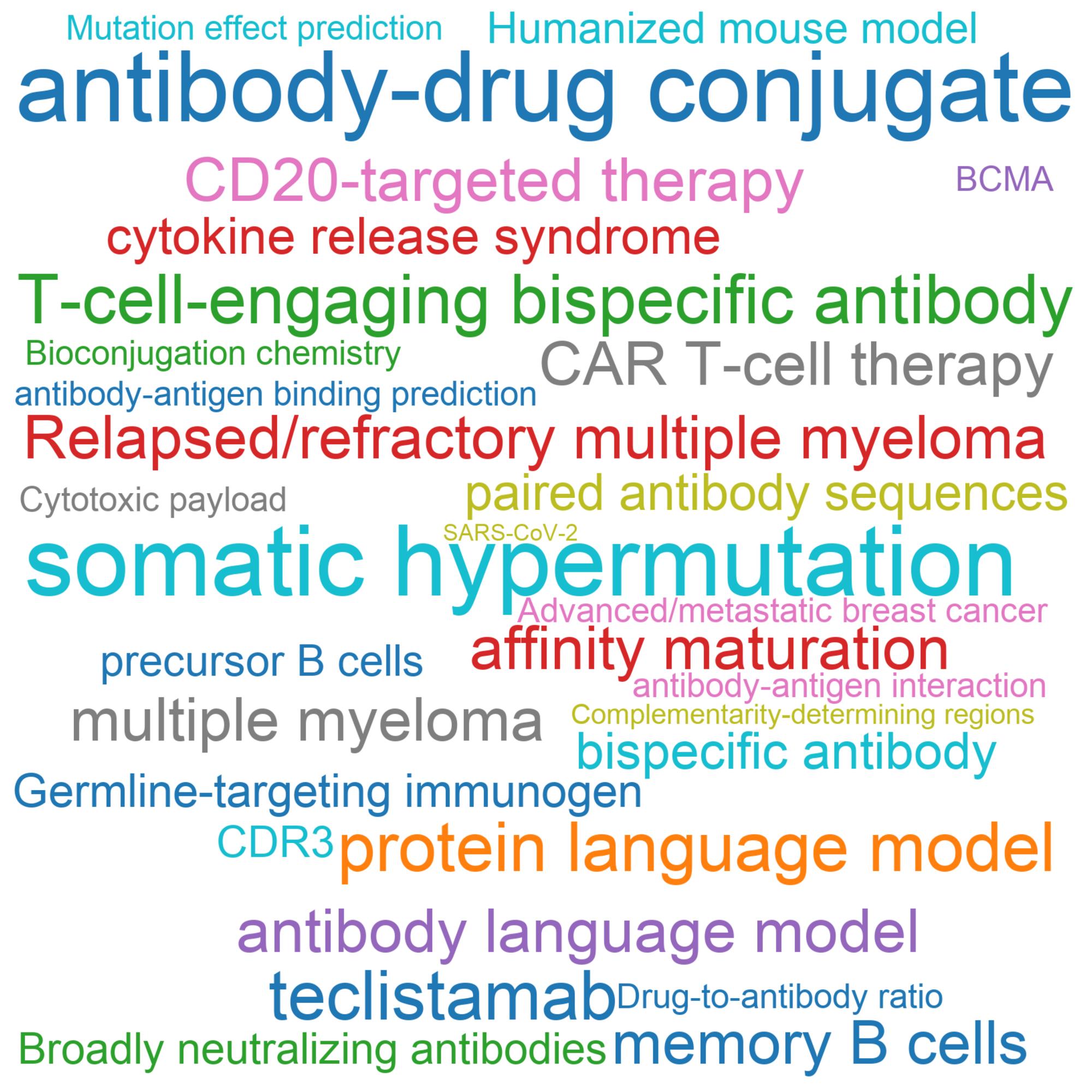
The Class of 2026 is defined by a dual focus on advanced therapeutics and foundational immunology. Antibody-drug conjugates (ADCs) continue to anchor the field, remaining a highly cited and stable topic as novel payload-linker technologies enter the clinic. Equally prominent, however, is a renewed emphasis on the mechanisms of antibody generation and maturation. Concepts such as somatic hypermutation and memory B cells emerged as top themes, reflecting a growing effort to understand natural immune repertoires and harness them for therapeutic discovery. Simultaneously, the landscape is heavily influenced by engineered biologics and bispecific formats. T-cell-engaging bispecific antibodies and targeted therapies (such as those directed at CD20 and BCMA) feature prominently, underscoring the ongoing translation of complex antibody architectures into standard-of-care treatments for malignancies like relapsed/refractory multiple myeloma. Notably, this cohort also highlights the rapid integration of artificial intelligence into the field, with protein language models cementing their position as critical tools for predicting antibody structure, function, and developability.
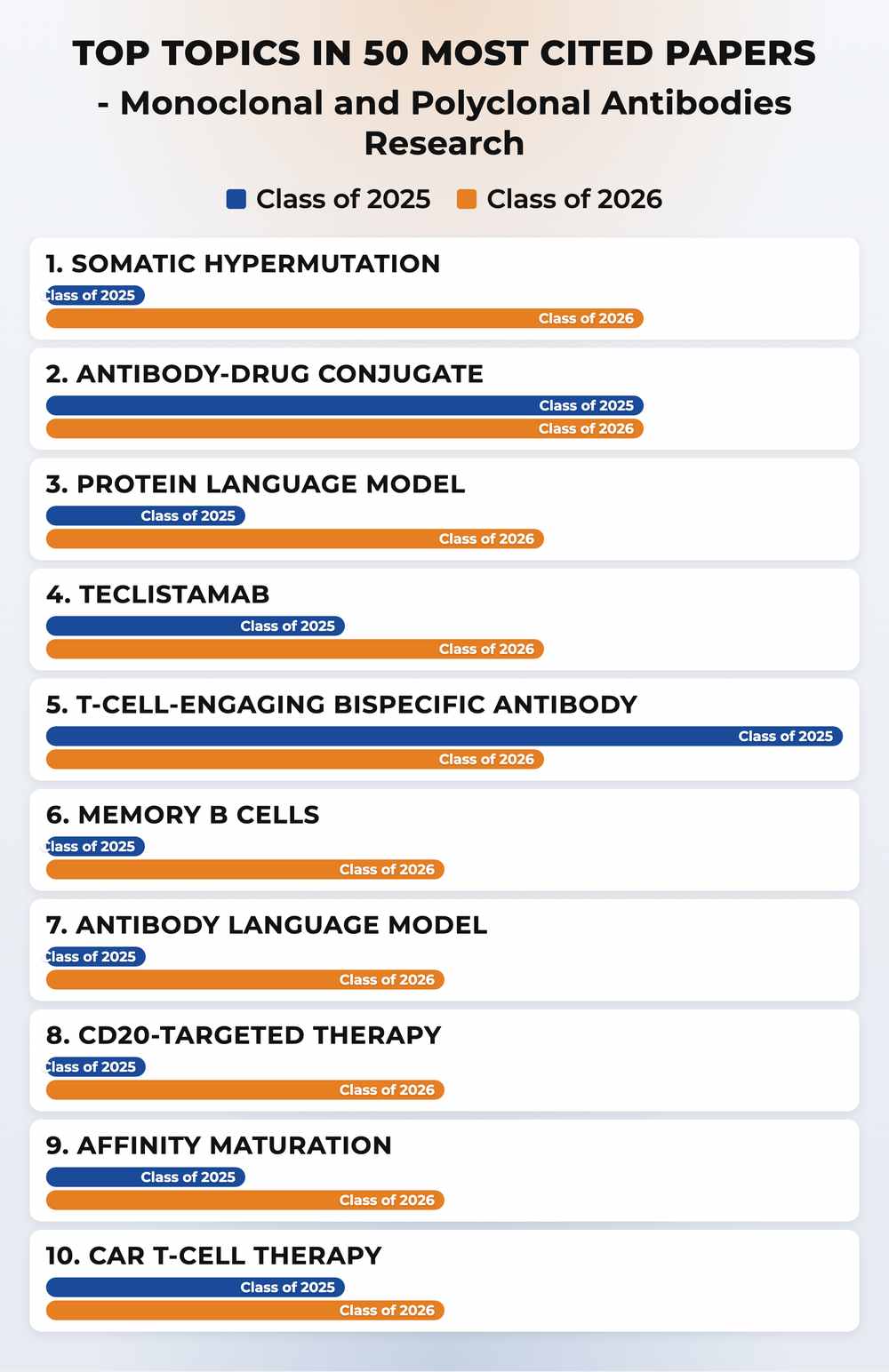
How Did Topics Shift from the Class of 2025 to the Class of 2026?
The shift from the Class of 2025 to 2026 reveals a transformative period for antibody research, marked by the explosive rise of computational methods and foundational B-cell biology. The most striking increase was seen in somatic hypermutation, which surged from a baseline of zero representation in the top tier to become one of the most defining concepts of the year. This was paralleled by a sharp rise in memory B cells, indicating a strategic pivot toward mining natural immune responses for novel antibody discovery. In tandem, the adoption of artificial intelligence accelerated dramatically. Protein language models and antibody language models experienced significant growth, transforming from niche computational techniques into mainstream approaches for in silico antibody design and affinity maturation. Conversely, some mature clinical themes, such as relapsed/refractory multiple myeloma and T-cell-engaging bispecific antibodies, saw a relative decline in citation share. This suggests that while these clinical applications remain important, the vanguard of the field is increasingly focused on the upstream discovery engines—both biological and computational—that will generate the next generation of antibody therapeutics.
Methodology
PRI identifies high-impact research using a transparent, topic-agnostic framework applied consistently across scientific domains. Bibliographic records are drawn from OpenAlex, including publication dates, citation relationships, and document types.
This ranking covers the Class of 2026 cohort: journal articles published in 2024. Reviews and other non-article document types are excluded to ensure comparability.
Research impact is quantified with an 18-month post-publication citation window—the number of citing works published within 18 months of each paper's publication date. This metric captures early impact while controlling for publication age.
An LLM-based relevance classifier then reviews each candidate's title and abstract to confirm substantive alignment with the target domain. Only papers classified as relevant appear in the final ranking.
Zheng Su, Tinsley Li, Thematic Shifts in Early-High-Impact Cancer Genomics and Diagnostics Research: A Bibliometric and Semantic Analysis. bioRxiv 2026.07.04.736459; doi: https://doi.org/10.64898/2026.07.04.736459
Cite this ranking
Pepkio Research Index (PRI). Topics and Trends in Most Cited Monoclonal and Polyclonal Antibodies Research Papers, Class of 2026. https://pri.pepkio.com/top-papers/monoclonal-and-polyclonal-antibodies-research/2026. Accessed 2026-10-14.

Methodology
Zheng Su, Tinsley Li, Thematic Shifts in Early-High-Impact Cancer Genomics and Diagnostics Research: A Bibliometric and Semantic Analysis. bioRxiv 2026.07.04.736459; doi: https://doi.org/10.64898/2026.07.04.736459