
What topics and trends defined most-cited Immunotherapy and Immune Responses research in the Class of 2026?
In the Class of 2026, the tumor microenvironment and combination immunotherapy continue to dominate research focus. We also observed significant growth in spatial omics and CD19 CAR T-cell therapy, while traditional topics like broad antigen presentation and T cell exhaustion saw notable declines.
At a glance
- Field
- Immunotherapy and Immune Responses
- Cohort label
- Class of 2026 (2024 publications)
- Papers analyzed
- 8,915
- Papers ranked
- 20
- Top topics in ranked papers
- Tumor microenvironment, immune checkpoint blockade, combination immunotherapy
- Publication window
- Jan 1, 2024 – Dec 31, 2024
- Eligibility
- Research articles; reviews excluded
- Citation window
- 18 months post-publication
- 18m citation range
- 108–369
- Data source
- OpenAlex · Retrieved July 2026
- License
- CC BY 4.0
Rankings
20 papers ranked by 18-month citation count
Individualised neoantigen therapy mRNA-4157 (V940) plus pembrolizumab versus pembrolizumab monotherapy in resected melanoma (KEYNOTE-942): a randomised, phase 2b study
The Lancet202410.1016/s0140-6736(23)02268-7
Neoadjuvant Nivolumab and Ipilimumab in Resectable Stage III Melanoma
New England Journal of Medicine202410.1056/nejmoa2402604
Safety, efficacy and determinants of response of allogeneic CD19-specific CAR-NK cells in CD19+ B cell tumors: a phase 1/2 trial
Nature Medicine202410.1038/s41591-023-02785-8
Targeting immunogenic cell stress and death for cancer therapy
Nature Reviews Drug Discovery202410.1038/s41573-024-00920-9
Towards targeting the breast cancer immune microenvironment
Nature reviews. Cancer202410.1038/s41568-024-00714-6
Obecabtagene Autoleucel in Adults with B-Cell Acute Lymphoblastic Leukemia
New England Journal of Medicine202410.1056/nejmoa2406526
Immunogenic cell death in cancer: targeting necroptosis to induce antitumour immunity
Nature reviews. Cancer202410.1038/s41568-024-00674-x
Afamitresgene autoleucel for advanced synovial sarcoma and myxoid round cell liposarcoma (SPEARHEAD-1): an international, open-label, phase 2 trial
The Lancet202410.1016/s0140-6736(24)00319-2
Intravenous and intracranial GD2-CAR T cells for H3K27M+ diffuse midline gliomas
Nature202410.1038/s41586-024-08171-9
Combined JAK inhibition and PD-1 immunotherapy for non–small cell lung cancer patients
Science202410.1126/science.adf1329
Evolution of myeloid-mediated immunotherapy resistance in prostate cancer
Nature202410.1038/s41586-024-08290-3
Tertiary lymphoid structures in anticancer immunity
Nature reviews. Cancer202410.1038/s41568-024-00728-0
Probiotic neoantigen delivery vectors for precision cancer immunotherapy
Nature202410.1038/s41586-024-08033-4
Personalized neoantigen vaccine and pembrolizumab in advanced hepatocellular carcinoma: a phase 1/2 trial
Nature Medicine202410.1038/s41591-024-02894-y
Lymph-node-targeted, mKRAS-specific amphiphile vaccine in pancreatic and colorectal cancer: the phase 1 AMPLIFY-201 trial
Nature Medicine202410.1038/s41591-023-02760-3
Claudin18.2-specific CAR T cells in gastrointestinal cancers: phase 1 trial final results
Nature Medicine202410.1038/s41591-024-03037-z
Cancer cells impair monocyte-mediated T cell stimulation to evade immunity
Nature202410.1038/s41586-024-08257-4
CD19-CAR T-cell therapy induces deep tissue depletion of B cells
Annals of the Rheumatic Diseases202410.1136/ard-2024-226142
Intratumoral immune triads are required for immunotherapy-mediated elimination of solid tumors
Cancer Cell202410.1016/j.ccell.2024.05.025
Spatiotemporal single-cell analysis decodes cellular dynamics underlying different responses to immunotherapy in colorectal cancer
Cancer Cell202410.1016/j.ccell.2024.06.009
Topic trends
Dominant research themes and year-over-year shifts in Immunotherapy and Immune Responses
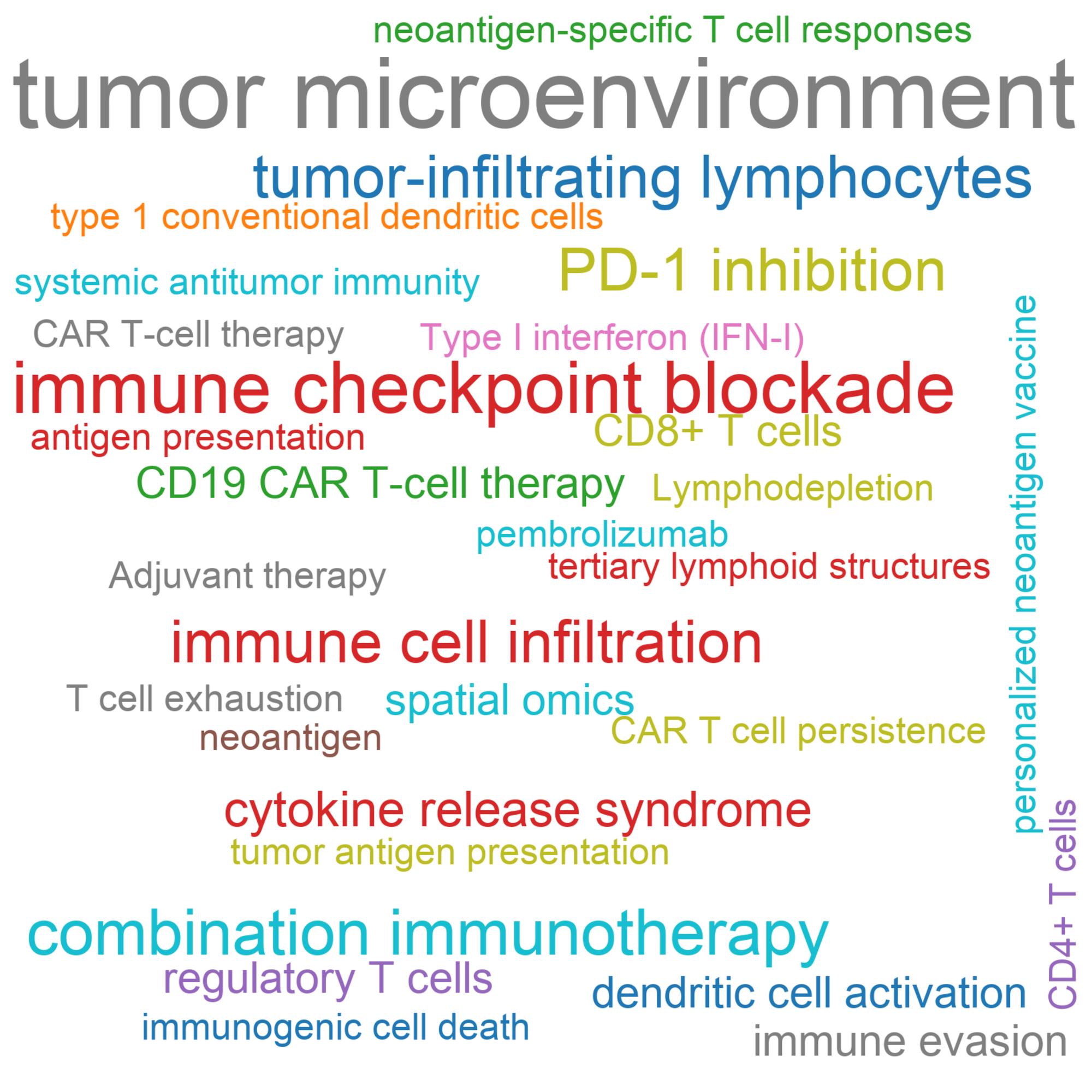
What Topics Define the Class of 2026?
The 2024 cohort for Immunotherapy and Immune Responses is heavily focused on understanding and modulating the tumor microenvironment, alongside optimizing immune checkpoint blockade and combination immunotherapies. By dissecting the cellular neighborhood and immune cell infiltration within tumors, researchers are developing more targeted and effective treatments. We observe a strong presence of topics such as tumor-infiltrating lymphocytes, PD-1 inhibition, and cytokine release syndrome, reflecting a mature field transitioning from single-agent therapies to complex combinatorial strategies designed to overcome resistance and enhance patient outcomes. This shift emphasizes the field's commitment to personalized and precise immunotherapeutic interventions.
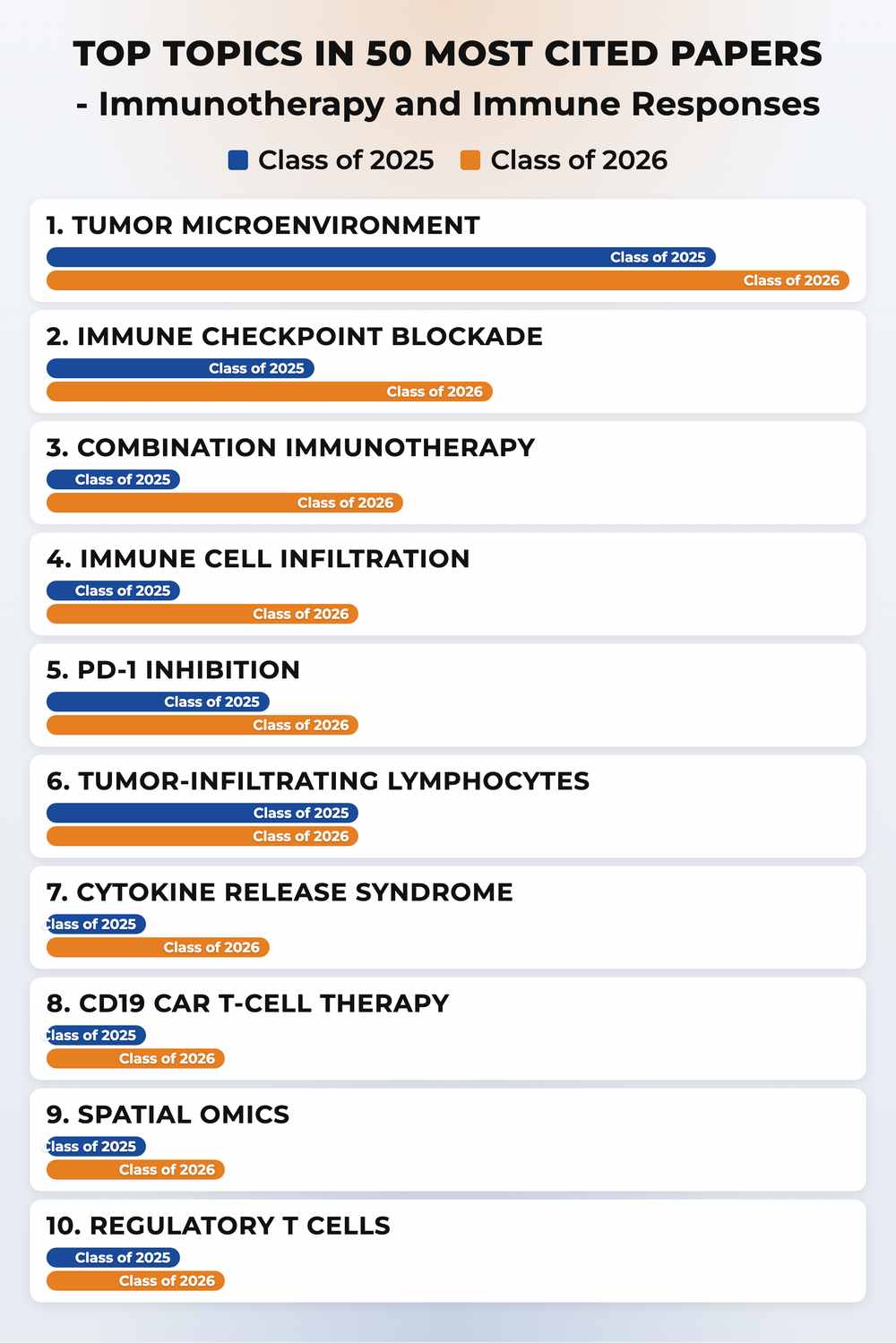
How Did Topics Shift from the Class of 2025 to the Class of 2026?
The shift from 2023 to 2024 reveals a dynamic re-prioritization in immunotherapy research. We see explosive growth in high-resolution analytical techniques, most notably spatial omics, which quadrupled in frequency, reflecting the field's need to map the tumor microenvironment with unprecedented detail. Simultaneously, specific therapeutic modalities like CD19 CAR T-cell therapy and the role of CD4+ T cells emerged as significant risers. Conversely, foundational concepts such as generic antigen presentation and broad studies on T cell exhaustion experienced marked declines, suggesting these areas have become settled science or are now integrated into more specialized contexts rather than serving as the primary focus of highly cited papers.
Methodology
PRI identifies high-impact research using a transparent, topic-agnostic framework applied consistently across scientific domains. Bibliographic records are drawn from OpenAlex, including publication dates, citation relationships, and document types.
This ranking covers the Class of 2026 cohort: journal articles published in 2024. Reviews and other non-article document types are excluded to ensure comparability.
Research impact is quantified with an 18-month post-publication citation window—the number of citing works published within 18 months of each paper's publication date. This metric captures early impact while controlling for publication age.
An LLM-based relevance classifier then reviews each candidate's title and abstract to confirm substantive alignment with the target domain. Only papers classified as relevant appear in the final ranking.
Zheng Su, Tinsley Li, Thematic Shifts in Early-High-Impact Cancer Genomics and Diagnostics Research: A Bibliometric and Semantic Analysis. bioRxiv 2026.07.04.736459; doi: https://doi.org/10.64898/2026.07.04.736459
Cite this ranking
Pepkio Research Index (PRI). Topics and Trends in Most Cited Immunotherapy and Immune Responses Papers, Class of 2026. https://pri.pepkio.com/top-papers/immunotherapy-and-immune-responses/2026. Accessed 2026-10-16.

Methodology
Zheng Su, Tinsley Li, Thematic Shifts in Early-High-Impact Cancer Genomics and Diagnostics Research: A Bibliometric and Semantic Analysis. bioRxiv 2026.07.04.736459; doi: https://doi.org/10.64898/2026.07.04.736459