
What topics and trends defined most-cited Receptor Mechanisms and Signaling research in the Class of 2026?
The Class of 2026 highlights a 5-fold surge in μ-opioid receptor research and the rapid rise of positive allosteric modulators and optogenetic stimulation. High-resolution cryo-EM and GLP-1 receptor signaling remain central, while studies on biased agonism declined sharply, shifting emphasis toward circuit-level neuromodulation and metabolic receptor targeting.
At a glance
- Field
- Receptor Mechanisms and Signaling
- Cohort label
- Class of 2026 (2024 publications)
- Papers analyzed
- 3,950
- Papers ranked
- 20
- Top topics in ranked papers
- μ-opioid receptor, GLP-1 receptor, cryo-electron microscopy, β-arrestin recruitment
- Publication window
- Jan 1, 2024 – Dec 31, 2024
- Eligibility
- Research articles; reviews excluded
- Citation window
- 18 months post-publication
- 18m citation range
- 41–116
- Data source
- OpenAlex · Retrieved July 2026
- License
- CC BY 4.0
Rankings
20 papers ranked by 18-month citation count
A GIPR antagonist conjugated to GLP-1 analogues promotes weight loss with improved metabolic parameters in preclinical and phase 1 settings
Nature Metabolism202410.1038/s42255-023-00966-w
Dissociable hindbrain GLP1R circuits for satiety and aversion
Nature202410.1038/s41586-024-07685-6
Efficacy and Safety of Xanomeline-Trospium Chloride in Schizophrenia
JAMA Psychiatry202410.1001/jamapsychiatry.2024.0785
Homodimerization of CB2 cannabinoid receptor triggered by a bivalent ligand enhances cellular signaling
Pharmacological Research202410.1016/j.phrs.2024.107363
A concerted neuron–astrocyte program declines in ageing and schizophrenia
Nature202410.1038/s41586-024-07109-5
AlphaFold3 versus experimental structures: assessment of the accuracy in ligand-bound G protein-coupled receptors
Acta Pharmacologica Sinica202410.1038/s41401-024-01429-y
Time-resolved cryo-EM of G-protein activation by a GPCR
Nature202410.1038/s41586-024-07153-1
GPCRdb in 2025: adding odorant receptors, data mapper, structure similarity search and models of physiological ligand complexes
Nucleic Acids Research202410.1093/nar/gkae1065
Dopamine reuptake and inhibitory mechanisms in human dopamine transporter
Nature202410.1038/s41586-024-07796-0
Dopamine transients follow a striatal gradient of reward time horizons
Nature Neuroscience202410.1038/s41593-023-01566-3
Improved green and red GRAB sensors for monitoring spatiotemporal serotonin release in vivo
Nature Methods202410.1038/s41592-024-02188-8
Periodic ER-plasma membrane junctions support long-range Ca2+ signal integration in dendrites
Cell202410.1016/j.cell.2024.11.029
Monitoring norepinephrine release in vivo using next-generation GRABNE sensors
Neuron202410.1016/j.neuron.2024.03.001
Distinct µ-opioid ensembles trigger positive and negative fentanyl reinforcement
Nature202410.1038/s41586-024-07440-x
RAS-ON inhibition overcomes clinical resistance to KRAS G12C-OFF covalent blockade
Nature Communications202410.1038/s41467-024-51828-2
Transport and inhibition mechanisms of the human noradrenaline transporter
Nature202410.1038/s41586-024-07638-z
Molecular connectomics reveals a glucagon-like peptide 1-sensitive neural circuit for satiety
Nature Metabolism202410.1038/s42255-024-01168-8
Synthetic GPCRs for programmable sensing and control of cell behaviour
Nature202410.1038/s41586-024-08282-3
Ligand efficacy modulates conformational dynamics of the µ-opioid receptor
Nature202410.1038/s41586-024-07295-2
A bitter anti-inflammatory drug binds at two distinct sites of a human bitter taste GPCR
Nature Communications202410.1038/s41467-024-54157-6
Topic trends
Dominant research themes and year-over-year shifts in Receptor Mechanisms and Signaling
What Topics Define the Class of 2026?
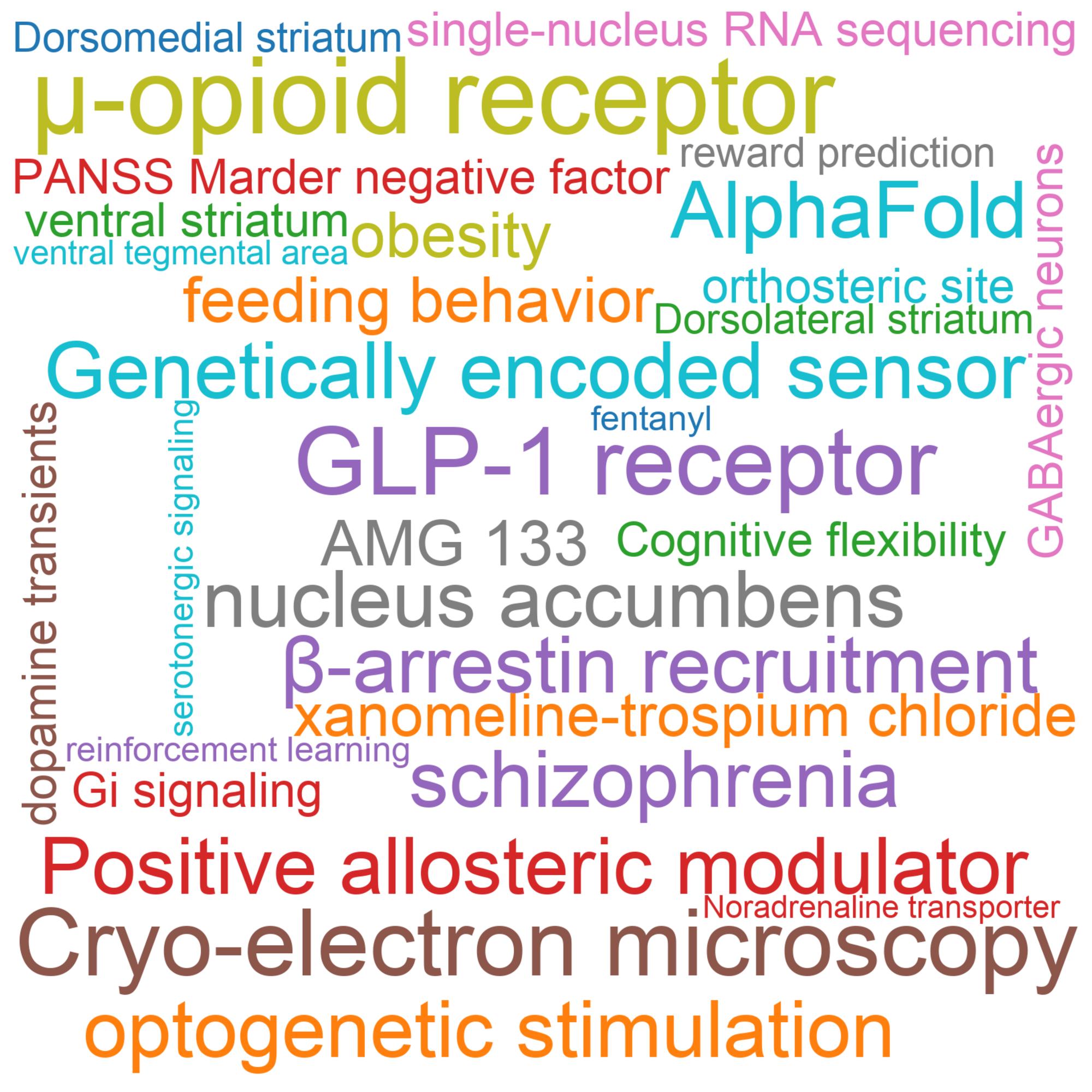
The Class of 2026 in Receptor Mechanisms and Signaling is anchored by high-resolution structural and physiological characterizations of key G protein-coupled receptors (GPCRs). Research surrounding the μ-opioid receptor stands at the forefront, driven by novel therapeutic efforts targeting pain management and opioid addiction, with related compounds like fentanyl and naloxone gaining notable focus. Concurrently, metabolic GPCR signaling—particularly the GLP-1 receptor and glucagon-like peptide 1 pathways—remains a major focal point due to ongoing clinical interest in metabolic disease and obesity therapeutics. Structural determination tools, led by cryo-electron microscopy (cryo-EM) and computational structure prediction using AlphaFold, continue to serve as indispensible foundational methodologies across top-cited literature. Downstream signaling mechanisms are prominently featured through β-arrestin recruitment studies and genetically encoded fluorescent sensors for tracking neurochemical dynamics in vivo. Furthermore, neuropharmacology topics intersecting with striatal microcircuits—including the nucleus accumbens, dopamine transients, and schizophrenia therapeutics such as xanomeline-trospium chloride—demonstrate a strong integration between molecular receptor pharmacology and systems-level neural circuit function.
How Did Topics Shift from the Class of 2025 to the Class of 2026?
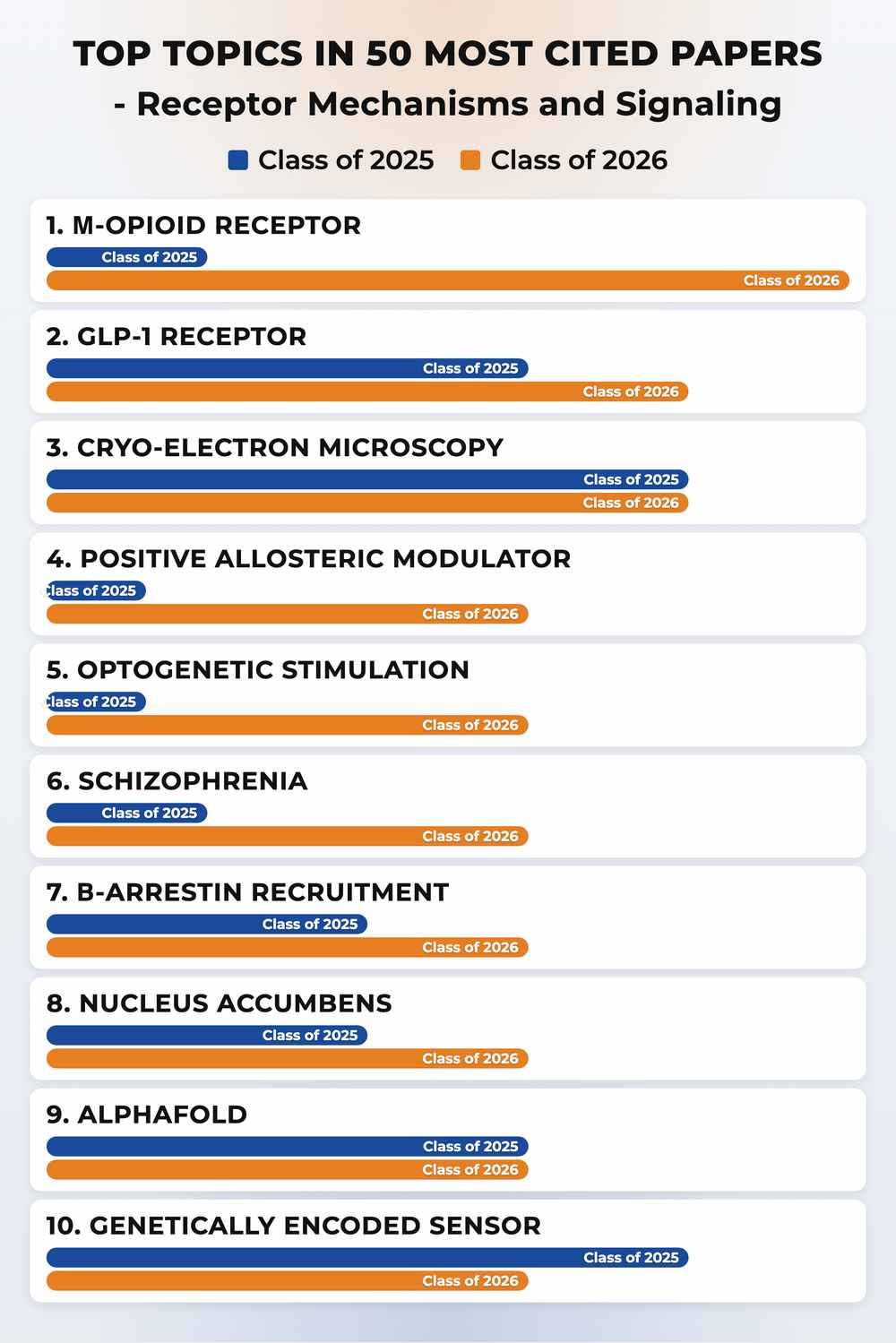
Comparing the Class of 2025 and Class of 2026 reveals significant thematic evolutions in receptor signaling and pharmacology. The most prominent upward trend is seen in μ-opioid receptor studies, which experienced a 5-fold increase in representation (from 2% to 10% normalized frequency). Novel pharmacological approaches gained dramatic traction, marked by the emergence of positive allosteric modulators (PAMs), negative allosteric modulators (NAMs), and orthosteric site targeting, all rising from near-zero baseline frequencies in 2025. In addition, experimental methodologies saw a surge in optogenetic stimulation, single-nucleus RNA sequencing, and transcriptomic profiling to decipher cell-type-specific receptor signaling. Conversely, research explicitly centered on biased agonism underwent a sharp decline, dropping by two-thirds from 12% in 2025 to 4% in 2026. While foundational structural tools like cryo-EM and AlphaFold maintained steady representation, the focus of top-ranked publications moved away from generalized ligand-binding kinetics toward specific circuit-level mechanisms, such as feeding behavior, reward prediction, and appetite regulation. This trajectory reflects a broader paradigm shift from abstract signaling bias toward targeted allosteric modulation and neurocircuit validation.
Methodology
PRI identifies high-impact research using a transparent, topic-agnostic framework applied consistently across scientific domains. Bibliographic records are drawn from OpenAlex, including publication dates, citation relationships, and document types.
This ranking covers the Class of 2026 cohort: journal articles published in 2024. Reviews and other non-article document types are excluded to ensure comparability.
Research impact is quantified with an 18-month post-publication citation window—the number of citing works published within 18 months of each paper's publication date. This metric captures early impact while controlling for publication age.
An LLM-based relevance classifier then reviews each candidate's title and abstract to confirm substantive alignment with the target domain. Only papers classified as relevant appear in the final ranking.
Zheng Su, Tinsley Li, Thematic Shifts in Early-High-Impact Cancer Genomics and Diagnostics Research: A Bibliometric and Semantic Analysis. bioRxiv 2026.07.04.736459; doi: https://doi.org/10.64898/2026.07.04.736459
Cite this ranking
Pepkio Research Index (PRI). Topics and Trends in Most Cited Receptor Mechanisms and Signaling Papers, Class of 2026. https://pri.pepkio.com/top-papers/receptor-mechanisms-and-signaling/2026. Accessed 2026-10-24.

Methodology
Zheng Su, Tinsley Li, Thematic Shifts in Early-High-Impact Cancer Genomics and Diagnostics Research: A Bibliometric and Semantic Analysis. bioRxiv 2026.07.04.736459; doi: https://doi.org/10.64898/2026.07.04.736459