
What topics and trends defined most-cited Ion channel regulation and function research in the Class of 2026?
Mechanosensitive ion channels and cryo-electron microscopy define the Class of 2026 ion channel cohort, led by structural gating insights into PIEZO1. PIEZO1, mechanosensitive currents, molecular dynamics simulations, and Nav1.8 rose sharply from the Class of 2025, while the relative share of static cryo-EM structures and PIEZO2 receded among top-cited papers.
At a glance
- Field
- Ion channel regulation and function
- Cohort label
- Class of 2026 (2024 publications)
- Papers analyzed
- 3,454
- Papers ranked
- 20
- Top topics in ranked papers
- Cryo-electron microscopy, Mechanosensitive ion channels, PIEZO1, mechanotransduction, Nav1.8
- Publication window
- Jan 1, 2024 – Dec 31, 2024
- Eligibility
- Research articles; reviews excluded
- Citation window
- 18 months post-publication
- 18m citation range
- 27–199
- Data source
- OpenAlex · Retrieved June 2026
- License
- CC BY 4.0
Rankings
20 papers ranked by 18-month citation count
Mechanisms of mechanotransduction and physiological roles of PIEZO channels
Nature Reviews Molecular Cell Biology202410.1038/s41580-024-00773-5
Solvent-mediated analgesia via the suppression of water permeation through TRPV1 ion channels
Nature Biomedical Engineering202410.1038/s41551-024-01288-2
Structural biology and molecular pharmacology of voltage-gated ion channels
Nature Reviews Molecular Cell Biology202410.1038/s41580-024-00763-7
KCNK1 promotes proliferation and metastasis of breast cancer cells by activating lactate dehydrogenase A (LDHA) and up-regulating H3K18 lactylation
PLoS Biology202410.1371/journal.pbio.3002666
Endothelial Piezo1 channel mediates mechano-feedback control of brain blood flow
Nature Communications202410.1038/s41467-024-52969-0
A Non‐Invasive and DNA‐free Approach to Upregulate Mammalian Voltage‐Gated Calcium Channels and Neuronal Calcium Signaling via Terahertz Stimulation
Advanced Science202410.1002/advs.202405436
Glutamate acts on acid-sensing ion channels to worsen ischaemic brain injury
Nature202410.1038/s41586-024-07684-7
State-Dependent Inhibition of Nav1.8 Sodium Channels by VX-150 and VX-548
Molecular Pharmacology202410.1124/molpharm.124.000944
Molecular mechanism of ligand gating and opening of NMDA receptor
Nature202410.1038/s41586-024-07742-0
An intermediate open structure reveals the gating transition of the mechanically activated PIEZO1 channel
Neuron202410.1016/j.neuron.2024.11.020
Interplay of Nav1.8 and Nav1.7 channels drives neuronal hyperexcitability in neuropathic pain
The Journal of General Physiology202410.1085/jgp.202413596
Structural basis of TRPV1 modulation by endogenous bioactive lipids
Nature Structural & Molecular Biology202410.1038/s41594-024-01299-2
Allosteric modulation and G-protein selectivity of the Ca2+-sensing receptor
Nature202410.1038/s41586-024-07055-2
TRPV3 activation by different agonists accompanied by lipid dissociation from the vanilloid site
Science Advances202410.1126/sciadv.adn2453
Mechanisms of sensory adaptation and inhibition of the cold and menthol receptor TRPM8
Science Advances202410.1126/sciadv.adp2211
The mechanosensitive Piezo1 channel exacerbates myocardial ischaemia/reperfusion injury by activating caspase-8-mediated PANoptosis
International Immunopharmacology202410.1016/j.intimp.2024.112664
Structural switch in acetylcholine receptors in developing muscle
Nature202410.1038/s41586-024-07774-6
Photo‐Controlled Calcium Overload from Endogenous Sources for Tumor Therapy
Angewandte Chemie International Edition202410.1002/anie.202317578
Structural basis for ryanodine receptor type 2 leak in heart failure and arrhythmogenic disorders
Nature Communications202410.1038/s41467-024-51791-y
Amplifying Ca2+ overload by engineered biomaterials for synergistic cancer therapy
Biomaterials202410.1016/j.biomaterials.2024.123027
Topic trends
Dominant research themes and year-over-year shifts in Ion channel regulation and function
What Topics Define the Class of 2026?
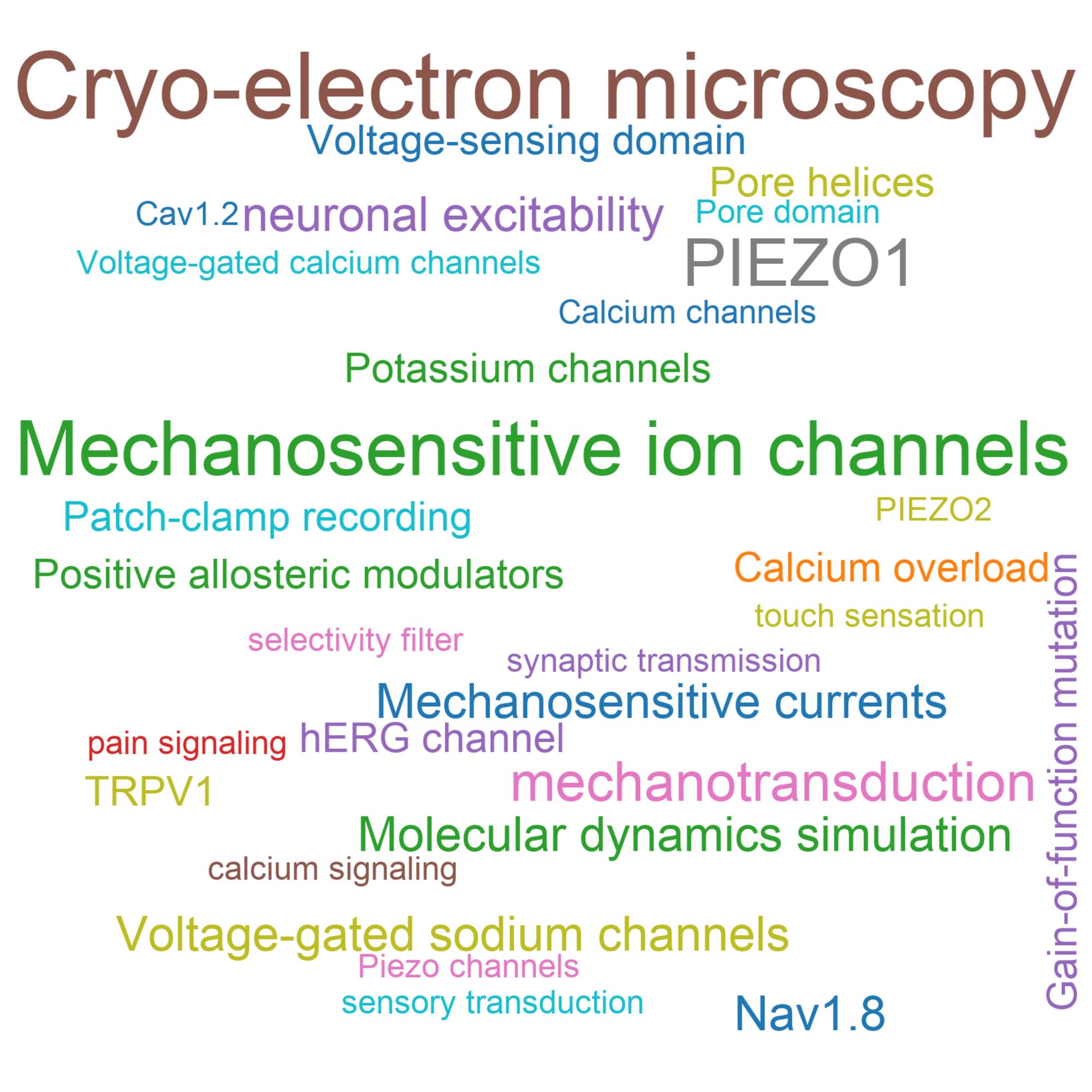
The Class of 2026 in Ion Channel Regulation and Function is strongly anchored by high-resolution structural biology and mechanosensitive channel biophysics. Cryo-electron microscopy remains the single most dominant methodology, appearing in 20% of the top-cited papers (10 of 50 papers) and providing atomic-level insights into gating mechanisms and ligand binding. Mechanosensitive ion channels represent the primary functional cluster, led by general mechanosensation themes in 18% of papers and specific focus on PIEZO1 in 14% of top works. Foundational mechanotransduction mechanisms (10%) and mechanosensitive currents (8%) highlight growing interest in how physical forces translate into intracellular chemical signaling across vascular, somatosensory, and physiological systems. In parallel, computational and electrophysiological approaches feature prominently, with molecular dynamics simulation and Nav1.8 voltage-gated sodium channel studies each reaching 8% representation, alongside voltage-gated sodium channels overall (8%) and neuronal excitability (8%). Specialized structural features such as pore helices and voltage-sensing domains, together with pharmacological probes like positive allosteric modulators and hERG channel safety screening, round out a landscape driven by mechanobiology, neuronal signaling, and structure-guided channel modulation.
How Did Topics Shift from the Class of 2025 to the Class of 2026?
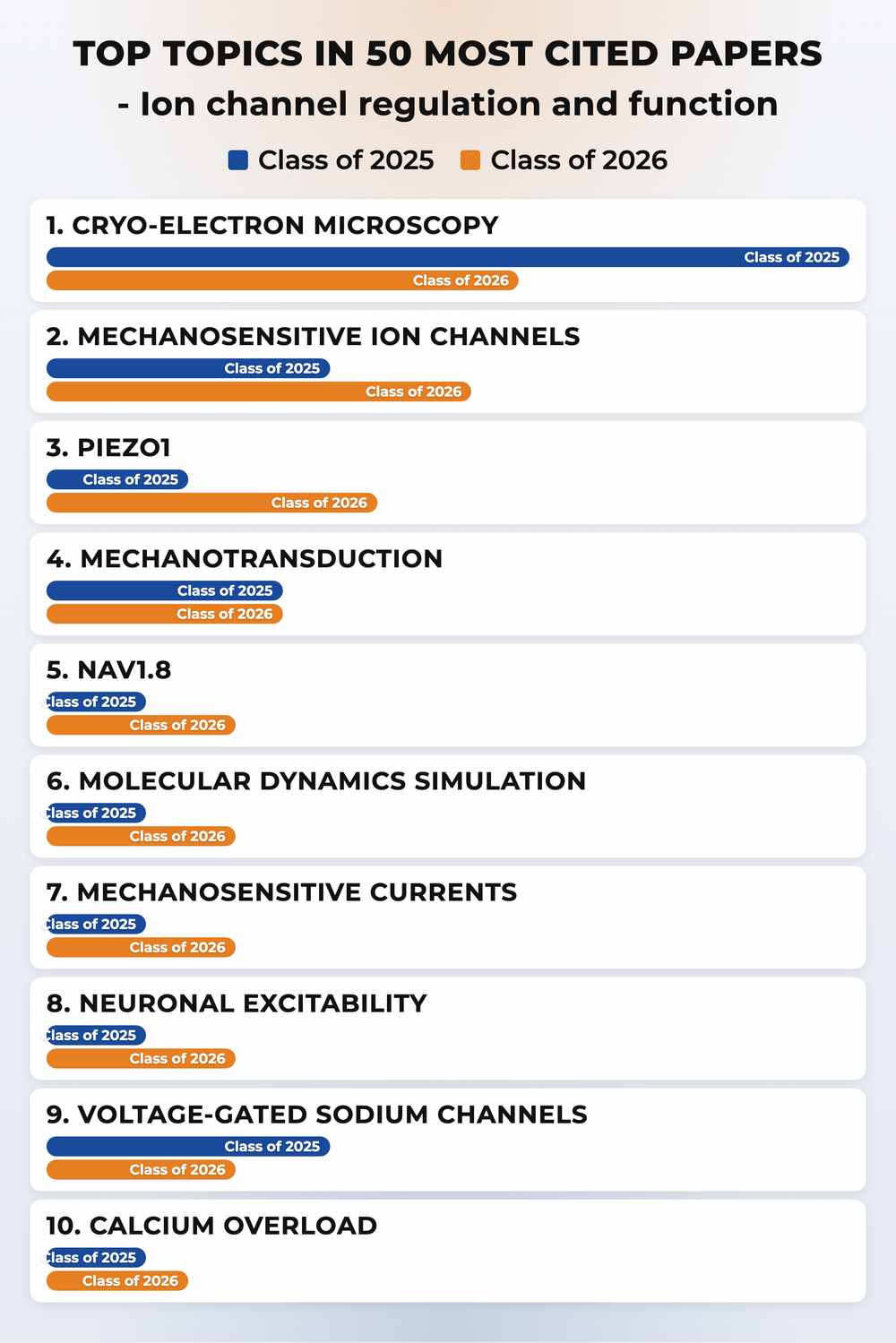
Comparing the Class of 2025 (2023 publications) to the Class of 2026 (2024 publications) reveals a clear pivot toward force-sensing biophysics and computational-electrophysiological integration. PIEZO1 exhibited the largest normalized frequency gain (+0.08; rising from 6% to 14% representation), accompanied by sharp increases in mechanosensitive currents (from 2% to 8%) and mechanosensitive ion channels (from 12% to 18%). Computational molecular dynamics simulations and subtype-specific Nav1.8 channel studies emerged as major new focal points, both climbing from 0% in 2023 to 8% in 2024. Additional rising areas include patch-clamp recording, hERG channel profiling, positive allosteric modulation, and pore helix structural dynamics (each +0.06 gain). Conversely, while Cryo-electron microscopy remains the top technical approach, its relative share among high-impact papers contracted (-0.14; from 34% to 20%), reflecting a transition from purely static structural determination to dynamic functional validation. PIEZO2 (-0.08) and generic pore domain studies (-0.08) also receded, alongside minor declines in voltage-gated calcium channels (-0.04). Together, these trends signify a field advancing beyond initial cryo-EM structural snapshots toward mechanistic force-gating kinetics, targeted subtype neuropharmacology, and allosteric modulation.
Methodology
PRI identifies high-impact research using a transparent, topic-agnostic framework applied consistently across scientific domains. Bibliographic records are drawn from OpenAlex, including publication dates, citation relationships, and document types.
This ranking covers the Class of 2026 cohort: journal articles published in 2024. Reviews and other non-article document types are excluded to ensure comparability.
Research impact is quantified with an 18-month post-publication citation window—the number of citing works published within 18 months of each paper's publication date. This metric captures early impact while controlling for publication age.
An LLM-based relevance classifier then reviews each candidate's title and abstract to confirm substantive alignment with the target domain. Only papers classified as relevant appear in the final ranking.
Zheng Su, Tinsley Li, Thematic Shifts in Early-High-Impact Cancer Genomics and Diagnostics Research: A Bibliometric and Semantic Analysis. bioRxiv 2026.07.04.736459; doi: https://doi.org/10.64898/2026.07.04.736459
Cite this ranking
Pepkio Research Index (PRI). Topics and Trends in Most Cited Ion channel regulation and function Papers, Class of 2026. https://pri.pepkio.com/top-papers/ion-channel-regulation-and-function/2026. Accessed 2026-10-16.

Methodology
Zheng Su, Tinsley Li, Thematic Shifts in Early-High-Impact Cancer Genomics and Diagnostics Research: A Bibliometric and Semantic Analysis. bioRxiv 2026.07.04.736459; doi: https://doi.org/10.64898/2026.07.04.736459