
What topics and trends defined most-cited DNA Repair Mechanisms research in the Class of 2026?
The Class of 2026 is defined by a shift towards targeted interventions and high-resolution methodologies. Surges in synthetic lethality and replication stress research underscore a focus on exploiting DNA repair vulnerabilities, while advanced structural techniques are reshaping our understanding of complex repair machinery.
At a glance
- Field
- DNA Repair Mechanisms
- Cohort label
- Class of 2026 (2024 publications)
- Papers analyzed
- 3401
- Papers ranked
- 20
- Top topics in ranked papers
- Homologous recombination, DNA double-strand breaks, PARP inhibitor
- Publication window
- Jan 1, 2024 – Dec 31, 2024
- Eligibility
- Research articles; reviews excluded
- Citation window
- 18 months post-publication
- 18m citation range
- 37–343
- Data source
- OpenAlex · Retrieved July 2026
- License
- CC BY 4.0
Rankings
20 papers ranked by 18-month citation count
NBS1 lactylation is required for efficient DNA repair and chemotherapy resistance
Nature202410.1038/s41586-024-07620-9
Transcription–replication conflicts underlie sensitivity to PARP inhibitors
Nature202410.1038/s41586-024-07217-2
PARP1-DNA co-condensation drives DNA repair site assembly to prevent disjunction of broken DNA ends
Cell202410.1016/j.cell.2024.01.015
Cell-type-specific CAG repeat expansions and toxicity of mutant Huntingtin in human striatum and cerebellum
Nature Genetics202410.1038/s41588-024-01653-6
Structure and repair of replication-coupled DNA breaks
Science202410.1126/science.ado3867
The ribotoxic stress response drives UV-mediated cell death
Cell202410.1016/j.cell.2024.05.018
Discovery of WRN inhibitor HRO761 with synthetic lethality in MSI cancers
Nature202410.1038/s41586-024-07350-y
Chemoproteomic discovery of a covalent allosteric inhibitor of WRN helicase
Nature202410.1038/s41586-024-07318-y
The PARP1 selective inhibitor saruparib (AZD5305) elicits potent and durable antitumor activity in patient-derived BRCA1/2-associated cancer models
Genome Medicine202410.1186/s13073-024-01370-z
The Fanconi anemia pathway induces chromothripsis and ecDNA-driven cancer drug resistance
Cell202410.1016/j.cell.2024.08.001
Targeting ATR in patients with cancer
Nature Reviews Clinical Oncology202410.1038/s41571-024-00863-5
Early oxidative stress and DNA damage in Aβ-burdened hippocampal neurons in an Alzheimer’s-like transgenic rat model
Communications Biology202410.1038/s42003-024-06552-4
Mechanism of BRCA1–BARD1 function in DNA end resection and DNA protection
Nature202410.1038/s41586-024-07909-9
Endogenous aldehyde-induced DNA–protein crosslinks are resolved by transcription-coupled repair
Nature Cell Biology202410.1038/s41556-024-01401-2
DNA mismatch and damage patterns revealed by single-molecule sequencing
Nature202410.1038/s41586-024-07532-8
YBX1 promotes homologous recombination and resistance to platinum-induced stress in ovarian cancer by recognizing m5C modification
Cancer Letters202410.1016/j.canlet.2024.217064
Structural basis for RNA polymerase II ubiquitylation and inactivation in transcription-coupled repair
Nature Structural & Molecular Biology202410.1038/s41594-023-01207-0
A p62-dependent rheostat dictates micronuclei catastrophe and chromosome rearrangements
Science202410.1126/science.adj7446
Transcription-coupled repair of DNA–protein cross-links depends on CSA and CSB
Nature Cell Biology202410.1038/s41556-024-01391-1
Transcription-coupled DNA–protein crosslink repair by CSB and CRL4CSA-mediated degradation
Nature Cell Biology202410.1038/s41556-024-01394-y
Topic trends
Dominant research themes and year-over-year shifts in DNA Repair Mechanisms
What Topics Define the Class of 2026?
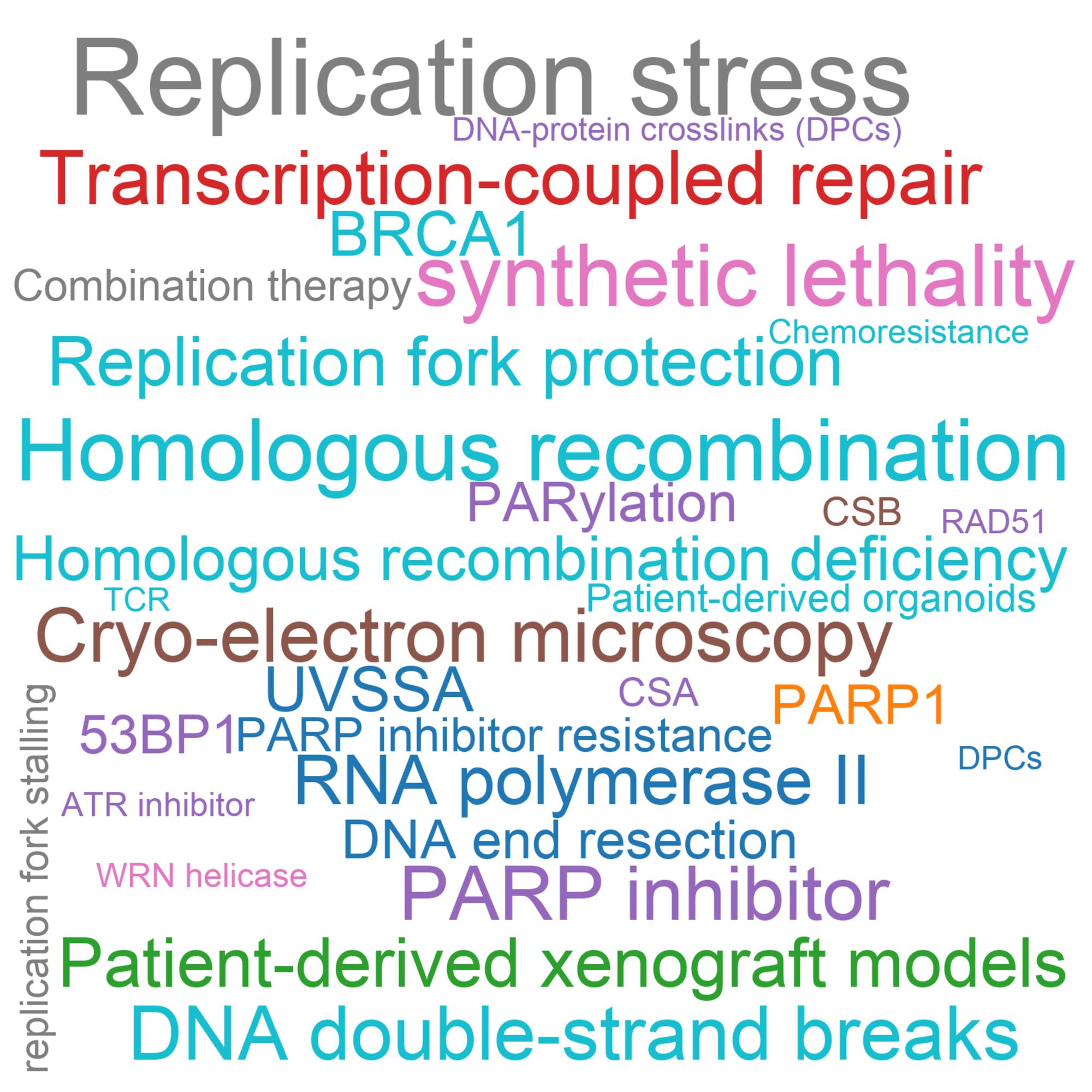
The Class of 2026 highlights a significant focus on targeted therapies and complex DNA damage repair systems. Homologous recombination and DNA double-strand breaks remain prominent topics, reflecting ongoing efforts to map out intricate repair pathways and their implications for genomic stability. Additionally, the presence of PARP inhibitors indicates a continuing translational interest in exploiting repair deficiencies for cancer treatment, highlighting the bench-to-bedside evolution of DNA repair research.
How Did Topics Shift from the Class of 2025 to the Class of 2026?
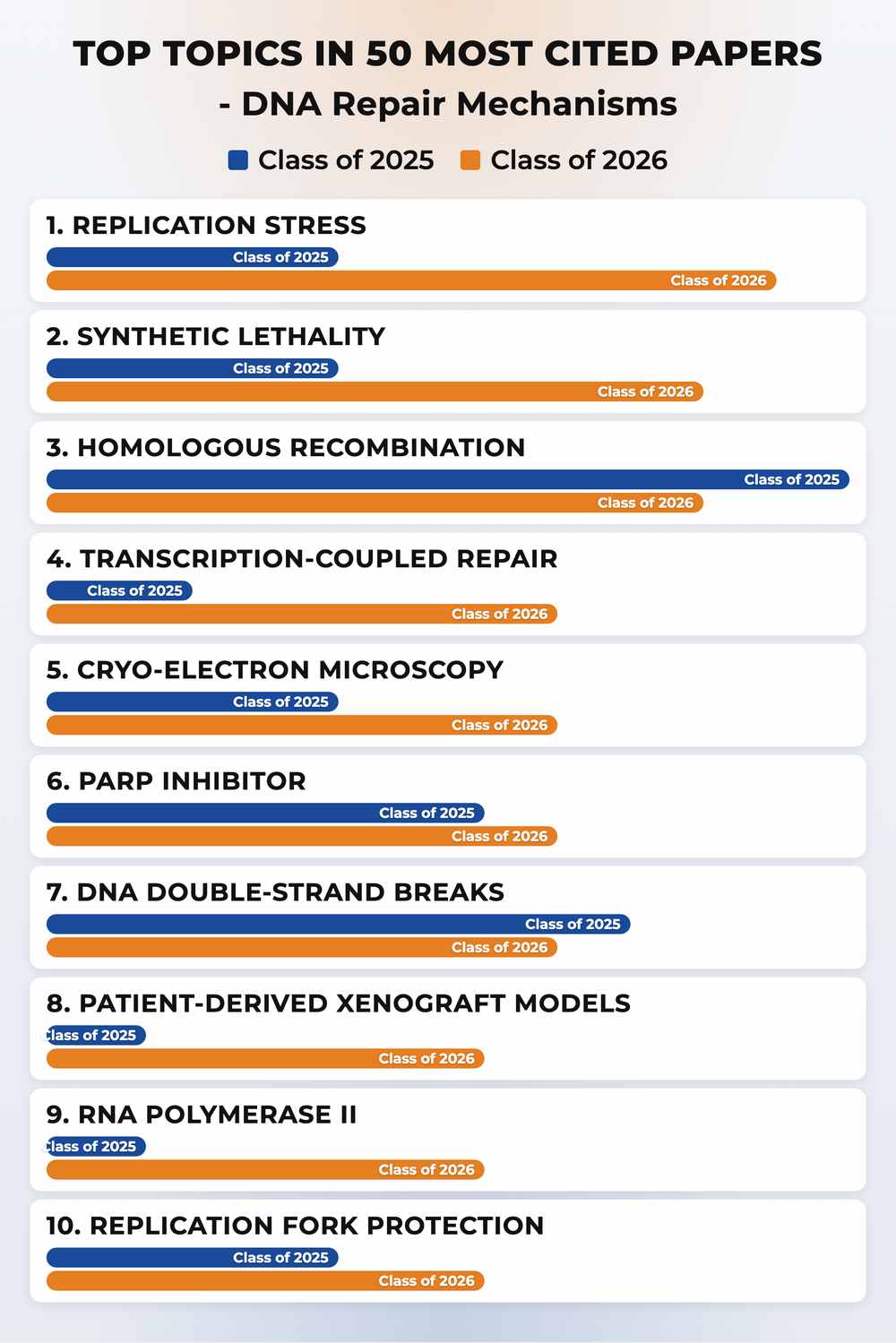
A notable shift towards advanced therapeutic strategies and specialized cellular models is evident in the transition to the Class of 2026. Topics such as replication stress and synthetic lethality experienced substantial growth, underscoring a pivot towards exploiting vulnerabilities in cancer cell replication. The rise in patient-derived xenograft models and cryo-electron microscopy signifies a methodological leap toward personalized medicine and high-resolution structural analysis. Conversely, broad topics like general DNA damage response saw a relative decline, suggesting a maturation of the field toward more specific, actionable targets.
Methodology
PRI identifies high-impact research using a transparent, topic-agnostic framework applied consistently across scientific domains. Bibliographic records are drawn from OpenAlex, including publication dates, citation relationships, and document types.
This ranking covers the Class of 2026 cohort: journal articles published in 2024. Reviews and other non-article document types are excluded to ensure comparability.
Research impact is quantified with an 18-month post-publication citation window—the number of citing works published within 18 months of each paper's publication date. This metric captures early impact while controlling for publication age.
An LLM-based relevance classifier then reviews each candidate's title and abstract to confirm substantive alignment with the target domain. Only papers classified as relevant appear in the final ranking.
Zheng Su, Tinsley Li, Thematic Shifts in Early-High-Impact Cancer Genomics and Diagnostics Research: A Bibliometric and Semantic Analysis. bioRxiv 2026.07.04.736459; doi: https://doi.org/10.64898/2026.07.04.736459
Cite this ranking
Pepkio Research Index (PRI). Topics and Trends in Most Cited DNA Repair Mechanisms Papers, Class of 2026. https://pri.pepkio.com/top-papers/dna-repair-mechanisms/2026. Accessed 2026-10-16.

Methodology
Zheng Su, Tinsley Li, Thematic Shifts in Early-High-Impact Cancer Genomics and Diagnostics Research: A Bibliometric and Semantic Analysis. bioRxiv 2026.07.04.736459; doi: https://doi.org/10.64898/2026.07.04.736459