
What topics and trends defined most-cited RNA and protein synthesis mechanisms research in the Class of 2026?
The Class of 2026 highlights a shift in RNA and protein synthesis research from broad epitranscriptomic profiling to specific mechanisms like mRNA stability, pseudouridine, and 2'-O-methylation. Structural insights via cryo-electron microscopy continue to drive innovation, alongside an increasing translational focus on mRNA therapeutics.
At a glance
- Field
- RNA and protein synthesis mechanisms
- Cohort label
- Class of 2026 (2024 publications)
- Papers analyzed
- 8,083
- Papers ranked
- 20
- Top topics in ranked papers
- mRNA stability, N6-methyladenosine (m6A), cryo-electron microscopy
- Publication window
- Jan 1, 2024 – Dec 31, 2024
- Eligibility
- Research articles; reviews excluded
- Citation window
- 18 months post-publication
- 18m citation range
- 44–369
- Data source
- OpenAlex · Retrieved Jul 2026
- License
- CC BY 4.0
Rankings
20 papers ranked by 18-month citation count
Sequence modeling and design from molecular to genome scale with Evo
Science202410.1126/science.ado9336
The diversity of splicing modifiers acting on A -1 bulged 5 -splice sites reveals rules for rational drug design
HAL (Le Centre pour la Communication Scientifique Directe)202410.1093/nar
Genome organization around nuclear speckles drives mRNA splicing efficiency
Nature202410.1038/s41586-024-07429-6
The modified RNA base acp3U is an attachment site for N-glycans in glycoRNA
Cell202410.1016/j.cell.2024.07.044
De novo variants in the RNU4-2 snRNA cause a frequent neurodevelopmental syndrome
Nature202410.1038/s41586-024-07773-7
Metabolic Recoding of NSUN2‐Mediated m<sup>5</sup>C Modification Promotes the Progression of Colorectal Cancer via the NSUN2/YBX1/m<sup>5</sup>C‐ENO1 Positive Feedback Loop
Advanced Science202410.1002/advs.202309840
DNA damage induces p53-independent apoptosis through ribosome stalling
Science202410.1126/science.adh7950
m6A sites in the coding region trigger translation-dependent mRNA decay
Molecular Cell202410.1016/j.molcel.2024.10.033
A 5′ UTR language model for decoding untranslated regions of mRNA and function predictions
Nature Machine Intelligence202410.1038/s42256-024-00823-9
Branched chemically modified poly(A) tails enhance the translation capacity of mRNA
Nature Biotechnology202410.1038/s41587-024-02174-7
Chemical and topological design of multicapped mRNA and capped circular RNA to augment translation
Nature Biotechnology202410.1038/s41587-024-02393-y
IGF2BP3 promotes mRNA degradation through internal m7G modification
Nature Communications202410.1038/s41467-024-51634-w
Adding α,α-disubstituted and β-linked monomers to the genetic code of an organism
Nature202410.1038/s41586-023-06897-6
DDX21 mediates co-transcriptional RNA m6A modification to promote transcription termination and genome stability
Molecular Cell202410.1016/j.molcel.2024.03.006
snoRNA-facilitated protein secretion revealed by transcriptome-wide snoRNA target identification
Cell202410.1016/j.cell.2024.10.046
Optimizing 5’UTRs for mRNA-delivered gene editing using deep learning
Nature Communications202410.1038/s41467-024-49508-2
Deep-m5U: a deep learning-based approach for RNA 5-methyluridine modification prediction using optimized feature integration
BMC Bioinformatics202410.1186/s12859-024-05978-1
The structure of a human translation initiation complex reveals two independent roles for the helicase eIF4A
Nature Structural & Molecular Biology202410.1038/s41594-023-01196-0
Discovering Consensus Regions for Interpretable Identification of RNA N6-Methyladenosine Modification Sites via Graph Contrastive Clustering
IEEE Journal of Biomedical and Health Informatics202410.1109/jbhi.2024.3357979
2′-O-methylation at internal sites on mRNA promotes mRNA stability
Molecular Cell202410.1016/j.molcel.2024.04.011
Topic trends
Dominant research themes and year-over-year shifts in RNA and protein synthesis mechanisms
What Topics Define the Class of 2026?
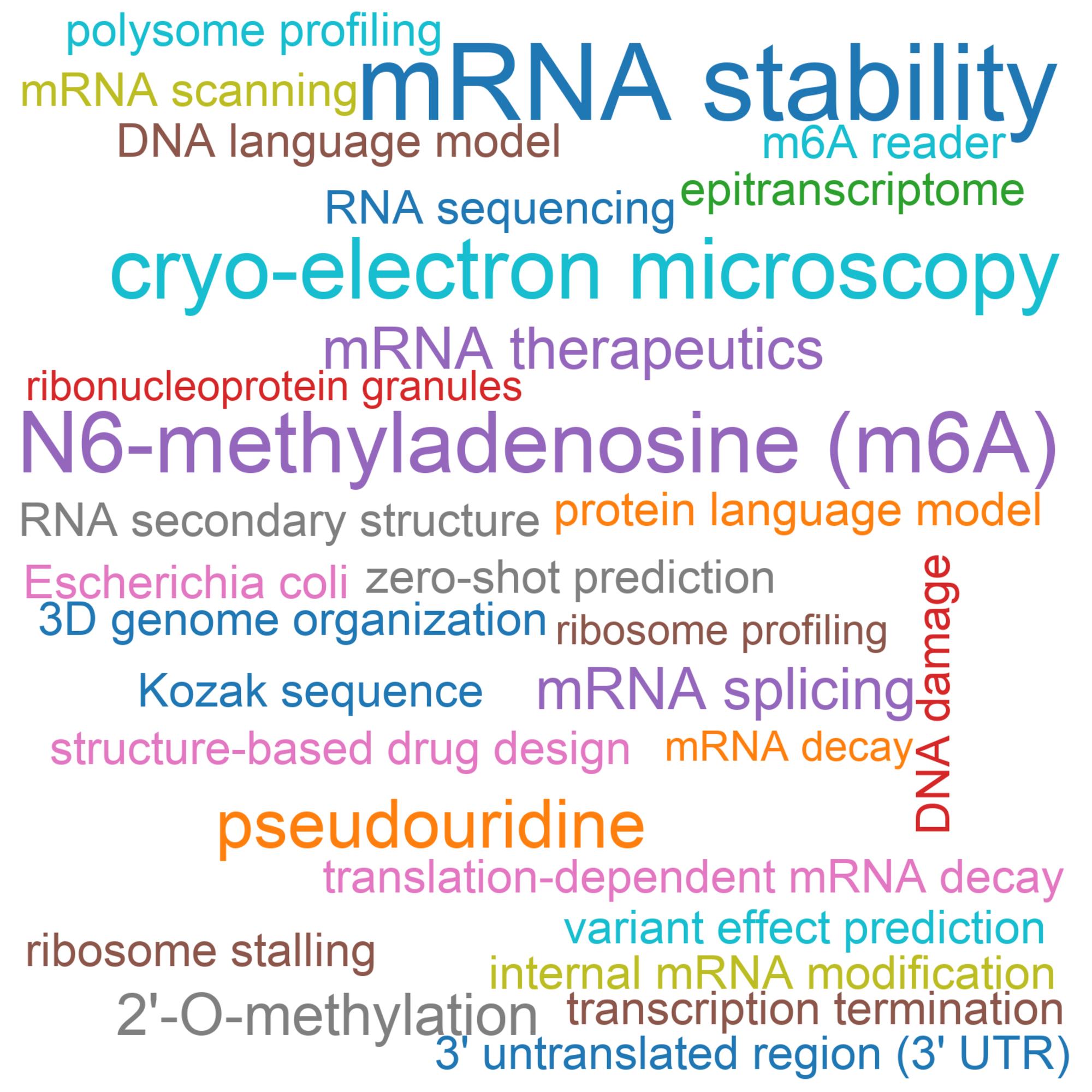
The research landscape is strongly defined by fundamental and applied studies of RNA modifications and structural biology. Topics such as mRNA stability, N6-methyladenosine (m6A) modifications, and high-resolution techniques like cryo-electron microscopy lead the cohort, underscoring the deep mechanistic focus of current studies. Epitranscriptomic modifications, including pseudouridine and 2'-O-methylation, also emerged as central themes. Furthermore, as fundamental insights translate into clinical applications, mRNA therapeutics continues to shape the trajectory of research in RNA and protein synthesis mechanisms.
How Did Topics Shift from the Class of 2025 to the Class of 2026?
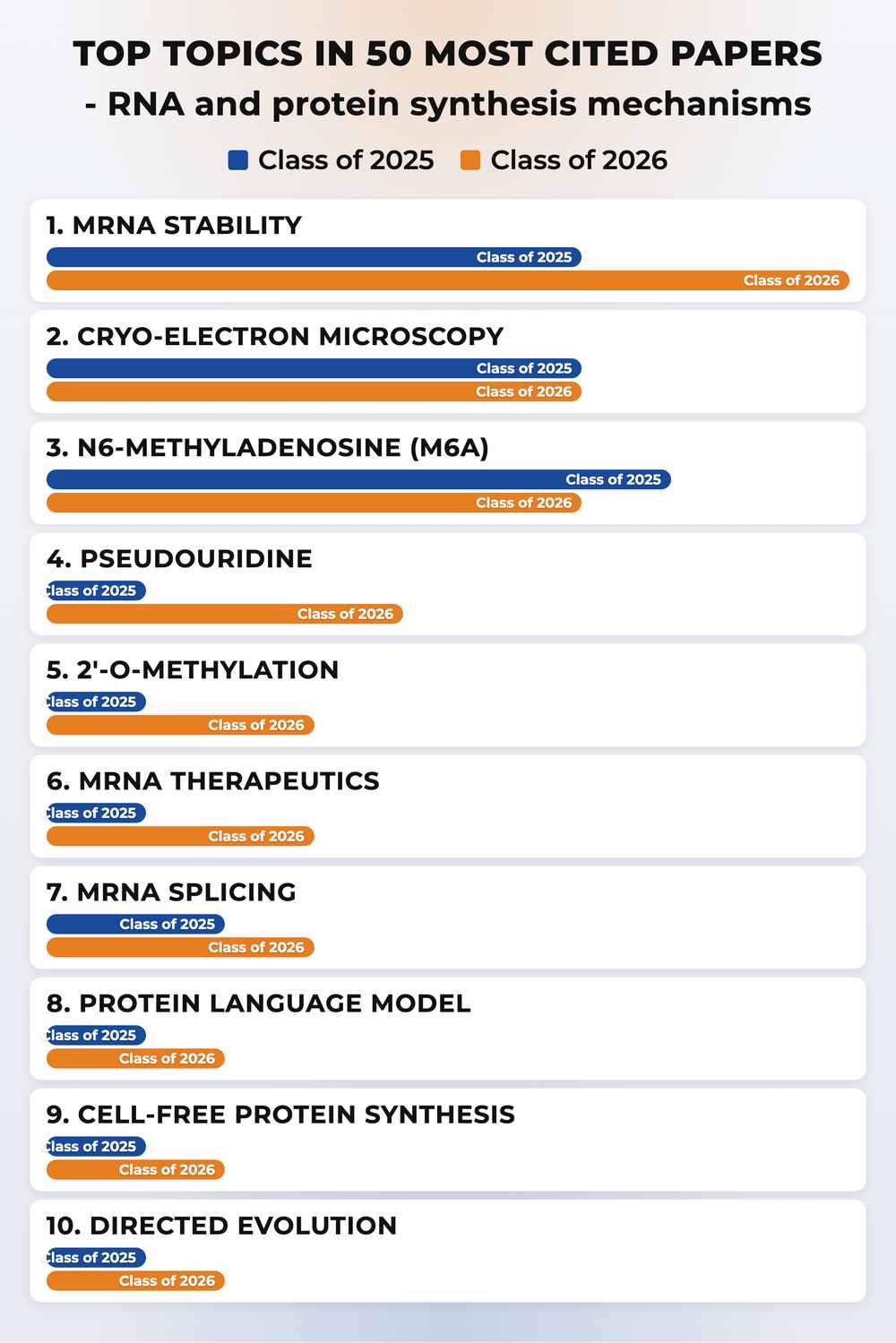
The transition between cohorts reveals a distinct move toward highly specific RNA modifications and their therapeutic utilities. We observe significant rises in studies exploring pseudouridine and 2'-O-methylation, which show dramatic fold changes. Conversely, broader topics such as general epitranscriptomics and ribosome profiling, along with nonspecific m6A reader research, experienced relative declines. This shift suggests that the field is maturing past broad profiling efforts and focusing on the precise molecular impacts of distinct modifications on translation and stability.
Methodology
PRI identifies high-impact research using a transparent, topic-agnostic framework applied consistently across scientific domains. Bibliographic records are drawn from OpenAlex, including publication dates, citation relationships, and document types.
This ranking covers the Class of 2026 cohort: journal articles published in 2024. Reviews and other non-article document types are excluded to ensure comparability.
Research impact is quantified with an 18-month post-publication citation window—the number of citing works published within 18 months of each paper's publication date. This metric captures early impact while controlling for publication age.
An LLM-based relevance classifier then reviews each candidate's title and abstract to confirm substantive alignment with the target domain. Only papers classified as relevant appear in the final ranking.
Zheng Su, Tinsley Li, Thematic Shifts in Early-High-Impact Cancer Genomics and Diagnostics Research: A Bibliometric and Semantic Analysis. bioRxiv 2026.07.04.736459; doi: https://doi.org/10.64898/2026.07.04.736459
Cite this ranking
Pepkio Research Index (PRI). Topics and Trends in Most Cited RNA and protein synthesis mechanisms Papers, Class of 2026. https://pri.pepkio.com/top-papers/rna-and-protein-synthesis-mechanisms/2026. Accessed 2026-10-14.

Methodology
Zheng Su, Tinsley Li, Thematic Shifts in Early-High-Impact Cancer Genomics and Diagnostics Research: A Bibliometric and Semantic Analysis. bioRxiv 2026.07.04.736459; doi: https://doi.org/10.64898/2026.07.04.736459