
What topics and trends defined most-cited Cell Adhesion Molecules Research research in the Class of 2026?
Cell adhesion research in the Class of 2026 centers on tumor microenvironment interactions, focal adhesions, and immunohistochemistry mapping. Emerging targets like CLDN18.2, mechanosensing, and endothelial dysfunction surged rapidly, while broad structural topics including extracellular matrix remodeling and fibronectin experienced relative declines.
At a glance
- Field
- Cell Adhesion Molecules Research
- Cohort label
- Class of 2026 (2024 publications)
- Papers analyzed
- 3,557
- Papers ranked
- 20
- Top topics in ranked papers
- Immunohistochemistry, Tumor microenvironment, Focal adhesions, Single-cell RNA sequencing, Angiogenesis
- Publication window
- Jan 1, 2024 – Dec 31, 2024
- Eligibility
- Research articles; reviews excluded
- Citation window
- 18 months post-publication
- 18m citation range
- 27–201
- Data source
- OpenAlex · Retrieved July 2026
- License
- CC BY 4.0
Rankings
20 papers ranked by 18-month citation count
Mechanisms of assembly and remodelling of the extracellular matrix
Nature Reviews Molecular Cell Biology202410.1038/s41580-024-00767-3
The role and regulation of integrins in cell migration and invasion
Nature Reviews Molecular Cell Biology202410.1038/s41580-024-00777-1
Single‐extracellular vesicle (EV) analyses validate the use of L1 Cell Adhesion Molecule (L1CAM) as a reliable biomarker of neuron‐derived EVs
Journal of Extracellular Vesicles202410.1002/jev2.12459
CD63 sorts cholesterol into endosomes for storage and distribution via exosomes
Nature Cell Biology202410.1038/s41556-024-01432-9
Recognition and control of neutrophil extracellular trap formation by MICL
Nature202410.1038/s41586-024-07820-3
An engineered α1β1 integrin-mediated FcγRI signaling component to control enhanced CAR macrophage activation and phagocytosis
Journal of Controlled Release202410.1016/j.jconrel.2024.11.064
Determination of single-molecule loading rate during mechanotransduction in cell adhesion
Science202410.1126/science.adk6921
CD151-enriched migrasomes mediate hepatocellular carcinoma invasion by conditioning cancer cells and promoting angiogenesis
Journal of Experimental & Clinical Cancer Research202410.1186/s13046-024-03082-z
Neutrophil trapping and nexocytosis, mast cell-mediated processes for inflammatory signal relay
Cell202410.1016/j.cell.2024.07.014
Global prevalence of claudin 18 isoform 2 in tumors of patients with locally advanced unresectable or metastatic gastric or gastroesophageal junction adenocarcinoma
Gastric Cancer202410.1007/s10120-024-01518-1
Ligand binding initiates single-molecule integrin conformational activation
Cell202410.1016/j.cell.2024.04.049
Neutrophil-derived migrasomes are an essential part of the coagulation system
Nature Cell Biology202410.1038/s41556-024-01440-9
Rare genetic variation in fibronectin 1 (FN1) protects against APOEε4 in Alzheimer’s disease
Acta Neuropathologica202410.1007/s00401-024-02721-1
Focal adhesions contain three specialized actin nanoscale layers
Nature Communications202410.1038/s41467-024-46868-7
Clinicopathological analysis of claudin 18.2 focusing on intratumoral heterogeneity and survival in patients with metastatic or unresectable gastric cancer
ESMO Open202410.1016/j.esmoop.2024.104000
A phase 3 randomized trial of mavorixafor, a CXCR4 antagonist, for WHIM syndrome
Blood202410.1182/blood.2023022658
Integrin <i>β</i>8 Facilitates Macrophage Infiltration and Polarization by Regulating CCL5 to Promote LUAD Progression
Advanced Science202410.1002/advs.202406865
Knockdown of integrin β1 inhibits proliferation and promotes apoptosis in bladder cancer cells
BioFactors202410.1002/biof.2150
Von Willebrand factor exacerbates heart failure through formation of neutrophil extracellular traps
European Heart Journal202410.1093/eurheartj/ehae517
The humanized platelet glycoprotein VI Fab inhibitor EMA601 protects from arterial thrombosis and ischaemic stroke in mice
European Heart Journal202410.1093/eurheartj/ehae482
Topic trends
Dominant research themes and year-over-year shifts in Cell Adhesion Molecules Research
What Topics Define the Class of 2026?
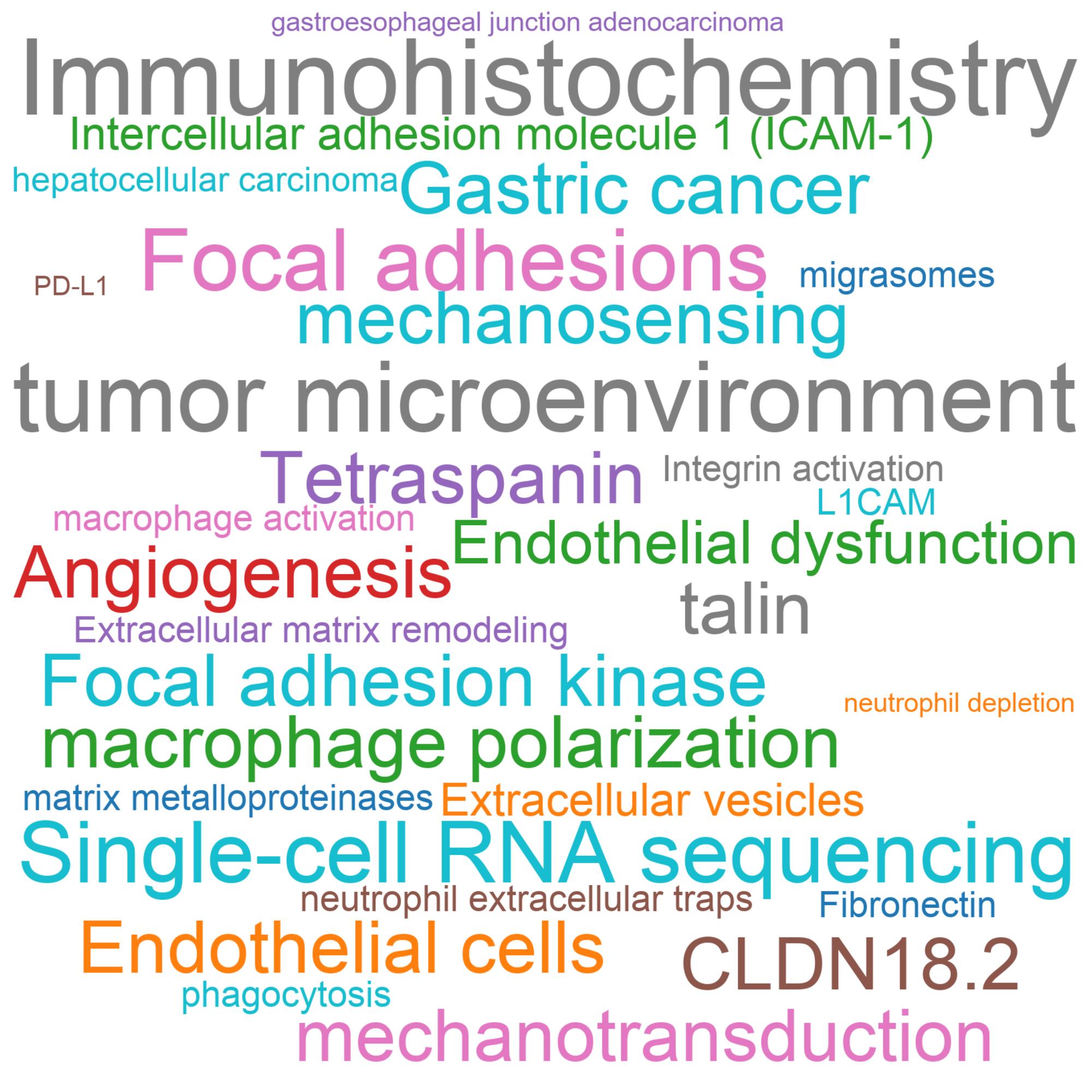
The Class of 2026 in cell adhesion molecules research is defined by an intense focus on the structural and functional interplay between adhesion complexes and the tumor microenvironment. Methodological advances in immunohistochemistry (10% normalized frequency, 5 mentions) and single-cell RNA sequencing (8% normalized frequency, 4 mentions) dominate the top-ranked literature, enabling high-resolution mapping of cellular interfaces. At the subcellular level, focal adhesions (8%) and focal adhesion kinase (6%) remain fundamental hubs for mechanotransduction and signaling pathways regulating cell survival and migration. Concurrently, vascular and stromal adhesion mechanisms feature prominently through endothelial dysfunction (6%), ICAM-1 (6%), and extracellular vesicles (6%), which mediate intercellular communication and barrier integrity. Research increasingly links these adhesion structures to pathological states, notably gastric cancer and tumor-associated angiogenesis (6%). Together, these dominant clusters demonstrate a field-wide transition from basic structural characterization toward deciphering how cell-matrix and cell-cell adhesion dynamics drive disease progression and microenvironmental remodeling.
How Did Topics Shift from the Class of 2025 to the Class of 2026?
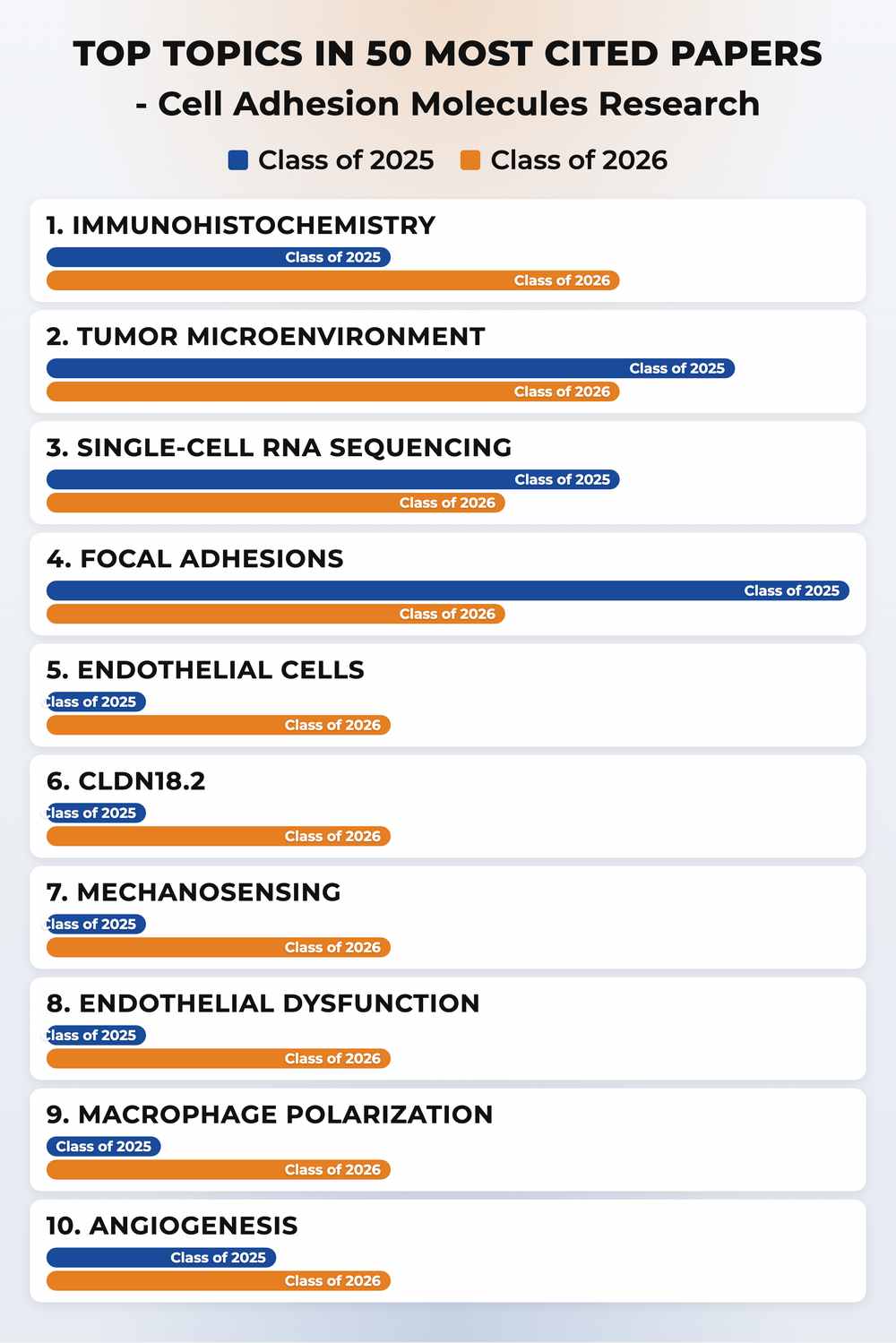
Between the Class of 2025 and the Class of 2026, cell adhesion molecules research experienced a clear shift from generalized matrix components toward specialized cell-surface targets and mechanosensing mechanisms. The most dramatic surge occurred in CLDN18.2 (claudin 18.2), rising from unranked status in 2023 to a 6% normalized frequency in 2024, highlighting its rapid emergence as a pivotal tight junction protein and therapeutic target in gastric oncology. Similarly, mechanosensing, endothelial cells, and endothelial dysfunction surged to 6% normalized frequency, reflecting heightened interest in physical force transduction and vascular adhesion dynamics. Macrophage polarization also expanded threefold (from 2% to 6%), underscoring immune adhesion in tumor biology. Conversely, foundational structural themes saw relative declines, including extracellular matrix remodeling (dropping from 12% to 4%), fibronectin (10% to 4%), and focal adhesions (14% to 8%). This evolution indicates that while foundational adhesion scaffolds remain essential, high-impact research has pivoted toward precise molecular targets and mechanobiological regulation at cell interfaces.
Methodology
PRI identifies high-impact research using a transparent, topic-agnostic framework applied consistently across scientific domains. Bibliographic records are drawn from OpenAlex, including publication dates, citation relationships, and document types.
This ranking covers the Class of 2026 cohort: journal articles published in 2024. Reviews and other non-article document types are excluded to ensure comparability.
Research impact is quantified with an 18-month post-publication citation window—the number of citing works published within 18 months of each paper's publication date. This metric captures early impact while controlling for publication age.
An LLM-based relevance classifier then reviews each candidate's title and abstract to confirm substantive alignment with the target domain. Only papers classified as relevant appear in the final ranking.
Zheng Su, Tinsley Li, Thematic Shifts in Early-High-Impact Cancer Genomics and Diagnostics Research: A Bibliometric and Semantic Analysis. bioRxiv 2026.07.04.736459; doi: https://doi.org/10.64898/2026.07.04.736459
Cite this ranking
Pepkio Research Index (PRI). Topics and Trends in Most Cited Cell Adhesion Molecules Research Papers, Class of 2026. https://pri.pepkio.com/top-papers/cell-adhesion-molecules-research/2026. Accessed 2026-10-16.

Methodology
Zheng Su, Tinsley Li, Thematic Shifts in Early-High-Impact Cancer Genomics and Diagnostics Research: A Bibliometric and Semantic Analysis. bioRxiv 2026.07.04.736459; doi: https://doi.org/10.64898/2026.07.04.736459