
What topics and trends defined most-cited RNA Research and Splicing research in the Class of 2026?
Biomolecular condensates and RNA stability mechanisms dominated the Class of 2026. The most striking shift was the surge in fluorogenic aptamers, spliceosome assembly, and neurodevelopmental disorders, while general RNA-binding protein studies declined as research pivoted toward targeted molecular mechanisms and AI-driven structural predictions.
At a glance
- Field
- RNA Research and Splicing
- Cohort label
- Class of 2026 (2024 publications)
- Papers analyzed
- 7,854
- Papers ranked
- 20
- Top topics in ranked papers
- Biomolecular condensate, RNA stability, Fluorogenic aptamers, Neurodevelopmental disorders, Spliceosome
- Publication window
- Jan 1, 2024 – Dec 31, 2024
- Eligibility
- Research articles; reviews excluded
- Citation window
- 18 months post-publication
- 18m citation range
- 61–148
- Data source
- OpenAlex · Retrieved June 2026
- License
- CC BY 4.0
Rankings
20 papers ranked by 18-month citation count
The diversity of splicing modifiers acting on A -1 bulged 5 -splice sites reveals rules for rational drug design
HAL (Le Centre pour la Communication Scientifique Directe)202410.1093/nar
rMATS-turbo: an efficient and flexible computational tool for alternative splicing analysis of large-scale RNA-seq data
Nature Protocols202410.1038/s41596-023-00944-2
SQANTI3: curation of long-read transcriptomes for accurate identification of known and novel isoforms
Nature Methods202410.1038/s41592-024-02229-2
Genome organization around nuclear speckles drives mRNA splicing efficiency
Nature202410.1038/s41586-024-07429-6
Targeting the transferrin receptor to transport antisense oligonucleotides across the mammalian blood-brain barrier
Science Translational Medicine202410.1126/scitranslmed.adi2245
De novo variants in the RNU4-2 snRNA cause a frequent neurodevelopmental syndrome
Nature202410.1038/s41586-024-07773-7
RNA-driven phase transitions in biomolecular condensates
Molecular Cell202410.1016/j.molcel.2024.09.005
Cell surface RNAs control neutrophil recruitment
Cell202410.1016/j.cell.2023.12.033
Mis-spliced transcripts generate de novo proteins in TDP-43–related ALS/FTD
Science Translational Medicine202410.1126/scitranslmed.adg7162
Spatially exploring RNA biology in archival formalin-fixed paraffin-embedded tissues
Cell202410.1016/j.cell.2024.09.001
Transcriptome-wide splicing network reveals specialized regulatory functions of the core spliceosome
Science202410.1126/science.adn8105
Global impact of unproductive splicing on human gene expression
Nature Genetics202410.1038/s41588-024-01872-x
m6A sites in the coding region trigger translation-dependent mRNA decay
Molecular Cell202410.1016/j.molcel.2024.10.033
Multi-purpose RNA language modelling with motif-aware pretraining and type-guided fine-tuning
Nature Machine Intelligence202410.1038/s42256-024-00836-4
RNA m5C oxidation by TET2 regulates chromatin state and leukaemogenesis
Nature202410.1038/s41586-024-07969-x
Identification of RNA structures and their roles in RNA functions
Nature Reviews Molecular Cell Biology202410.1038/s41580-024-00748-6
miRNATissueAtlas 2025: an update to the uniformly processed and annotated human and mouse non-coding RNA tissue atlas
Nucleic Acids Research202410.1093/nar/gkae1036
Nuclear export of circular RNA
Nature202410.1038/s41586-024-07060-5
On the genetic basis of tail-loss evolution in humans and apes
Nature202410.1038/s41586-024-07095-8
Single-cell long-read sequencing-based mapping reveals specialized splicing patterns in developing and adult mouse and human brain
Nature Neuroscience202410.1038/s41593-024-01616-4
Topic trends
Dominant research themes and year-over-year shifts in RNA Research and Splicing
What Topics Define the Class of 2026?
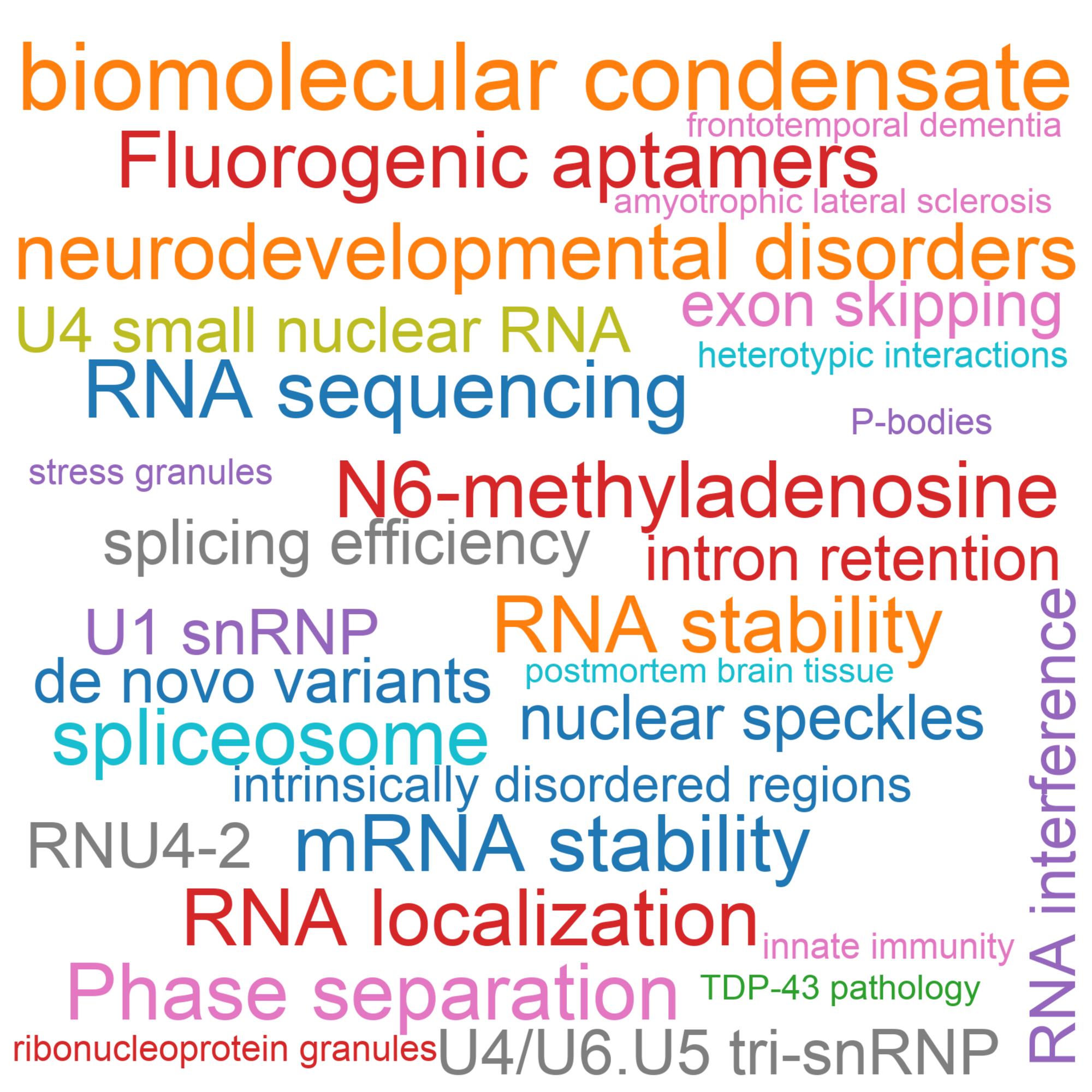
The Class of 2026 in RNA Research and Splicing is defined by an overarching focus on dynamic physical structures and regulatory control mechanisms governing post-transcriptional expression. Biomolecular condensates lead the field as the single most prominent concept, featured in 8% of top-ranked publications, emphasizing how liquid-liquid phase separation organizes cellular machinery for RNA metabolism. Closely coupled with phase behavior are core post-transcriptional processes: RNA stability, mRNA stability, and RNA localization each account for 6% of top papers, highlighting an active research focus on intracellular transport and turnover dynamics. Emerging technological and disease frontiers are also strongly represented. Fluorogenic aptamers featured prominently in 6% of papers, reflecting rapid adoption of novel live-cell RNA imaging tools. Simultaneously, the spliceosome complex and its involvement in neurodevelopmental disorders emerged as key disease mechanisms, alongside N6-methyladenosine (m6A) epitranscriptomic modifications. Together, these foundational topics illustrate how structural biophysics, RNA modification, and imaging technologies converge to unravel regulatory networks in health and disease.
How Did Topics Shift from the Class of 2025 to the Class of 2026?
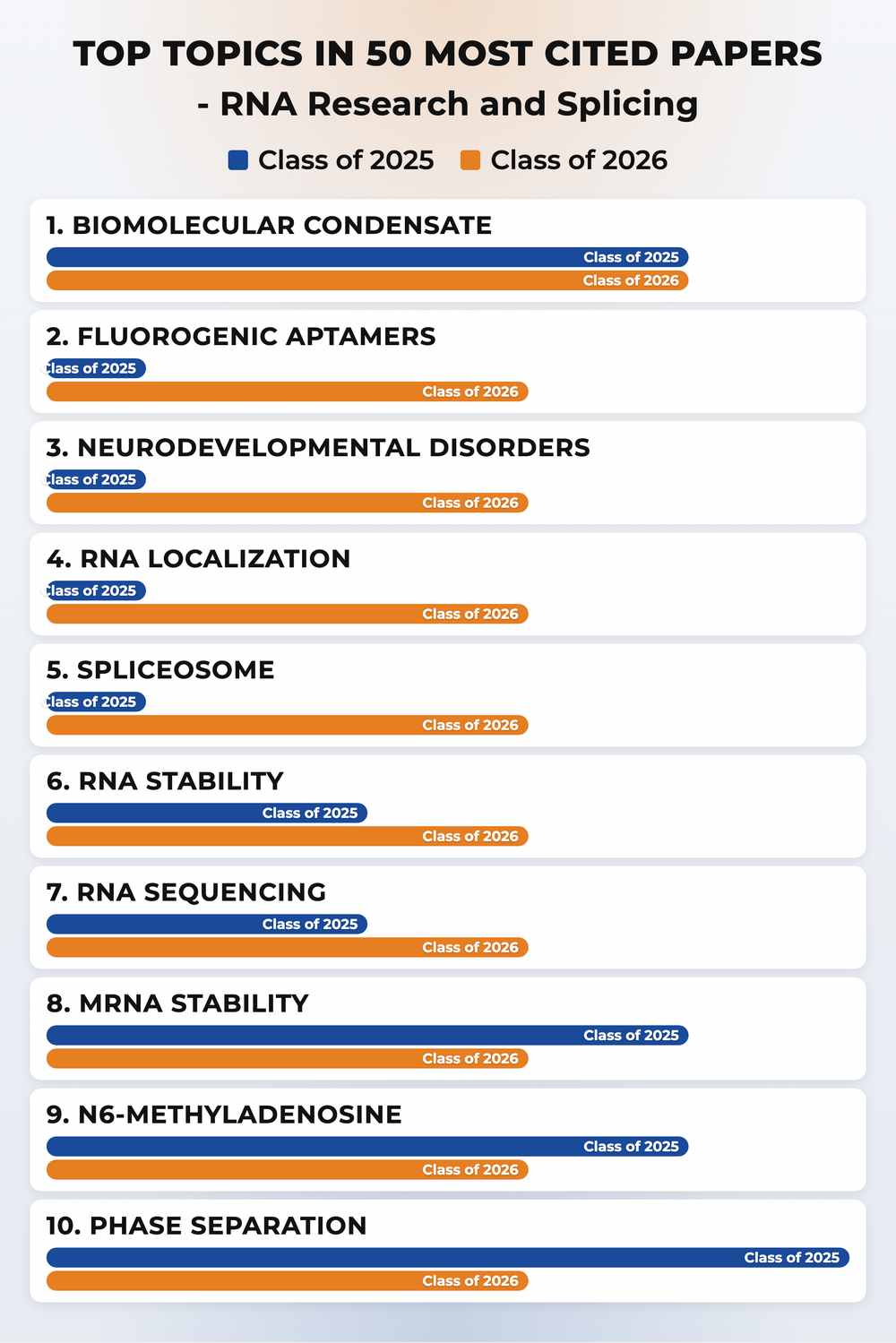
The transition from the Class of 2025 to the Class of 2026 reveals a significant shift toward precision RNA biophysics and neurodevelopmental pathology. Most notably, fluorogenic aptamers, spliceosome structural biology, neurodevelopmental disorders, and RNA localization emerged as major new focal points, climbing from absence in previous cohorts to being featured in 6% of top publications. Similarly, specialized concepts such as masked language modeling for RNA structure prediction, de novo variant identification, nuclear speckles, and RNU4-2 snRNA entered the top rankings, demonstrating the integration of machine learning and genomic sequencing in splicing studies. In contrast, broader foundational terms experienced relative declines in mention frequency. General RNA-binding protein studies fell by 66% (from 12% to 4%), while phase separation (-40%), N6-methyladenosine (-25%), and amyotrophic lateral sclerosis (-50%) saw moderate consolidation. This realignment indicates that research has evolved from broad descriptive characterizations of phase separation toward highly specialized molecular mechanisms and diagnostic applications.
Methodology
PRI identifies high-impact research using a transparent, topic-agnostic framework applied consistently across scientific domains. Bibliographic records are drawn from OpenAlex, including publication dates, citation relationships, and document types.
This ranking covers the Class of 2026 cohort: journal articles published in 2024. Reviews and other non-article document types are excluded to ensure comparability.
Research impact is quantified with an 18-month post-publication citation window—the number of citing works published within 18 months of each paper's publication date. This metric captures early impact while controlling for publication age.
An LLM-based relevance classifier then reviews each candidate's title and abstract to confirm substantive alignment with the target domain. Only papers classified as relevant appear in the final ranking.
Zheng Su, Tinsley Li, Thematic Shifts in Early-High-Impact Cancer Genomics and Diagnostics Research: A Bibliometric and Semantic Analysis. bioRxiv 2026.07.04.736459; doi: https://doi.org/10.64898/2026.07.04.736459
Cite this ranking
Pepkio Research Index (PRI). Topics and Trends in Most Cited RNA Research and Splicing Papers, Class of 2026. https://pri.pepkio.com/top-papers/rna-research-and-splicing/2026. Accessed 2026-10-16.

Methodology
Zheng Su, Tinsley Li, Thematic Shifts in Early-High-Impact Cancer Genomics and Diagnostics Research: A Bibliometric and Semantic Analysis. bioRxiv 2026.07.04.736459; doi: https://doi.org/10.64898/2026.07.04.736459