
What topics and trends defined most-cited Microtubule and mitosis dynamics research in the Class of 2026?
Research in microtubule and mitosis dynamics is rapidly transitioning from descriptive cellular imaging to atomic-level structural mechanism. The Class of 2026 is highlighted by a major rise in γ-tubulin ring complex (γ-TuRC) architectures, 13-protofilament microtubule nucleation, and Cryo-ET imaging, coupled with PLK1 and Ndc80 kinetochore regulation preventing chromosome mis-segregation.
At a glance
- Field
- Microtubule and mitosis dynamics
- Cohort label
- Class of 2026 (2024 publications)
- Papers analyzed
- 2,954
- Papers ranked
- 20
- Top topics in ranked papers
- γ-tubulin ring complex, Cryo-ET, PLK1, 13-protofilament microtubule, Cryo-EM
- Publication window
- Jan 1, 2024 – Dec 31, 2024
- Eligibility
- Research articles; reviews excluded
- Citation window
- 18 months post-publication
- 18m citation range
- 23–75
- Data source
- OpenAlex · Retrieved Jul 2026
- License
- CC BY 4.0
Rankings
20 papers ranked by 18-month citation count
Chromosomal instability as a driver of cancer progression
Nature Reviews Genetics202410.1038/s41576-024-00761-7
Mechanism and regulation of kinesin motors
Nature Reviews Molecular Cell Biology202410.1038/s41580-024-00780-6
Time-series reconstruction of the molecular architecture of human centriole assembly
Cell202410.1016/j.cell.2024.03.025
Molecular mechanism of dynein-dynactin complex assembly by LIS1
Science202410.1126/science.adk8544
Control of cell proliferation by memories of mitosis
Science202410.1126/science.add9528
Ciliopathy patient variants reveal organelle-specific functions for TUBB4B in axonemal microtubules
Science202410.1126/science.adf5489
Ultraviolet Superradiance from Mega-Networks of Tryptophan in Biological Architectures
The Journal of Physical Chemistry B202410.1021/acs.jpcb.3c07936
Compression-dependent microtubule reinforcement enables cells to navigate confined environments
Nature Cell Biology202410.1038/s41556-024-01476-x
Transition of human γ-tubulin ring complex into a closed conformation during microtubule nucleation
Science202410.1126/science.adk6160
Endoplasmic reticulum–plasma membrane contact gradients direct cell migration
Nature202410.1038/s41586-024-07527-5
Mechanisms of minor pole–mediated spindle bipolarization in human oocytes
Science202410.1126/science.ado1022
Structure of the γ-tubulin ring complex-capped microtubule
Nature Structural & Molecular Biology202410.1038/s41594-024-01264-z
Paradoxical Activation of Oncogenic Signaling as a Cancer Treatment Strategy
Cancer Discovery202410.1158/2159-8290.cd-23-0216
Mitotic chromosomes are self-entangled and disentangle through a topoisomerase-II-dependent two-stage exit from mitosis
Molecular Cell202410.1016/j.molcel.2024.02.025
Vertebrate centromeres in mitosis are functionally bipartite structures stabilized by cohesin
Cell202410.1016/j.cell.2024.04.014
Onvansertib in Combination with FOLFIRI and Bevacizumab in Second-Line Treatment of <i>KRAS</i> -Mutant Metastatic Colorectal Cancer: A Phase Ib Clinical Study
Clinical Cancer Research202410.1158/1078-0432.ccr-23-3053
Role of protein kinase PLK1 in the epigenetic maintenance of centromeres
Science202410.1126/science.ado5178
Life-cycle-coupled evolution of mitosis in close relatives of animals
Nature202410.1038/s41586-024-07430-z
Orientation-independent-DIC imaging reveals that a transient rise in depletion attraction contributes to mitotic chromosome condensation
Proceedings of the National Academy of Sciences202410.1073/pnas.2403153121
Structure of the human outer kinetochore KMN network complex
Nature Structural & Molecular Biology202410.1038/s41594-024-01249-y
Topic trends
Dominant research themes and year-over-year shifts in Microtubule and mitosis dynamics
What Topics Define the Class of 2026?
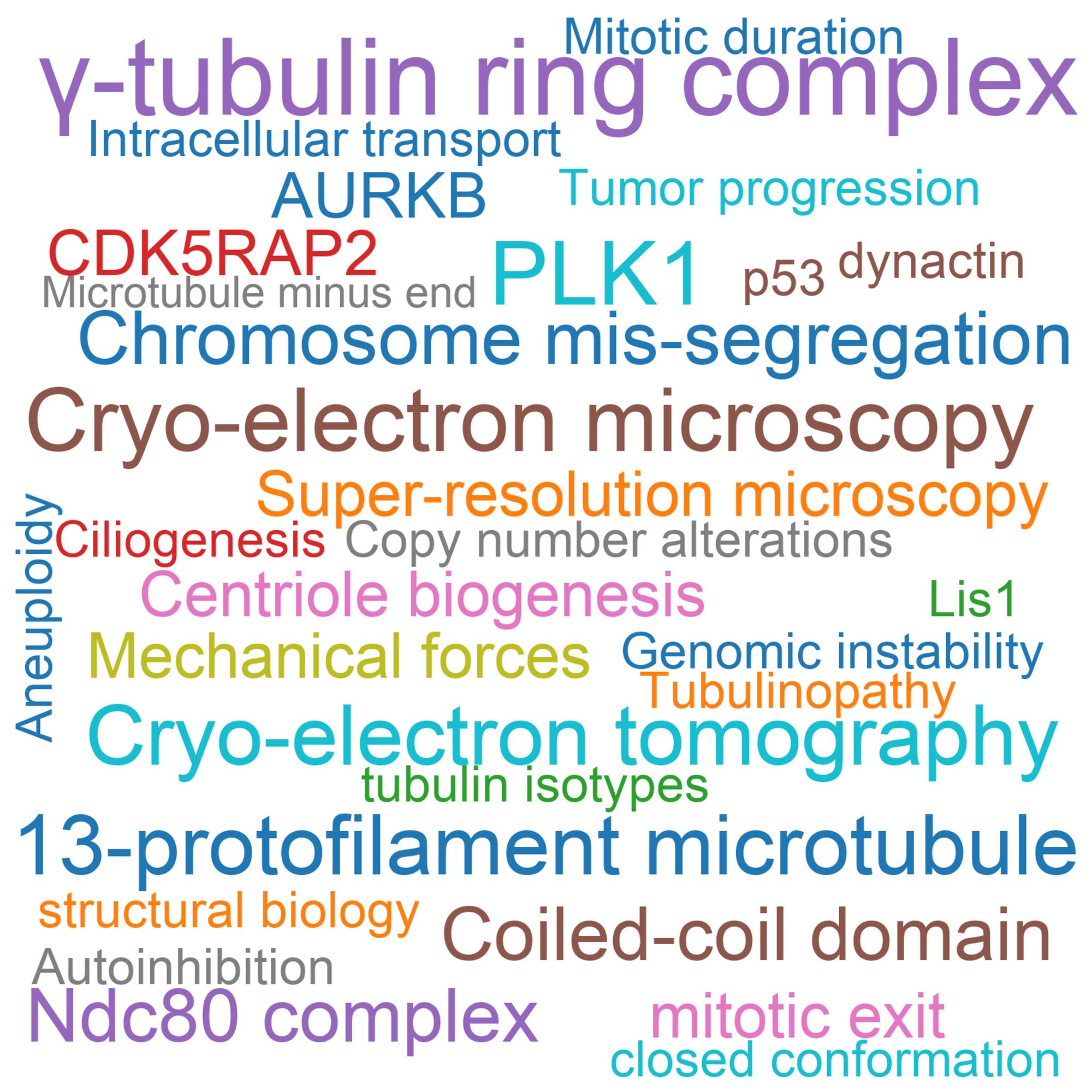
Research in microtubule and mitosis dynamics within the Class of 2026 centers on high-resolution structural architectures and key regulatory mechanisms controlling chromosome segregation. Structural determination via cryo-electron microscopy (Cryo-EM) and cryo-electron tomography (Cryo-ET) dominates the landscape, enabling atomic-level visualization of complex cellular machinery in situ. A primary focal point is the γ-tubulin ring complex (γ-TuRC), which accounts for 14% of normalized concept mentions in top-cited literature, alongside 13-protofilament microtubule lattice templates that dictate nucleation geometry. Kinetochore-microtubule attachments are another central hub, with prominent investigation into the Ndc80 complex, KMN network, and associated coiled-coil domain proteins. Regulation of mitotic progression is heavily defined by key kinases including Polo-like kinase 1 (PLK1) and Aurora B kinase (AURKB), which orchestrate error correction, spindle assembly checkpoint signaling, and mechanical force generation across the spindle apparatus. Together, these studies highlight how structural insights into nucleation complexes and kinase signaling cascades converge to explain mechanisms preventing chromosome mis-segregation during mitosis.
How Did Topics Shift from the Class of 2025 to the Class of 2026?
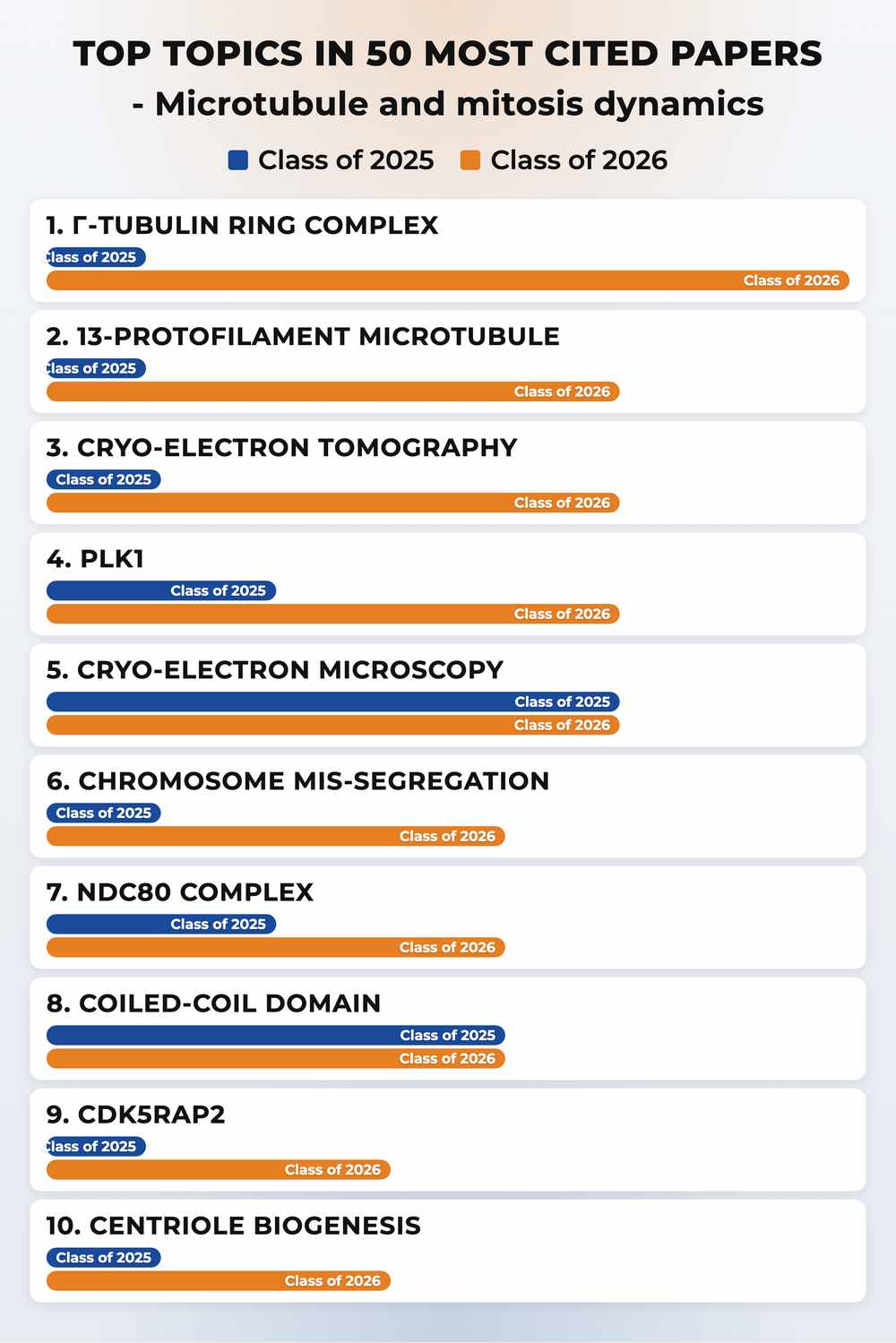
Between the Class of 2025 and the Class of 2026, research in microtubule and mitosis dynamics experienced a pronounced shift from descriptive, broad-scale cellular imaging toward atomic and sub-nanometer structural mechanism. The most striking emerging trend is the surge in γ-tubulin ring complex (γ-TuRC) structural studies, rising from 0% in 2023 to 14% of paper mentions in 2024. Similarly, 13-protofilament microtubule nucleation jumped from 0% to 10%, while cryo-electron tomography (Cryo-ET) expanded fivefold from 2% to 10%. Functional focus on Polo-like kinase 1 (PLK1) expanded from 4% to 10%, and chromosome mis-segregation mechanisms grew fourfold to 8%. Conversely, broader phenotypic tracking and general imaging methodologies saw relative declines; single-molecule imaging dropped from 8% down to 4%, while general clinical phenotypes like aneuploidy and genomic instability decreased from 6% to 4%. Meanwhile, foundational structural methodologies like Cryo-EM (10%) and coiled-coil domain analyses (8%) remained steady workhorses. This evolution reflects a field rapidly consolidating around structural biophysics and site-specific enzymatic control of centrosomal and kinetochore assemblies.
Methodology
PRI identifies high-impact research using a transparent, topic-agnostic framework applied consistently across scientific domains. Bibliographic records are drawn from OpenAlex, including publication dates, citation relationships, and document types.
This ranking covers the Class of 2026 cohort: journal articles published in 2024. Reviews and other non-article document types are excluded to ensure comparability.
Research impact is quantified with an 18-month post-publication citation window—the number of citing works published within 18 months of each paper's publication date. This metric captures early impact while controlling for publication age.
An LLM-based relevance classifier then reviews each candidate's title and abstract to confirm substantive alignment with the target domain. Only papers classified as relevant appear in the final ranking.
Zheng Su, Tinsley Li, Thematic Shifts in Early-High-Impact Cancer Genomics and Diagnostics Research: A Bibliometric and Semantic Analysis. bioRxiv 2026.07.04.736459; doi: https://doi.org/10.64898/2026.07.04.736459
Cite this ranking
Pepkio Research Index (PRI). Topics and Trends in Most Cited Microtubule and mitosis dynamics Papers, Class of 2026. https://pri.pepkio.com/top-papers/microtubule-and-mitosis-dynamics/2026. Accessed 2026-10-21.

Methodology
Zheng Su, Tinsley Li, Thematic Shifts in Early-High-Impact Cancer Genomics and Diagnostics Research: A Bibliometric and Semantic Analysis. bioRxiv 2026.07.04.736459; doi: https://doi.org/10.64898/2026.07.04.736459