
What topics and trends defined most-cited Genomics and Chromatin Dynamics research in the Class of 2026?
The Class of 2026 in Genomics and Chromatin Dynamics shifts focus from traditional mapping of enhancer-promoter interactions toward the biophysics of gene regulation. A remarkable surge in research on biomolecular condensates and phase separation underscores a new mechanistic frontier, while broader studies on chromatin accessibility and static transcription factors saw relative declines.
At a glance
- Field
- Genomics and Chromatin Dynamics
- Cohort label
- Class of 2026 (2024 publications)
- Papers analyzed
- 3,567
- Papers ranked
- 20
- Top topics in ranked papers
- Enhancer-promoter interactions, Chromatin accessibility, Phase separation
- Publication window
- Jan 1, 2024 – Dec 31, 2024
- Eligibility
- Research articles; reviews excluded
- Citation window
- 18 months post-publication
- 18m citation range
- 55–137
- Data source
- OpenAlex · Retrieved September 2026
- License
- CC BY 4.0
Rankings
20 papers ranked by 18-month citation count
Cooltools: Enabling high-resolution Hi-C analysis in Python
PLoS Computational Biology202410.1371/journal.pcbi.1012067
Transcription regulation by biomolecular condensates
Nature Reviews Molecular Cell Biology202410.1038/s41580-024-00789-x
Machine-guided design of cell-type-targeting cis-regulatory elements
Nature202410.1038/s41586-024-08070-z
TRAP1 drives smooth muscle cell senescence and promotes atherosclerosis via HDAC3-primed histone H4 lysine 12 lactylation
European Heart Journal202410.1093/eurheartj/ehae379
HBO1 catalyzes lysine lactylation and mediates histone H3K9la to regulate gene transcription
Nature Communications202410.1038/s41467-024-47900-6
Enhancer selectivity in space and time: from enhancer–promoter interactions to promoter activation
Nature Reviews Molecular Cell Biology202410.1038/s41580-024-00710-6
Genome organization around nuclear speckles drives mRNA splicing efficiency
Nature202410.1038/s41586-024-07429-6
Direct observation of a condensate effect on super-enhancer controlled gene bursting
Cell202410.1016/j.cell.2023.12.005
ChIP-Atlas 3.0: a data-mining suite to explore chromosome architecture together with large-scale regulome data
Nucleic Acids Research202410.1093/nar/gkae358
DPF2 reads histone lactylation to drive transcription and tumorigenesis
Proceedings of the National Academy of Sciences202410.1073/pnas.2421496121
Histone lactylation couples cellular metabolism with developmental gene regulatory networks
Nature Communications202410.1038/s41467-023-44121-1
Chromosomal instability as a driver of cancer progression
Nature Reviews Genetics202410.1038/s41576-024-00761-7
Systematic epigenome editing captures the context-dependent instructive function of chromatin modifications
Nature Genetics202410.1038/s41588-024-01706-w
Single-cell nascent RNA sequencing unveils coordinated global transcription
Nature202410.1038/s41586-024-07517-7
On the genetic basis of tail-loss evolution in humans and apes
Nature202410.1038/s41586-024-07095-8
Affinity-optimizing enhancer variants disrupt development
Nature202410.1038/s41586-023-06922-8
Inferring gene regulatory networks from single-cell multiome data using atlas-scale external data
Nature Biotechnology202410.1038/s41587-024-02182-7
Increased enhancer–promoter interactions during developmental enhancer activation in mammals
Nature Genetics202410.1038/s41588-024-01681-2
Position-dependent function of human sequence-specific transcription factors
Nature202410.1038/s41586-024-07662-z
Sequence basis of transcription initiation in the human genome
Science202410.1126/science.adj0116
Topic trends
Dominant research themes and year-over-year shifts in Genomics and Chromatin Dynamics
What Topics Define the Class of 2026?
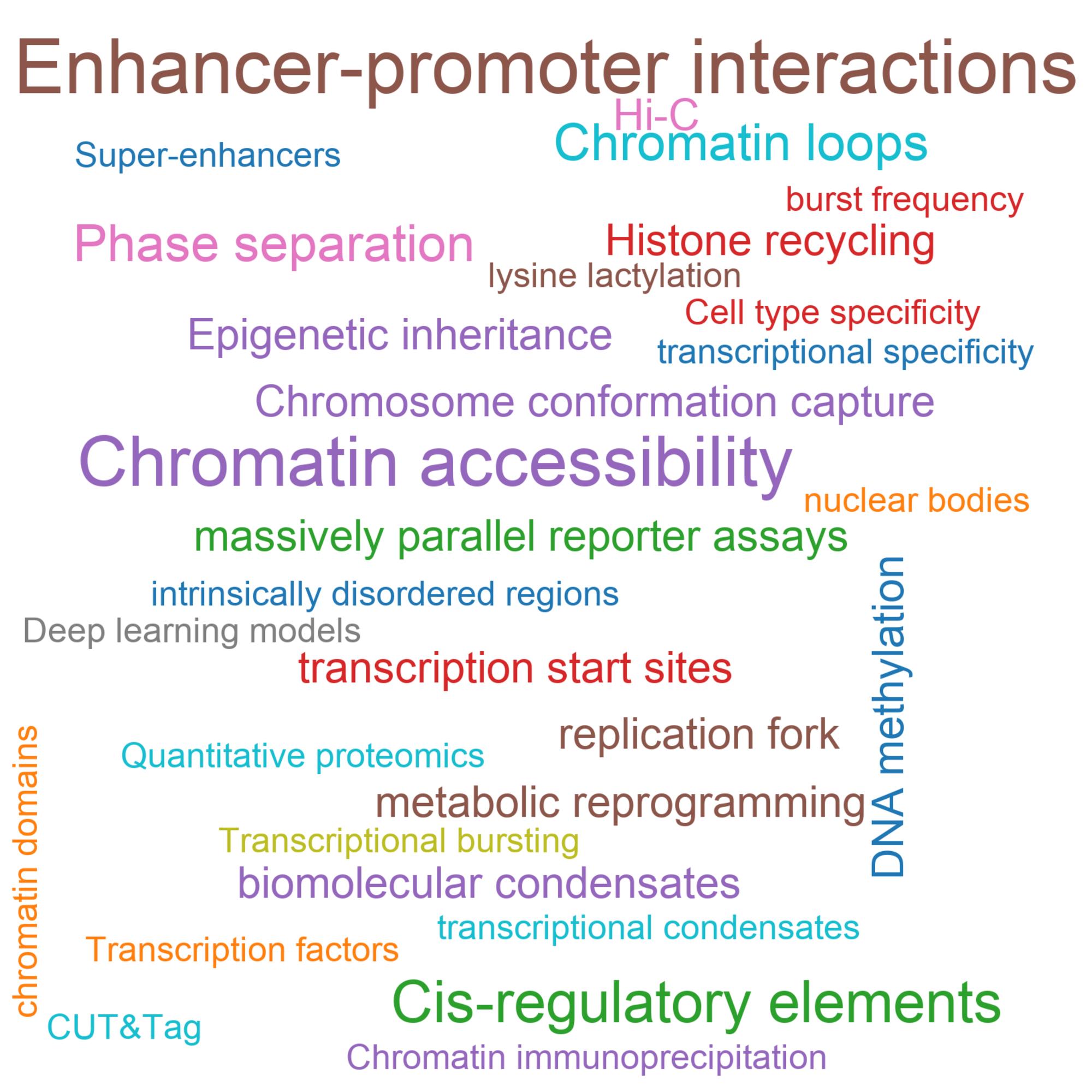
The Class of 2026 for Genomics and Chromatin Dynamics is strongly characterized by topics examining the physical and spatial organization of the genome. While foundational elements like enhancer-promoter interactions and chromatin accessibility remain the most frequently cited concepts, there is a pronounced focus on three-dimensional architectural components such as chromatin loops and cis-regulatory elements. Notably, the emergence of biophysical mechanisms is evident, with phase separation and biomolecular condensates capturing significant attention. This suggests a paradigm shift where researchers are increasingly integrating soft-matter physics to explain how dynamic nuclear compartments govern gene regulation. Technologies enabling high-resolution and high-throughput investigation, such as massively parallel reporter assays, are also prominent, underscoring a broader push toward understanding the functional consequences of spatial genomic organization at single-cell and molecular scales.
How Did Topics Shift from the Class of 2025 to the Class of 2026?
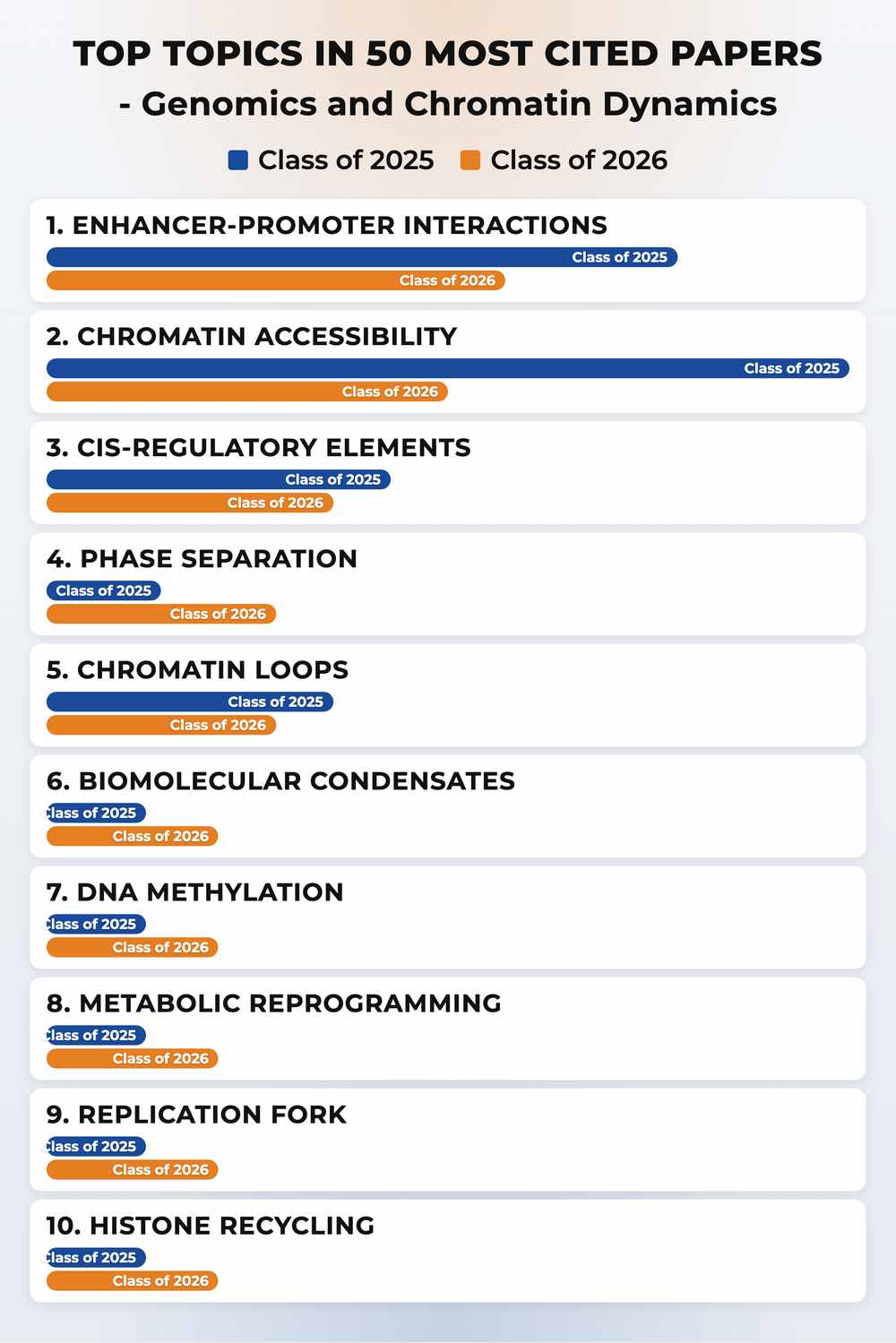
Comparing the Class of 2025 to the Class of 2026 reveals a distinct transition in research priorities within chromatin dynamics. The most striking risers are concepts tied to transient cellular states and physical organization—specifically biomolecular condensates, metabolic reprogramming, and histone recycling, all of which grew from minimal presence in the previous cohort to notable prominence. This surge highlights an accelerating interest in how metabolic inputs and biophysical phase transitions dynamically modulate the epigenome. Conversely, more traditional regulatory topics saw relative declines. Chromatin accessibility and enhancer-promoter interactions, while still highly cited overall, decreased in relative frequency, alongside methodological topics like deep learning models and broad categories such as transcription factors. This shift implies that the field is moving beyond simply cataloging accessible regions and static regulatory networks, toward a mechanistic focus on the real-time physical and metabolic constraints that shape chromatin topology.
Methodology
PRI identifies high-impact research using a transparent, topic-agnostic framework applied consistently across scientific domains. Bibliographic records are drawn from OpenAlex, including publication dates, citation relationships, and document types.
This ranking covers the Class of 2026 cohort: journal articles published in 2024. Reviews and other non-article document types are excluded to ensure comparability.
Research impact is quantified with an 18-month post-publication citation window—the number of citing works published within 18 months of each paper's publication date. This metric captures early impact while controlling for publication age.
An LLM-based relevance classifier then reviews each candidate's title and abstract to confirm substantive alignment with the target domain. Only papers classified as relevant appear in the final ranking.
Zheng Su, Tinsley Li, Thematic Shifts in Early-High-Impact Cancer Genomics and Diagnostics Research: A Bibliometric and Semantic Analysis. bioRxiv 2026.07.04.736459; doi: https://doi.org/10.64898/2026.07.04.736459
Cite this ranking
Pepkio Research Index (PRI). Topics and Trends in Most Cited Genomics and Chromatin Dynamics Papers, Class of 2026. https://pri.pepkio.com/top-papers/genomics-and-chromatin-dynamics/2026. Accessed 2026-10-24.

Methodology
Zheng Su, Tinsley Li, Thematic Shifts in Early-High-Impact Cancer Genomics and Diagnostics Research: A Bibliometric and Semantic Analysis. bioRxiv 2026.07.04.736459; doi: https://doi.org/10.64898/2026.07.04.736459