
What topics and trends defined most-cited Genomics and Phylogenetic Studies research in the Class of 2026?
The Class of 2026 reveals a strong shift towards AI-driven genomic analysis, with DNA language models and Transformer architectures rising sharply. Concurrently, advanced long-read sequencing technologies like HiFi and Nanopore continue to provide high-resolution data, indicating a deep integration of predictive computational models and cutting-edge sequencing in modern phylogenetics.
At a glance
- Field
- Genomics and Phylogenetic Studies
- Cohort label
- Class of 2026 (2024 publications)
- Papers analyzed
- 10,194
- Papers ranked
- 20
- Top topics in ranked papers
- DNA language model, 16S rRNA gene sequencing, AlphaFold Protein Structure Database, HiFi sequencing, Transformer models
- Publication window
- Jan 1, 2024 – Dec 31, 2024
- Eligibility
- Research articles; reviews excluded
- Citation window
- 18 months post-publication
- 18m citation range
- 110–1,911
- Data source
- OpenAlex · Retrieved Jul 2026
- License
- CC BY 4.0
Rankings
20 papers ranked by 18-month citation count
KEGG: biological systems database as a model of the real world
Nucleic Acids Research202410.1093/nar/gkae909
Interactive Tree of Life (iTOL) v6: recent updates to the phylogenetic tree display and annotation tool
Nucleic Acids Research202410.1093/nar/gkae268
Sequence modeling and design from molecular to genome scale with Evo
Science202410.1126/science.ado9336
Nucleotide Transformer: building and evaluating robust foundation models for human genomics
Nature Methods202410.1038/s41592-024-02523-z
GENCODE 2025: reference gene annotation for human and mouse
Nucleic Acids Research202410.1093/nar/gkae1078
JCVI: A versatile toolkit for comparative genomics analysis
iMeta202410.1002/imt2.211
SBSM-Pro: support bio-sequence machine for proteins
Science China Information Sciences202410.1007/s11432-024-4171-9
OrthoDB and BUSCO update: annotation of orthologs with wider sampling of genomes
Nucleic Acids Research202410.1093/nar/gkae987
EzBioCloud: a genome-driven database and platform for microbiome identification and discovery
INTERNATIONAL JOURNAL OF SYSTEMATIC AND EVOLUTIONARY MICROBIOLOGY202410.1099/ijsem.0.006421
Rapid and sensitive detection of genome contamination at scale with FCS-GX
Genome biology202410.1186/s13059-024-03198-7
Detection of mosaic and population-level structural variants with Sniffles2
Nature Biotechnology202410.1038/s41587-023-02024-y
SeqKit2: A Swiss army knife for sequence and alignment processing
iMeta202410.1002/imt2.191
Complexity of avian evolution revealed by family-level genomes
Nature202410.1038/s41586-024-07323-1
The nature of the last universal common ancestor and its impact on the early Earth system
Nature Ecology & Evolution202410.1038/s41559-024-02461-1
Rfam 15: RNA families database in 2025
Nucleic Acids Research202410.1093/nar/gkae1023
RCSB protein Data Bank: exploring protein 3D similarities via comprehensive structural alignments
Bioinformatics202410.1093/bioinformatics/btae370
Global marine microbial diversity and its potential in bioprospecting
Nature202410.1038/s41586-024-07891-2
<scp>TreeViewer</scp>: Flexible, modular software to visualise and manipulate phylogenetic trees
Ecology and Evolution202410.1002/ece3.10873
The variation and evolution of complete human centromeres
Nature202410.1038/s41586-024-07278-3
Prediction of strain level phage–host interactions across the Escherichia genus using only genomic information
Nature Microbiology202410.1038/s41564-024-01832-5
Topic trends
Dominant research themes and year-over-year shifts in Genomics and Phylogenetic Studies
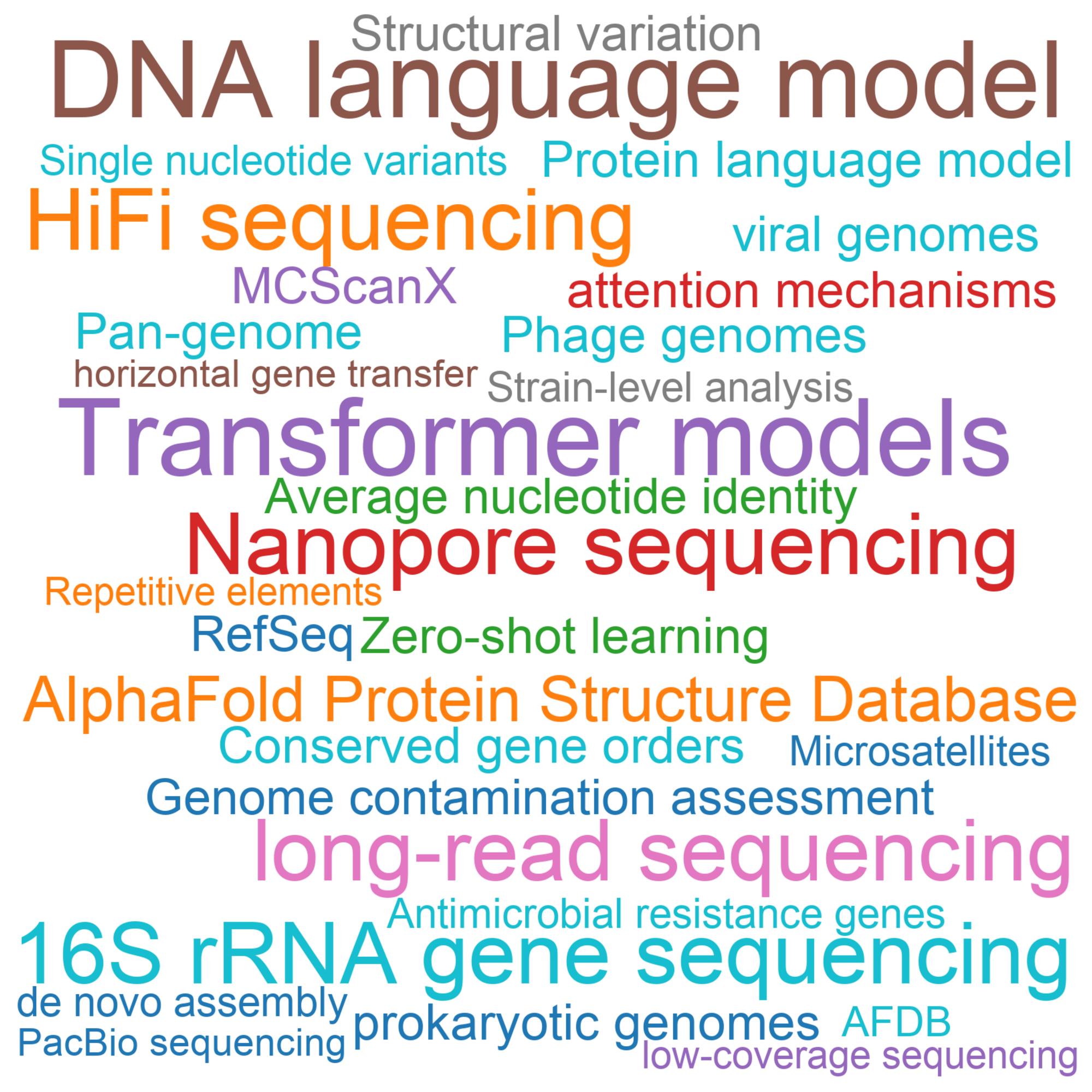
What Topics Define the Class of 2026?
In the Class of 2026, genomics and phylogenetic studies are increasingly defined by the integration of artificial intelligence and advanced sequencing technologies. DNA language models, Transformer architectures, and the AlphaFold Protein Structure Database are among the most prominent topics, indicating a major shift towards computational and predictive modeling in genomics. Concurrently, high-fidelity approaches such as HiFi and Nanopore long-read sequencing maintain a strong presence, enabling unprecedented resolution of complex genomes. This dual focus highlights a field where cutting-edge sequencing provides the high-quality data necessary to train powerful deep learning models, ultimately accelerating sequence analysis, structural prediction, and our understanding of evolutionary relationships.
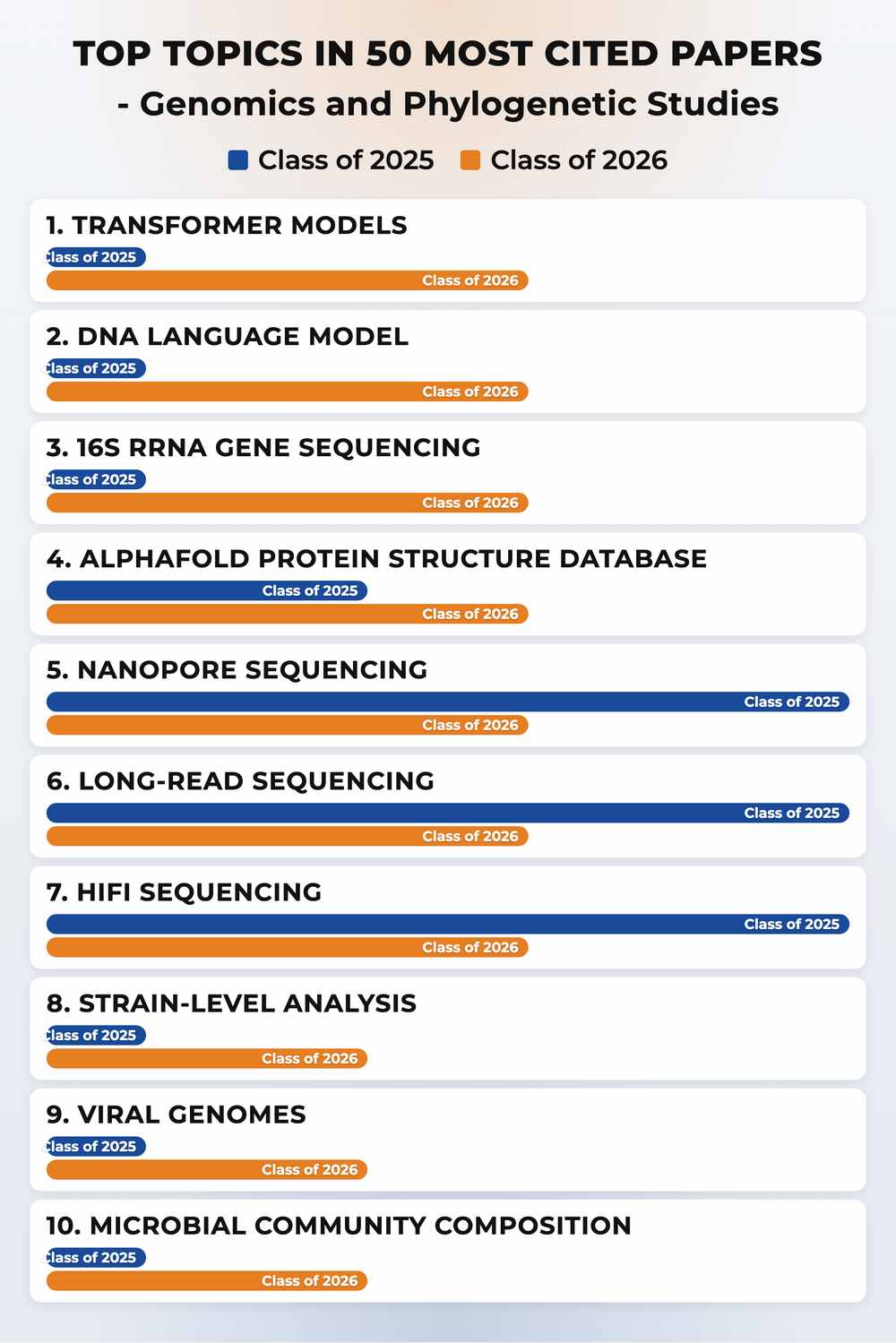
How Did Topics Shift from the Class of 2025 to the Class of 2026?
The transition to the Class of 2026 reveals a distinct pivot toward AI-driven methodologies in genomic analysis. Topics like DNA language models and Transformer models emerged rapidly, reflecting the broader adoption of large language model architectures for interpreting genomic sequences and regulatory elements. Meanwhile, structural prediction tools such as the AlphaFold Protein Structure Database also saw significant growth. Conversely, traditional phylogenetic pipelines and basic genomic assembly approaches experienced relative declines in prominence. This evolution underscores a broader trend in genomics and phylogenetics: researchers are rapidly moving beyond basic sequence assembly to leverage deep learning frameworks that can extract complex, predictive insights from vast genomic datasets.
Methodology
PRI identifies high-impact research using a transparent, topic-agnostic framework applied consistently across scientific domains. Bibliographic records are drawn from OpenAlex, including publication dates, citation relationships, and document types.
This ranking covers the Class of 2026 cohort: journal articles published in 2024. Reviews and other non-article document types are excluded to ensure comparability.
Research impact is quantified with an 18-month post-publication citation window—the number of citing works published within 18 months of each paper's publication date. This metric captures early impact while controlling for publication age.
An LLM-based relevance classifier then reviews each candidate's title and abstract to confirm substantive alignment with the target domain. Only papers classified as relevant appear in the final ranking.
Zheng Su, Tinsley Li, Thematic Shifts in Early-High-Impact Cancer Genomics and Diagnostics Research: A Bibliometric and Semantic Analysis. bioRxiv 2026.07.04.736459; doi: https://doi.org/10.64898/2026.07.04.736459
Cite this ranking
Pepkio Research Index (PRI). Topics and Trends in Most Cited Genomics and Phylogenetic Studies Papers, Class of 2026. https://pri.pepkio.com/top-papers/genomics-and-phylogenetic-studies/2026. Accessed 2026-10-14.

Methodology
Zheng Su, Tinsley Li, Thematic Shifts in Early-High-Impact Cancer Genomics and Diagnostics Research: A Bibliometric and Semantic Analysis. bioRxiv 2026.07.04.736459; doi: https://doi.org/10.64898/2026.07.04.736459