
What topics and trends defined most-cited Genetic diversity and population structure research in the Class of 2026?
The most impactful recent research in genetic diversity and population structure highlights a strong shift toward "Adaptive potential" and "Hybridization," which surged significantly in prominence. While foundational "Comparative genomics" declined, the rising focus on "Ancient genomes" underscores a growing reliance on paleogenomics to uncover how past demographic dynamics inform current conservation strategies.
At a glance
- Field
- Genetic diversity and population structure
- Cohort label
- Class of 2026 (2024 publications)
- Papers analyzed
- 5,207
- Papers ranked
- 20
- Top topics in ranked papers
- Ancient genomes, Effective population size, Adaptive potential, Hybridization
- Publication window
- Jan 1, 2024 – Dec 31, 2024
- Eligibility
- Research articles; reviews excluded
- Citation window
- 18 months post-publication
- 18m citation range
- 35–174
- Data source
- OpenAlex · Retrieved August 2026
- License
- CC BY 4.0
Rankings
20 papers ranked by 18-month citation count
Complexity of avian evolution revealed by family-level genomes
Nature202410.1038/s41586-024-07323-1
Population genomics of post-glacial western Eurasia
Nature202410.1038/s41586-023-06865-0
Widespread horse-based mobility arose around 2200 bce in Eurasia
Nature202410.1038/s41586-024-07597-5
The hagfish genome and the evolution of vertebrates
Nature202410.1038/s41586-024-07070-3
Hybrid speciation driven by multilocus introgression of ecological traits
Nature202410.1038/s41586-024-07263-w
Recurrent evolution and selection shape structural diversity at the amylase locus
Nature202410.1038/s41586-024-07911-1
The super-pangenome of Populus unveils genomic facets for its adaptation and diversification in widespread forest trees
Molecular Plant202410.1016/j.molp.2024.03.009
A lethal mitonuclear incompatibility in complex I of natural hybrids
Nature202410.1038/s41586-023-06895-8
The genetic origins and impacts of historical Papuan migrations into Wallacea
Proceedings of the National Academy of Sciences202410.1073/pnas.2412355121
Large-scale gene expression alterations introduced by structural variation drive morphotype diversification in Brassica oleracea
Nature Genetics202410.1038/s41588-024-01655-4
Global assessment of effective population sizes: Consistent taxonomic differences in meeting the 50/500 rule
Molecular Ecology202410.1111/mec.17353
Mind the lag: understanding genetic extinction debt for conservation
Trends in Ecology & Evolution202410.1016/j.tree.2024.10.008
Reconstructing the Genetic Relationship between Ancient and Present-Day Siberian Populations
Genome Biology and Evolution202410.1093/gbe/evae063
Resilience of genetic diversity in forest trees over the Quaternary
Nature Communications202410.1038/s41467-024-52612-y
The global distribution of angiosperm genome size is shaped by climate
New Phytologist202410.1111/nph.19544
The genomes of all lungfish inform on genome expansion and tetrapod evolution
Nature202410.1038/s41586-024-07830-1
The genome-wide signature of short-term temporal selection
Proceedings of the National Academy of Sciences202410.1073/pnas.2307107121
Monitoring of species’ genetic diversity in Europe varies greatly and overlooks potential climate change impacts
Nature Ecology & Evolution202410.1038/s41559-023-02260-0
Too simple, too complex, or just right? Advantages, challenges, and guidance for indicators of genetic diversity
BioScience202410.1093/biosci/biae006
Phytop: a tool for visualizing and recognizing signals of incomplete lineage sorting and hybridization using species trees output from ASTRAL
Horticulture Research202410.1093/hr/uhae330
Topic trends
Dominant research themes and year-over-year shifts in Genetic diversity and population structure
What Topics Define the Class of 2026?
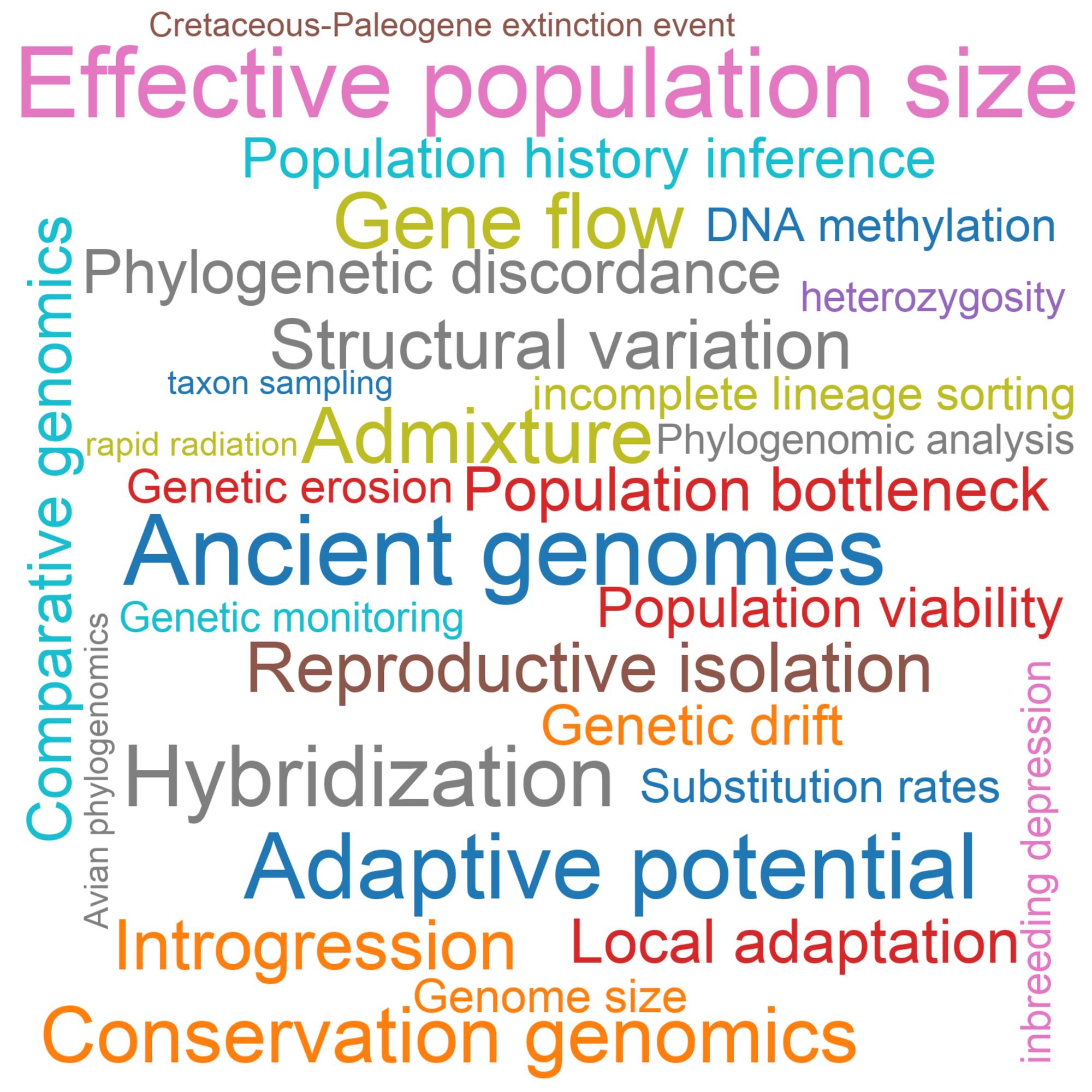
The Class of 2026 in genetic diversity and population structure is defined by an emphasis on historical and adaptive genomics. "Ancient genomes" and "Effective population size" are the most prominent themes, with "Ancient genomes" surging notably over the past year. This points to a field deeply engaged in reconstructing demographic histories and understanding how past population dynamics shape present-day genetic variation. Additionally, topics like "Adaptive potential" and "Hybridization" show massive fold increases, reflecting a growing focus on how species adapt to rapidly changing environments and the role of interspecific gene flow in generating novel traits. "Admixture," "Conservation genomics," and "Gene flow" remain fundamental pillars, underscoring the ongoing priority of applying genomic tools to preserve endangered populations and manage biodiversity. Together, these topics reveal a transition toward using deep temporal data and adaptive mechanisms to inform both evolutionary theory and practical conservation efforts.
How Did Topics Shift from the Class of 2025 to the Class of 2026?
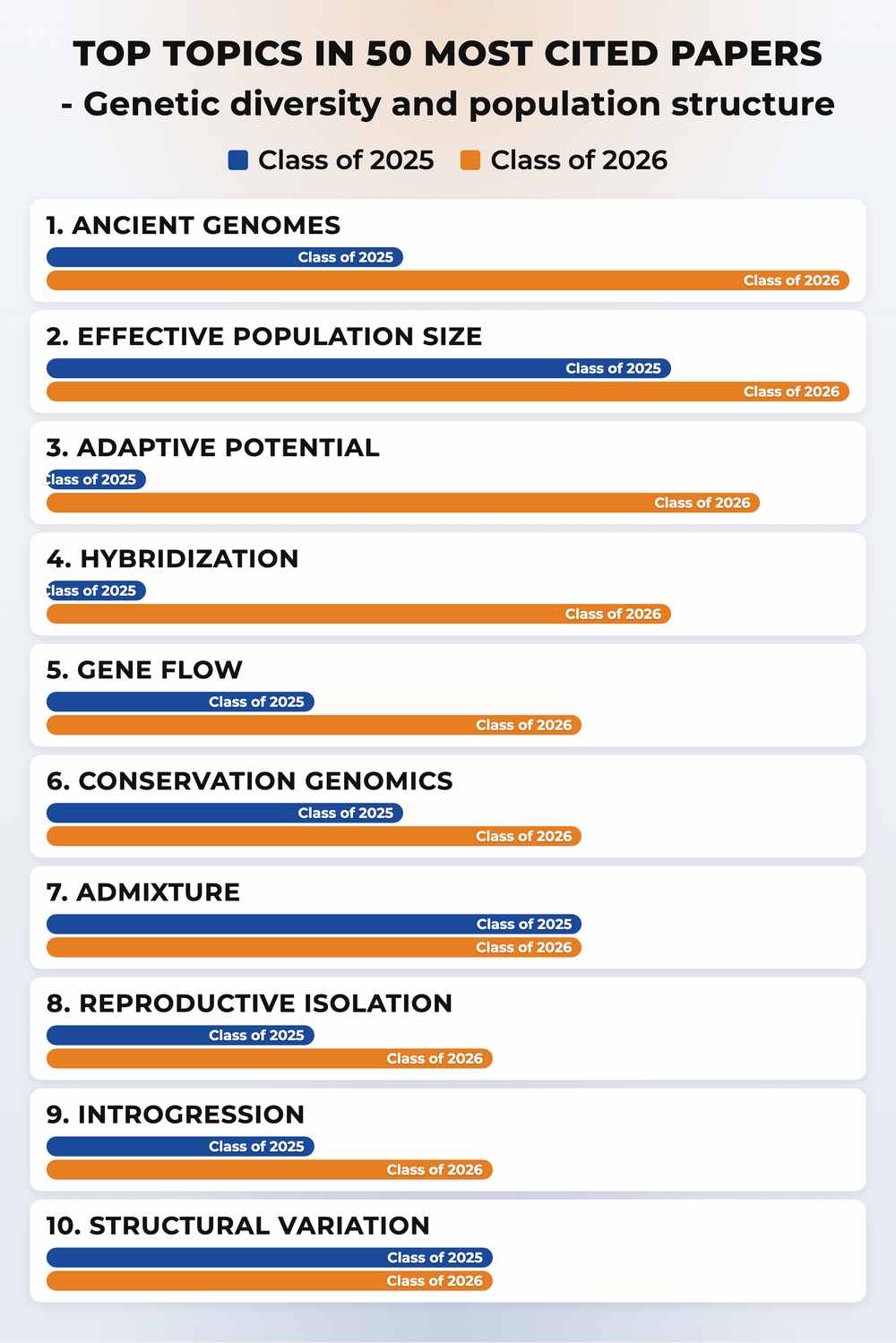
The shift from the Class of 2025 to the Class of 2026 highlights a strategic pivot toward forward-looking evolutionary potential and complex genetic exchanges. "Adaptive potential" experienced an eight-fold relative increase, and "Hybridization" surged seven-fold. This dramatic rise indicates that researchers are increasingly prioritizing the study of how introgression and hybridization fuel rapid adaptation, especially in response to anthropogenic climate change and environmental stressors. "Ancient genomes" also saw significant growth, more than doubling in prominence as methodological advances allow for deeper insights into paleogenomics. In contrast, foundational topics such as "Comparative genomics" and "Population history inference" saw relative declines, dropping by half and one-third respectively. This suggests that while baseline comparative studies and demographic modeling were heavily represented in the previous cohort, the field has now shifted its primary focus towards understanding the functional consequences of genetic diversity and the dynamic mechanisms of evolutionary rescue.
Methodology
PRI identifies high-impact research using a transparent, topic-agnostic framework applied consistently across scientific domains. Bibliographic records are drawn from OpenAlex, including publication dates, citation relationships, and document types.
This ranking covers the Class of 2026 cohort: journal articles published in 2024. Reviews and other non-article document types are excluded to ensure comparability.
Research impact is quantified with an 18-month post-publication citation window—the number of citing works published within 18 months of each paper's publication date. This metric captures early impact while controlling for publication age.
An LLM-based relevance classifier then reviews each candidate's title and abstract to confirm substantive alignment with the target domain. Only papers classified as relevant appear in the final ranking.
Zheng Su, Tinsley Li, Thematic Shifts in Early-High-Impact Cancer Genomics and Diagnostics Research: A Bibliometric and Semantic Analysis. bioRxiv 2026.07.04.736459; doi: https://doi.org/10.64898/2026.07.04.736459
Cite this ranking
Pepkio Research Index (PRI). Topics and Trends in Most Cited Genetic diversity and population structure Papers, Class of 2026. https://pri.pepkio.com/top-papers/genetic-diversity-and-population-structure/2026. Accessed 2026-10-24.

Methodology
Zheng Su, Tinsley Li, Thematic Shifts in Early-High-Impact Cancer Genomics and Diagnostics Research: A Bibliometric and Semantic Analysis. bioRxiv 2026.07.04.736459; doi: https://doi.org/10.64898/2026.07.04.736459