
What topics and trends defined most-cited MicroRNA in disease regulation research in the Class of 2026?
The Class of 2026 in MicroRNA research is heavily defined by its mechanistic focus on the tumor microenvironment and extracellular vesicles. High-throughput RNA sequencing has surged as the primary profiling tool, while studies increasingly integrate microRNAs with other non-coding RNAs like circular and long non-coding RNAs to decode complex regulatory networks.
At a glance
- Field
- MicroRNA in disease regulation
- Cohort label
- Class of 2026 (2024 publications)
- Papers analyzed
- 11,173
- Papers ranked
- 20
- Top topics in ranked papers
- Tumor microenvironment, RNA sequencing, extracellular vesicles, circular RNA
- Publication window
- Jan 1, 2024 – Dec 31, 2024
- Eligibility
- Research articles; reviews excluded
- Citation window
- 18 months post-publication
- 18m citation range
- 37–178
- Data source
- OpenAlex · Retrieved June 2026
- License
- CC BY 4.0
Rankings
20 papers ranked by 18-month citation count
miRTarBase 2025: updates to the collection of experimentally validated microRNA–target interactions
Nucleic Acids Research202410.1093/nar/gkae1072
Harnessing extracellular vesicle heterogeneity for diagnostic and therapeutic applications
Nature Nanotechnology202410.1038/s41565-024-01774-3
The biogenesis and regulation of animal microRNAs
Nature Reviews Molecular Cell Biology202410.1038/s41580-024-00805-0
Exosome circATP8A1 induces macrophage M2 polarization by regulating the miR-1-3p/STAT6 axis to promote gastric cancer progression
Molecular Cancer202410.1186/s12943-024-01966-4
Brucea javanica derived exosome-like nanovesicles deliver miRNAs for cancer therapy
Journal of Controlled Release202410.1016/j.jconrel.2024.01.060
miRNATissueAtlas 2025: an update to the uniformly processed and annotated human and mouse non-coding RNA tissue atlas
Nucleic Acids Research202410.1093/nar/gkae1036
Integrative analysis of genomic and epigenomic regulation reveals miRNA mediated tumor heterogeneity and immune evasion in lower grade glioma
Communications Biology202410.1038/s42003-024-06488-9
Laser-induced graphene (LIG)-based electrochemical microfluidic chip for simultaneous analysis of multiplex microRNAs
Chemical Engineering Journal202410.1016/j.cej.2024.150233
Development of an Inhalable DNA Tetrahedron MicroRNA Sponge
Advanced Materials202410.1002/adma.202414336
Exosomal miR-106a-5p from highly metastatic colorectal cancer cells drives liver metastasis by inducing macrophage M2 polarization in the tumor microenvironment
Journal of Experimental & Clinical Cancer Research202410.1186/s13046-024-03204-7
A heterogeneous information network learning model with neighborhood-level structural representation for predicting lncRNA-miRNA interactions
Computational and Structural Biotechnology Journal202410.1016/j.csbj.2024.06.032
Construction of circRNA–miRNA–mRNA ceRNA regulatory network and screening of diagnostic targets for tuberculosis
Annals of Medicine202410.1080/07853890.2024.2416604
Engineered extracellular vesicles for targeted reprogramming of cancer-associated fibroblasts to potentiate therapy of pancreatic cancer
Signal Transduction and Targeted Therapy202410.1038/s41392-024-01872-7
Targeting delivery of miR-146a via IMTP modified milk exosomes exerted cardioprotective effects by inhibiting NF-κB signaling pathway after myocardial ischemia-reperfusion injury
Journal of Nanobiotechnology202410.1186/s12951-024-02631-0
RETRACTED: Exploring the molecular mechanisms of MSC-derived exosomes in Alzheimer's disease: Autophagy, insulin and the PI3K/Akt/mTOR signaling pathway
Biomedicine & Pharmacotherapy202410.1016/j.biopha.2024.116836
Ginger exosome-like nanoparticle-derived miRNA therapeutics: A strategic inhibitor of intestinal inflammation
Journal of Advanced Research202410.1016/j.jare.2024.04.001
M2 Tumor‐Associated Macrophages‐Derived Exosomal <i>MALAT1</i> Promotes Glycolysis and Gastric Cancer Progression
Advanced Science202410.1002/advs.202309298
Circulating miRNA panels as a novel non-invasive diagnostic, prognostic, and potential predictive biomarkers in non-small cell lung cancer (NSCLC)
British Journal of Cancer202410.1038/s41416-024-02831-3
Exploring ncRNA-mediated regulation of EGFR signalling in glioblastoma: From mechanisms to therapeutics
Life Sciences202410.1016/j.lfs.2024.122613
CircPPAP2B controls metastasis of clear cell renal cell carcinoma via HNRNPC-dependent alternative splicing and targeting the miR-182-5p/CYP1B1 axis
Molecular Cancer202410.1186/s12943-023-01912-w
Topic trends
Dominant research themes and year-over-year shifts in MicroRNA in disease regulation
What Topics Define the Class of 2026?
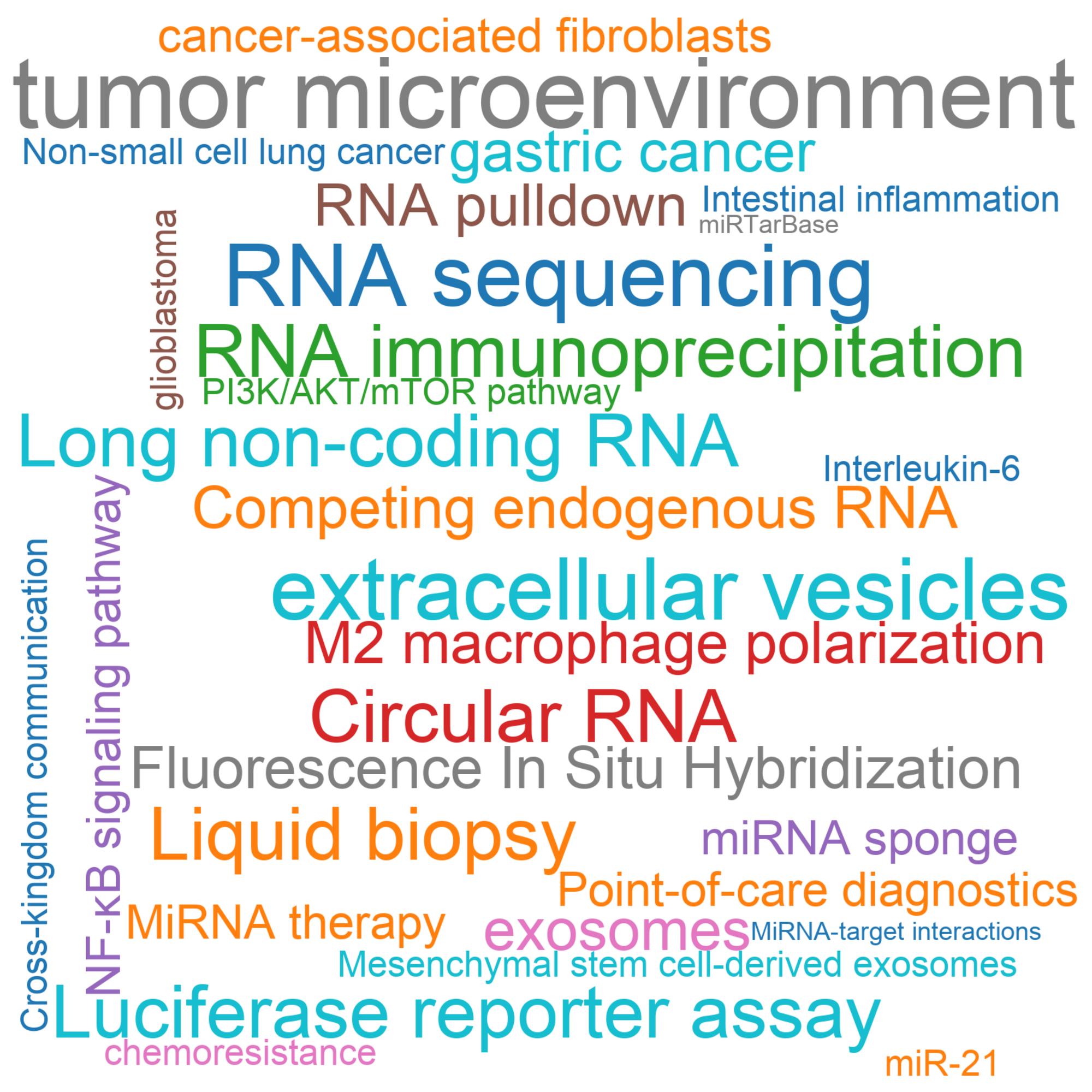
In the Class of 2026 for MicroRNA in disease regulation, the tumor microenvironment emerges as a dominant focal point, appearing in roughly 16.6% of ranked papers. This highlights a strong emphasis on how microRNAs modulate cellular interactions within cancerous tissues. Methodologically, RNA sequencing and extracellular vesicles also take center stage, underscoring the field's shift towards high-throughput transcriptomics and intercellular communication via exosomes. Additionally, there is a prominent focus on related non-coding RNAs such as circular RNAs and long non-coding RNAs, which are frequently studied alongside microRNAs to map complex regulatory networks. Diagnostic applications remain robust, evidenced by the prevalence of liquid biopsy studies. Together, these themes reflect a comprehensive approach, linking microRNA molecular mechanisms with clinical diagnostics and tumor biology.
How Did Topics Shift from the Class of 2025 to the Class of 2026?
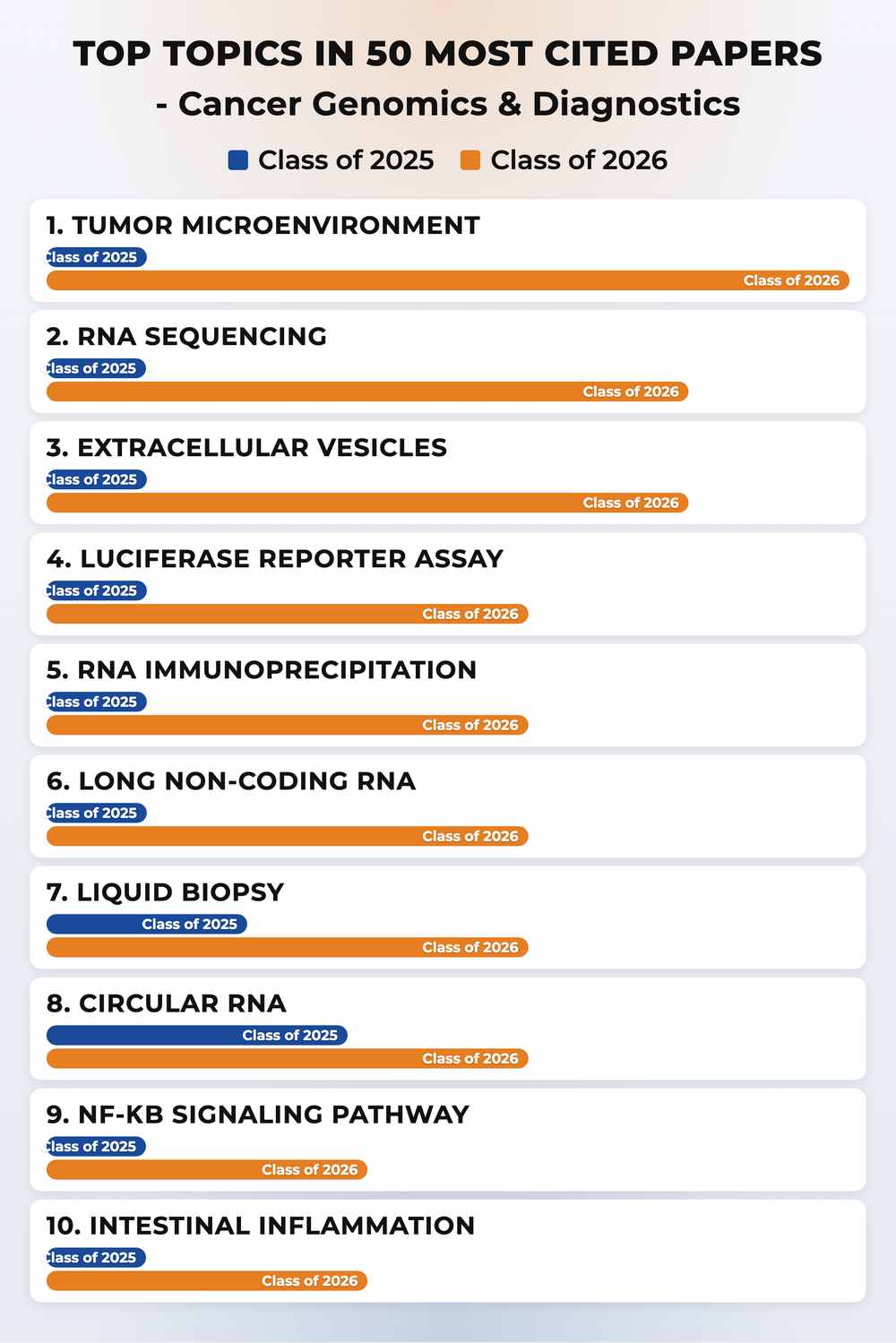
The transition from the Class of 2025 to the Class of 2026 reveals significant momentum in advanced molecular techniques and specific disease contexts. RNA sequencing experienced a dramatic rise, reflecting its becoming a standard tool for comprehensive microRNA profiling. The tumor microenvironment also saw substantial growth, increasing by over a log2 fold change of nearly 3, emphasizing a deeper investigation into how microRNAs shape immune evasion and tumor progression. Extracellular vesicles surged notably, pointing to an intensifying interest in how microRNAs are packaged and transported between cells. Conversely, broader topics like MiRNA-disease association plateaued or saw relative declines in prominence. This pattern suggests a maturation of the field: rather than merely establishing associations, current research increasingly prioritizes mechanistic dissection within the tumor microenvironment and extracellular delivery systems.
Methodology
PRI identifies high-impact research using a transparent, topic-agnostic framework applied consistently across scientific domains. Bibliographic records are drawn from OpenAlex, including publication dates, citation relationships, and document types.
This ranking covers the Class of 2026 cohort: journal articles published in 2024. Reviews and other non-article document types are excluded to ensure comparability.
Research impact is quantified with an 18-month post-publication citation window—the number of citing works published within 18 months of each paper's publication date. This metric captures early impact while controlling for publication age.
An LLM-based relevance classifier then reviews each candidate's title and abstract to confirm substantive alignment with the target domain. Only papers classified as relevant appear in the final ranking.
Zheng Su, Tinsley Li, Thematic Shifts in Early-High-Impact Cancer Genomics and Diagnostics Research: A Bibliometric and Semantic Analysis. bioRxiv 2026.07.04.736459; doi: https://doi.org/10.64898/2026.07.04.736459
Cite this ranking
Pepkio Research Index (PRI). Topics and Trends in Most Cited MicroRNA in disease regulation Papers, Class of 2026. https://pri.pepkio.com/top-papers/microrna-in-disease-regulation/2026. Accessed 2026-10-16.

Methodology
Zheng Su, Tinsley Li, Thematic Shifts in Early-High-Impact Cancer Genomics and Diagnostics Research: A Bibliometric and Semantic Analysis. bioRxiv 2026.07.04.736459; doi: https://doi.org/10.64898/2026.07.04.736459