
What topics and trends defined most-cited Virus-based gene therapy research research in the Class of 2026?
Virus-based gene therapy is rapidly pivoting toward immuno-oncology, with massive growth in CAR T-cell therapy and CD8+ T cell infiltration. While traditional AAV vector design and systemic administration research are declining, the field is intensely focused on oncolytic viruses, intratumoral delivery, and rigorous clinical safety monitoring like aminotransferase elevation.
At a glance
- Field
- Virus-based gene therapy research
- Cohort label
- Class of 2026 (2024 publications)
- Papers analyzed
- 6480
- Papers ranked
- 20
- Top topics in ranked papers
- Oncolytic virus, Adeno-Associated Virus, CAR T-cell therapy
- Publication window
- Jan 1, 2024 – Dec 31, 2024
- Eligibility
- Research articles; reviews excluded
- Citation window
- 18 months post-publication
- 18m citation range
- 36–189
- Data source
- OpenAlex · Retrieved July 2026
- License
- CC BY 4.0
Rankings
20 papers ranked by 18-month citation count
AAV1-hOTOF gene therapy for autosomal recessive deafness 9: a single-arm trial
The Lancet202410.1016/s0140-6736(23)02874-x
Risk of Second Tumors and T-Cell Lymphoma after CAR T-Cell Therapy
New England Journal of Medicine202410.1056/nejmoa2401361
AAV gene therapy for Duchenne muscular dystrophy: the EMBARK phase 3 randomized trial
Nature Medicine202410.1038/s41591-024-03304-z
Engineered virus-like particles for transient delivery of prime editor ribonucleoprotein complexes in vivo
Nature Biotechnology202410.1038/s41587-023-02078-y
In vivo human T cell engineering with enveloped delivery vehicles
Nature Biotechnology202410.1038/s41587-023-02085-z
An AAV capsid reprogrammed to bind human transferrin receptor mediates brain-wide gene delivery
Science202410.1126/science.adm8386
Gene Therapy with Fidanacogene Elaparvovec in Adults with Hemophilia B
New England Journal of Medicine202410.1056/nejmoa2302982
Gene therapy for neovascular age-related macular degeneration by subretinal delivery of RGX-314: a phase 1/2a dose-escalation study
The Lancet202410.1016/s0140-6736(24)00310-6
Directed evolution of engineered virus-like particles with improved production and transduction efficiencies
Nature Biotechnology202410.1038/s41587-024-02467-x
Lentiviral Gene Therapy with CD34+ Hematopoietic Cells for Hemophilia A
New England Journal of Medicine202410.1056/nejmoa2410597
Split intein-mediated protein trans-splicing to express large dystrophins
Nature202410.1038/s41586-024-07710-8
Expression of tumor antigens within an oncolytic virus enhances the anti-tumor T cell response
Nature Communications202410.1038/s41467-024-49286-x
In vivo CAR T-cell generation in nonhuman primates using lentiviral vectors displaying a multidomain fusion ligand
Blood202410.1182/blood.2024024523
Combination therapy with oncolytic virus and T cells or mRNA vaccine amplifies antitumor effects
Signal Transduction and Targeted Therapy202410.1038/s41392-024-01824-1
Chimeric Antigen Receptor T Cells Targeting CD19 and GCC in Metastatic Colorectal Cancer
JAMA Oncology202410.1001/jamaoncol.2024.3891
An oncolytic virus–T cell chimera for cancer immunotherapy
Nature Biotechnology202410.1038/s41587-023-02118-7
LOAd703, an oncolytic virus-based immunostimulatory gene therapy, combined with chemotherapy for unresectable or metastatic pancreatic cancer (LOKON001): results from arm 1 of a non-randomised, single-centre, phase 1/2 study
The Lancet Oncology202410.1016/s1470-2045(24)00079-2
Systematic multi-trait AAV capsid engineering for efficient gene delivery
Nature Communications202410.1038/s41467-024-50555-y
Carcinoembryonic antigen-expressing oncolytic measles virus derivative in recurrent glioblastoma: a phase 1 trial
Nature Communications202410.1038/s41467-023-43076-7
Analytical characterization of full, intermediate, and empty AAV capsids
Gene Therapy202410.1038/s41434-024-00444-2
Topic trends
Dominant research themes and year-over-year shifts in Virus-based gene therapy research
What Topics Define the Class of 2026?
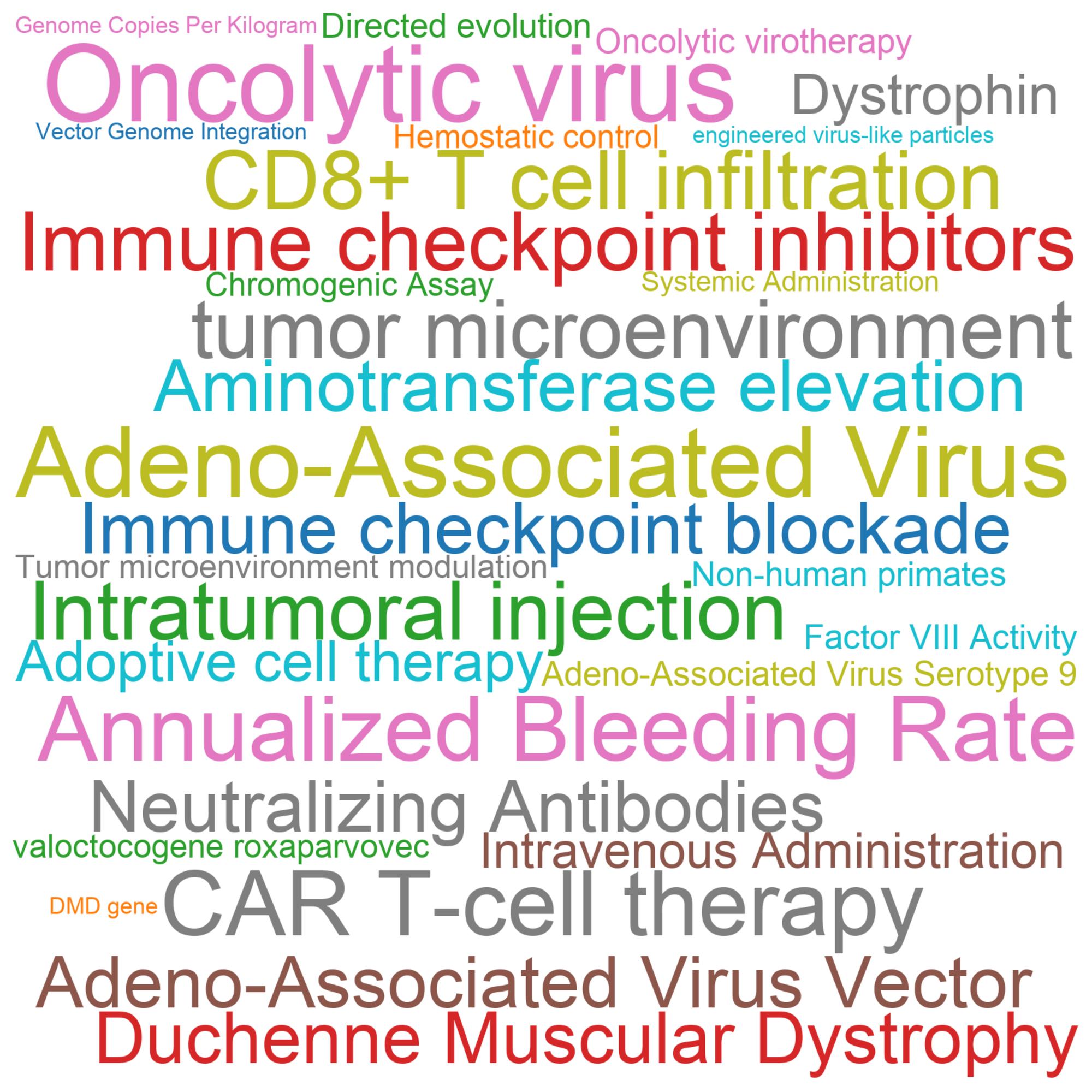
The Class of 2026 for Virus-based gene therapy research is defined by a pronounced focus on oncology and the treatment of specific genetic disorders. The most dominant concept is 'Oncolytic virus', followed closely by 'Adeno-Associated Virus' (AAV) and 'gene therapy'. There is a clear clustering around cancer immunotherapy, evidenced by the prevalence of terms like 'CAR T-cell therapy', 'CD8+ T cell infiltration', 'Immune checkpoint inhibitors', 'Intratumoral injection', and the 'tumor microenvironment'. This indicates that researchers are intensely investigating how engineered viruses can be leveraged to stimulate targeted anti-tumor immune responses and overcome the immunosuppressive tumor microenvironment. Additionally, there is significant emphasis on specific clinical outcomes for monogenic diseases, highlighted by the prominence of 'Annualized Bleeding Rate', which strongly points to ongoing clinical evaluations of AAV-mediated gene therapies for hemophilia. Overall, the field is dominated by efforts to refine viral vectors for targeted delivery and to maximize therapeutic efficacy in both cancer and severe genetic bleeding disorders.
How Did Topics Shift from the Class of 2025 to the Class of 2026?
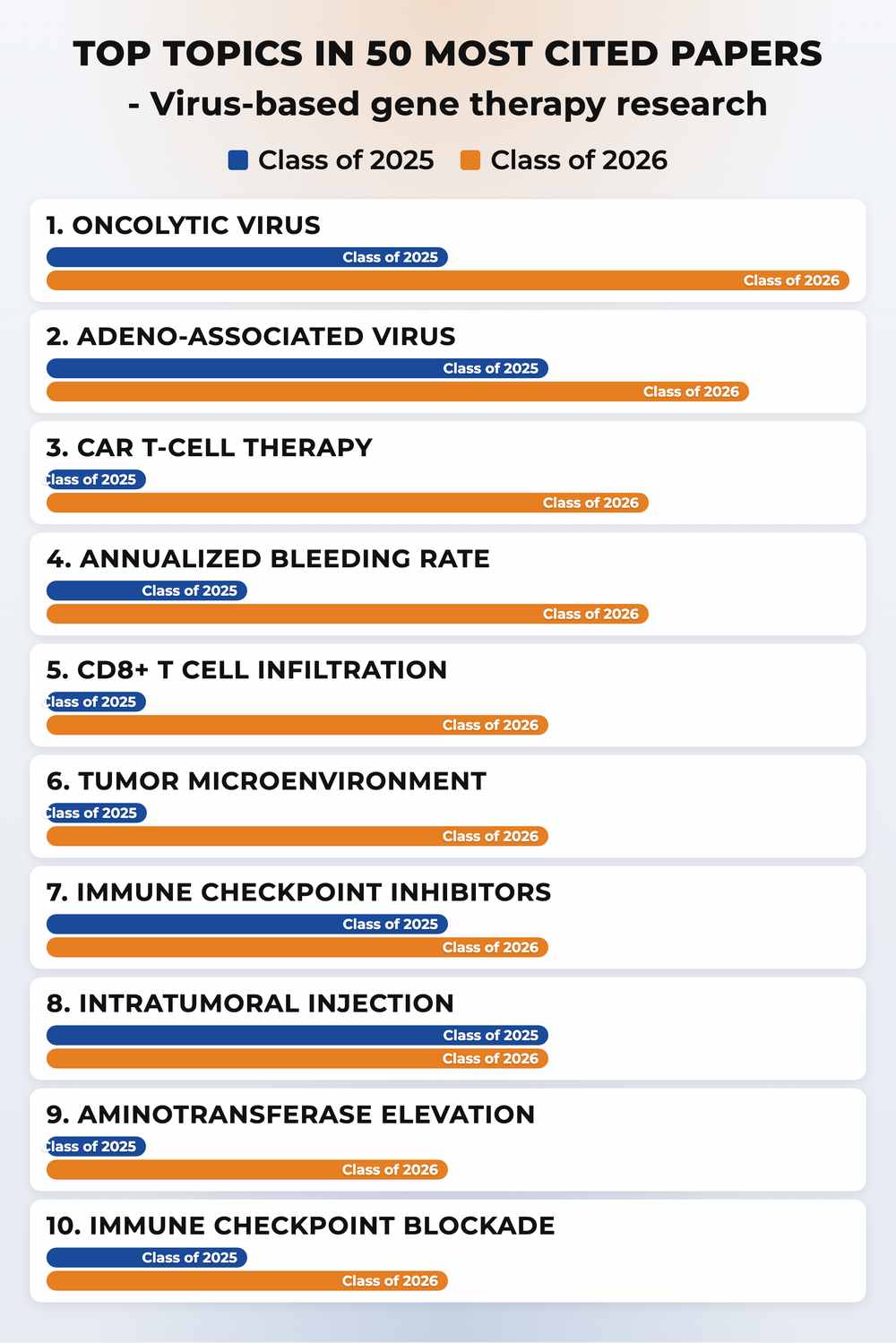
Between the Class of 2025 and the Class of 2026, the field experienced a dramatic shift towards advanced immuno-oncology applications and closer monitoring of clinical safety. The most explosive growth was seen in concepts related to 'CAR T-cell therapy' and 'CD8+ T cell infiltration', which surged from virtually no presence to becoming top concepts. This reflects a rapid pivot towards combining viral vectors with cell therapies and measuring precise immune responses within the tumor microenvironment. We also observe a sharp rise in clinical and safety endpoints, such as 'Hemostatic control', 'partial response', and 'Aminotransferase elevation', suggesting that many therapies have progressed into advanced clinical trials where detailed efficacy and liver toxicity are closely scrutinized. Conversely, foundational vector concepts like 'Adeno-Associated Virus Vector', 'Adeno-Associated Virus Serotype 9', and 'AAV serotypes' saw significant declines, alongside 'Systemic Administration' and 'Glioblastoma'. This pattern implies a maturation of the field: researchers are moving away from basic vector design and broad systemic delivery, focusing instead on targeted applications, precise immunological mechanisms, and rigorous clinical outcome reporting.
Methodology
PRI identifies high-impact research using a transparent, topic-agnostic framework applied consistently across scientific domains. Bibliographic records are drawn from OpenAlex, including publication dates, citation relationships, and document types.
This ranking covers the Class of 2026 cohort: journal articles published in 2024. Reviews and other non-article document types are excluded to ensure comparability.
Research impact is quantified with an 18-month post-publication citation window—the number of citing works published within 18 months of each paper's publication date. This metric captures early impact while controlling for publication age.
An LLM-based relevance classifier then reviews each candidate's title and abstract to confirm substantive alignment with the target domain. Only papers classified as relevant appear in the final ranking.
Zheng Su, Tinsley Li, Thematic Shifts in Early-High-Impact Cancer Genomics and Diagnostics Research: A Bibliometric and Semantic Analysis. bioRxiv 2026.07.04.736459; doi: https://doi.org/10.64898/2026.07.04.736459
Cite this ranking
Pepkio Research Index (PRI). Topics and Trends in Most Cited Virus-based gene therapy research Papers, Class of 2026. https://pri.pepkio.com/top-papers/virus-based-gene-therapy-research/2026. Accessed 2026-10-16.

Methodology
Zheng Su, Tinsley Li, Thematic Shifts in Early-High-Impact Cancer Genomics and Diagnostics Research: A Bibliometric and Semantic Analysis. bioRxiv 2026.07.04.736459; doi: https://doi.org/10.64898/2026.07.04.736459