
What topics and trends defined most-cited CRISPR and Genetic Engineering research in the Class of 2026?
The 2024 CRISPR and Genetic Engineering cohort highlights a surge in Cas12a adoption, prime editing, and diagnostic trans-cleavage activity, alongside a 6-fold increase in targeted DNA insertion. Emerging themes like AI-guided protein design and programmable recombination expanded rapidly, while early base editing modalities saw relative declines.
At a glance
- Field
- CRISPR and Genetic Engineering
- Cohort label
- Class of 2026 (2024 publications)
- Papers analyzed
- 9,342
- Papers ranked
- 20
- Top topics in ranked papers
- Cas12a, prime editing, off-target editing, trans-cleavage activity, targeted DNA insertion
- Publication window
- Jan 1, 2024 – Dec 31, 2024
- Eligibility
- Research articles; reviews excluded
- Citation window
- 18 months post-publication
- 18m citation range
- 70–369
- Data source
- OpenAlex · Retrieved Jun 2026
- License
- CC BY 4.0
Rankings
20 papers ranked by 18-month citation count
Sequence modeling and design from molecular to genome scale with Evo
Science202410.1126/science.ado9336
Rapid in silico directed evolution by a protein language model with EVOLVEpro
Science202410.1126/science.adr6006
Improving prime editing with an endogenous small RNA-binding protein
Nature202410.1038/s41586-024-07259-6
Split crRNA with CRISPR-Cas12a enabling highly sensitive and multiplexed detection of RNA and DNA
Nature Communications202410.1038/s41467-024-52691-x
FOXO1 enhances CAR T cell stemness, metabolic fitness and efficacy
Nature202410.1038/s41586-024-07242-1
Targeted genome-modification tools and their advanced applications in crop breeding
Nature Reviews Genetics202410.1038/s41576-024-00720-2
In vivo editing of lung stem cells for durable gene correction in mice
Science202410.1126/science.adk9428
CRISPR-Cas9 Gene Editing with Nexiguran Ziclumeran for ATTR Cardiomyopathy
New England Journal of Medicine202410.1056/nejmoa2412309
Engineered virus-like particles for transient delivery of prime editor ribonucleoprotein complexes in vivo
Nature Biotechnology202410.1038/s41587-023-02078-y
In vivo human T cell engineering with enveloped delivery vehicles
Nature Biotechnology202410.1038/s41587-023-02085-z
Durable and efficient gene silencing in vivo by hit-and-run epigenome editing
Nature202410.1038/s41586-024-07087-8
Lung and liver editing by lipid nanoparticle delivery of a stable CRISPR–Cas9 ribonucleoprotein
Nature Biotechnology202410.1038/s41587-024-02437-3
Efficient site-specific integration of large genes in mammalian cells via continuously evolved recombinases and prime editing
Nature Biomedical Engineering202410.1038/s41551-024-01227-1
Bridge RNAs direct programmable recombination of target and donor DNA
Nature202410.1038/s41586-024-07552-4
CD70-Targeted Allogeneic CAR T-Cell Therapy for Advanced Clear Cell Renal Cell Carcinoma
Cancer Discovery202410.1158/2159-8290.cd-24-0102
In situ targeted base editing of bacteria in the mouse gut
Nature202410.1038/s41586-024-07681-w
Bone-marrow-homing lipid nanoparticles for genome editing in diseased and malignant haematopoietic stem cells
Nature Nanotechnology202410.1038/s41565-024-01680-8
Structure and repair of replication-coupled DNA breaks
Science202410.1126/science.ado3867
Machine Learning-Assisted, Dual-Channel CRISPR/Cas12a Biosensor-In-Microdroplet for Amplification-Free Nucleic Acid Detection for Food Authenticity Testing
ACS Nano202410.1021/acsnano.4c10823
RNA-Activated CRISPR/Cas12a Nanorobots Operating in Living Cells
Journal of the American Chemical Society202410.1021/jacs.4c02354
Topic trends
Dominant research themes and year-over-year shifts in CRISPR and Genetic Engineering
What Topics Define the Class of 2026?
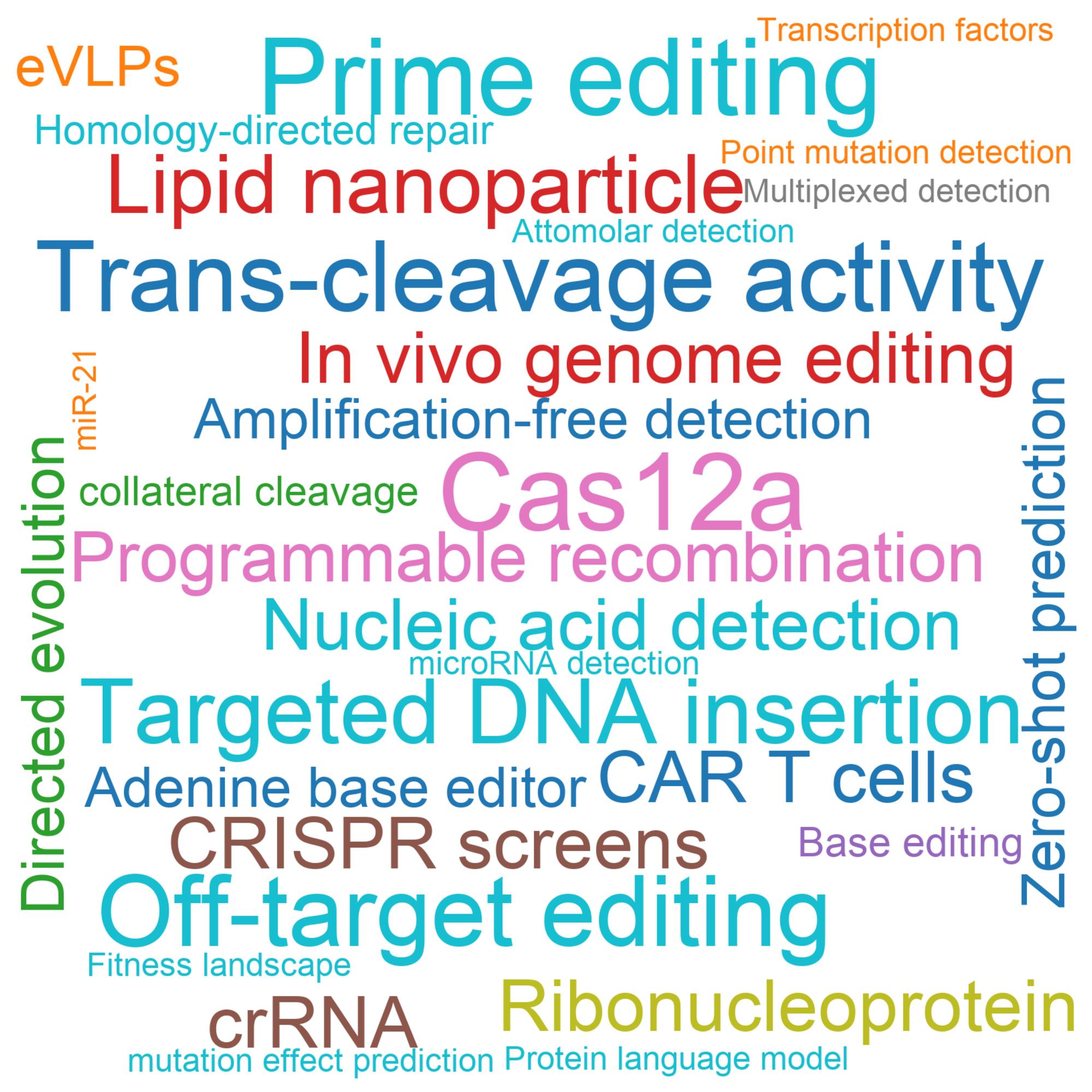
The 2024 CRISPR and Genetic Engineering cohort is characterized by a strong shift toward next-generation precision editing toolkits and translational delivery mechanisms. Next-generation enzymes and precision platforms lead the field, with Cas12a and prime editing emerging as the most frequent specific themes (each appearing in 16% of top-ranked publications). Rather than simple double-strand break induction, research heavily emphasizes precise sequence rewriting and safety, reflected in prominent mentions of off-target editing evaluation (14%) and targeted DNA insertion (12%). Simultaneously, diagnostic and delivery innovations feature prominently. Trans-cleavage activity (14%) and nucleic acid detection (8%) highlight the expanding diagnostic utility of CRISPR effectors. On the therapeutic front, lipid nanoparticle (LNP) delivery (10%) and ribonucleoprotein (RNP) formulations (8%) represent primary vehicles for in vivo genome editing (8%). Furthermore, cell therapy applications remain robust, driven by CAR T cell engineering (8%) and high-throughput CRISPR screening (8%). Overall, the Class of 2026 highlights a mature landscape where biochemical precision, non-viral delivery, and off-target mitigation drive high-impact research.
How Did Topics Shift from the Class of 2025 to the Class of 2026?
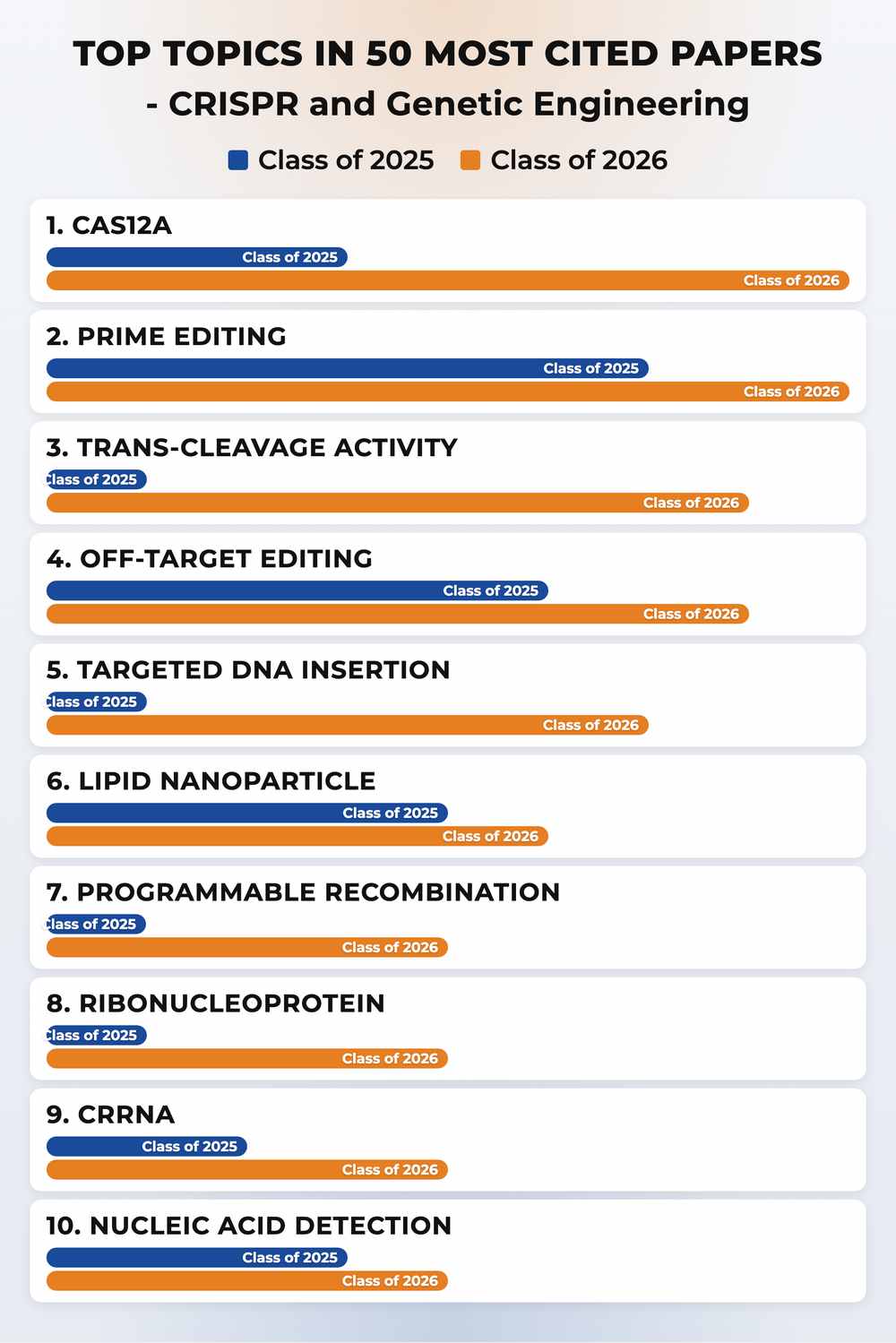
Comparing the Class of 2025 (2023 publications) to the Class of 2026 (2024 publications) reveals a clear pivot from early base editing modalities toward advanced spatial insertion, diagnostic trans-cleavage, and AI-guided design. Trans-cleavage activity witnessed the most dramatic growth, surging 7-fold from 2% to 14% of top publications as CRISPR-based diagnostic assays gained widespread adoption. Targeted DNA insertion also experienced a 6-fold rise (2% to 12%), reflecting increased momentum around large-payload gene integration without donor DNA or double-strand breaks. Cas12a variants expanded nearly 2.7-fold (6% to 16%), solidifying their role as preferred effectors for both diagnostics and editing. Furthermore, 2024 marked the rapid rise of AI-driven protein engineering and programmable recombination—such as zero-shot mutation prediction and bridge RNA recombinases—which entered the top-cited tier from zero previous representation. In contrast, early-generation base editing platforms experienced relative declines: general base editing dropped from 14% to 6%, and adenine base editors decreased from 10% to 6%. This shift underscores a broader reorientation toward larger, safer, and machine-learning-designed genomic modifications.
Methodology
PRI identifies high-impact research using a transparent, topic-agnostic framework applied consistently across scientific domains. Bibliographic records are drawn from OpenAlex, including publication dates, citation relationships, and document types.
This ranking covers the Class of 2026 cohort: journal articles published in 2024. Reviews and other non-article document types are excluded to ensure comparability.
Research impact is quantified with an 18-month post-publication citation window—the number of citing works published within 18 months of each paper's publication date. This metric captures early impact while controlling for publication age.
An LLM-based relevance classifier then reviews each candidate's title and abstract to confirm substantive alignment with the target domain. Only papers classified as relevant appear in the final ranking.
Zheng Su, Tinsley Li, Thematic Shifts in Early-High-Impact Cancer Genomics and Diagnostics Research: A Bibliometric and Semantic Analysis. bioRxiv 2026.07.04.736459; doi: https://doi.org/10.64898/2026.07.04.736459
Cite this ranking
Pepkio Research Index (PRI). Topics and Trends in Most Cited CRISPR and Genetic Engineering Papers, Class of 2026. https://pri.pepkio.com/top-papers/crispr-and-genetic-engineering/2026. Accessed 2026-10-16.

Methodology
Zheng Su, Tinsley Li, Thematic Shifts in Early-High-Impact Cancer Genomics and Diagnostics Research: A Bibliometric and Semantic Analysis. bioRxiv 2026.07.04.736459; doi: https://doi.org/10.64898/2026.07.04.736459