
What topics and trends defined most-cited Bacterial Genetics and Biotechnology research in the Class of 2026?
The Class of 2026 for Bacterial Genetics and Biotechnology is defined by advanced structural insights and defense mechanisms. Cryo-EM structure determination and horizontal gene transfer saw the largest growth, while studies focusing broadly on Pseudomonas aeruginosa and general E. coli characterization declined.
At a glance
- Field
- Bacterial Genetics and Biotechnology
- Cohort label
- Class of 2026 (2024 publications)
- Papers analyzed
- 2,919
- Papers ranked
- 20
- Top topics in ranked papers
- Bacterial anti-phage defense systems, Escherichia coli, Cryo-EM structure, Horizontal gene transfer
- Publication window
- Jan 1, 2024 – Dec 31, 2024
- Eligibility
- Research articles; reviews excluded
- Citation window
- 18 months post-publication
- 18m citation range
- 32–78
- Data source
- OpenAlex · Retrieved Jul 2026
- License
- CC BY 4.0
Rankings
20 papers ranked by 18-month citation count
In situ targeted base editing of bacteria in the mouse gut
Nature202410.1038/s41586-024-07681-w
Diverse anti-defence systems are encoded in the leading region of plasmids
Nature202410.1038/s41586-024-07994-w
Bacterial defense systems exhibit synergistic anti-phage activity
Cell Host & Microbe202410.1016/j.chom.2024.01.015
Hybracter: enabling scalable, automated, complete and accurate bacterial genome assemblies
Microbial Genomics202410.1099/mgen.0.001244
Strategies to overcome the challenges of low or no expression of heterologous proteins in Escherichia coli
Biotechnology Advances202410.1016/j.biotechadv.2024.108417
Establishing a synthetic orthogonal replication system enables accelerated evolution in <i>E. coli</i>
Science202410.1126/science.adk1281
Quinolone-mediated metabolic cross-feeding develops aluminium tolerance in soil microbial consortia
Nature Communications202410.1038/s41467-024-54616-0
Architecture and activation mechanism of the bacterial PARIS defence system
Nature202410.1038/s41586-024-07772-8
Phage Paride can kill dormant, antibiotic-tolerant cells of Pseudomonas aeruginosa by direct lytic replication
Nature Communications202410.1038/s41467-023-44157-3
Darwinian Evolution of Self-Replicating DNA in a Synthetic Protocell
Nature Communications202410.1038/s41467-024-53226-0
Revisiting the y-ome of <i>Escherichia coli</i>
Nucleic Acids Research202410.1093/nar/gkae857
Structure and mechanism of the Zorya anti-phage defence system
Nature202410.1038/s41586-024-08493-8
Strategies to enhance stress tolerance in lactic acid bacteria across diverse stress conditions
World Journal of Microbiology and Biotechnology202410.1007/s11274-024-03905-3
Phage-triggered reverse transcription assembles a toxic repetitive gene from a noncoding RNA
Science202410.1126/science.adq3977
PilY1 regulates the dynamic architecture of the type IV pilus machine in Pseudomonas aeruginosa
Nature Communications202410.1038/s41467-024-53638-y
Mechanism of bacterial predation via ixotrophy
Science202410.1126/science.adp0614
Tracking transcription–translation coupling in real time
Nature202410.1038/s41586-024-08308-w
Autologous DNA mobilization and multiplication expedite natural products discovery from bacteria
Science202410.1126/science.abq7333
Structural basis of directional switching by the bacterial flagellum
Nature Microbiology202410.1038/s41564-024-01630-z
Structure-guided discovery of ancestral CRISPR-Cas13 ribonucleases
Science202410.1126/science.adq0553
Topic trends
Dominant research themes and year-over-year shifts in Bacterial Genetics and Biotechnology
What Topics Define the Class of 2026?
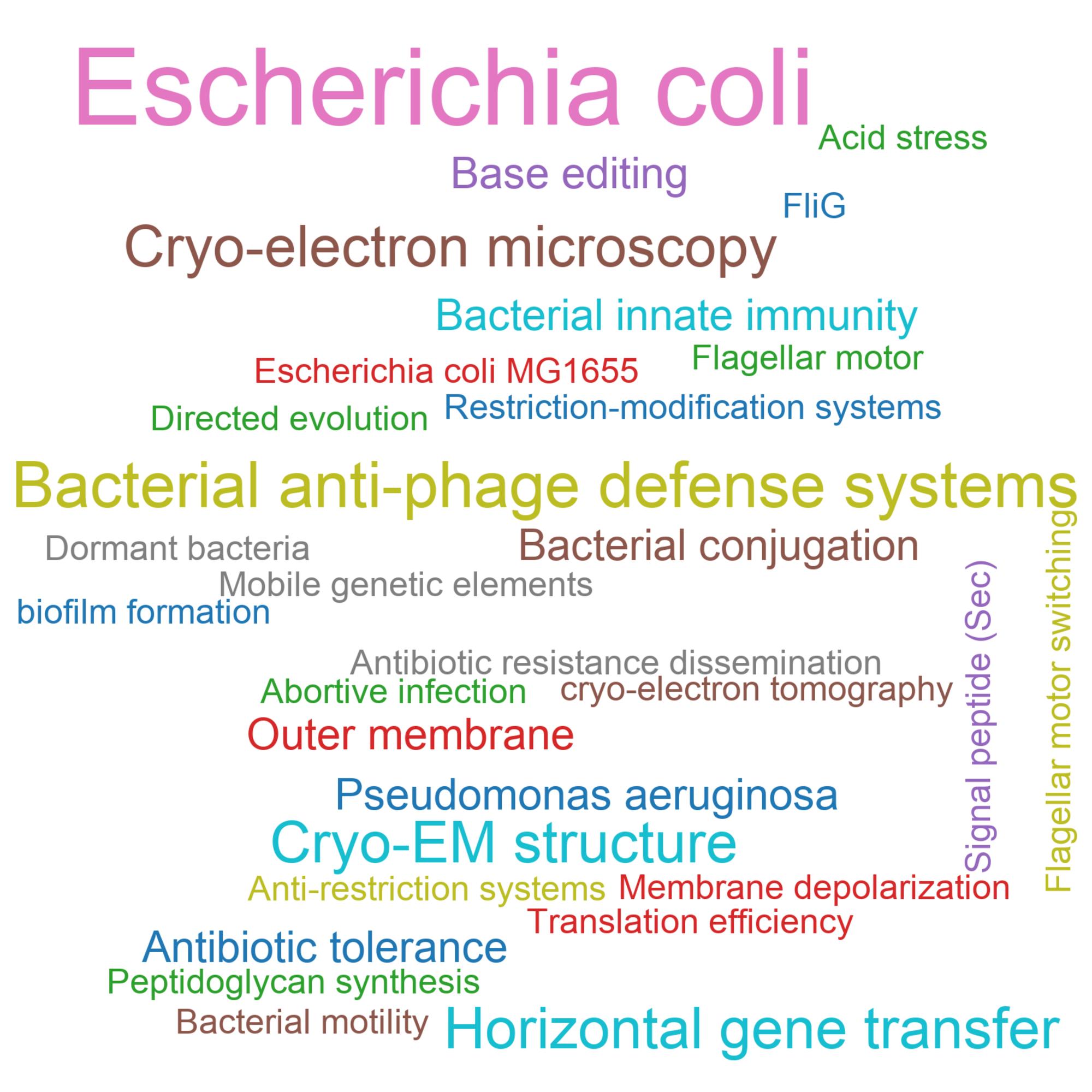
In the 2024 cohort for Bacterial Genetics and Biotechnology, the landscape is heavily influenced by deep structural and mechanistic analyses. The most prominent topics include bacterial anti-phage defense systems and Escherichia coli (both at 12% normalized frequency). The widespread application of advanced imaging is evident, with cryo-EM structure and cryo-electron microscopy each appearing in 10% of the highly cited papers. Horizontal gene transfer also features prominently at 10%. Additionally, the field demonstrates a strong focus on applied genetic engineering and cellular mechanics, as shown by the prevalence of base editing, bacterial innate immunity, bacterial conjugation, and studies on the outer membrane. This distribution indicates a mature field where foundational organisms like E. coli serve as models for high-resolution structural biology and the characterization of complex genetic mobility and defense networks.
How Did Topics Shift from the Class of 2025 to the Class of 2026?
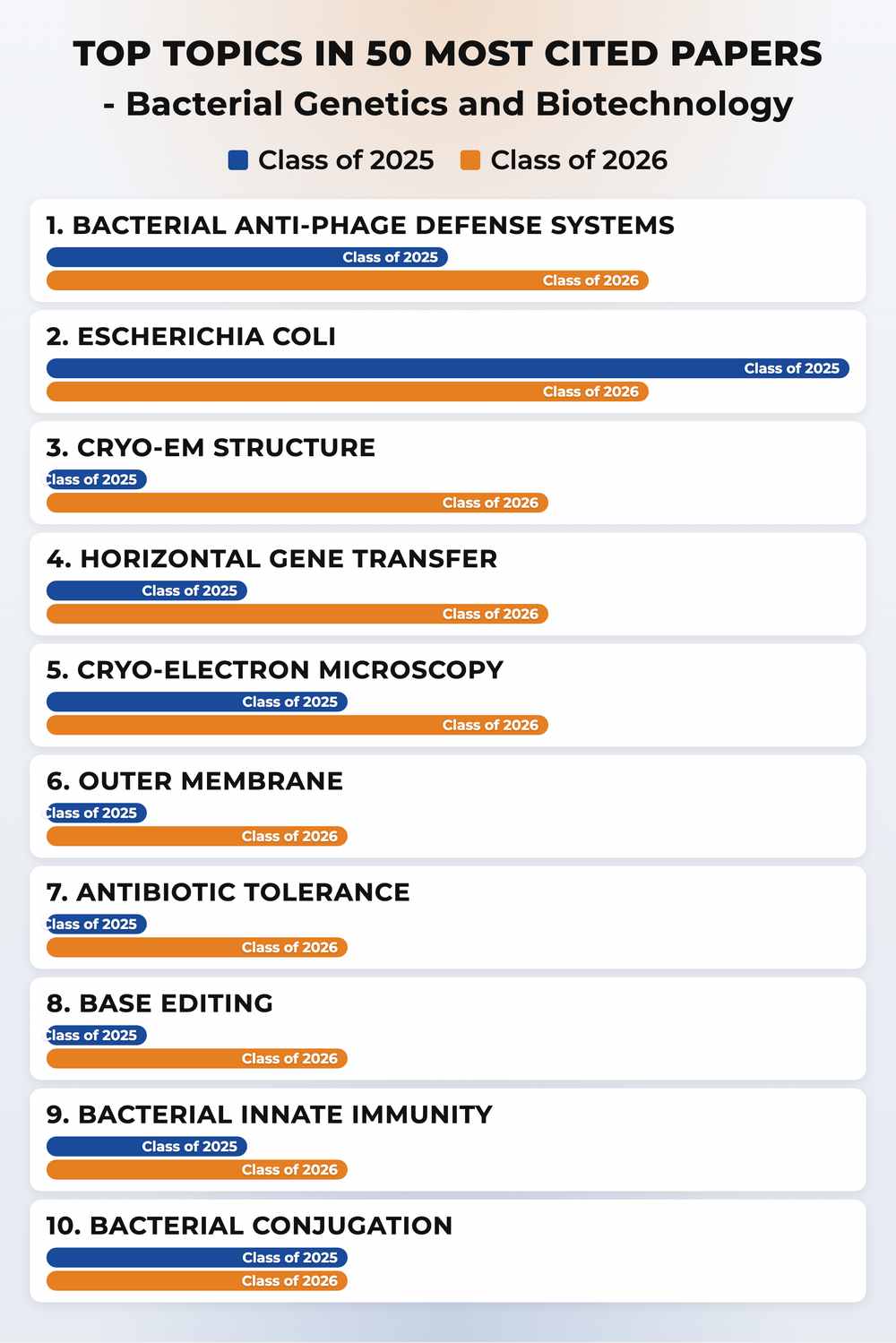
The transition from 2023 to 2024 reveals a distinct shift toward high-resolution structural analysis and specific molecular machinery. The largest absolute increases were seen in cryo-EM structure (rising by 0.08 in normalized frequency) and horizontal gene transfer (+0.06). We also observed a sudden emergence of research into the flagellar motor apparatus, with terms like C-ring (flagellar switch complex), flagellar motor, FliG, and FliM surging from near zero to significant presence. Conversely, broader organism-level studies experienced relative declines. Pseudomonas aeruginosa saw the steepest drop (-0.06), and general mentions of Escherichia coli decreased by 0.04, even as specific strains like E. coli MG1655 rose. Topics such as antimicrobial resistance and mobile genetic elements remained flat. This evolution suggests that the field is moving away from broad phenotypic characterization toward precise, structure-function elucidation of bacterial nanomachines and complex gene transfer events.
Methodology
PRI identifies high-impact research using a transparent, topic-agnostic framework applied consistently across scientific domains. Bibliographic records are drawn from OpenAlex, including publication dates, citation relationships, and document types.
This ranking covers the Class of 2026 cohort: journal articles published in 2024. Reviews and other non-article document types are excluded to ensure comparability.
Research impact is quantified with an 18-month post-publication citation window—the number of citing works published within 18 months of each paper's publication date. This metric captures early impact while controlling for publication age.
An LLM-based relevance classifier then reviews each candidate's title and abstract to confirm substantive alignment with the target domain. Only papers classified as relevant appear in the final ranking.
Zheng Su, Tinsley Li, Thematic Shifts in Early-High-Impact Cancer Genomics and Diagnostics Research: A Bibliometric and Semantic Analysis. bioRxiv 2026.07.04.736459; doi: https://doi.org/10.64898/2026.07.04.736459
Cite this ranking
Pepkio Research Index (PRI). Topics and Trends in Most Cited Bacterial Genetics and Biotechnology Papers, Class of 2026. https://pri.pepkio.com/top-papers/bacterial-genetics-and-biotechnology/2026. Accessed 2026-10-24.

Methodology
Zheng Su, Tinsley Li, Thematic Shifts in Early-High-Impact Cancer Genomics and Diagnostics Research: A Bibliometric and Semantic Analysis. bioRxiv 2026.07.04.736459; doi: https://doi.org/10.64898/2026.07.04.736459