
What topics and trends defined most-cited Salmonella and Campylobacter epidemiology research in the Class of 2026?
Salmonella and Campylobacter research in the Class of 2026 centers on antimicrobial resistance and serotype-specific surveillance, led by Salmonella Typhimurium and multidrug-resistant strains. Lytic phage therapeutics, Campylobacter jejuni, and One Health interventions emerged as rapidly expanding themes, while broad genomic profiling and legacy typing showed declining focus.
At a glance
- Field
- Salmonella and Campylobacter epidemiology
- Cohort label
- Class of 2026 (2024 publications)
- Papers analyzed
- 3,311
- Papers ranked
- 20
- Top topics in ranked papers
- Antimicrobial resistance, Salmonella Typhimurium, multidrug resistance, Salmonella Typhi, One Health
- Publication window
- Jan 1, 2024 – Dec 31, 2024
- Eligibility
- Research articles; reviews excluded
- Citation window
- 18 months post-publication
- 18m citation range
- 19–44
- Data source
- OpenAlex · Retrieved Jul 2026
- License
- CC BY 4.0
Rankings
20 papers ranked by 18-month citation count
Economic Burden of Foodborne Illnesses Acquired in the United States
Foodborne Pathogens and Disease202410.1089/fpd.2023.0157
Campylobacter jejuni-derived cytolethal distending toxin promotes colorectal cancer metastasis
Cell Host & Microbe202410.1016/j.chom.2024.11.006
Salmonella: Infection mechanism and control strategies
Microbiological Research202410.1016/j.micres.2024.128013
Reported Incidence of Infections Caused by Pathogens Transmitted Commonly Through Food: Impact of Increased Use of Culture-Independent Diagnostic Tests — Foodborne Diseases Active Surveillance Network, 1996–2023
MMWR Morbidity and Mortality Weekly Report202410.15585/mmwr.mm7326a1
Nationwide trends and features of human salmonellosis outbreaks in China
Emerging Microbes & Infections202410.1080/22221751.2024.2372364
Population structure and antibiotic resistance of swine extraintestinal pathogenic Escherichia coli from China
Nature Communications202410.1038/s41467-024-50268-2
Incidence of typhoid fever in Burkina Faso, Democratic Republic of the Congo, Ethiopia, Ghana, Madagascar, and Nigeria (the Severe Typhoid in Africa programme): a population-based study
The Lancet Global Health202410.1016/s2214-109x(24)00007-x
Interrogating Salmonella Typhi biofilm formation and dynamics to understand antimicrobial resistance
Life Sciences202410.1016/j.lfs.2024.122418
Machine learning to attribute the source of Campylobacter infections in the United States: A retrospective analysis of national surveillance data
Journal of Infection202410.1016/j.jinf.2024.106265
Global surveillance of antimicrobial resistance in food animals using priority drugs maps
Nature Communications202410.1038/s41467-024-45111-7
A One Health Perspective on <i>Salmonella</i> <i>enterica</i> Serovar Infantis, an Emerging Human Multidrug-Resistant Pathogen
Emerging infectious diseases202410.3201/eid3004.231031
Estimating the subnational prevalence of antimicrobial resistant Salmonella enterica serovars Typhi and Paratyphi A infections in 75 endemic countries, 1990–2019: a modelling study
The Lancet Global Health202410.1016/s2214-109x(23)00585-5
Centralized industrialization of pork in Europe and America contributes to the global spread of Salmonella enterica
Nature Food202410.1038/s43016-024-00968-1
Benchmarking short and long read polishing tools for nanopore assemblies: achieving near-perfect genomes for outbreak isolates
BMC Genomics202410.1186/s12864-024-10582-x
Luteolin exhibits antimicrobial actions against Salmonella Typhimurium and Escherichia coli: Impairment of cell adhesion, membrane integrity, and energy metabolism
Food Control202410.1016/j.foodcont.2024.110734
Commensal E. coli limits Salmonella gut invasion during inflammation by producing toxin-bound siderophores in a tonB-dependent manner
PLoS Biology202410.1371/journal.pbio.3002616
Salmonella Typhimurium screen identifies shifts in mixed-acid fermentation during gut colonization
Cell Host & Microbe202410.1016/j.chom.2024.08.015
A prophage competition element protects Salmonella from lysis
Cell Host & Microbe202410.1016/j.chom.2024.10.012
Characterization of a Salmonella enterica serovar Typhimurium lineage with rough colony morphology and multidrug resistance
Nature Communications202410.1038/s41467-024-50331-y
Gut metabolite L-lactate supports <i>Campylobacter jejuni</i> population expansion during acute infection
Proceedings of the National Academy of Sciences202410.1073/pnas.2316540120
Topic trends
Dominant research themes and year-over-year shifts in Salmonella and Campylobacter epidemiology
What Topics Define the Class of 2026?
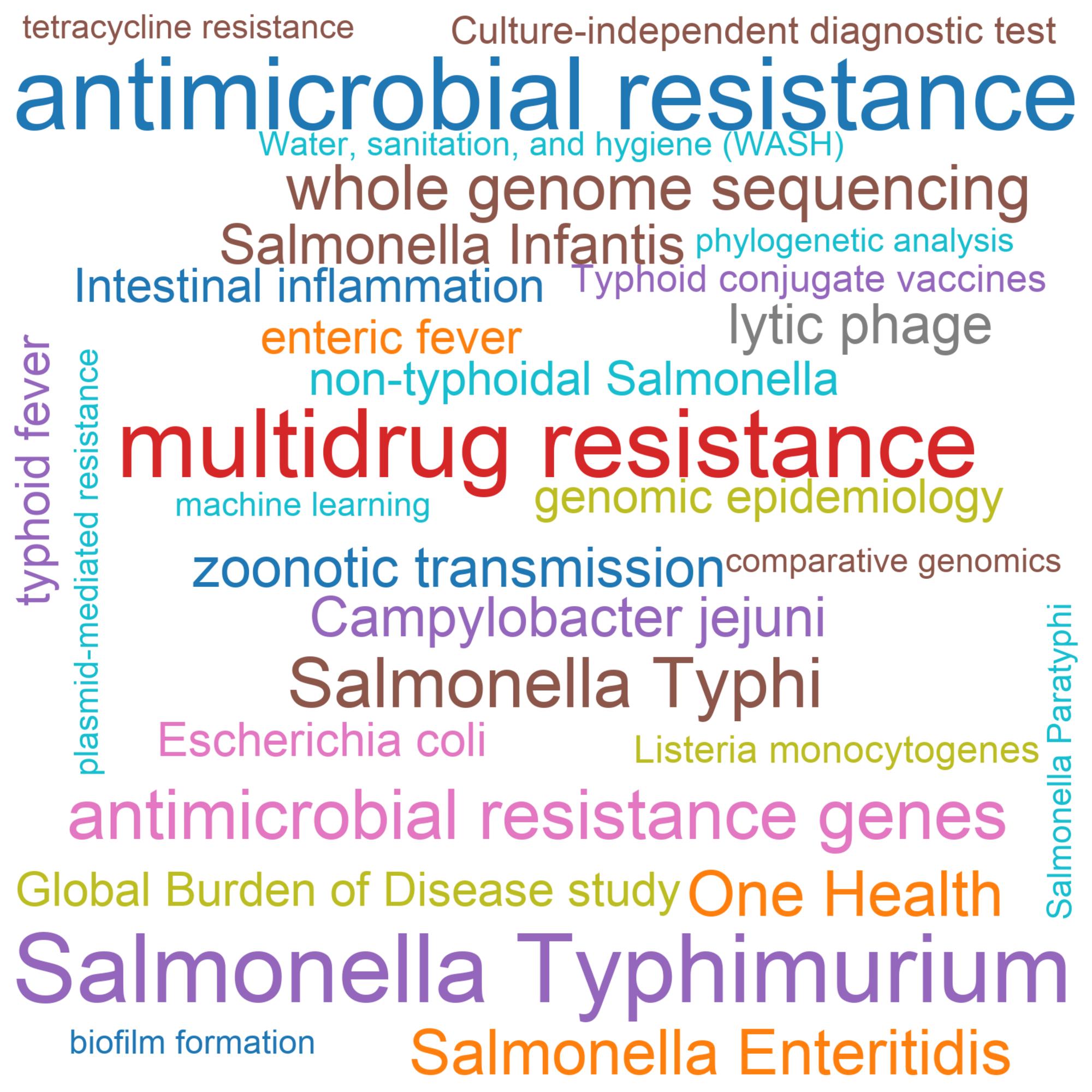
Research in the Class of 2026 is prominently anchored by antimicrobial resistance (0.24 normalized frequency) and multidrug resistance (0.22), reflecting an intense global focus on combating drug-resistant foodborne pathogens. Epidemiological characterization centers heavily on specific serotypes, led by Salmonella Typhimurium (0.22), Salmonella Typhi (0.12), and Salmonella Enteritidis (0.10). Genomic surveillance methods, particularly whole genome sequencing (0.10) and the detection of antimicrobial resistance genes (0.12), provide high-resolution insights into strain transmission and resistome evolution across food production chains. Concurrently, the One Health framework (0.10) serves as an overarching paradigm connecting human clinical isolates with animal reservoirs and agricultural environments. Additional key topics include zoonotic transmission dynamics and target pathogens such as Campylobacter jejuni (0.08) and Salmonella Infantis (0.08), alongside emerging investigative areas like lytic phage applications (0.08) and intestinal inflammation (0.06). Together, these themes demonstrate a shift from descriptive outbreak reports toward genomic-backed, interdisciplinary surveillance strategies aimed at controlling recalcitrant enteric pathogens across global food supply networks.
How Did Topics Shift from the Class of 2025 to the Class of 2026?
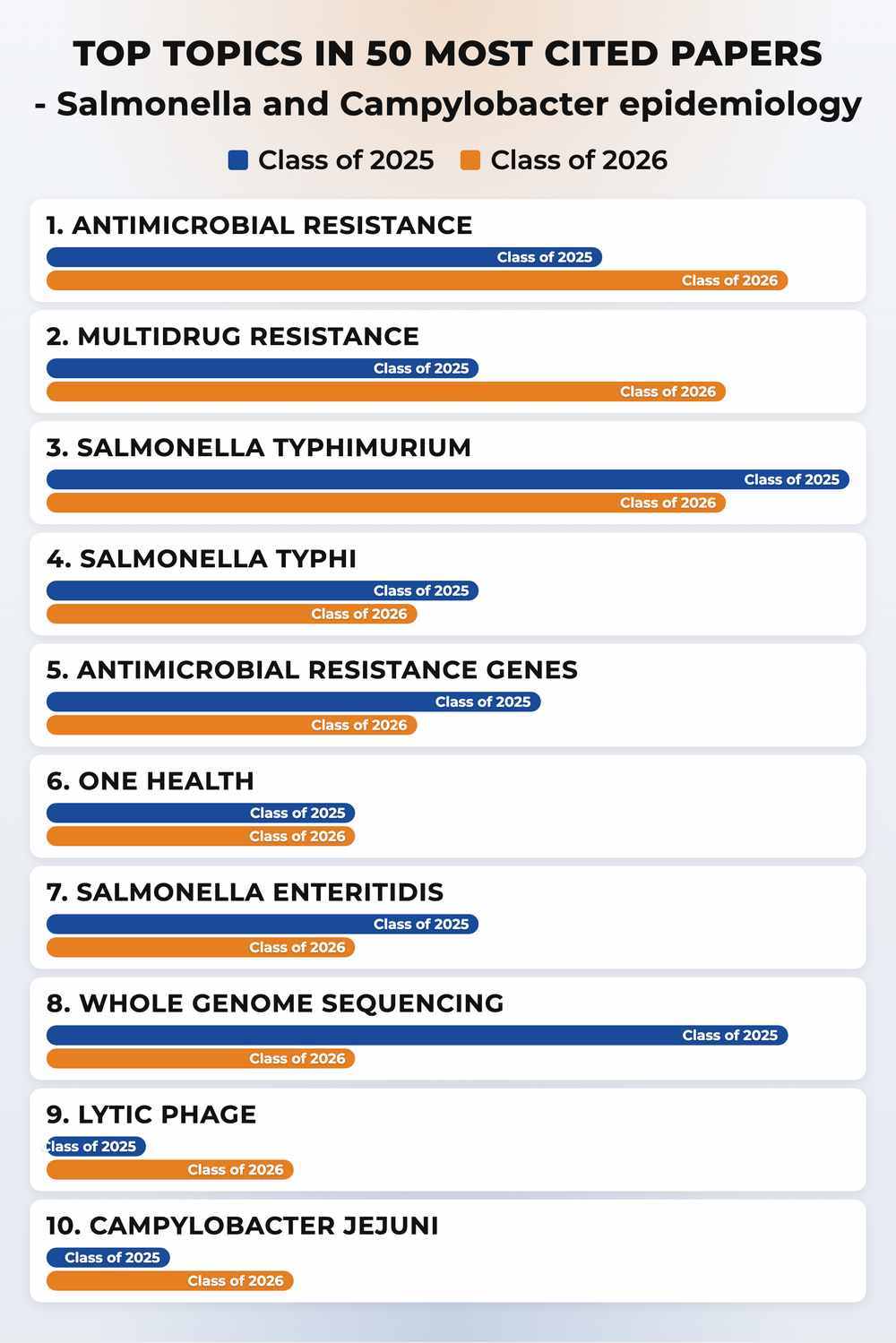
Comparison between the Class of 2025 and Class of 2026 reveals significant thematic repositioning in foodborne pathogen research. Antimicrobial resistance priorities intensified, with multidrug resistance rising from 0.14 to 0.22 normalized frequency (+57% relative increase) and general antimicrobial resistance expanding to 0.24. Novel therapeutic and biocontrol avenues surged, highlighted by lytic phage (0.08 frequency, up from 0) as researchers explore alternatives to traditional antibiotics. Additional expanding focus areas included Campylobacter jejuni, Salmonella Infantis, and zoonotic transmission, each doubling in normalized frequency from 0.04 to 0.08. Public health modeling also gained traction, evidenced by new appearances of the Global Burden of Disease study (0.06) and enteric fever (0.06). Conversely, whole genome sequencing saw a decline in explicit topic frequency from 0.24 to 0.10, indicating its transition from a novel standalone research topic into standard methodological infrastructure. Traditional focus areas like typhoid fever (0.10 to 0.06) and Salmonella Enteritidis (0.14 to 0.10) also moderated, reflecting a broader pivot toward multi-drug resistant serotypes and alternative antimicrobial strategies.
Methodology
PRI identifies high-impact research using a transparent, topic-agnostic framework applied consistently across scientific domains. Bibliographic records are drawn from OpenAlex, including publication dates, citation relationships, and document types.
This ranking covers the Class of 2026 cohort: journal articles published in 2024. Reviews and other non-article document types are excluded to ensure comparability.
Research impact is quantified with an 18-month post-publication citation window—the number of citing works published within 18 months of each paper's publication date. This metric captures early impact while controlling for publication age.
An LLM-based relevance classifier then reviews each candidate's title and abstract to confirm substantive alignment with the target domain. Only papers classified as relevant appear in the final ranking.
Zheng Su, Tinsley Li, Thematic Shifts in Early-High-Impact Cancer Genomics and Diagnostics Research: A Bibliometric and Semantic Analysis. bioRxiv 2026.07.04.736459; doi: https://doi.org/10.64898/2026.07.04.736459
Cite this ranking
Pepkio Research Index (PRI). Topics and Trends in Most Cited Salmonella and Campylobacter epidemiology Papers, Class of 2026. https://pri.pepkio.com/top-papers/salmonella-and-campylobacter-epidemiology/2026. Accessed 2026-10-21.

Methodology
Zheng Su, Tinsley Li, Thematic Shifts in Early-High-Impact Cancer Genomics and Diagnostics Research: A Bibliometric and Semantic Analysis. bioRxiv 2026.07.04.736459; doi: https://doi.org/10.64898/2026.07.04.736459