
What topics and trends defined most-cited Antibiotic Resistance in Bacteria research in the Class of 2026?
In 2024, research on antibiotic resistance was dominated by horizontal gene transfer, Klebsiella pneumoniae, and mobile genetic elements. A significant shift occurred towards studying Carbapenem-resistant Klebsiella pneumoniae and implementing antimicrobial stewardship, while focus on broad resistance mortality burdens saw a relative decline. New methodologies like metagenomic sequencing also emerged strongly.
At a glance
- Field
- Antibiotic Resistance in Bacteria
- Cohort label
- Class of 2026 (2024 publications)
- Papers analyzed
- 9,706
- Papers ranked
- 20
- Top topics in ranked papers
- Horizontal gene transfer, Klebsiella pneumoniae, Mobile genetic elements
- Publication window
- Jan 1, 2024 – Dec 31, 2024
- Eligibility
- Research articles; reviews excluded
- Citation window
- 18 months post-publication
- 18m citation range
- 56–2,321
- Data source
- OpenAlex · Retrieved July 2026
- License
- CC BY 4.0
Rankings
20 papers ranked by 18-month citation count
Global burden of bacterial antimicrobial resistance 1990–2021: a systematic analysis with forecasts to 2050
The Lancet202410.1016/s0140-6736(24)01867-1
Global trends in antibiotic consumption during 2016–2023 and future projections through 2030
Proceedings of the National Academy of Sciences202410.1073/pnas.2411919121
A novel antibiotic class targeting the lipopolysaccharide transporter
Nature202410.1038/s41586-023-06873-0
VFDB 2025: an integrated resource for exploring anti-virulence compounds
Nucleic Acids Research202410.1093/nar/gkae968
Antibiotic susceptibility testing using minimum inhibitory concentration (MIC) assays
npj Antimicrobials and Resistance202410.1038/s44259-024-00051-6
Global burden of antimicrobial resistance and forecasts to 2050
The Lancet202410.1016/s0140-6736(24)01885-3
Burden of bacterial antimicrobial resistance in low-income and middle-income countries avertible by existing interventions: an evidence review and modelling analysis
The Lancet202410.1016/s0140-6736(24)00862-6
Global antimicrobial resistance and use surveillance system (GLASS 2022): Investigating the relationship between antimicrobial resistance and antimicrobial consumption data across the participating countries
PLoS ONE202410.1371/journal.pone.0297921
A new antibiotic traps lipopolysaccharide in its intermembrane transporter
Nature202410.1038/s41586-023-06799-7
Aztreonam–avibactam versus meropenem for the treatment of serious infections caused by Gram-negative bacteria (REVISIT): a descriptive, multinational, open-label, phase 3, randomised trial
The Lancet Infectious Diseases202410.1016/s1473-3099(24)00499-7
Prophage-encoded antibiotic resistance genes are enriched in human-impacted environments
Nature Communications202410.1038/s41467-024-52450-y
Carbapenem-resistant Klebsiella pneumoniae capsular types, antibiotic resistance and virulence factors in China: a longitudinal, multi-centre study
Nature Microbiology202410.1038/s41564-024-01612-1
Evolution and host-specific adaptation of<i>Pseudomonas aeruginosa</i>
Science202410.1126/science.adi0908
Organic fertilization co-selects genetically linked antibiotic and metal(loid) resistance genes in global soil microbiome
Nature Communications202410.1038/s41467-024-49165-5
International and regional spread of carbapenem-resistant Klebsiella pneumoniae in Europe
Nature Communications202410.1038/s41467-024-49349-z
A Klebsiella-phage cocktail to broaden the host range and delay bacteriophage resistance both in vitro and in vivo
npj Biofilms and Microbiomes202410.1038/s41522-024-00603-8
Hypervirulent and carbapenem-resistant Klebsiella pneumoniae: A global public health threat
Microbiological Research202410.1016/j.micres.2024.127839
Profiles, drivers, and prioritization of antibiotics in China’s major rivers
Journal of Hazardous Materials202410.1016/j.jhazmat.2024.135399
Rifaximin prophylaxis causes resistance to the last-resort antibiotic daptomycin
Nature202410.1038/s41586-024-08095-4
The influence of efflux pump, outer membrane permeability and β-lactamase production on the resistance profile of multi, extensively and pandrug resistant Klebsiella pneumoniae
Journal of Infection and Public Health202410.1016/j.jiph.2024.102544
Topic trends
Dominant research themes and year-over-year shifts in Antibiotic Resistance in Bacteria
What Topics Define the Class of 2026?
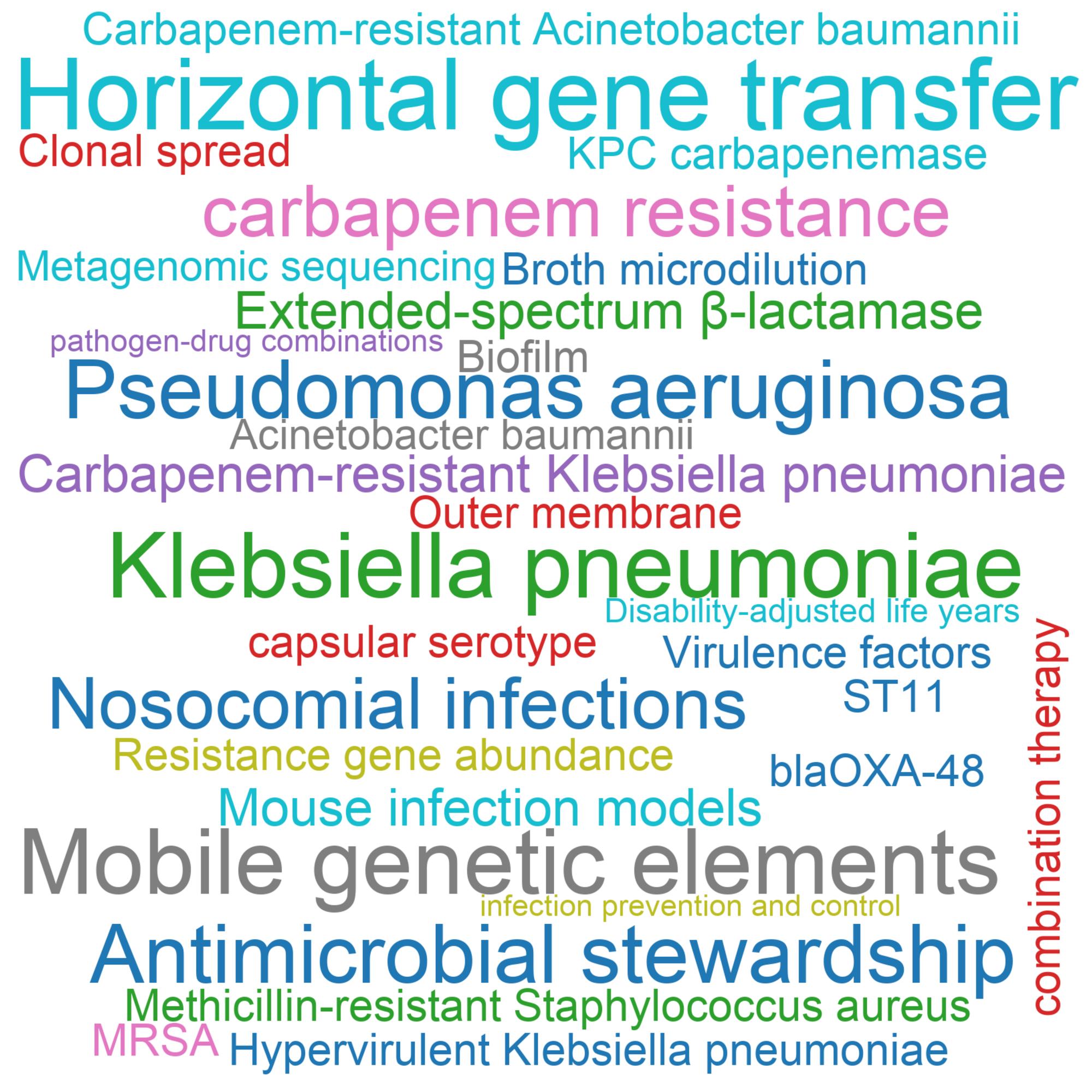
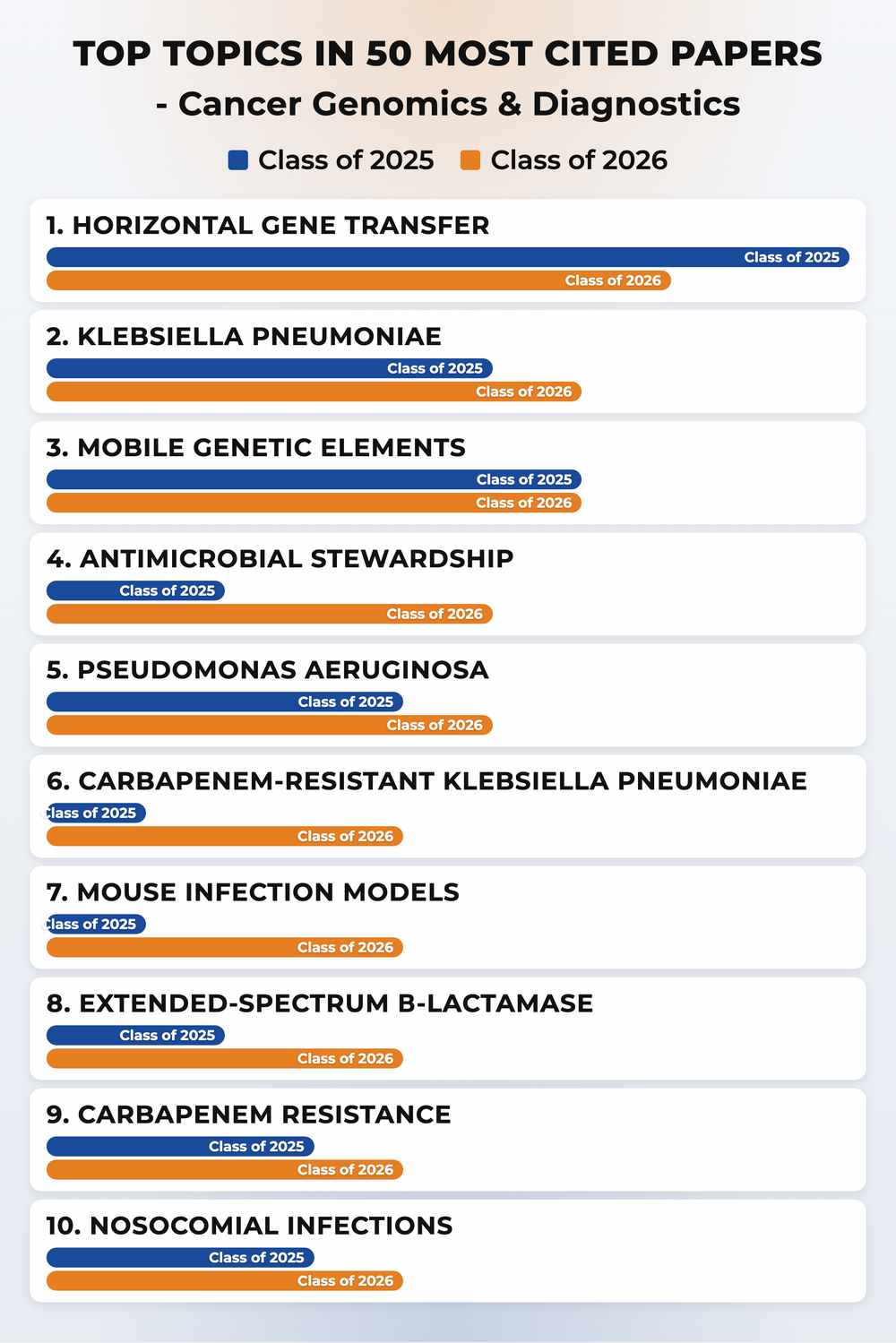
The research landscape for the Class of 2026 is fundamentally driven by the mechanistic spread and clinical impact of resistance. **Horizontal gene transfer** and **mobile genetic elements** form the core of the biological focus, highlighting how resistance traits disseminate across bacterial populations. Clinically, **Klebsiella pneumoniae** and **Pseudomonas aeruginosa** emerged as the most critical pathogens studied, reflecting their status as major threats in healthcare settings. Additionally, **antimicrobial stewardship** is a prominent theme, indicating a strong parallel emphasis on managing and optimizing existing antibiotic use to combat resistance. The intersection of these themes underscores a dual approach: understanding the genetic basis of resistance spread and implementing clinical strategies to mitigate it.
How Did Topics Shift from the Class of 2025 to the Class of 2026?
The transition to the Class of 2026 reveals a sharp pivot toward specific resistant phenotypes and advanced diagnostic methodologies. The most striking increase was seen in **Carbapenem-resistant Klebsiella pneumoniae**, which surged in prominence alongside related topics like **KPC carbapenemase** and the **ST11** clone. Methodologically, the use of **mouse infection models** and **metagenomic sequencing** saw significant growth, reflecting a move towards more complex in vivo studies and high-resolution genomic tracking. Conversely, broader topics such as the **antimicrobial resistance mortality burden** and specific pathogens like **Carbapenem-resistant Acinetobacter baumannii** experienced relative declines. This shift suggests a maturing field that is moving away from broad epidemiological sizing towards targeted mechanistic studies and precision interventions for high-priority resistant strains.
Methodology
PRI identifies high-impact research using a transparent, topic-agnostic framework applied consistently across scientific domains. Bibliographic records are drawn from OpenAlex, including publication dates, citation relationships, and document types.
This ranking covers the Class of 2026 cohort: journal articles published in 2024. Reviews and other non-article document types are excluded to ensure comparability.
Research impact is quantified with an 18-month post-publication citation window—the number of citing works published within 18 months of each paper's publication date. This metric captures early impact while controlling for publication age.
An LLM-based relevance classifier then reviews each candidate's title and abstract to confirm substantive alignment with the target domain. Only papers classified as relevant appear in the final ranking.
Zheng Su, Tinsley Li, Thematic Shifts in Early-High-Impact Cancer Genomics and Diagnostics Research: A Bibliometric and Semantic Analysis. bioRxiv 2026.07.04.736459; doi: https://doi.org/10.64898/2026.07.04.736459
Cite this ranking
Pepkio Research Index (PRI). Topics and Trends in Most Cited Antibiotic Resistance in Bacteria Papers, Class of 2026. https://pri.pepkio.com/top-papers/antibiotic-resistance-in-bacteria/2026. Accessed 2026-10-14.

Methodology
Zheng Su, Tinsley Li, Thematic Shifts in Early-High-Impact Cancer Genomics and Diagnostics Research: A Bibliometric and Semantic Analysis. bioRxiv 2026.07.04.736459; doi: https://doi.org/10.64898/2026.07.04.736459