
What topics and trends defined most-cited Antimicrobial Resistance in Staphylococcus research in the Class of 2026?
Staphylococcus resistance research in the Class of 2026 shifted decisively toward reserve antibiotic efficacy and phenotypic tolerance. Vancomycin saw a 7-fold rise alongside surges in dalbavancin, linezolid, and Pseudomonas aeruginosa co-infections, while novel topics like antibiotic tolerance emerged. Conversely, traditional biofilm eradication and mecA gene surveillance contracted.
At a glance
- Field
- Antimicrobial Resistance in Staphylococcus
- Cohort label
- Class of 2026 (2024 publications)
- Papers analyzed
- 4,139
- Papers ranked
- 20
- Top topics in ranked papers
- Vancomycin resistance, Pseudomonas aeruginosa co-infection, biofilm formation, antibiotic tolerance, dalbavancin
- Publication window
- Jan 1, 2024 – Dec 31, 2024
- Eligibility
- Research articles; reviews excluded
- Citation window
- 18 months post-publication
- 18m citation range
- 18–56
- Data source
- OpenAlex · Retrieved Jul 2026
- License
- CC BY 4.0
Rankings
20 papers ranked by 18-month citation count
Two codependent routes lead to high-level MRSA
Science202410.1126/science.adn1369
Restriction of arginine induces antibiotic tolerance in Staphylococcus aureus
Nature Communications202410.1038/s41467-024-51144-9
Development of Membrane-Targeting Fluorescent 2-Phenyl-1<i>H</i>-phenanthro[9,10-<i>d</i>]imidazole-Antimicrobial Peptide Mimic Conjugates against Methicillin-Resistant <i>Staphylococcus aureus</i>
Journal of Medicinal Chemistry202410.1021/acs.jmedchem.4c00436
Gallic acid exerts antibiofilm activity by inhibiting methicillin-resistant Staphylococcus aureus adhesion
Scientific Reports202410.1038/s41598-024-68279-w
<i>Bacillus subtilis</i> -derived peptides disrupt quorum sensing and biofilm assembly in multidrug-resistant <i>Staphylococcus aureus</i>
mSystems202410.1128/msystems.00712-24
Deep learning model for personalized prediction of positive MRSA culture using time-series electronic health records
Nature Communications202410.1038/s41467-024-46211-0
Resistance to linezolid in Staphylococcus aureus by mutation, modification, and acquisition of genes
The Journal of Antibiotics202410.1038/s41429-024-00778-4
Exploring essential oil-based bio-composites: molecular docking and in vitro analysis for oral bacterial biofilm inhibition
Frontiers in Chemistry202410.3389/fchem.2024.1383620
LysSYL: a broad-spectrum phage endolysin targeting Staphylococcus species and eradicating S. aureus biofilms
Microbial Cell Factories202410.1186/s12934-024-02359-4
Zoonotic linkage and environmental contamination of Methicillin-resistant Staphylococcus aureus (MRSA) in dairy farms: A one health perspective
One Health202410.1016/j.onehlt.2024.100680
Antimicrobial Sub-MIC induces Staphylococcus aureus biofilm formation without affecting the bacterial count
BMC Infectious Diseases202410.1186/s12879-024-09790-3
Biguanide-Vancomycin Conjugates are Effective Broad-Spectrum Antibiotics against Actively Growing and Biofilm-Associated Gram-Positive and Gram-Negative ESKAPE Pathogens and Mycobacteria
Journal of the American Chemical Society202410.1021/jacs.4c06520
β-Lactam Inoculum Effect in Methicillin-Susceptible <i>Staphylococcus aureus</i> Infective Endocarditis
JAMA Network Open202410.1001/jamanetworkopen.2024.51353
Genome-wide CRISPRi screens for high-throughput fitness quantification and identification of determinants for dalbavancin susceptibility in <i>Staphylococcus aureus</i>
mSystems202410.1128/msystems.01289-23
Antimicrobial Resistance Patterns of Outpatient <i>Staphylococcus aureus</i> Isolates
JAMA Network Open202410.1001/jamanetworkopen.2024.17199
Methicillin-resistant Staphylococcus spp. investigation in hospitalized horses and contacting personnel in a teaching veterinary hospital
Journal of Equine Veterinary Science202410.1016/j.jevs.2024.105031
Proton-coupled transport mechanism of the efflux pump NorA
Nature Communications202410.1038/s41467-024-48759-3
Socioeconomic Disparities and the Prevalence of Antimicrobial Resistance
Clinical Infectious Diseases202410.1093/cid/ciae313
Alarming multidrug resistance in Staphylococcus aureus isolated from raw milk of cows with subclinical mastitis: Antibiotic resistance patterns and occurrence of selected resistance genes
PLoS ONE202410.1371/journal.pone.0301200
Repurposing MALDI-TOF MS for effective antibiotic resistance screening in Staphylococcus epidermidis using machine learning
Scientific Reports202410.1038/s41598-024-75044-6
Topic trends
Dominant research themes and year-over-year shifts in Antimicrobial Resistance in Staphylococcus
What Topics Define the Class of 2026?
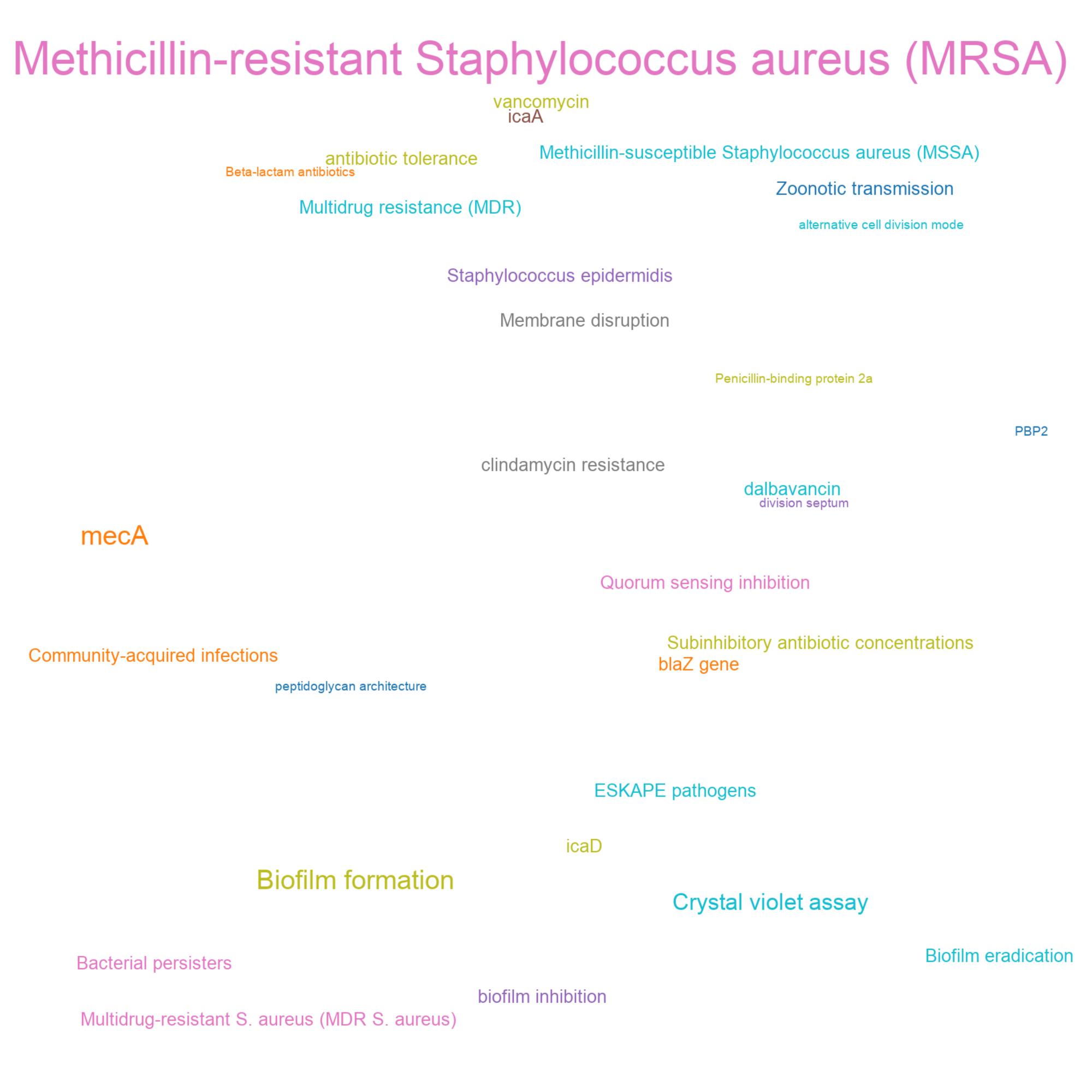
Research in the Class of 2026 for antimicrobial resistance in Staphylococcus is anchored by last-resort therapeutic options, biofilm mechanics, and polymicrobial interactions. Vancomycin emerges as the most prominent specific therapeutic topic, featured in 14% of highly cited literature, supported by increasing clinical attention to lipoglycopeptides and second-line salvage agents such as dalbavancin and linezolid. A major mechanistic domain is biofilm biology—encompassing biofilm formation (10%) and biofilm inhibition (6%)—which underlines the critical clinical challenge of chronic, implant-related, and device-associated staphylococcal recalcitrance. Parallelly, research prominently features Pseudomonas aeruginosa (10%), signaling an expanding investigative emphasis on polymicrobial co-infections and interspecies bacterial interactions within complex wound and pulmonary clinical settings. Furthermore, non-classical resistance phenotypes such as phenotypic antibiotic tolerance (8%) and non-Aureus coagulase-negative species like Staphylococcus epidermidis (6%) represent key active investigative fronts, demonstrating a broad systemic expansion beyond classical MRSA genotypic surveillance toward holistic infectious disease management, rapid diagnostics, and multi-targeted antimicrobial therapeutic interventions.
How Did Topics Shift from the Class of 2025 to the Class of 2026?
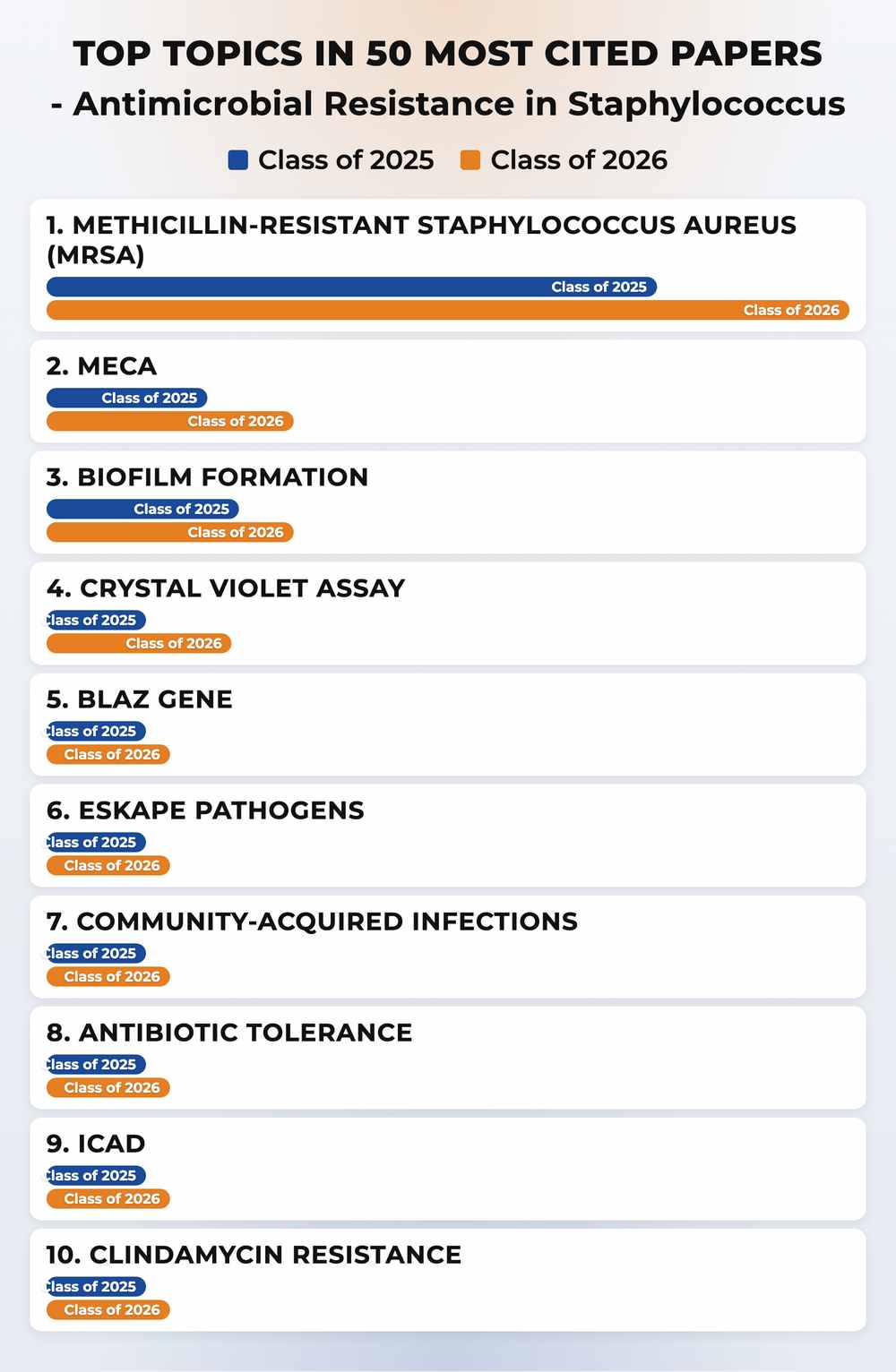
Comparing the Class of 2025 (2023 publications) to the Class of 2026 (2024 publications) reveals a clear pivot from traditional resistance gene surveillance toward reserve antibiotic clinical efficacy and phenotypic tolerance mechanisms. Vancomycin experienced a dramatic 7-fold increase in prevalence, rising from 1 paper (2%) to 7 papers (14%) among top-cited literature, accompanied by solid gains for reserve antimicrobials dalbavancin and linezolid (both rising from 1 to 4 papers). Phenotypic recalcitrance emerged as a primary focus, with antibiotic tolerance showing the largest surge from zero baseline mentions in 2023 to 8% normalized frequency in 2024, alongside new appearances for small colony variants, mobile genetic elements, and antibiofilm agents. In contrast, studies centered strictly on biofilm eradication experienced a 50% decline (dropping from 4 to 2 papers), while classical genetic markers like the mecA gene saw a slight contraction (4 to 3 papers). This shift reflects a maturing field moving beyond basic genotypic identification toward combatting refractory clinical infections and preserving salvage therapeutic regimens.
Methodology
PRI identifies high-impact research using a transparent, topic-agnostic framework applied consistently across scientific domains. Bibliographic records are drawn from OpenAlex, including publication dates, citation relationships, and document types.
This ranking covers the Class of 2026 cohort: journal articles published in 2024. Reviews and other non-article document types are excluded to ensure comparability.
Research impact is quantified with an 18-month post-publication citation window—the number of citing works published within 18 months of each paper's publication date. This metric captures early impact while controlling for publication age.
An LLM-based relevance classifier then reviews each candidate's title and abstract to confirm substantive alignment with the target domain. Only papers classified as relevant appear in the final ranking.
Zheng Su, Tinsley Li, Thematic Shifts in Early-High-Impact Cancer Genomics and Diagnostics Research: A Bibliometric and Semantic Analysis. bioRxiv 2026.07.04.736459; doi: https://doi.org/10.64898/2026.07.04.736459
Cite this ranking
Pepkio Research Index (PRI). Topics and Trends in Most Cited Antimicrobial Resistance in Staphylococcus Papers, Class of 2026. https://pri.pepkio.com/top-papers/antimicrobial-resistance-in-staphylococcus/2026. Accessed 2026-10-16.

Methodology
Zheng Su, Tinsley Li, Thematic Shifts in Early-High-Impact Cancer Genomics and Diagnostics Research: A Bibliometric and Semantic Analysis. bioRxiv 2026.07.04.736459; doi: https://doi.org/10.64898/2026.07.04.736459