
What topics and trends defined most-cited Microbial Community Ecology and Physiology research in the Class of 2026?
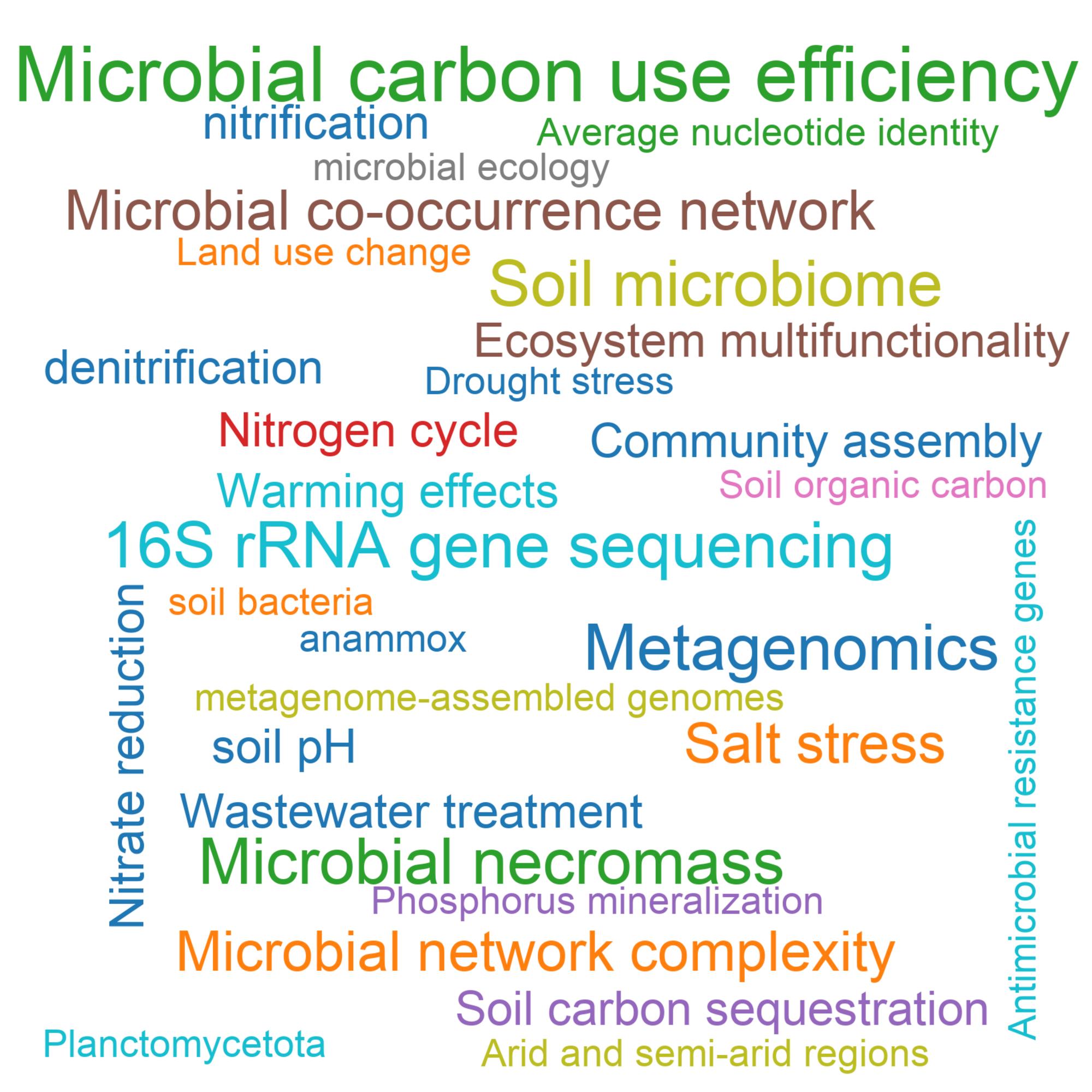
Microbial carbon use efficiency dominates the 2026 cohort, driven by a growing focus on mechanistic soil ecology. High-throughput tools like metagenomics and 16S sequencing remain foundational, while specialized topics like network complexity and salt stress showed the largest year-over-year gains in citation share.
At a glance
- Field
- Microbial Community Ecology and Physiology
- Cohort label
- Class of 2026 (2024 publications)
- Papers analyzed
- 8739
- Papers ranked
- 20
- Top topics in ranked papers
- Microbial carbon use efficiency, 16S rRNA gene sequencing, Metagenomics, Microbial necromass
- Publication window
- Jan 1, 2024 – Dec 31, 2024
- Eligibility
- Research articles; reviews excluded
- Citation window
- 18 months post-publication
- 18m citation range
- 78–203
- Data source
- OpenAlex · Retrieved July 2026
- License
- CC BY 4.0
Rankings
20 papers ranked by 18-month citation count
EzBioCloud: a genome-driven database and platform for microbiome identification and discovery
INTERNATIONAL JOURNAL OF SYSTEMATIC AND EVOLUTIONARY MICROBIOLOGY202410.1099/ijsem.0.006421
The nature of the last universal common ancestor and its impact on the early Earth system
Nature Ecology & Evolution202410.1038/s41559-024-02461-1
Soil microbiomes show consistent and predictable responses to extreme events
Nature202410.1038/s41586-024-08185-3
Nitrogen-fixing organelle in a marine alga
Science202410.1126/science.adk1075
The microbial carbon pump and climate change
Nature Reviews Microbiology202410.1038/s41579-024-01018-0
Global marine microbial diversity and its potential in bioprospecting
Nature202410.1038/s41586-024-07891-2
Land conversion to agriculture induces taxonomic homogenization of soil microbial communities globally
Nature Communications202410.1038/s41467-024-47348-8
Reducing the uncertainty in estimating soil microbial-derived carbon storage
Proceedings of the National Academy of Sciences202410.1073/pnas.2401916121
Environmental stress mediates groundwater microbial community assembly
Nature Microbiology202410.1038/s41564-023-01573-x
Global analysis of soil bacterial genera and diversity in response to pH
Soil Biology and Biochemistry202410.1016/j.soilbio.2024.109552
Unexplored microbial diversity from 2,500 food metagenomes and links with the human microbiome
Cell202410.1016/j.cell.2024.07.039
Microbial trait multifunctionality drives soil organic matter formation potential
Nature Communications202410.1038/s41467-024-53947-2
Water periods impact the structure and metabolic potential of the nitrogen-cycling microbial communities in rivers of arid and semi-arid regions
Water Research202410.1016/j.watres.2024.122472
Microbially mediated mechanisms underlie soil carbon accrual by conservation agriculture under decade-long warming
Nature Communications202410.1038/s41467-023-44647-4
Biochar and organic fertilizer applications enhance soil functional microbial abundance and agroecosystem multifunctionality
Biochar202410.1007/s42773-023-00296-w
Simplified microbial network reduced microbial structure stability and soil functionality in alpine grassland along a natural aridity gradient
Soil Biology and Biochemistry202410.1016/j.soilbio.2024.109366
Nutrient and moisture limitations reveal keystone metabolites linking rhizosphere metabolomes and microbiomes
Proceedings of the National Academy of Sciences202410.1073/pnas.2303439121
Achieving Stable Partial Denitrification by Selective Inhibition of Nitrite Reductase with the Biosafe Aprotic Solvent DMSO
Environmental Science & Technology202410.1021/acs.est.4c08731
Unlocking bacterial potential to reduce farmland N2O emissions
Nature202410.1038/s41586-024-07464-3
Insights into plant interactions and the biogeochemical role of the globally widespread Acidobacteriota phylum
Soil Biology and Biochemistry202410.1016/j.soilbio.2024.109369
Topic trends
Dominant research themes and year-over-year shifts in Microbial Community Ecology and Physiology
What Topics Define the Class of 2026?
The Class of 2026 is defined by a deep focus on microbial physiology in environmental contexts, with "Microbial carbon use efficiency" emerging as the most prominent informative concept. This highlights a shift from simply describing who is there to understanding how microbes process carbon and energy. Foundational profiling techniques—specifically "16S rRNA gene sequencing" and "Metagenomics"—remain central to the field, providing the necessary resolution to map community structures. Additionally, "Microbial necromass" and "Soil microbiome" feature heavily, indicating strong continued interest in carbon sequestration and soil health dynamics. Together, these themes reflect an ecology field increasingly focused on the mechanistic links between community composition and biogeochemical outcomes.
How Did Topics Shift from the Class of 2025 to the Class of 2026?
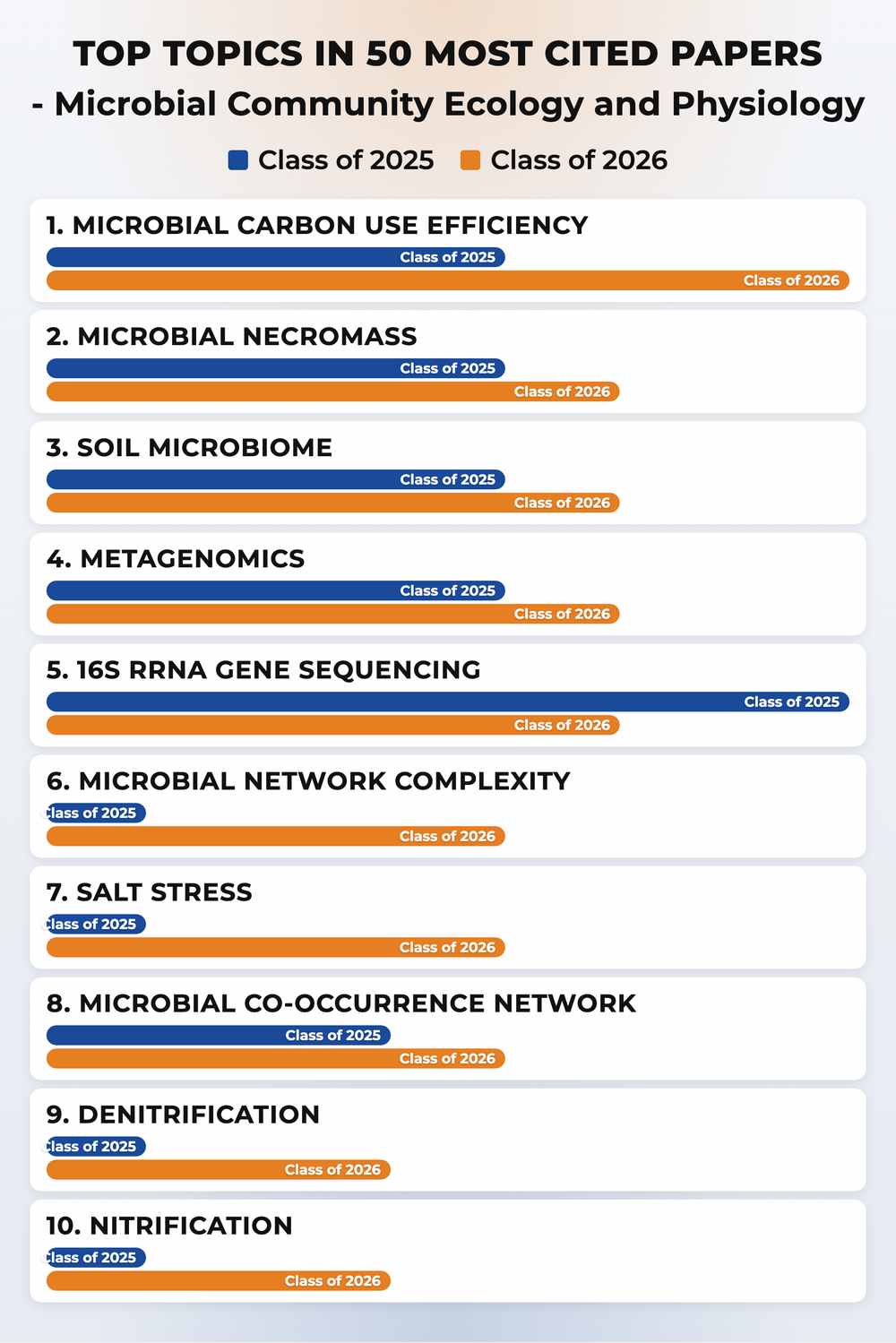
The transition to the Class of 2026 reveals a distinct pivot toward stress responses and complex interaction modeling. "Salt stress" and "Microbial network complexity" experienced dramatic surges, rising from negligible frequencies in the previous cohort to become major themes in 2026. This indicates a rapidly growing interest in how microbial networks adapt to environmental extremes. "Microbial carbon use efficiency" also saw a substantial increase, reinforcing its dominance as a core metabolic metric. Conversely, broader community descriptors like "Bacterial community" and "Community assembly" declined, suggesting that researchers are moving beyond general community characterization toward targeted investigations of specific stressors and intricate network dynamics.
Methodology
PRI identifies high-impact research using a transparent, topic-agnostic framework applied consistently across scientific domains. Bibliographic records are drawn from OpenAlex, including publication dates, citation relationships, and document types.
This ranking covers the Class of 2026 cohort: journal articles published in 2024. Reviews and other non-article document types are excluded to ensure comparability.
Research impact is quantified with an 18-month post-publication citation window—the number of citing works published within 18 months of each paper's publication date. This metric captures early impact while controlling for publication age.
An LLM-based relevance classifier then reviews each candidate's title and abstract to confirm substantive alignment with the target domain. Only papers classified as relevant appear in the final ranking.
Zheng Su, Tinsley Li, Thematic Shifts in Early-High-Impact Cancer Genomics and Diagnostics Research: A Bibliometric and Semantic Analysis. bioRxiv 2026.07.04.736459; doi: https://doi.org/10.64898/2026.07.04.736459
Cite this ranking
Pepkio Research Index (PRI). Topics and Trends in Most Cited Microbial Community Ecology and Physiology Papers, Class of 2026. https://pri.pepkio.com/top-papers/microbial-community-ecology-and-physiology/2026. Accessed 2026-10-16.

Methodology
Zheng Su, Tinsley Li, Thematic Shifts in Early-High-Impact Cancer Genomics and Diagnostics Research: A Bibliometric and Semantic Analysis. bioRxiv 2026.07.04.736459; doi: https://doi.org/10.64898/2026.07.04.736459