
What topics and trends defined most-cited Lipid Membrane Structure and Behavior research in the Class of 2026?
The Class of 2026 for Lipid Membrane Structure and Behavior is defined by a rapid pivot toward translational applications, particularly mRNA therapeutics. Lipid nanoparticles and ionizable lipids dominate the highly-cited landscape, with major growth in research optimizing endosomal release and transfection efficiency compared to previous years.
At a glance
- Field
- Lipid Membrane Structure and Behavior
- Cohort label
- Class of 2026 (2024 publications)
- Papers analyzed
- 4,164
- Papers ranked
- 20
- Top topics in ranked papers
- Lipid nanoparticles, Ionizable lipids, Messenger RNA delivery
- Publication window
- Jan 1, 2024 – Dec 31, 2024
- Eligibility
- Research articles; reviews excluded
- Citation window
- 18 months post-publication
- 18m citation range
- 41–119
- Data source
- OpenAlex · Retrieved June 2026
- License
- CC BY 4.0
Rankings
20 papers ranked by 18-month citation count
AGILE platform: a deep learning powered approach to accelerate LNP development for mRNA delivery
Nature Communications202410.1038/s41467-024-50619-z
Peptide-Functionalized Lipid Nanoparticles for Targeted Systemic mRNA Delivery to the Brain
Nano Letters202410.1021/acs.nanolett.4c05186
Charge-assisted stabilization of lipid nanoparticles enables inhaled mRNA delivery for mucosal vaccination
Nature Communications202410.1038/s41467-024-53914-x
Breaking the final barrier: Evolution of cationic and ionizable lipid structure in lipid nanoparticles to escape the endosome
Advanced Drug Delivery Reviews202410.1016/j.addr.2024.115446
A Foundation Model Identifies Broad-Spectrum Antimicrobial Peptides against Drug-Resistant Bacterial Infection
Nature Communications202410.1038/s41467-024-51933-2
Decreased lipidated ApoE-receptor interactions confer protection against pathogenicity of ApoE and its lipid cargoes in lysosomes
Cell202410.1016/j.cell.2024.10.027
Molecular architecture of coronavirus double-membrane vesicle pore complex
Nature202410.1038/s41586-024-07817-y
Biomolecular condensates mediate bending and scission of endosome membranes
Nature202410.1038/s41586-024-07990-0
Acid-degradable lipid nanoparticles enhance the delivery of mRNA
Nature Nanotechnology202410.1038/s41565-024-01765-4
Lipidome atlas of the adult human brain
Nature Communications202410.1038/s41467-024-48734-y
Regulation of cellular and systemic sphingolipid homeostasis
Nature Reviews Molecular Cell Biology202410.1038/s41580-024-00742-y
Liquid crystalline inverted lipid phases encapsulating siRNA enhance lipid nanoparticle mediated transfection
Nature Communications202410.1038/s41467-024-45666-5
Enhancing extracellular vesicle cargo loading and functional delivery by engineering protein-lipid interactions
Nature Communications202410.1038/s41467-024-49678-z
Lipid nanodisc scaffold and size alter the structure of a pentameric ligand-gated ion channel
Nature Communications202410.1038/s41467-023-44366-w
Lysosomal damage sensing and lysophagy initiation by SPG20-ITCH
Molecular Cell202410.1016/j.molcel.2024.02.029
Short-distance vesicle transport via phase separation
Cell202410.1016/j.cell.2024.03.003
Ion and lipid orchestration of secondary active transport
Nature202410.1038/s41586-024-07062-3
Homeocurvature adaptation of phospholipids to pressure in deep-sea invertebrates
Science202410.1126/science.adm7607
High-resolution electron cryomicroscopy of V-ATPase in native synaptic vesicles
Science202410.1126/science.adp5577
Sculpting conducting nanopore size and shape through de novo protein design
Science202410.1126/science.adn3796
Topic trends
Dominant research themes and year-over-year shifts in Lipid Membrane Structure and Behavior
What Topics Define the Class of 2026?
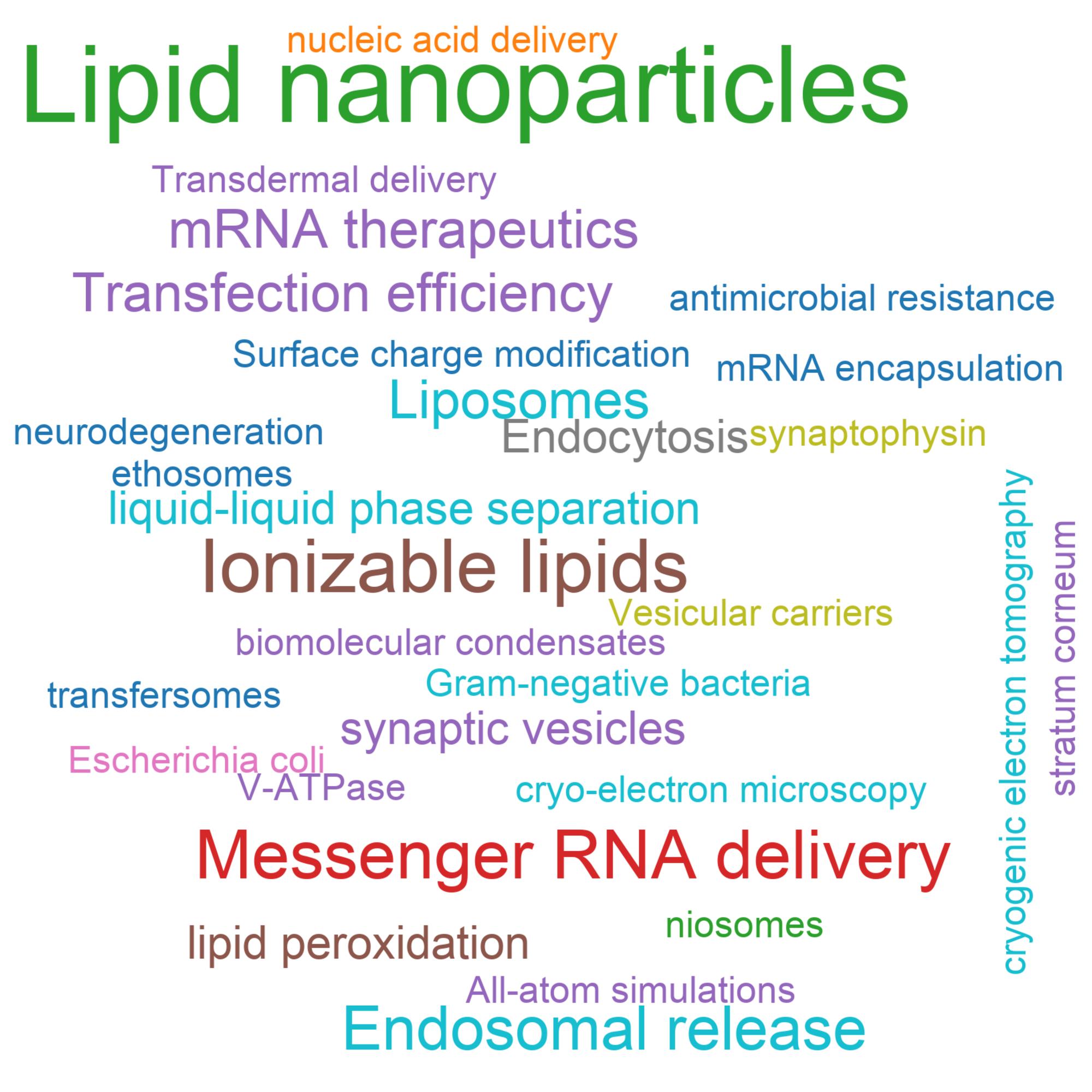
In the Class of 2026 for Lipid Membrane Structure and Behavior, the literature is heavily anchored by innovations in nucleic acid delivery systems. Dominating the landscape are "Lipid nanoparticles" and "Ionizable lipids," underscoring a pronounced shift toward therapeutic applications. We see significant focus on "Messenger RNA delivery" and "Endosomal release", highlighting the mechanistic challenges of translating lipid membrane biology into functional mRNA therapeutics. Rather than pure biophysics, the most cited papers are bridging structural lipid chemistry with transfection efficiency and clinical utility. Topics like liposomes and liquid-liquid phase separation remain visible, providing foundational context to these delivery mechanisms.
How Did Topics Shift from the Class of 2025 to the Class of 2026?
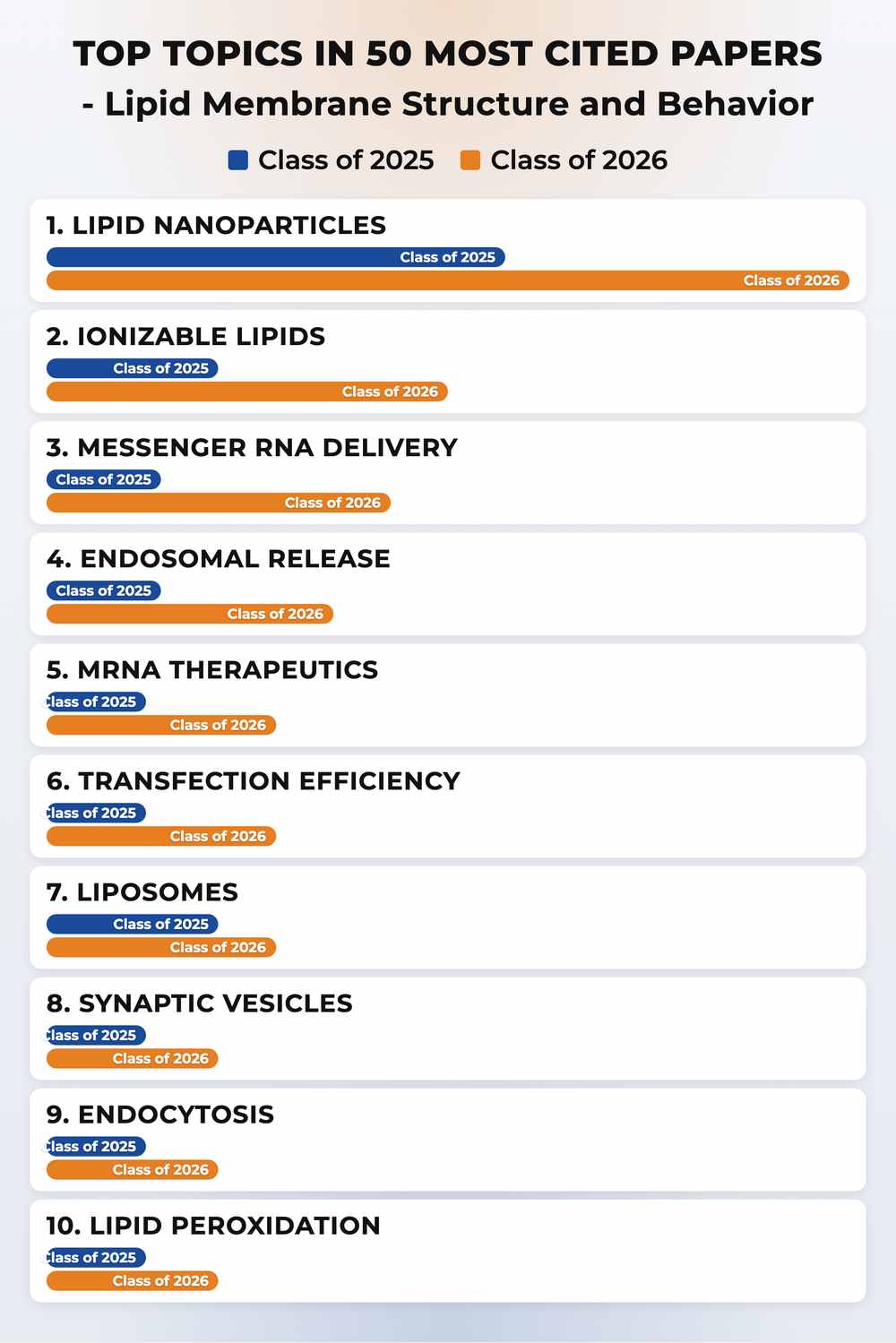
Comparing the Class of 2025 to 2026 reveals a dramatic acceleration in translation-focused research. The largest structural shifts center on "mRNA therapeutics" and "Transfection efficiency," both of which surged from negligible baseline prominence in this specific highly-cited cohort to major focal points. We also observe substantial momentum in "Ionizable lipids" and "Messenger RNA delivery," demonstrating that the field is rapidly advancing beyond basic structural characterization into optimizing lipid architectures for endosomal escape. Interestingly, more traditional topics like basic "Liposomes" showed only modest growth compared to the explosive rise of specialized lipid nanoparticles, indicating a targeted evolution in how researchers leverage membrane behavior for advanced drug delivery.
Methodology
PRI identifies high-impact research using a transparent, topic-agnostic framework applied consistently across scientific domains. Bibliographic records are drawn from OpenAlex, including publication dates, citation relationships, and document types.
This ranking covers the Class of 2026 cohort: journal articles published in 2024. Reviews and other non-article document types are excluded to ensure comparability.
Research impact is quantified with an 18-month post-publication citation window—the number of citing works published within 18 months of each paper's publication date. This metric captures early impact while controlling for publication age.
An LLM-based relevance classifier then reviews each candidate's title and abstract to confirm substantive alignment with the target domain. Only papers classified as relevant appear in the final ranking.
Zheng Su, Tinsley Li, Thematic Shifts in Early-High-Impact Cancer Genomics and Diagnostics Research: A Bibliometric and Semantic Analysis. bioRxiv 2026.07.04.736459; doi: https://doi.org/10.64898/2026.07.04.736459
Cite this ranking
Pepkio Research Index (PRI). Topics and Trends in Most Cited Lipid Membrane Structure and Behavior Papers, Class of 2026. https://pri.pepkio.com/top-papers/lipid-membrane-structure-and-behavior/2026. Accessed 2026-10-24.

Methodology
Zheng Su, Tinsley Li, Thematic Shifts in Early-High-Impact Cancer Genomics and Diagnostics Research: A Bibliometric and Semantic Analysis. bioRxiv 2026.07.04.736459; doi: https://doi.org/10.64898/2026.07.04.736459