
What topics and trends defined most-cited Food Quality and Safety Studies research in the Class of 2026?
Analytical chemistry techniques, particularly gas chromatography-mass spectrometry and metabolomics, dominate the Class of 2026. The field shows a marked shift toward advanced, data-driven methodologies, with liquid chromatography-mass spectrometry emerging as a significant rising topic, indicating a deeper focus on high-resolution food quality profiling.
At a glance
- Field
- Food Quality and Safety Studies
- Cohort label
- Class of 2026 (2024 publications)
- Papers analyzed
- 4964
- Papers ranked
- 20
- Top topics in ranked papers
- Volatile organic compounds, Gas chromatography-mass spectrometry, Metabolomics, Sensory evaluation
- Publication window
- Jan 1, 2024 – Dec 31, 2024
- Eligibility
- Research articles; reviews excluded
- Citation window
- 18 months post-publication
- 18m citation range
- 29–64
- Data source
- OpenAlex · Retrieved September 2026
- License
- CC BY 4.0
Rankings
20 papers ranked by 18-month citation count
Effect of inoculation with different Eurotium cristatum strains on the microbial communities and volatile organic compounds of Fu brick tea
Food Research International202410.1016/j.foodres.2024.115219
Physicochemical and Antimicrobial Properties of Lactic Acid-Based Natural Deep Eutectic Solvents as a Function of Water Content
Applied Sciences202410.3390/app142210409
Exploration of the impact of different drying methods on the quality of Gastrodia elata: A study based on drying kinetics and multidimensional quality evaluation
Food Chemistry202410.1016/j.foodchem.2024.141628
Exploring Core fermentation microorganisms, flavor compounds, and metabolic pathways in fermented Rice and wheat foods
Food Chemistry202410.1016/j.foodchem.2024.141019
Comparison of Gidyea gum, gum Arabic, and maltodextrin in the microencapsulation and colour stabilisation of anthocyanin-rich powders using freeze-drying and spray-drying techniques
Food Hydrocolloids202410.1016/j.foodhyd.2024.111023
Different effects of polyphenols on hydration, pasting and rheological properties of rice starch under extrusion condition: From the alterations in starch structure
Food Chemistry202410.1016/j.foodchem.2024.142002
Rapid and non-destructive identification of Panax ginseng origins using hyperspectral imaging, visible light imaging, and X-ray imaging combined with multi-source data fusion strategies
Food Research International202410.1016/j.foodres.2024.114758
Dynamic effects of ultrasonic treatment on flavor and metabolic pathway of pumpkin juice during storage based on GC–MS and GC-IMS
Food Chemistry202410.1016/j.foodchem.2024.142599
A comprehensive analysis of aroma quality and perception mechanism in ginger-infused stewed beef using instrumental analysis, sensory evaluation and molecular docking
Food Chemistry202410.1016/j.foodchem.2024.140435
Exploring the Biogenic Transformation Mechanism of Polyphenols by Lactobacillus plantarum NCU137 Fermentation and Its Enhancement of Antioxidant Properties in Wolfberry Juice
Journal of Agricultural and Food Chemistry202410.1021/acs.jafc.4c01393
The unique aroma of ripened Pu-erh tea, Liupao tea and Tietban tea: Associated post-fermentation condition and dominant microorganism with key aroma-active compound
Food Chemistry202410.1016/j.foodchem.2024.141788
Deep learning and feature reconstruction assisted vis-NIR calibration method for on-line monitoring of key growth indicators during kombucha production
Food Chemistry202410.1016/j.foodchem.2024.141411
The shaking and standing processing improve the aroma quality of summer black tea
Food Chemistry202410.1016/j.foodchem.2024.139772
Deciphering the effects of different types of high-temperature Daqu on the fermentation process and flavor profiles of sauce-flavor Baijiu
Food Bioscience202410.1016/j.fbio.2024.104917
Characterization of flavor and taste profile of different radish (Raphanus Sativus L.) varieties by headspace-gas chromatography-ion mobility spectrometry (GC/IMS) and E-nose/tongue
Food Chemistry X202410.1016/j.fochx.2024.101419
Effect of thermal pretreatment on quality of Camellia oleifera seed oil by wet extraction: Focusing on bioactive components, flavor and lipid composition
Food Chemistry202410.1016/j.foodchem.2024.142279
Effects of fermentation duration on the flavour quality of large leaf black tea based on metabolomics
Food Chemistry202410.1016/j.foodchem.2024.138680
Characteristic volatile compounds contributed to aroma of braised pork and their precursor sources
Food Chemistry202410.1016/j.foodchem.2024.140335
Key umami taste contributors in Longjing green tea uncovered by integrated means of sensory quantitative descriptive analysis, metabolomics, quantification analysis and taste addition experiments
Food Chemistry202410.1016/j.foodchem.2024.139628
Effects of solid-state fermentation with Aspergillus cristatus (MK346334) on the dynamics changes in the chemical and flavor profile of dark tea by HS-SPME-GC–MS, HS-GC-IMS and electronic nose
Food Chemistry202410.1016/j.foodchem.2024.139864
Topic trends
Dominant research themes and year-over-year shifts in Food Quality and Safety Studies
What Topics Define the Class of 2026?
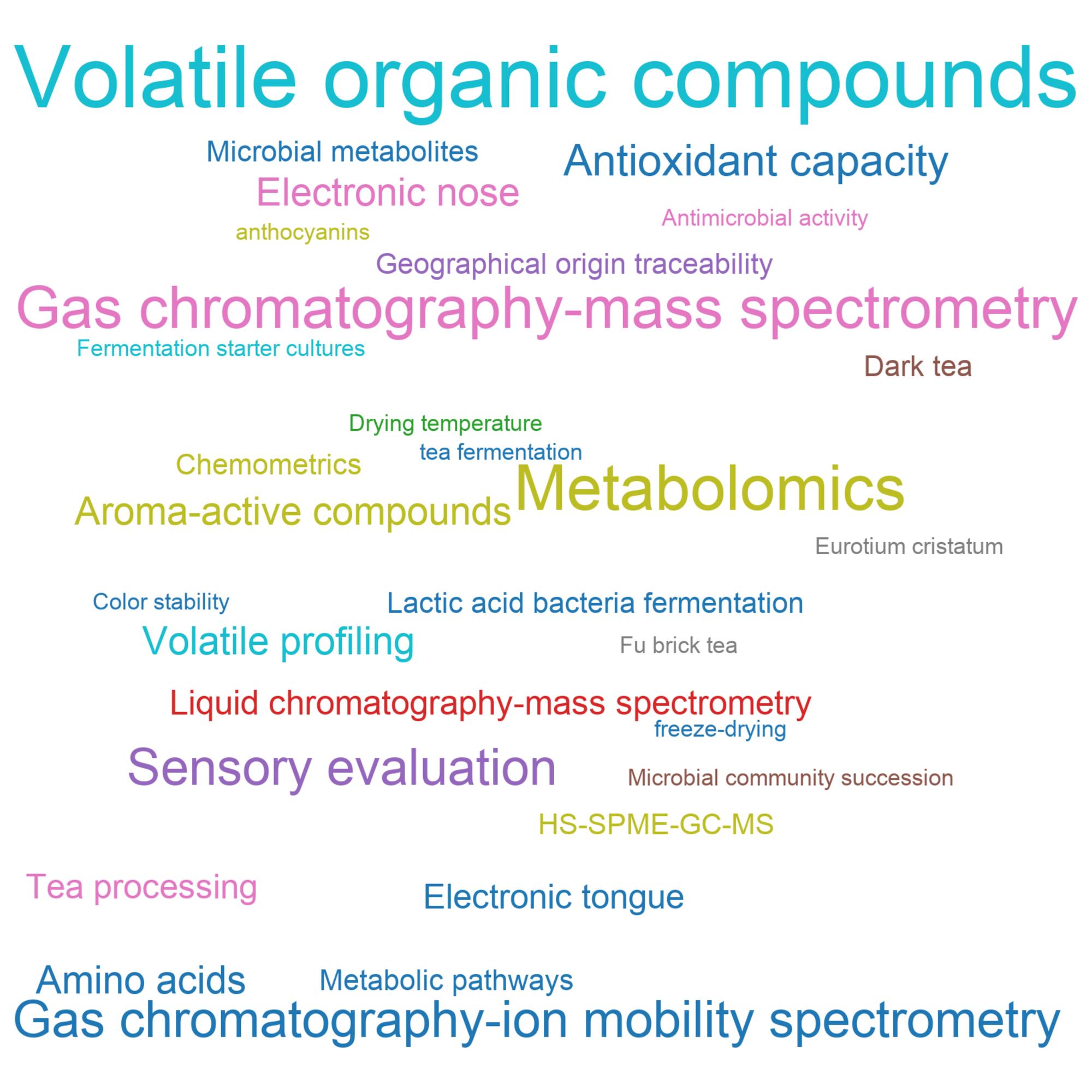
The word cloud highlights the prominence of analytical chemistry techniques and their application to food quality. 'Volatile organic compounds,' 'Gas chromatography-mass spectrometry,' and 'Metabolomics' dominate the landscape, reflecting a strong emphasis on characterizing food profiles at a molecular level. Complementing these analytical approaches are experiential topics like 'Sensory evaluation,' indicating a bridge between chemical composition and human perception. This focus underscores an industry-wide drive towards objective, data-driven food quality assessment.
How Did Topics Shift from the Class of 2025 to the Class of 2026?
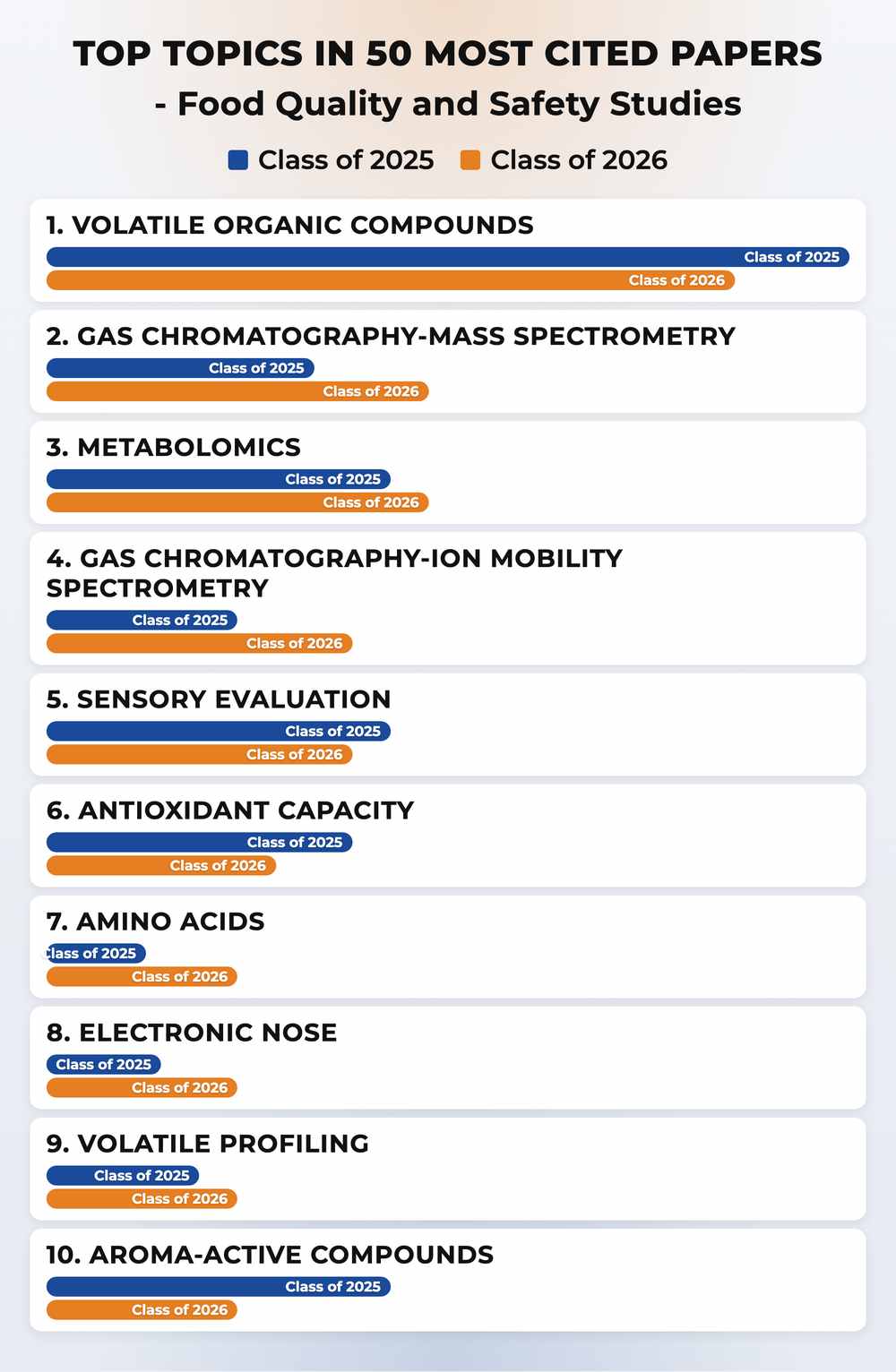
Comparing the Class of 2025 to 2026 reveals a distinct shift toward advanced analytical methodologies. The most significant risers include 'Liquid chromatography-mass spectrometry' and 'Chemometrics,' showing a growing reliance on complex data analysis and high-resolution techniques. Meanwhile, broader topics like 'Microbial community succession' saw slight declines. This evolution suggests that researchers are moving beyond basic profiling towards more targeted, sophisticated metabolomics to understand intricate food quality markers.
Methodology
PRI identifies high-impact research using a transparent, topic-agnostic framework applied consistently across scientific domains. Bibliographic records are drawn from OpenAlex, including publication dates, citation relationships, and document types.
This ranking covers the Class of 2026 cohort: journal articles published in 2024. Reviews and other non-article document types are excluded to ensure comparability.
Research impact is quantified with an 18-month post-publication citation window—the number of citing works published within 18 months of each paper's publication date. This metric captures early impact while controlling for publication age.
An LLM-based relevance classifier then reviews each candidate's title and abstract to confirm substantive alignment with the target domain. Only papers classified as relevant appear in the final ranking.
Zheng Su, Tinsley Li, Thematic Shifts in Early-High-Impact Cancer Genomics and Diagnostics Research: A Bibliometric and Semantic Analysis. bioRxiv 2026.07.04.736459; doi: https://doi.org/10.64898/2026.07.04.736459
Cite this ranking
Pepkio Research Index (PRI). Topics and Trends in Most Cited Food Quality and Safety Studies Papers, Class of 2026. https://pri.pepkio.com/top-papers/food-quality-and-safety-studies/2026. Accessed 2026-10-24.

Methodology
Zheng Su, Tinsley Li, Thematic Shifts in Early-High-Impact Cancer Genomics and Diagnostics Research: A Bibliometric and Semantic Analysis. bioRxiv 2026.07.04.736459; doi: https://doi.org/10.64898/2026.07.04.736459