
What topics and trends defined most-cited Insect Resistance and Genetics research in the Class of 2026?
Insect resistance research in 2024 is defined by a major shift toward RNA interference, double-stranded RNA delivery, and molecular docking. The field demonstrates significant cohort growth in dsRNA stability, foliar application, and resistance allele tracking, while broad cytochrome P450 enzyme profiling and single-species Spodoptera studies experienced relative declines.
At a glance
- Field
- Insect Resistance and Genetics
- Cohort label
- Class of 2026 (2024 publications)
- Papers analyzed
- 4,653
- Papers ranked
- 20
- Top topics in ranked papers
- RNA interference, Spodoptera frugiperda, Double-stranded RNA, Molecular docking, Pyrethroid resistance
- Publication window
- Jan 1, 2024 – Dec 31, 2024
- Eligibility
- Research articles; reviews excluded
- Citation window
- 18 months post-publication
- 18m citation range
- 23–40
- Data source
- OpenAlex · Retrieved Jul 2026
- License
- CC BY 4.0
Rankings
20 papers ranked by 18-month citation count
Challenges in current pest management practices: Navigating problems and a way forward by integrating controlled release system approach
Chemical Engineering Journal202410.1016/j.cej.2024.154989
Detoxification of phoxim by a gut bacterium of Delia antiqua
The Science of The Total Environment202410.1016/j.scitotenv.2024.173866
Thiadiazole/Thiadiazine Derivatives as Insecticidal Agent: Design, Synthesis, and Biological Assessment of 1,3,4-(Thiadiazine/Thiadiazole)-Benzenesulfonamide Derivatives as IGRs Analogues against <i>Spodoptera littoralis</i>
Journal of Agricultural and Food Chemistry202410.1021/acs.jafc.3c09703
Nanoparticle LDH enhances RNAi efficiency of dsRNA in piercing-sucking pests by promoting dsRNA stability and transport in plants
Journal of Nanobiotechnology202410.1186/s12951-024-02819-4
Synthesis, insecticidal Activity, and molecular docking analysis of some benzo[h]quinoline derivatives against Culex pipiens L. Larvae
Bioorganic Chemistry202410.1016/j.bioorg.2024.107591
Enhanced capacity of a leaf beetle to combat dual stress from entomopathogens and herbicides mediated by associated microbiota
Integrative Zoology202410.1111/1749-4877.12812
A single mutation G454A in the P450 <i>CYP9K1</i> drives pyrethroid resistance in the major malaria vector <i>Anopheles funestus</i> reducing bed net efficacy
Genetics202410.1093/genetics/iyae181
Population suppression by release of insects carrying a dominant sterile homing gene drive targeting doublesex in Drosophila
Nature Communications202410.1038/s41467-024-52473-5
GPCR–MAPK signaling pathways underpin fitness trade-offs in whitefly
Proceedings of the National Academy of Sciences202410.1073/pnas.2402407121
Discovery of Knock‐Down Resistance in the Major African Malaria Vector <i>Anopheles funestus</i>
Molecular Ecology202410.1111/mec.17542
Nanoparticle-delivered RNAi-based pesticide target screening for the rice pest white-backed planthopper and risk assessment for a natural predator
The Science of The Total Environment202410.1016/j.scitotenv.2024.171286
Mechanistic exploration of odorant binding protein-mediated chlorpyrifos resistance in Nilaparvata lugens: Insights from insecticide sequestration and transcriptional regulation
International Journal of Biological Macromolecules202410.1016/j.ijbiomac.2024.138108
Self-assembled co-delivery nanoplatform for increasing the broad-spectrum susceptibility of fall armyworm toward insecticides
Journal of Advanced Research202410.1016/j.jare.2024.01.031
Monitoring and Detection of Insecticide Resistance in Spodoptera frugiperda (Lepidoptera: Noctuidae): Evidence for Field-Evolved Resistance in Egypt
Insects202410.3390/insects15090705
Superior target genes and pathways for <scp>RNAi</scp>‐mediated pest control revealed by genome‐wide analysis in the beetle <scp><i>Tribolium castaneum</i></scp>
Pest Management Science202410.1002/ps.8505
UDP-glycosyltransferases act as key determinants of host plant range in generalist and specialist <i>Spodoptera</i> species
Proceedings of the National Academy of Sciences202410.1073/pnas.2402045121
Biocontrol effects of chemical molecules derived from Beauveria bassiana against larvae of Tuta absoluta (Meyrick) (Lepidoptera: Gelechiidae)
Frontiers in Microbiology202410.3389/fmicb.2024.1336334
CRISPR–Cas9-mediated construction of a cotton CDPK mutant library for identification of insect-resistance genes
Plant Communications202410.1016/j.xplc.2024.101047
Mismatch between lab-generated and field-evolved resistance to transgenic Bt crops in <i>Helicoverpa zea</i>
Proceedings of the National Academy of Sciences202410.1073/pnas.2416091121
Chlorantraniliprole Resistance in <i>Spodoptera frugiperda</i>: Resistance Monitoring, Resistance Risk, and Resistance Mechanisms
Journal of Agricultural and Food Chemistry202410.1021/acs.jafc.4c03361
Topic trends
Dominant research themes and year-over-year shifts in Insect Resistance and Genetics
What Topics Define the Class of 2026?
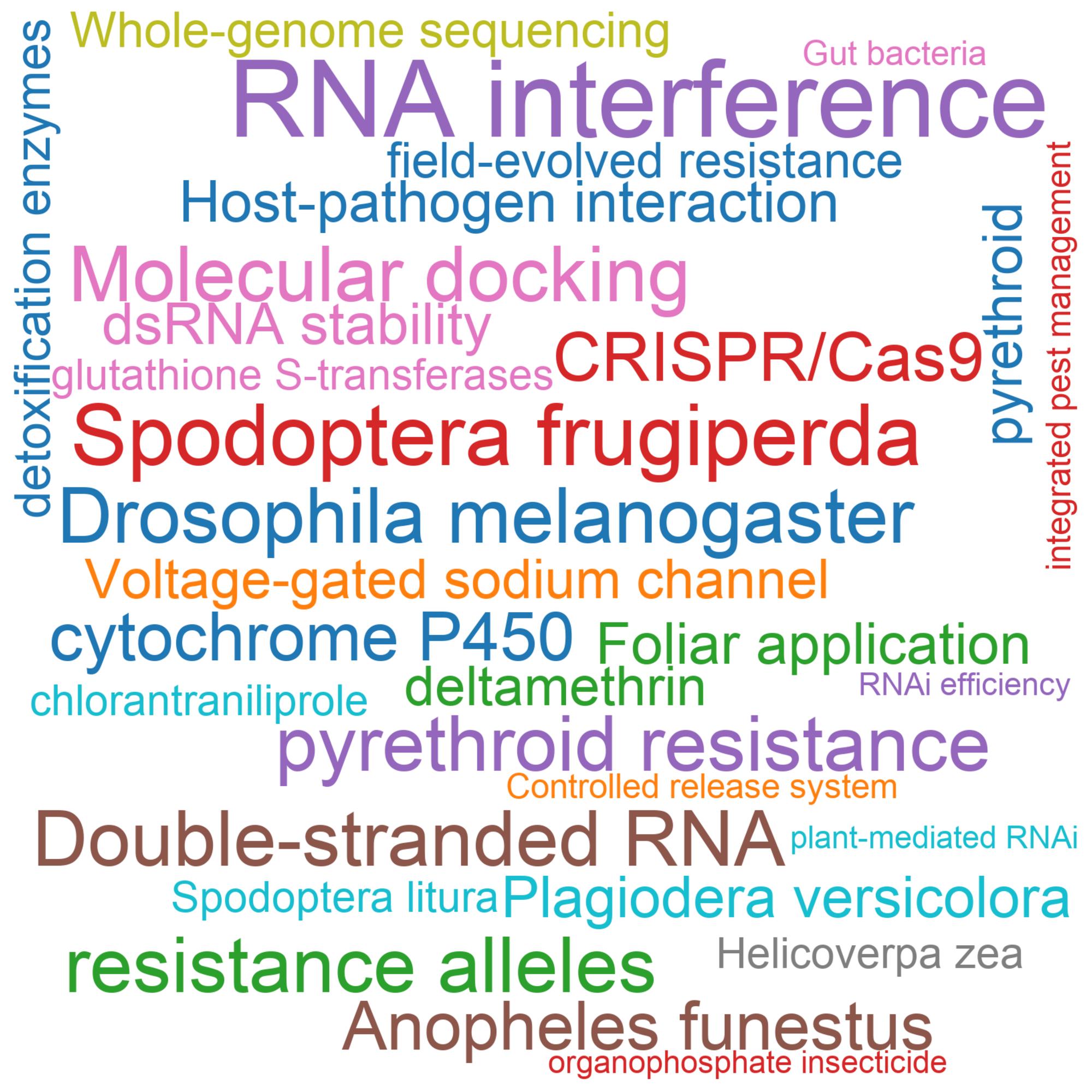
The 2024 publication cohort in insect resistance and genetics highlights a prominent structural shift toward precision molecular gene silencing and structural genomic characterization to mitigate pest management challenges. RNA interference (RNAi) leads the field as the single most prevalent technology, featured in 18% of highly cited studies, complemented by double-stranded RNA (dsRNA) delivery mechanisms (10% of top papers). This reflects intense research interest in developing targeted non-chemical bio-pesticides capable of selectively knocking down essential insect genes while minimizing off-target environmental toxicity. In parallel, functional genomic tools and structural modelling have gained widespread adoption. Molecular docking applications (10% of papers) and CRISPR/Cas9 genome editing (8%) are routinely deployed to elucidate binding affinities and validate target site insensitivity. Drosophila melanogaster serves as the principal genetic model organism (10%), enabling high-resolution mapping of resistance alleles and metabolic enzyme loci. Meanwhile, agricultural crop threats—most notably the fall armyworm Spodoptera frugiperda (12% of papers)—and malaria vectors such as Anopheles funestus (8%) remain primary empirical foci. Together, these methodologies demonstrate a field-wide emphasis on molecular biology and genomic mapping to unravel pyrethroid resistance mechanisms and extend target longevity.
How Did Topics Shift from the Class of 2025 to the Class of 2026?
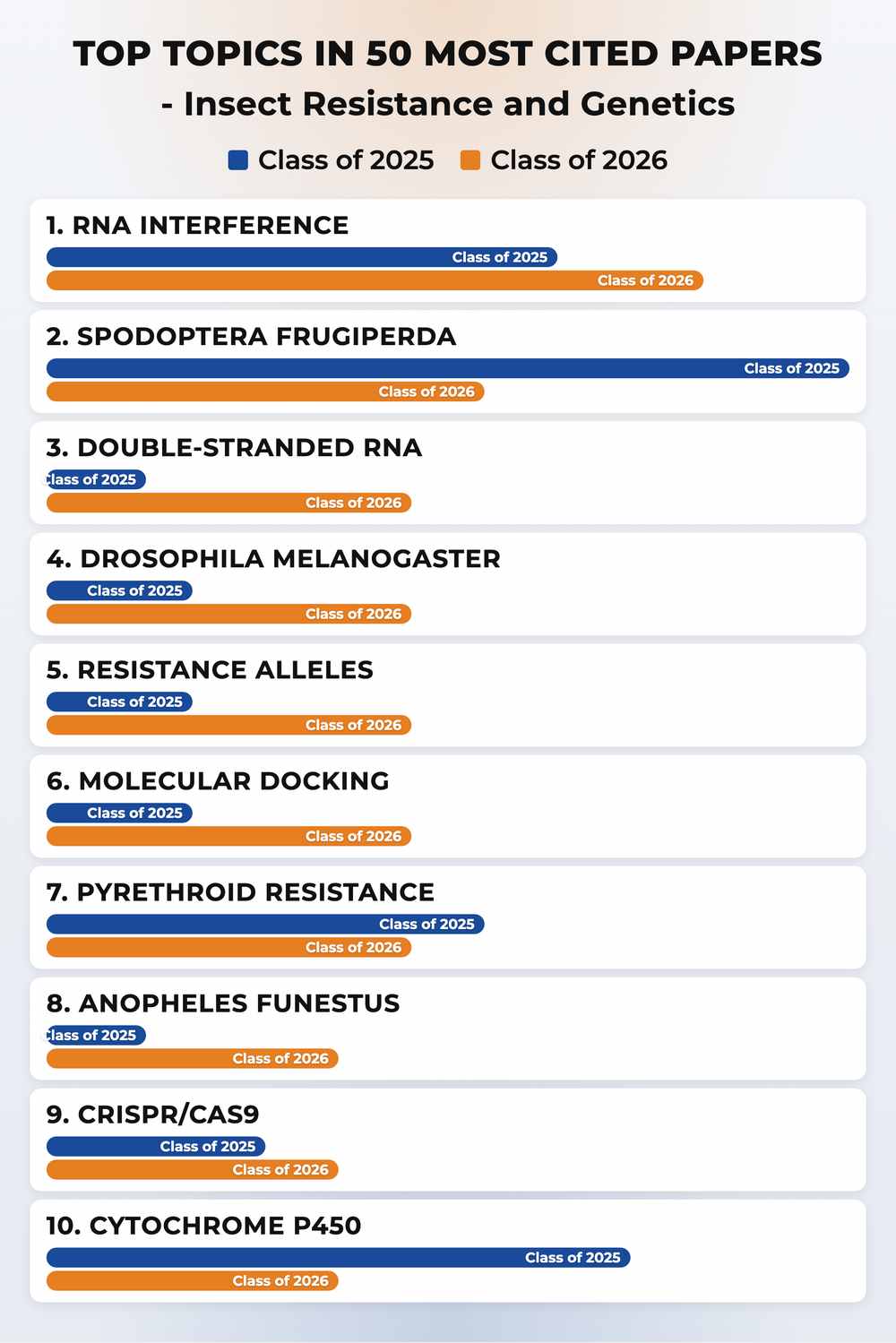
Comparing the Class of 2025 and Class of 2026 cohorts reveals a marked transition from descriptive enzyme profiling toward functional RNAi engineering, structural docking, and allele-level population genetics. The most substantial expansion occurred in double-stranded RNA technology, which surged from unranked status to 10% of top publications, alongside rising interest in dsRNA stability and foliar spray application methods. Simultaneously, computational structural screening via molecular docking and population-level detection of resistance alleles both grew from 4% to 10%, highlighting a shift toward predictive resistance monitoring and targeted ligand design. Conversely, traditional biochemical assays and broad pest surveys experienced notable relative declines. Studies focused on general cytochrome P450 monooxygenase activity fell from 16% to 8% of top literature, while broader detoxification enzyme profiling dropped from 12% to 6%. Additionally, single-species dominance moderated: publications centered on Spodoptera frugiperda dropped from 22% to 12%, and entomopathogenic fungal biocontrol decreased from 10% to 4%. Overall, the literature is pivoting away from legacy enzymatic toxicity screening in favor of advanced RNAi biopesticides, genomic allele tracking, and structure-guided target resistance analysis.
Methodology
PRI identifies high-impact research using a transparent, topic-agnostic framework applied consistently across scientific domains. Bibliographic records are drawn from OpenAlex, including publication dates, citation relationships, and document types.
This ranking covers the Class of 2026 cohort: journal articles published in 2024. Reviews and other non-article document types are excluded to ensure comparability.
Research impact is quantified with an 18-month post-publication citation window—the number of citing works published within 18 months of each paper's publication date. This metric captures early impact while controlling for publication age.
An LLM-based relevance classifier then reviews each candidate's title and abstract to confirm substantive alignment with the target domain. Only papers classified as relevant appear in the final ranking.
Zheng Su, Tinsley Li, Thematic Shifts in Early-High-Impact Cancer Genomics and Diagnostics Research: A Bibliometric and Semantic Analysis. bioRxiv 2026.07.04.736459; doi: https://doi.org/10.64898/2026.07.04.736459
Cite this ranking
Pepkio Research Index (PRI). Topics and Trends in Most Cited Insect Resistance and Genetics Papers, Class of 2026. https://pri.pepkio.com/top-papers/insect-resistance-and-genetics/2026. Accessed 2026-10-21.

Methodology
Zheng Su, Tinsley Li, Thematic Shifts in Early-High-Impact Cancer Genomics and Diagnostics Research: A Bibliometric and Semantic Analysis. bioRxiv 2026.07.04.736459; doi: https://doi.org/10.64898/2026.07.04.736459