
What topics and trends defined most-cited Horticultural and Viticultural Research research in the Class of 2026?
Anthocyanin biosynthesis, volatile organic compounds, transcriptional regulation, and hyperspectral imaging define the Class of 2026 horticultural cohort. Research shifted strongly toward MYB-bHLH transcriptional complexes, structural genomic variants, and non-destructive optical sensing, while traditional precision viticulture and empirical fermentation studies receded among top-cited papers.
At a glance
- Field
- Horticultural and Viticultural Research
- Cohort label
- Class of 2026 (2024 publications)
- Papers analyzed
- 5,847
- Papers ranked
- 20
- Top topics in ranked papers
- Anthocyanins, Volatile organic compounds, Transcriptional regulation, Structural variants, Vitis vinifera
- Publication window
- Jan 1, 2024 – Dec 31, 2024
- Eligibility
- Research articles; reviews excluded
- Citation window
- 18 months post-publication
- 18m citation range
- 26–86
- Data source
- OpenAlex · Retrieved Jul 2026
- License
- CC BY 4.0
Rankings
20 papers ranked by 18-month citation count
Grapevine pangenome facilitates trait genetics and genomic breeding
Nature Genetics202410.1038/s41588-024-01967-5
Advancements in deep learning for accurate classification of grape leaves and diagnosis of grape diseases
Journal of Plant Diseases and Protection202410.1007/s41348-024-00896-z
The transcription factors ERF105 and NAC72 regulate expression of a sugar transporter gene and hexose accumulation in grape
The Plant Cell202410.1093/plcell/koae326
Comparison of different computer vision methods for vineyard canopy detection using UAV multispectral images
Computers and Electronics in Agriculture202410.1016/j.compag.2024.109277
MdbHLH162 connects the gibberellin and jasmonic acid signals to regulate anthocyanin biosynthesis in apple
Journal of Integrative Plant Biology202410.1111/jipb.13608
The transcription factor VvMYB44-1 plays a role in reducing grapevine anthocyanin biosynthesis at high temperature
PLANT PHYSIOLOGY202410.1093/plphys/kiae657
VvFHY3 links auxin and endoplasmic reticulum stress to regulate grape anthocyanin biosynthesis at high temperatures
The Plant Cell202410.1093/plcell/koae303
A Comparative Analysis of XGBoost and Neural Network Models for Predicting Some Tomato Fruit Quality Traits from Environmental and Meteorological Data
Plants202410.3390/plants13050746
WRKY33 negatively regulates anthocyanin biosynthesis and cooperates with PHR1 to mediate acclimation to phosphate starvation
Plant Communications202410.1016/j.xplc.2024.100821
Characterization of differences in physicochemical properties, volatile organic compounds and non-volatile metabolites of prune wine by inoculation of different lactic acid bacteria during malolactic fermentation
Food Chemistry202410.1016/j.foodchem.2024.139616
Integrative genomics reveals the polygenic basis of seedlessness in grapevine
Current Biology202410.1016/j.cub.2024.07.022
Dynamic transformation in flavor during hawthorn wine fermentation: Sensory properties and profiles of nonvolatile and volatile aroma compounds coupled with multivariate analysis
Food Chemistry202410.1016/j.foodchem.2024.139982
Effect of sequential fermentation with indigenous non-Saccharomyces cerevisiae combinations and Saccharomyces cerevisiae on the chemical composition and aroma compounds evolution of kiwifruit wine
Food Chemistry202410.1016/j.foodchem.2024.140758
Climate change impact on Mediterranean viticultural regions and site-specific climate risk-reduction strategies
Mitigation and Adaptation Strategies for Global Change202410.1007/s11027-024-10146-0
Population comparative genomics discovers gene gain and loss during grapevine domestication
PLANT PHYSIOLOGY202410.1093/plphys/kiae039
The <i>LncNAT11</i>–MYB11<i>–</i>F3'H/FLS module mediates flavonol biosynthesis to regulate salt stress tolerance in <i>Ginkgo biloba</i>
Journal of Experimental Botany202410.1093/jxb/erae438
Allelic variation of BBX24 is a dominant determinant controlling red coloration and dwarfism in pear
Plant Biotechnology Journal202410.1111/pbi.14280
Comparing visible and near infrared ‘point’ spectroscopy and hyperspectral imaging techniques to visualize the variability of apple firmness
Spectrochimica Acta Part A Molecular and Biomolecular Spectroscopy202410.1016/j.saa.2024.124344
A Functional InDel in the WRKY10 Promoter Controls the Degree of Flesh Red Pigmentation in Apple
Advanced Science202410.1002/advs.202400998
Polyphenolic Screening and the Antioxidant Activity of Grape Pomace Extracts of Romanian White and Red Grape Varieties
Antioxidants202410.3390/antiox13091133
Topic trends
Dominant research themes and year-over-year shifts in Horticultural and Viticultural Research
What Topics Define the Class of 2026?
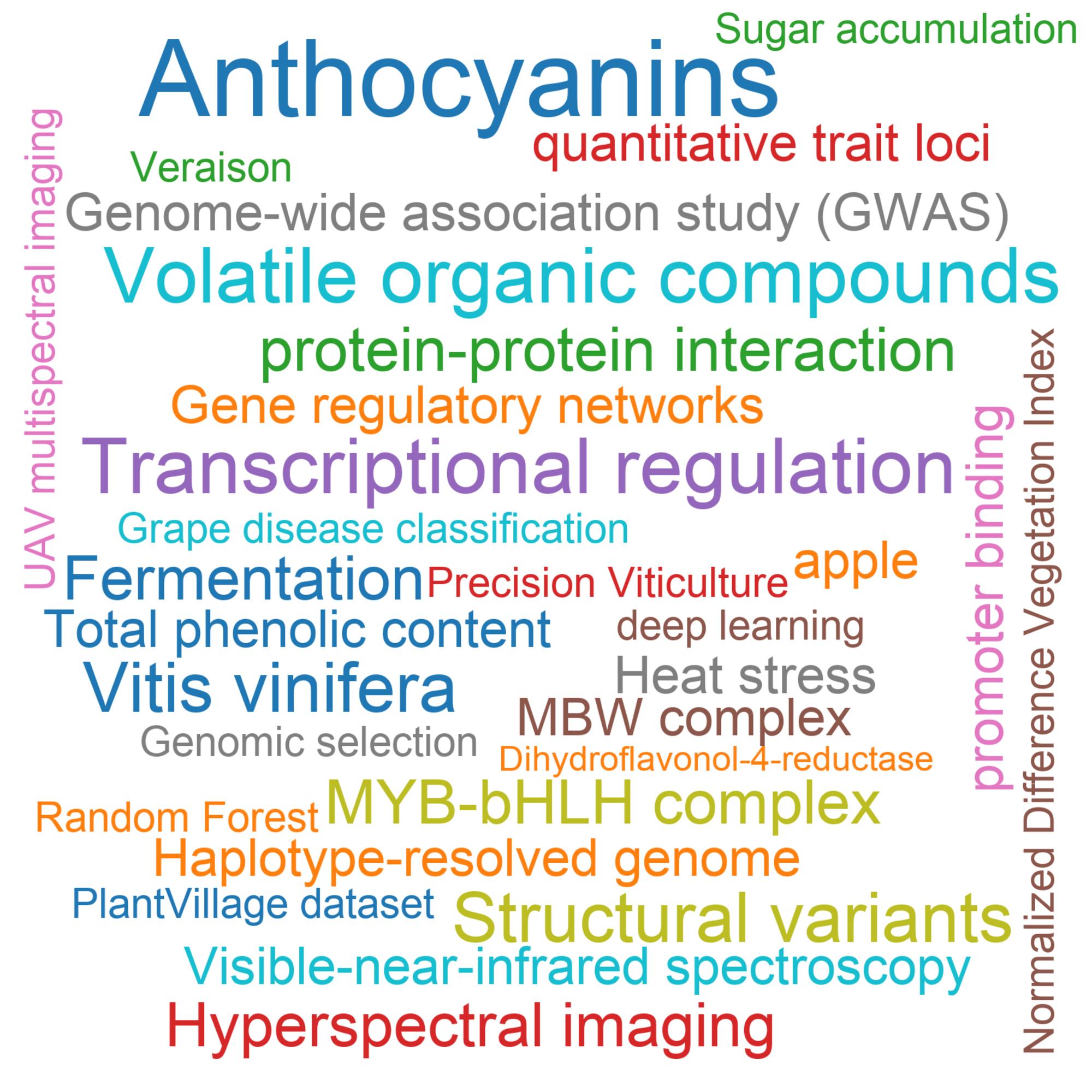
The informative word cloud across the 50 highest 18-month-cited horticultural and viticultural research papers reveals a field focused on plant secondary metabolism, transcriptional regulatory networks, and non-destructive crop monitoring technologies. Anthocyanin biosynthesis dominates the Class of 2026 cohort, appearing in 11 of 50 papers (normalized frequency 0.22), driven by studies investigating fruit pigmentation, environmental stress responses, and quality trait regulation in grapevine, apple, and horticultural crops. Volatile organic compounds (6 papers, 0.12) and transcriptional regulation (6 papers, 0.12) form a major secondary cluster, reflecting high interest in aroma profiles, fruit flavor development, and transcription factor cascades. Structural variants (5 papers, 0.10) and Vitis vinifera (5 papers, 0.10) anchor the genomic and viticultural foundation of the cohort, highlighted by grapevine pangenome reference assemblies and trait breeding tools. Mechanistic plant biology is strongly represented through MYB-bHLH complex (4 papers, 0.08), protein-protein interaction (4 papers, 0.08), and MBW complex (3 papers, 0.06), which govern flavonoid pathway activation under stress and hormonal cues. Simultaneously, technological advancements in smart horticulture are led by hyperspectral imaging (4 papers, 0.08) and visible-near-infrared spectroscopy (3 papers, 0.06) for non-destructive fruit quality assessment and disease diagnosis. Together, these topics demonstrate a dual emphasis on molecular trait regulation and precision phenotyping in modern horticultural science.
How Did Topics Shift from the Class of 2025 to the Class of 2026?
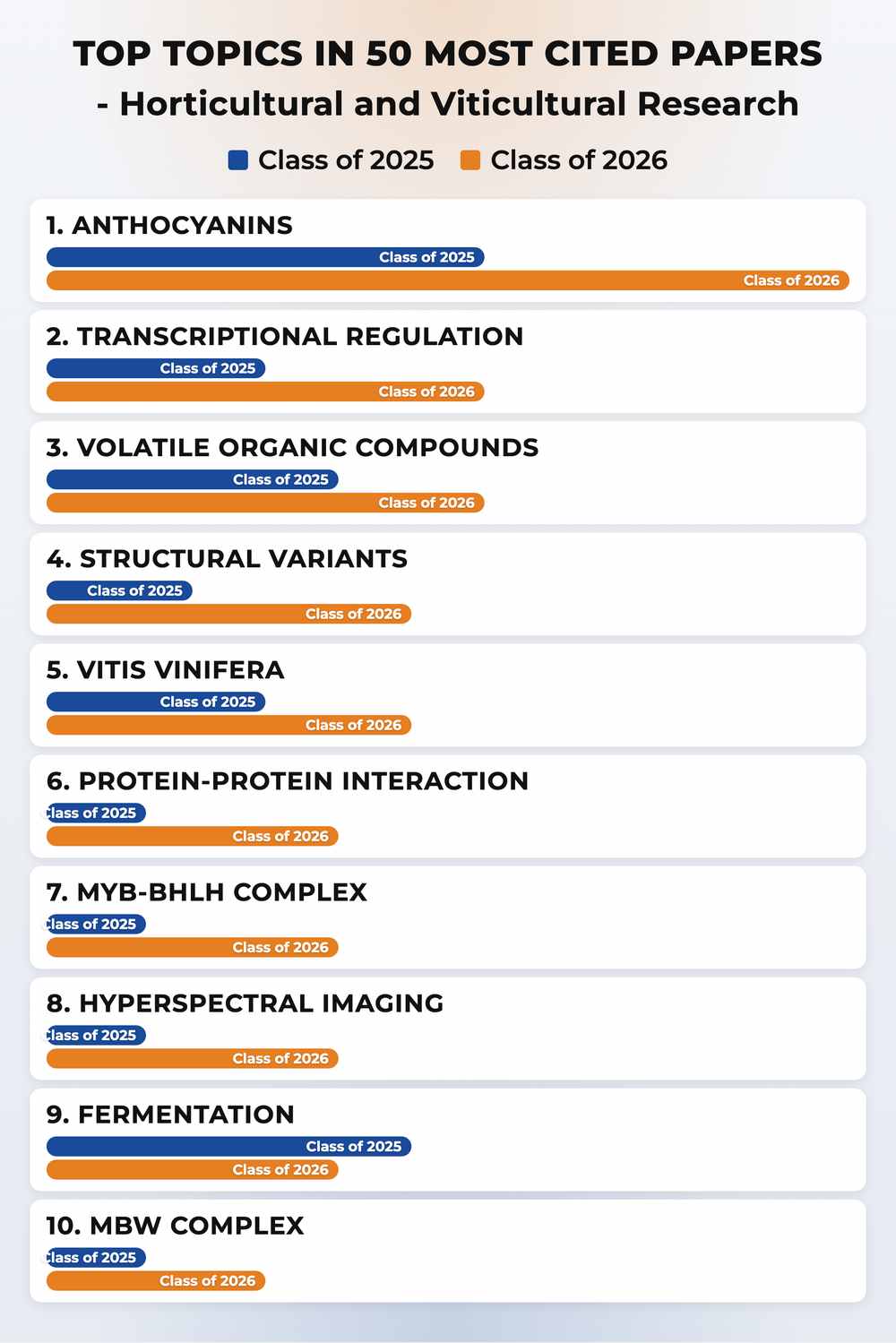
Comparing normalized concept frequencies between the Class of 2025 (2023 publications) and Class of 2026 (2024 publications) cohorts reveals a pronounced shift toward molecular gene regulation, pangenomics, and spectral phenotyping in horticultural research. Anthocyanins registered the largest absolute expansion (+0.10 normalized frequency; 6 to 11 papers), cementing its role as the central biochemical marker of fruit quality and stress acclimation. Transcription factor complexes saw the sharpest emergence: MYB-bHLH complex (+0.08; 0 to 4 papers), protein-protein interaction (+0.08; 0 to 4 papers), Gene regulatory networks (+0.06; 0 to 3 papers), and MBW complex (+0.06; 0 to 3 papers) were newly prominent in 2024 top-cited papers, reflecting deeper mechanistic dissection of fruit color and flavor pathways. In genomics, structural variants (+0.06; 2 to 5 papers), quantitative trait loci (+0.06; 0 to 3 papers), and Genome-wide association study (GWAS) (+0.06; 0 to 3 papers) gained momentum, driven by high-impact grapevine pangenome and haplotype-resolved genomic resources. On the technology front, hyperspectral imaging (+0.06; 1 to 4 papers) and visible-near-infrared spectroscopy (+0.06; 0 to 3 papers) expanded rapidly. Conversely, traditional field-level management and empirical fermentation studies receded among top-cited papers, led by Precision Viticulture (−0.04; 4 to 2 papers), Fermentation (−0.02; 5 to 4 papers), and Non-Saccharomyces yeasts (−0.02; 3 to 2 papers). These shifts highlight an evolving discipline increasingly centered on molecular regulatory networks and high-throughput optical sensing.
Methodology
PRI identifies high-impact research using a transparent, topic-agnostic framework applied consistently across scientific domains. Bibliographic records are drawn from OpenAlex, including publication dates, citation relationships, and document types.
This ranking covers the Class of 2026 cohort: journal articles published in 2024. Reviews and other non-article document types are excluded to ensure comparability.
Research impact is quantified with an 18-month post-publication citation window—the number of citing works published within 18 months of each paper's publication date. This metric captures early impact while controlling for publication age.
An LLM-based relevance classifier then reviews each candidate's title and abstract to confirm substantive alignment with the target domain. Only papers classified as relevant appear in the final ranking.
Zheng Su, Tinsley Li, Thematic Shifts in Early-High-Impact Cancer Genomics and Diagnostics Research: A Bibliometric and Semantic Analysis. bioRxiv 2026.07.04.736459; doi: https://doi.org/10.64898/2026.07.04.736459
Cite this ranking
Pepkio Research Index (PRI). Topics and Trends in Most Cited Horticultural and Viticultural Research Papers, Class of 2026. https://pri.pepkio.com/top-papers/horticultural-and-viticultural-research/2026. Accessed 2026-10-16.

Methodology
Zheng Su, Tinsley Li, Thematic Shifts in Early-High-Impact Cancer Genomics and Diagnostics Research: A Bibliometric and Semantic Analysis. bioRxiv 2026.07.04.736459; doi: https://doi.org/10.64898/2026.07.04.736459