
What topics and trends defined most-cited Meat and Animal Product Quality research in the Class of 2026?
Meat quality research in the Class of 2026 highlights a strong pivot toward intelligent packaging and real-time freshness monitoring. While flavor compounds and protein gelation maintain core representation, traditional myofibrillar protein studies declined significantly as attention shifted to alternative proteins and smart colorimetric sensors.
At a glance
- Field
- Meat and Animal Product Quality
- Cohort label
- Class of 2026 (2024 publications)
- Papers analyzed
- 9,855
- Papers ranked
- 20
- Top topics in ranked papers
- Flavor compounds, intelligent packaging, protein structure, freshness indicators
- Publication window
- Jan 1, 2024 – Dec 31, 2024
- Eligibility
- Research articles; reviews excluded
- Citation window
- 18 months post-publication
- 18m citation range
- 38–65
- Data source
- OpenAlex · Retrieved Jul 2026
- License
- CC BY 4.0
Rankings
20 papers ranked by 18-month citation count
Gel strength prediction in ultrasonicated chicken mince: Fusing near-infrared and Raman spectroscopy coupled with deep learning LSTM algorithm
Food Control202410.1016/j.foodcont.2024.110916
Nanoencapsulation of Oliveria decumbens Vent./basil essential oils into gum arabic/maltodextrin: Improved in vitro bioaccessibility and minced beef meat safety
International Journal of Biological Macromolecules202410.1016/j.ijbiomac.2024.132288
Comprehensive foodomics analysis reveals key lipids affect aroma generation in beef
Food Chemistry202410.1016/j.foodchem.2024.140954
Cultured meat with enriched organoleptic properties by regulating cell differentiation
Nature Communications202410.1038/s41467-023-44359-9
Characterization of the effect of different cooking methods on volatile compounds in fish cakes using a combination of GC–MS and GC-IMS
Food Chemistry X202410.1016/j.fochx.2024.101291
Formation mechanism of giant squid myofibrillar protein aggregates induced by egg white protein during heat treatment
Food Hydrocolloids202410.1016/j.foodhyd.2024.110573
Investigation of heat-induced pork batter quality detection and change mechanisms using Raman spectroscopy coupled with deep learning algorithms
Food Chemistry202410.1016/j.foodchem.2024.140798
pH-responsive color indicator film based on gelatin/chitosan cross-linking with anthocyanin-Fe2+ chelate for pork freshness monitoring
Food Hydrocolloids202410.1016/j.foodhyd.2024.110895
Enhancement of myofibrillar protein gelation by plant proteins for improved surimi gel characteristics: Mechanisms and performance
LWT202410.1016/j.lwt.2024.116045
Different stages of flavor variations among canned Antarctic krill (Euphausia superba): Based on GC-IMS and PLS-DA
Food Chemistry202410.1016/j.foodchem.2024.140465
Bioinspired hydrophobic chitosan-based films for monitoring the visual freshness of pork
Food Hydrocolloids202410.1016/j.foodhyd.2024.110932
Flavor profile analysis of grilled lamb seasoned with classic salt, chili pepper, and cumin (Cuminum cyminum) through HS-SPME-GC-MS, HS-GC-IMS, E-nose techniques, and sensory evaluation on Sonit sheep
Food Chemistry202410.1016/j.foodchem.2024.139514
Development of innovative active packaging films using gelatin/pullulan-based composites incorporated with cinnamon essential oil-loaded metal-organic frameworks for meat preservation
International Journal of Biological Macromolecules202410.1016/j.ijbiomac.2024.131606
Effect of food hydrocolloids on 3D meat-analog printing and deep-fat-frying
Food Hydrocolloids202410.1016/j.foodhyd.2024.110716
<i>Clostridium butyricum</i> and carbohydrate active enzymes contribute to the reduced fat deposition in pigs
iMeta202410.1002/imt2.160
A novel carboxymethyl cellulose/gum xanthan and citric acid-based film that enhances the precision of blackcurrant anthocyanin-induced color detection for beef spoilage tracking
Food Chemistry202410.1016/j.foodchem.2024.140905
Insights into flavor formation of braised chicken: Based on E-nose, GC–MS, GC-IMS, and UPLC-Q-Exactive-MS/MS
Food Chemistry202410.1016/j.foodchem.2024.138972
Enhanced antioxidant and antibacterial activities of chitosan/zein nanoparticle Pickering emulsion-incorporated chitosan coatings in the presence of cinnamaldehyde and tea polyphenol
International Journal of Biological Macromolecules202410.1016/j.ijbiomac.2024.131181
Development of multi-cross-linking, rapid curing, and easy cleaning, edible hydrogels for meat preservation
Food Hydrocolloids202410.1016/j.foodhyd.2024.110186
Dual enhancement effects of different yeast extract on gel properties and saltiness perception of low-salt surimi gel from silver carp
Food Hydrocolloids202410.1016/j.foodhyd.2024.109925
Topic trends
Dominant research themes and year-over-year shifts in Meat and Animal Product Quality
What Topics Define the Class of 2026?
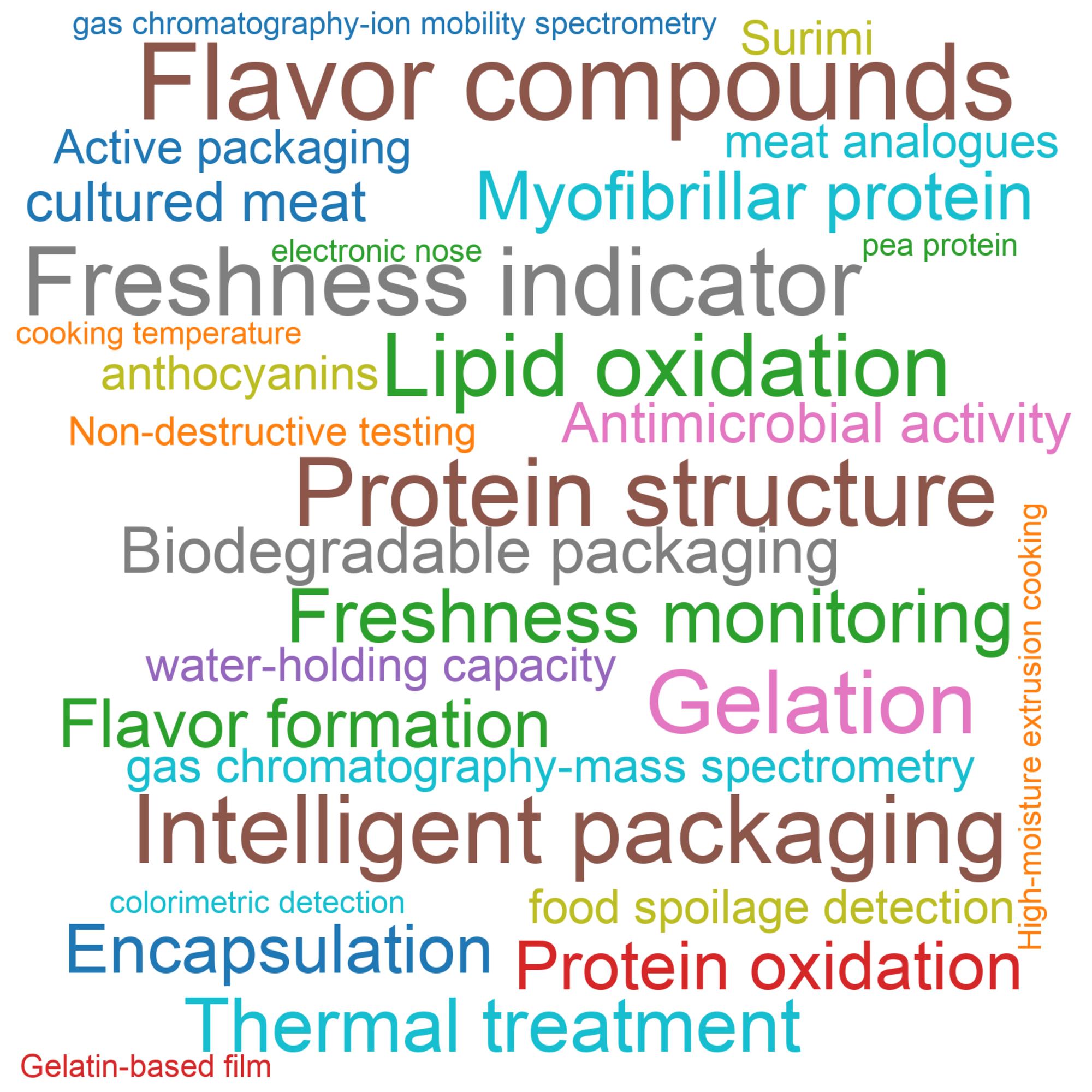
In the Class of 2026 cohort for Meat and Animal Product Quality, high-impact research centers on molecular characterization, flavor chemistry, and smart preservation technologies. Volatile profile evaluation via flavor compounds leads mention frequency across ranked papers, reflecting heightened focus on consumer sensory perception and aroma profiling. A prominent technological cluster revolves around intelligent packaging and freshness indicators, where functional bio-based sensors and colorimetric materials monitor real-time muscle food spoilage. Simultaneously, structural investigations into myofibrillar protein integrity, protein oxidation, and gelation mechanisms remain essential, as researchers seek to optimize textural properties, water-holding capacity, and thermal stability during processing. Further diversification is evident in emerging sustainable protein platforms, including cultured meat, plant-derived meat analogues, and high-moisture extrusion cooking using pea protein isolates. Collectively, these thematic clusters illustrate a field shifting from traditional quality preservation toward precision quality monitoring, biopolymer-based protective films, and alternative protein functionality.
How Did Topics Shift from the Class of 2025 to the Class of 2026?
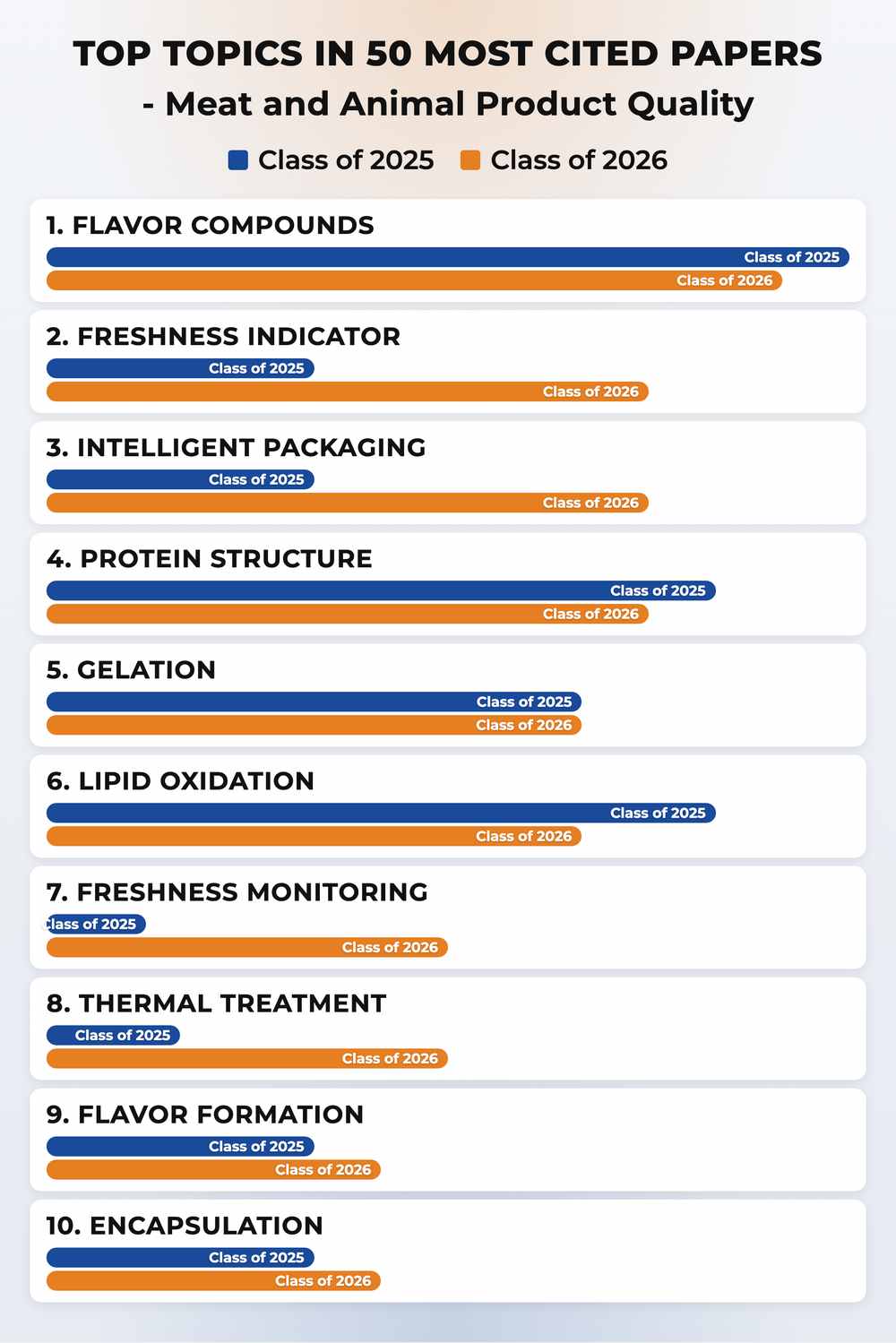
Comparing the Class of 2025 and Class of 2026 cohorts reveals a marked shift from static protein chemistry toward dynamic freshness sensing and alternative protein technologies. The sharpest growth occurred in freshness monitoring, which surged 6-fold from a single paper in the 2023 baseline to six papers in 2024, alongside intelligent packaging and freshness indicators, both expanding from four to nine papers (a 2.25-fold increase). Research into thermal treatment expanded 3-fold, complemented by the debut of high-moisture extrusion cooking, pea protein, and colorimetric detection. Cultured meat and plant-based meat analogues also grew 4-fold (from 1 to 4 papers each). Conversely, traditional topics experienced significant consolidation: fundamental myofibrillar protein studies fell from 13 papers (26% frequency) to 5 papers (10% frequency), representing a fold change of 0.38. Similarly, active packaging halved from eight to four papers as attention migrated toward interactive freshness-reporting systems. Surimi processing and general emulsion studies also registered downward trajectories, underscoring a broader discipline transition from passive preservation methods toward real-time quality monitoring and sustainable protein alternatives.
Methodology
PRI identifies high-impact research using a transparent, topic-agnostic framework applied consistently across scientific domains. Bibliographic records are drawn from OpenAlex, including publication dates, citation relationships, and document types.
This ranking covers the Class of 2026 cohort: journal articles published in 2024. Reviews and other non-article document types are excluded to ensure comparability.
Research impact is quantified with an 18-month post-publication citation window—the number of citing works published within 18 months of each paper's publication date. This metric captures early impact while controlling for publication age.
An LLM-based relevance classifier then reviews each candidate's title and abstract to confirm substantive alignment with the target domain. Only papers classified as relevant appear in the final ranking.
Zheng Su, Tinsley Li, Thematic Shifts in Early-High-Impact Cancer Genomics and Diagnostics Research: A Bibliometric and Semantic Analysis. bioRxiv 2026.07.04.736459; doi: https://doi.org/10.64898/2026.07.04.736459
Cite this ranking
Pepkio Research Index (PRI). Topics and Trends in Most Cited Meat and Animal Product Quality Papers, Class of 2026. https://pri.pepkio.com/top-papers/meat-and-animal-product-quality/2026. Accessed 2026-10-16.

Methodology
Zheng Su, Tinsley Li, Thematic Shifts in Early-High-Impact Cancer Genomics and Diagnostics Research: A Bibliometric and Semantic Analysis. bioRxiv 2026.07.04.736459; doi: https://doi.org/10.64898/2026.07.04.736459