
What topics and trends defined most-cited Insect Pest Control Strategies research in the Class of 2026?
Insect pest control research in 2024 is dominated by essential oils, insecticide resistance, and molecular docking target screening. The field demonstrates a strong cohort shift away from standard LC50 toxicity testing toward biological control, reactive oxygen species-mediated oxidative stress, and detoxification enzyme pathways to overcome chemical resistance.
At a glance
- Field
- Insect Pest Control Strategies
- Cohort label
- Class of 2026 (2024 publications)
- Papers analyzed
- 6,945
- Papers ranked
- 20
- Top topics in ranked papers
- Essential oils, insecticide resistance, molecular docking, detoxification enzymes, biopesticides
- Publication window
- Jan 1, 2024 – Dec 31, 2024
- Eligibility
- Research articles; reviews excluded
- Citation window
- 18 months post-publication
- 18m citation range
- 22–98
- Data source
- OpenAlex · Retrieved Jul 2026
- License
- CC BY 4.0
Rankings
20 papers ranked by 18-month citation count
Pervasive sublethal effects of agrochemicals on insects at environmentally relevant concentrations
Science202410.1126/science.ado0251
Network toxicological and molecular docking to investigate the mechanisms of toxicity of agricultural chemical Thiabendazole
Chemosphere202410.1016/j.chemosphere.2024.142711
Green synthesis of Eucalyptus globulus zinc nanoparticles and its use in antimicrobial insect repellent paint formulation in bulk industrial production
Heliyon202410.1016/j.heliyon.2024.e24467
Innovative formulation strategies for botanical- and essential oil-based insecticides
Journal of Pest Science202410.1007/s10340-024-01846-2
Effect of a spatial repellent on malaria incidence in an area of western Kenya characterised by high malaria transmission, insecticide resistance, and universal coverage of insecticide treated nets (part of the AEGIS Consortium): a cluster-randomised, controlled trial
The Lancet202410.1016/s0140-6736(24)02253-0
Thiadiazole/Thiadiazine Derivatives as Insecticidal Agent: Design, Synthesis, and Biological Assessment of 1,3,4-(Thiadiazine/Thiadiazole)-Benzenesulfonamide Derivatives as IGRs Analogues against <i>Spodoptera littoralis</i>
Journal of Agricultural and Food Chemistry202410.1021/acs.jafc.3c09703
Pyridine Derivatives as Insecticides. Part 5. New Thieno[2,3-<i>b</i>]pyridines and Pyrazolo[3,4-<i>b</i>]pyridines Containing Mainly Ethyl Nicotinate Scaffold and Their Insecticidal Activity toward <i>Aphis gossypii</i> (Glover,1887)
Journal of Agricultural and Food Chemistry202410.1021/acs.jafc.4c03112
Synthesis, insecticidal Activity, and molecular docking analysis of some benzo[h]quinoline derivatives against Culex pipiens L. Larvae
Bioorganic Chemistry202410.1016/j.bioorg.2024.107591
Enhanced capacity of a leaf beetle to combat dual stress from entomopathogens and herbicides mediated by associated microbiota
Integrative Zoology202410.1111/1749-4877.12812
Biocontrol efficacy of cajeput oil against Anopheles stephensi L. mosquito and its effect on non-target species
Frontiers in Physiology202410.3389/fphys.2024.1357411
Area-wide survey and monitoring of insecticide resistance in the brown planthopper, Nilaparvata lugens (Stål), from 2020 to 2023 in China
Pesticide Biochemistry and Physiology202410.1016/j.pestbp.2024.106173
Toxicity, biochemical and molecular docking studies of Acacia nilotica L., essential oils against insect pests
Toxicon202410.1016/j.toxicon.2024.107737
Imidacloprid affects human cells through mitochondrial dysfunction and oxidative stress
The Science of The Total Environment202410.1016/j.scitotenv.2024.175422
Monitoring and Detection of Insecticide Resistance in Spodoptera frugiperda (Lepidoptera: Noctuidae): Evidence for Field-Evolved Resistance in Egypt
Insects202410.3390/insects15090705
Biocontrol effects of chemical molecules derived from Beauveria bassiana against larvae of Tuta absoluta (Meyrick) (Lepidoptera: Gelechiidae)
Frontiers in Microbiology202410.3389/fmicb.2024.1336334
UDP-glycosyltransferases act as key determinants of host plant range in generalist and specialist <i>Spodoptera</i> species
Proceedings of the National Academy of Sciences202410.1073/pnas.2402045121
Synthesis of paeonol hydrazone derivatives and their anti‐oomycete, anti‐fungal, and nematicidal activities
Pest Management Science202410.1002/ps.8306
Field evaluation of a volatile pyrethroid spatial repellent and etofenprox treated clothing for outdoor protection against forest malaria vectors in Cambodia
Scientific Reports202410.1038/s41598-024-67470-3
Study on the virulence of <i>Metarhizium anisopliae</i> against <i>Spodoptera frugiperda</i> (J. E. Smith, 1797)
Journal of Basic Microbiology202410.1002/jobm.202300599
Circumscription of the Ganaspis brasiliensis (Ihering, 1905) species complex (Hymenoptera, Figitidae), and the description of two new species parasitizing the spotted wing drosophila, Drosophila suzukii Matsumura, 1931 (Diptera, Drosophilidae)
Journal of Hymenoptera Research202410.3897/jhr.97.118567
Topic trends
Dominant research themes and year-over-year shifts in Insect Pest Control Strategies
What Topics Define the Class of 2026?
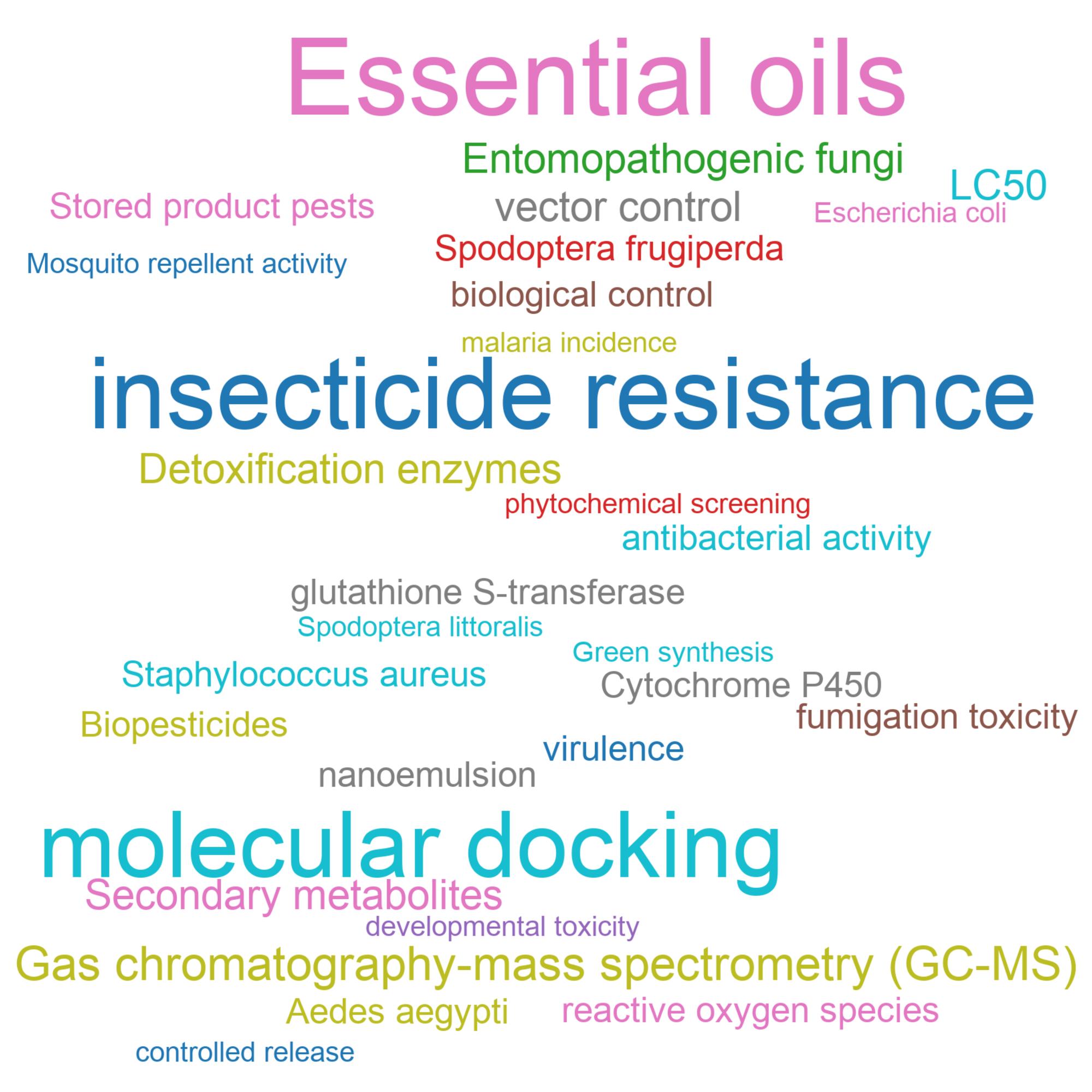
The 2024 publication cohort in insect pest control strategies demonstrates a decisive research pivot toward bio-based intervention methods and structural biochemical mechanisms to counteract rising synthetic pesticide resistance. Bio-derived active compounds lead the field, with essential oils emerging as the most dominant theme—featured in 18% of ranked papers—complemented by secondary metabolites and botanical biopesticides. This emphasis on natural products reflects urgent agricultural and public health demands for eco-friendly, non-toxic pest management solutions. Mechanistically, modern pest control studies heavily integrate computational and molecular approaches. Molecular docking has become a cornerstone methodology (appearing in 14% of top studies) to screen plant-derived phytochemicals against specific insect enzymatic targets. Concurrently, investigating insecticide resistance mechanisms remains paramount (16% of papers), with significant attention focused on detoxification enzyme pathways such as cytochrome P450s and glutathione S-transferases that drive metabolic resistance in major agricultural pests like Spodoptera frugiperda and disease vectors like Aedes aegypti. Furthermore, biological control strategies utilizing entomopathogenic fungi alongside gas chromatography-mass spectrometry (GC-MS) for chemical profiling underscore an integrated paradigm combining ecological bio-agents with precision analytical chemistry.
How Did Topics Shift from the Class of 2025 to the Class of 2026?
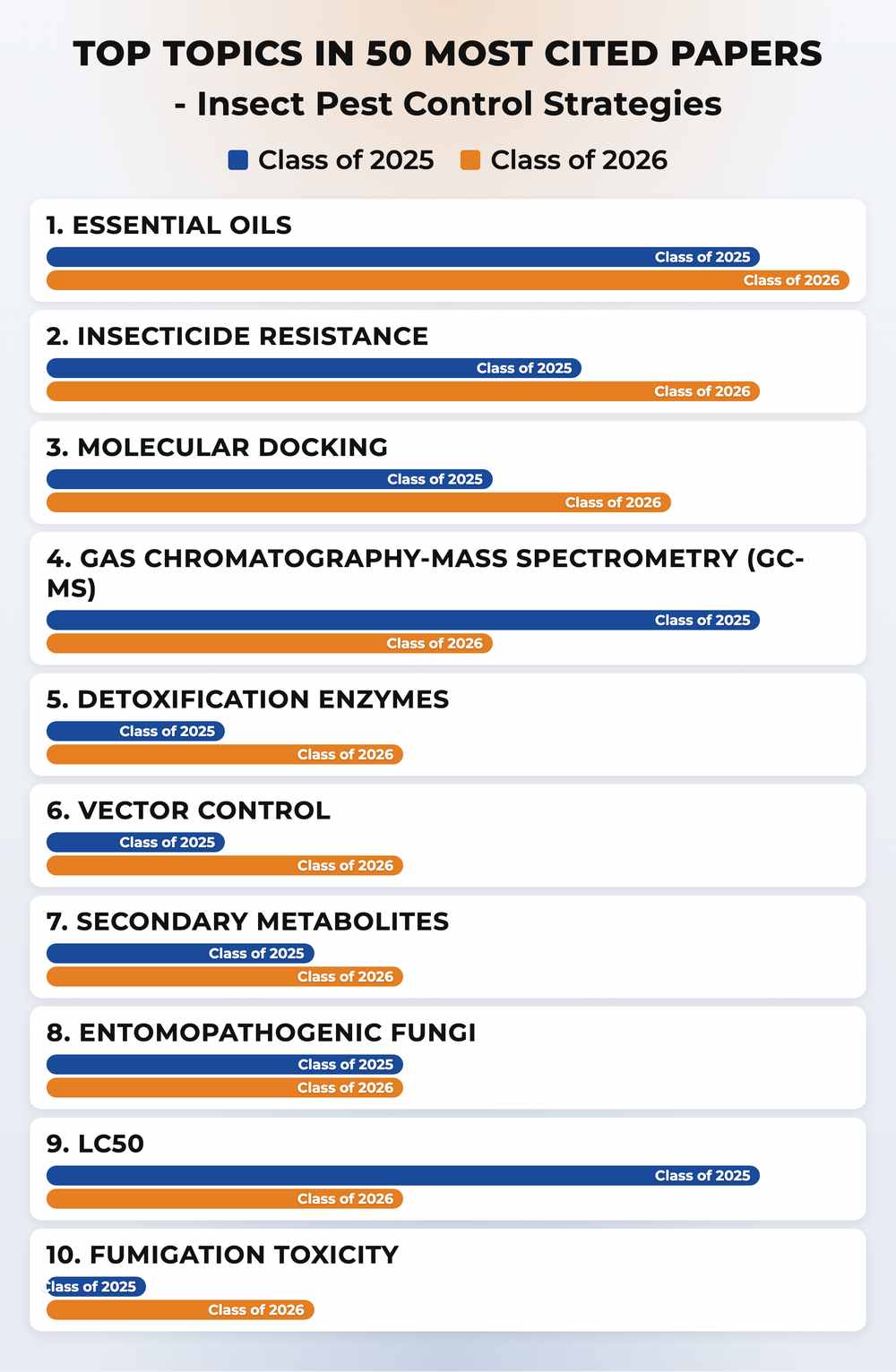
Comparing the Class of 2025 and Class of 2026 cohorts reveals a distinct transition from descriptive lethal concentration assays toward dynamic mode-of-action studies and functional biological interventions. The most substantial gains occurred in biological control and eco-friendly delivery mechanisms, with biological control applications, reactive oxygen species (ROS) induction, and fumigation toxicity seeing dramatic surges as novel non-synthetic control modalities. Applied storage preservation research also surged, reflected in emerging interest around active packaging incorporating botanical bio-actives to prevent post-harvest infestation. In contrast, classical toxicology metrics and broad screening assays experienced noticeable relative declines. Standard median lethal concentration assays (LC50) fell from 16% to 8% of top publications, while general analytical profiling via gas chromatography-mass spectrometry (GC-MS) dropped from 16% to 10%. Additionally, direct studies focusing primarily on Aedes aegypti (declining from 16% to 6%) and individual target genes like cytochrome P450 gave way to broader systemic investigations of detoxification enzyme networks (which doubled from 4% to 8%) and integrated vector control frameworks. Overall, the literature is shifting away from simple mortality reporting toward mechanistic bio-pesticide formulations and oxidative stress mechanisms in pest populations.
Methodology
PRI identifies high-impact research using a transparent, topic-agnostic framework applied consistently across scientific domains. Bibliographic records are drawn from OpenAlex, including publication dates, citation relationships, and document types.
This ranking covers the Class of 2026 cohort: journal articles published in 2024. Reviews and other non-article document types are excluded to ensure comparability.
Research impact is quantified with an 18-month post-publication citation window—the number of citing works published within 18 months of each paper's publication date. This metric captures early impact while controlling for publication age.
An LLM-based relevance classifier then reviews each candidate's title and abstract to confirm substantive alignment with the target domain. Only papers classified as relevant appear in the final ranking.
Zheng Su, Tinsley Li, Thematic Shifts in Early-High-Impact Cancer Genomics and Diagnostics Research: A Bibliometric and Semantic Analysis. bioRxiv 2026.07.04.736459; doi: https://doi.org/10.64898/2026.07.04.736459
Cite this ranking
Pepkio Research Index (PRI). Topics and Trends in Most Cited Insect Pest Control Strategies Papers, Class of 2026. https://pri.pepkio.com/top-papers/insect-pest-control-strategies/2026. Accessed 2026-10-16.

Methodology
Zheng Su, Tinsley Li, Thematic Shifts in Early-High-Impact Cancer Genomics and Diagnostics Research: A Bibliometric and Semantic Analysis. bioRxiv 2026.07.04.736459; doi: https://doi.org/10.64898/2026.07.04.736459