
What topics and trends defined most-cited Insect and Pesticide Research research in the Class of 2026?
Research in insect and pesticide science is rapidly shifting from broad residue monitoring toward mechanistic toxicology and molecular pest control. While neonicotinoids and honey bee health remain core concerns, the Class of 2026 highlights rapid growth in RNA interference, sublethal stress modeling, and climate-driven pollinator dynamics alongside declining interest in simple residue detection.
At a glance
- Field
- Insect and Pesticide Research
- Cohort label
- Class of 2026 (2024 publications)
- Papers analyzed
- 10,171
- Papers ranked
- 20
- Top topics in ranked papers
- Neonicotinoid insecticides, honey bees, insecticide resistance, sublethal effects, imidacloprid
- Publication window
- Jan 1, 2024 – Dec 31, 2024
- Eligibility
- Research articles; reviews excluded
- Citation window
- 18 months post-publication
- 18m citation range
- 30–98
- Data source
- OpenAlex · Retrieved Jul 2026
- License
- CC BY 4.0
Rankings
20 papers ranked by 18-month citation count
Pervasive sublethal effects of agrochemicals on insects at environmentally relevant concentrations
Science202410.1126/science.ado0251
Structural basis for odorant recognition of the insect odorant receptor OR-Orco heterocomplex
Science202410.1126/science.adn6881
Life-history stage determines the diet of ectoparasitic mites on their honey bee hosts
Nature Communications202410.1038/s41467-024-44915-x
From field to table: Ensuring food safety by reducing pesticide residues in food
The Science of The Total Environment202410.1016/j.scitotenv.2024.171382
Impact of pesticide use on wild bee distributions across the United States
Nature Sustainability202410.1038/s41893-024-01413-8
Gut bacteria of lepidopteran herbivores facilitate digestion of plant toxins
Proceedings of the National Academy of Sciences202410.1073/pnas.2412165121
Pesticide risk assessment in European agriculture: Distribution patterns, ban-substitution effects and regulatory implications
Environmental Pollution202410.1016/j.envpol.2024.123836
Impact of pesticides on non-target invertebrates in agricultural ecosystems
Pesticide Biochemistry and Physiology202410.1016/j.pestbp.2024.105974
Thiadiazole/Thiadiazine Derivatives as Insecticidal Agent: Design, Synthesis, and Biological Assessment of 1,3,4-(Thiadiazine/Thiadiazole)-Benzenesulfonamide Derivatives as IGRs Analogues against <i>Spodoptera littoralis</i>
Journal of Agricultural and Food Chemistry202410.1021/acs.jafc.3c09703
Wild insects and honey bees are equally important to crop yields in a global analysis
Global Ecology and Biogeography202410.1111/geb.13843
Nanoparticle LDH enhances RNAi efficiency of dsRNA in piercing-sucking pests by promoting dsRNA stability and transport in plants
Journal of Nanobiotechnology202410.1186/s12951-024-02819-4
Pyridine Derivatives as Insecticides. Part 5. New Thieno[2,3-<i>b</i>]pyridines and Pyrazolo[3,4-<i>b</i>]pyridines Containing Mainly Ethyl Nicotinate Scaffold and Their Insecticidal Activity toward <i>Aphis gossypii</i> (Glover,1887)
Journal of Agricultural and Food Chemistry202410.1021/acs.jafc.4c03112
Synthesis, insecticidal Activity, and molecular docking analysis of some benzo[h]quinoline derivatives against Culex pipiens L. Larvae
Bioorganic Chemistry202410.1016/j.bioorg.2024.107591
Insecticides, more than herbicides, land use, and climate, are associated with declines in butterfly species richness and abundance in the American Midwest
PLoS ONE202410.1371/journal.pone.0304319
Honey bee stressor networks are complex and dependent on crop and region
Current Biology202410.1016/j.cub.2024.03.039
Design, Synthesis, and Biological Activities of Novel Coumarin Derivatives as Pesticide Candidates
Journal of Agricultural and Food Chemistry202410.1021/acs.jafc.3c08161
The toxicity effects of imidacloprid and chlorpyrifos on oxidative stress and blood biochemistry in Cyprinus carpio
Comparative Biochemistry and Physiology Part C Toxicology & Pharmacology202410.1016/j.cbpc.2024.109979
Insufficient pollinator visitation often limits yield in crop systems worldwide
Nature Ecology & Evolution202410.1038/s41559-024-02460-2
Host-derived organic acids enable gut colonization of the honey bee symbiont Snodgrassella alvi
Nature Microbiology202410.1038/s41564-023-01572-y
Biocontrol efficacy of cajeput oil against Anopheles stephensi L. mosquito and its effect on non-target species
Frontiers in Physiology202410.3389/fphys.2024.1357411
Topic trends
Dominant research themes and year-over-year shifts in Insect and Pesticide Research
What Topics Define the Class of 2026?
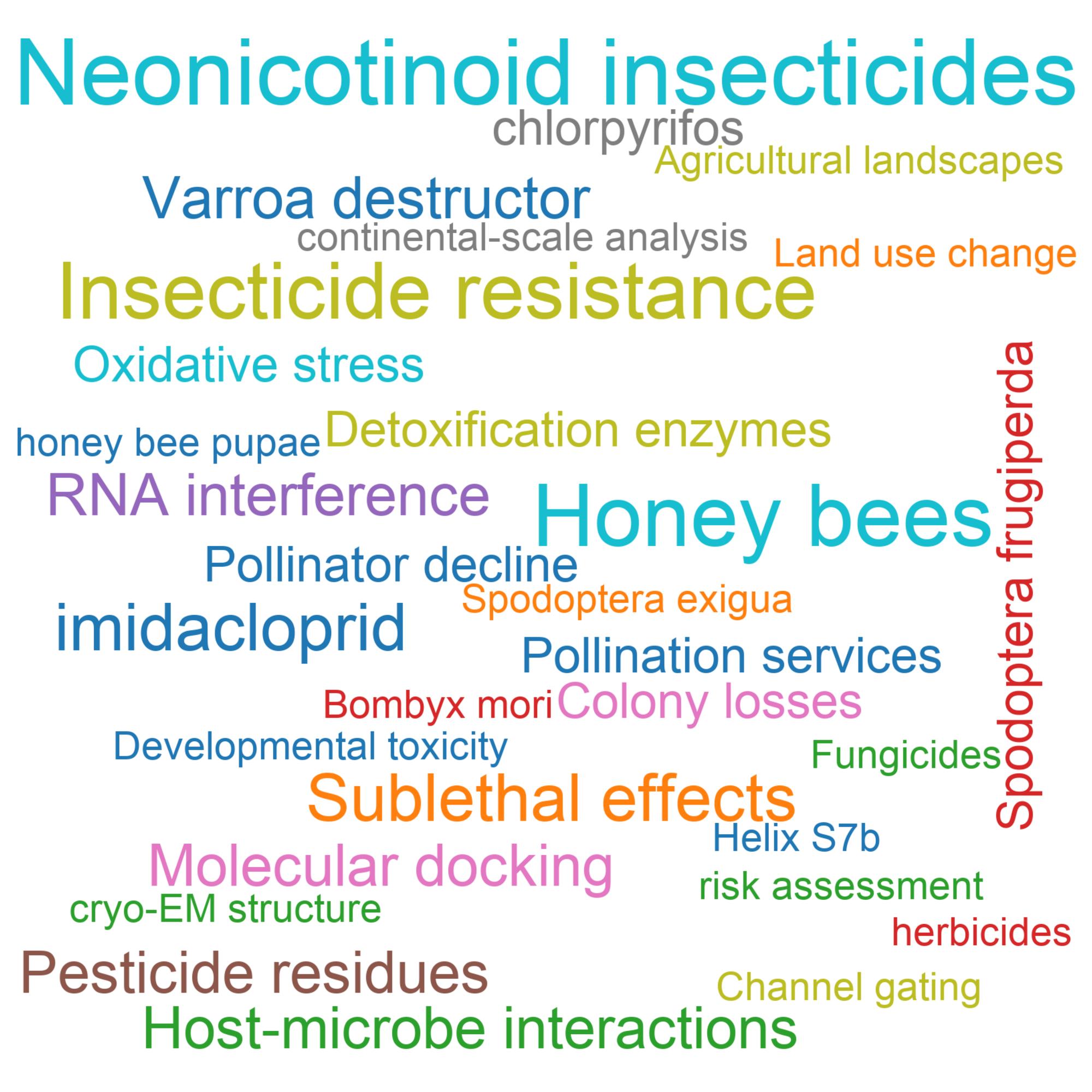
Topics in the Class of 2026 highlight a major research shift from broad pesticide measurement toward mechanistic toxicological impacts, pollinator protection, and molecular pest management strategies. Neonicotinoid insecticides remain the single most prominent topic, appearing in 18% of top-ranked publications, closely tied to specific active compounds such as imidacloprid and chlorpyrifos. Research heavily centers on managed pollinators, specifically honey bees (16% normalized frequency) and parasitic threats like Varroa destructor, examining how chemical exposures compromise colony survival and essential pollination services. Beyond direct mortality, investigating sublethal effects (10% normalized frequency) has emerged as a major focus area. Studies evaluate subtle physiological disruptions including oxidative stress, detoxification enzyme induction (such as glutathione-S-transferase), and alteration of host-microbe interactions within the honey bee gut microbiota. Simultaneously, agricultural pest control research emphasizes emerging resistance mechanisms, leveraging molecular docking and cryo-EM structural analysis to inspect target site channel gating and P450 enzyme overexpression. Advanced bio-based strategies, particularly double-stranded RNA delivery via RNA interference, are increasingly investigated to mitigate target pest damage in invasive species such as Spodoptera frugiperda while protecting non-target insects.
How Did Topics Shift from the Class of 2025 to the Class of 2026?
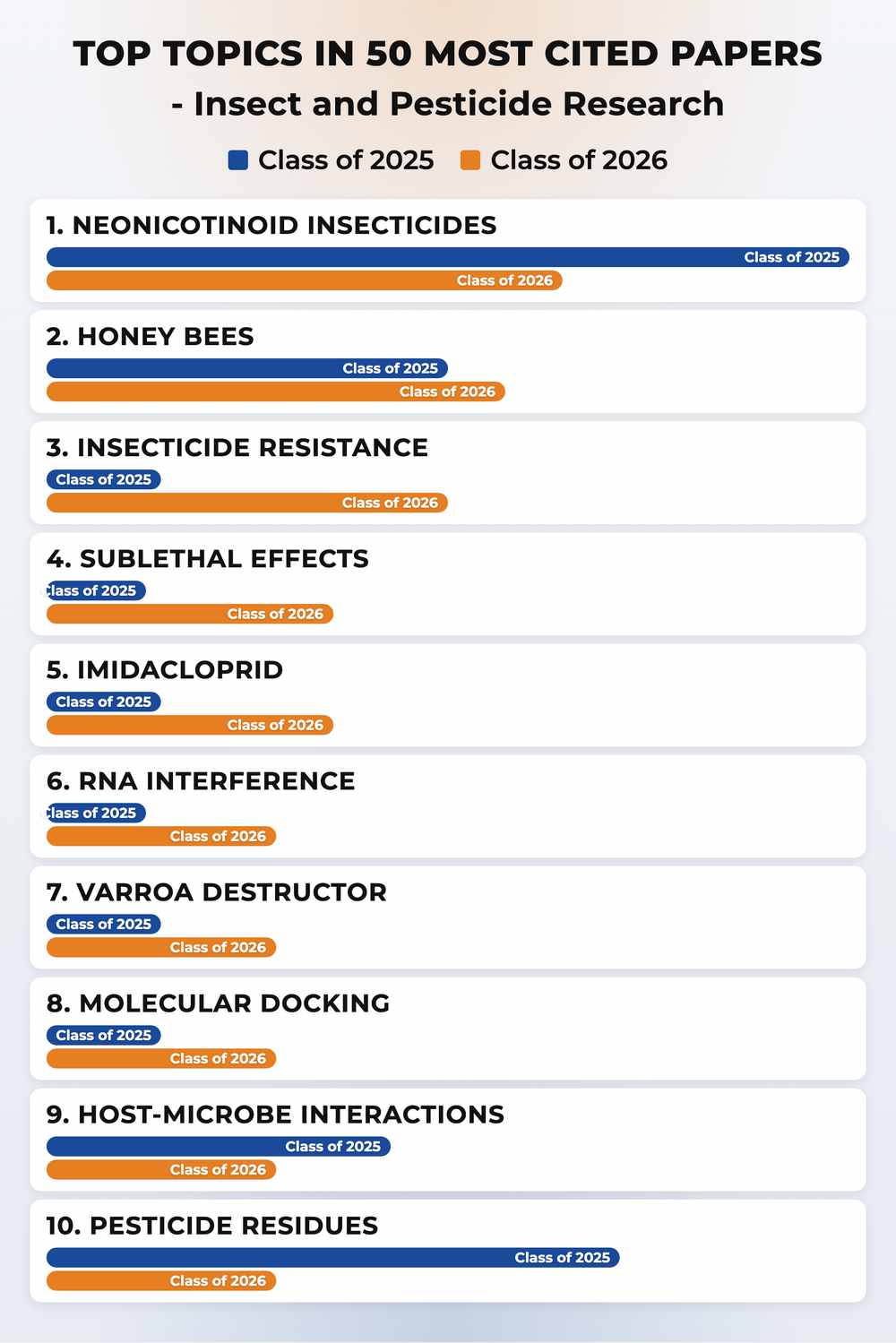
Comparing topic frequencies between the Class of 2025 and Class of 2026 reveals a distinct pivot toward mechanistic eco-toxicology and targeted pest control solutions. The most significant growth occurs in research targeting major crop pests and emerging environmental stressors. Studies focusing on the invasive fall armyworm (Spodoptera frugiperda) and climate change impacts on pollinators experienced dramatic surges, reflecting heightened agricultural urgency. Methodological innovations also surged, with RNA interference (+300% relative change, expanding to 8% of publications) and sublethal physiological modeling (+400% relative change, reaching 10%) replacing traditional endpoint toxicity assays like simple LC50 calculations. In contrast, traditional residue monitoring and environmental fate studies underwent a pronounced decline. Publications centered on broad pesticide residues fell sharply from 20% to 8% normalized frequency (-60% relative drop), while pesticide degradation studies decreased from 8% to 4%. Even foundational neonicotinoid papers saw a relative frequency drop of 36% (from 28% down to 18%), as research transitioned from establishing basic field toxicity toward resolving specific molecular mechanisms of cross-resistance and evaluating multi-stressor interactions across continental-scale agricultural landscapes.
Methodology
PRI identifies high-impact research using a transparent, topic-agnostic framework applied consistently across scientific domains. Bibliographic records are drawn from OpenAlex, including publication dates, citation relationships, and document types.
This ranking covers the Class of 2026 cohort: journal articles published in 2024. Reviews and other non-article document types are excluded to ensure comparability.
Research impact is quantified with an 18-month post-publication citation window—the number of citing works published within 18 months of each paper's publication date. This metric captures early impact while controlling for publication age.
An LLM-based relevance classifier then reviews each candidate's title and abstract to confirm substantive alignment with the target domain. Only papers classified as relevant appear in the final ranking.
Zheng Su, Tinsley Li, Thematic Shifts in Early-High-Impact Cancer Genomics and Diagnostics Research: A Bibliometric and Semantic Analysis. bioRxiv 2026.07.04.736459; doi: https://doi.org/10.64898/2026.07.04.736459
Cite this ranking
Pepkio Research Index (PRI). Topics and Trends in Most Cited Insect and Pesticide Research Papers, Class of 2026. https://pri.pepkio.com/top-papers/insect-and-pesticide-research/2026. Accessed 2026-10-16.

Methodology
Zheng Su, Tinsley Li, Thematic Shifts in Early-High-Impact Cancer Genomics and Diagnostics Research: A Bibliometric and Semantic Analysis. bioRxiv 2026.07.04.736459; doi: https://doi.org/10.64898/2026.07.04.736459
Source data
The full ranking corpus and analysis files are openly available on an external repository. Please cite the dataset below when reusing this data.
View source dataset →Pepkio Research Index (2026). Class of 2026: Insect and Pesticide Research [Data set]. Figshare.