
What topics and trends defined most-cited Cancer Cells and Metastasis research in the Class of 2026?
The Class of 2026 in metastasis research is defined by the explosive growth of spatial transcriptomics and deep profiling of the tumor microenvironment. Subpopulation dynamics—particularly regarding cancer-associated fibroblasts and tumor-associated macrophages—are driving new mechanistic insights into how spatial cellular interactions fuel cancer spread.
At a glance
- Field
- Cancer Cells and Metastasis
- Cohort label
- Class of 2026 (2024 publications)
- Papers analyzed
- 5,847
- Papers ranked
- 20
- Top topics in ranked papers
- Spatial transcriptomics, single-cell RNA sequencing, cancer-associated fibroblasts, patient-derived organoids
- Publication window
- Jan 1, 2024 – Dec 31, 2024
- Eligibility
- Research articles; reviews excluded
- Citation window
- 18 months post-publication
- 18m citation range
- 62–189
- Data source
- OpenAlex · Retrieved September 2026
- License
- CC BY 4.0
Rankings
20 papers ranked by 18-month citation count
Cross-tissue human fibroblast atlas reveals myofibroblast subtypes with distinct roles in immune modulation
Cancer Cell202410.1016/j.ccell.2024.08.020
Deterministic reprogramming of neutrophils within tumors
Science202410.1126/science.adf6493
Tumor-associated macrophages restrict CD8+ T cell function through collagen deposition and metabolic reprogramming of the breast cancer microenvironment
Nature Cancer202410.1038/s43018-024-00775-4
Cancer-associated fibroblast phenotypes are associated with patient outcome in non-small cell lung cancer
Cancer Cell202410.1016/j.ccell.2023.12.021
Progressive plasticity during colorectal cancer metastasis
Nature202410.1038/s41586-024-08150-0
Tumour vasculature at single-cell resolution
Nature202410.1038/s41586-024-07698-1
CAF-macrophage crosstalk in tumour microenvironments governs the response to immune checkpoint blockade in gastric cancer peritoneal metastases
Gut202410.1136/gutjnl-2024-333617
Human organoids with an autologous tissue-resident immune compartment
Nature202410.1038/s41586-024-07791-5
Ononin inhibits triple-negative breast cancer lung metastasis by targeting the EGFR-mediated PI3K/Akt/mTOR pathway
Science China Life Sciences202410.1007/s11427-023-2499-2
Cancer stem cell mimicry for immune evasion and therapeutic resistance
Cell stem cell202410.1016/j.stem.2024.06.003
Cancer-associated fibroblast subtypes modulate the tumor-immune microenvironment and are associated with skin cancer malignancy
Nature Communications202410.1038/s41467-024-53908-9
THBS2 + cancer-associated fibroblasts promote EMT leading to oxaliplatin resistance via COL8A1-mediated PI3K/AKT activation in colorectal cancer
Molecular Cancer202410.1186/s12943-024-02180-y
An atlas of epithelial cell states and plasticity in lung adenocarcinoma
Nature202410.1038/s41586-024-07113-9
Deciphering the spatial landscape and plasticity of immunosuppressive fibroblasts in breast cancer
Nature Communications202410.1038/s41467-024-47068-z
Modulating autophagy to boost the antitumor efficacy of TROP2-directed antibody-drug conjugate in pancreatic cancer
Biomedicine & Pharmacotherapy202410.1016/j.biopha.2024.117550
Two distinct epithelial-to-mesenchymal transition programs control invasion and inflammation in segregated tumor cell populations
Nature Cancer202410.1038/s43018-024-00839-5
Sonodynamic Nano-LYTACs Reverse Tumor Immunosuppressive Microenvironment for Cancer Immunotherapy
Journal of the American Chemical Society202410.1021/jacs.4c13022
Spatiotemporally resolved colorectal oncogenesis in mini-colons ex vivo
Nature202410.1038/s41586-024-07330-2
Personalized Vascularized Tumor Organoid‐on‐a‐Chip for Tumor Metastasis and Therapeutic Targeting Assessment
Advanced Materials202410.1002/adma.202412815
PDGFRα+ITGA11+ fibroblasts foster early-stage cancer lymphovascular invasion and lymphatic metastasis via ITGA11-SELE interplay
Cancer Cell202410.1016/j.ccell.2024.02.002
Topic trends
Dominant research themes and year-over-year shifts in Cancer Cells and Metastasis
What Topics Define the Class of 2026?
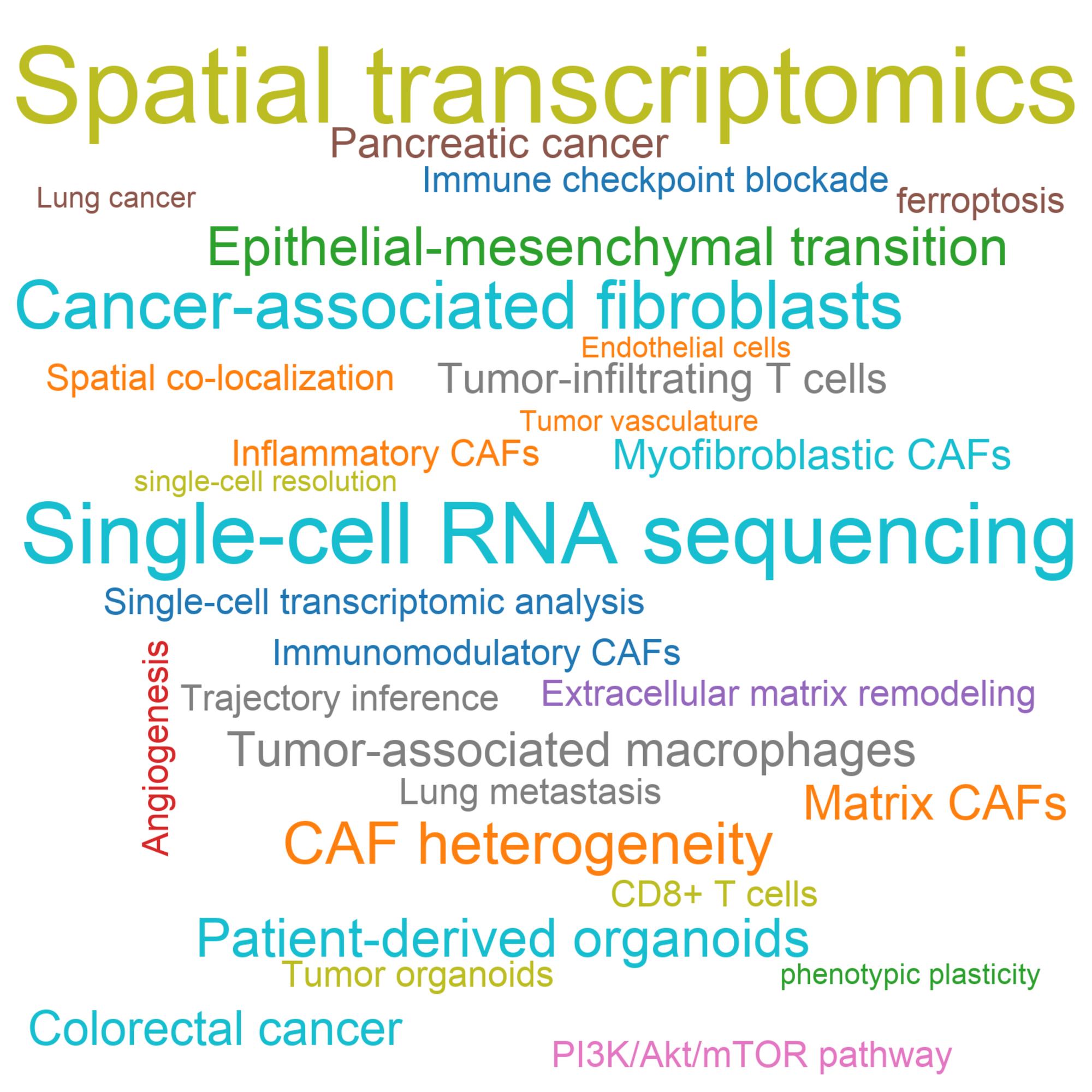
The Class of 2026 in cancer cells and metastasis research is strongly driven by high-resolution multi-omic profiling technologies and deep characterization of the tumor microenvironment (TME). **Spatial transcriptomics** (15 mentions) and **single-cell RNA sequencing** (14 mentions) emerged as the dominant methodological themes, indicating a shift toward mapping cellular interactions in their native architectural context. A major biological focus of the top-cited papers is the stromal compartment, particularly **cancer-associated fibroblasts (CAFs)** (9 mentions) and **CAF heterogeneity** (7 mentions). Researchers are increasingly dissecting specific subpopulations, such as matrix CAFs, to understand their distinct roles in promoting or restricting tumor progression. Other core themes include **epithelial-mesenchymal transition (EMT)** and the development of advanced functional assays like **patient-derived organoids** (6 mentions) to model these complex dynamics ex vivo. Together, these defining topics illustrate a field that is moving away from bulk tumor analysis toward dissecting the precise cellular state and spatial organization of metastatic niches.
How Did Topics Shift from the Class of 2025 to the Class of 2026?
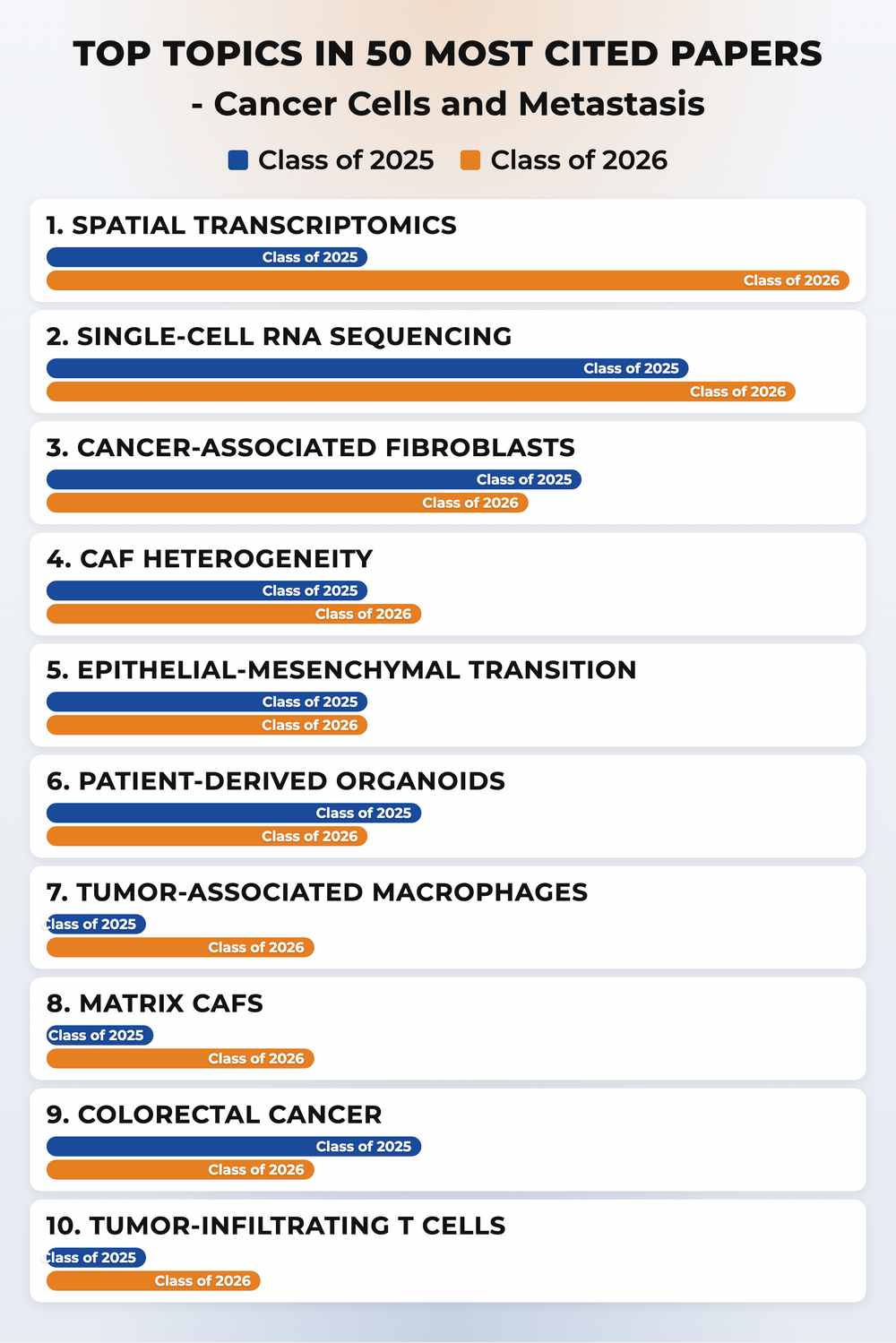
Comparing the top-cited papers of 2024 to the previous cohort reveals a pronounced acceleration in spatial biology and specific TME cell-state analyses. **Spatial transcriptomics** experienced massive growth, increasing 2.5-fold compared to the previous year, highlighting its rapid adoption as a critical tool for mapping metastasis. Similarly, focus on **tumor-associated macrophages (TAMs)** spiked significantly (a 5-fold increase), alongside a sharp rise in studies examining distinct fibroblast subpopulations like **matrix CAFs** (up 2.5-fold). Notably, the application of computational methods for tracking cellular state changes, such as **trajectory inference** and **cell-cell communication patterns**, emerged as rapidly growing areas of interest. Meanwhile, some broader or more established themes, while still highly relevant, saw relative stabilization in the very top tier of citations. The overall trajectory from 2025 to 2026 indicates a field rapidly translating single-cell transcriptomic discoveries into spatially resolved, mechanistic studies of how immune and stromal cells cooperate to facilitate cancer spread.
Methodology
PRI identifies high-impact research using a transparent, topic-agnostic framework applied consistently across scientific domains. Bibliographic records are drawn from OpenAlex, including publication dates, citation relationships, and document types.
This ranking covers the Class of 2026 cohort: journal articles published in 2024. Reviews and other non-article document types are excluded to ensure comparability.
Research impact is quantified with an 18-month post-publication citation window—the number of citing works published within 18 months of each paper's publication date. This metric captures early impact while controlling for publication age.
An LLM-based relevance classifier then reviews each candidate's title and abstract to confirm substantive alignment with the target domain. Only papers classified as relevant appear in the final ranking.
Zheng Su, Tinsley Li, Thematic Shifts in Early-High-Impact Cancer Genomics and Diagnostics Research: A Bibliometric and Semantic Analysis. bioRxiv 2026.07.04.736459; doi: https://doi.org/10.64898/2026.07.04.736459
Cite this ranking
Pepkio Research Index (PRI). Topics and Trends in Most Cited Cancer Cells and Metastasis Papers, Class of 2026. https://pri.pepkio.com/top-papers/cancer-cells-and-metastasis/2026. Accessed 2026-10-24.

Methodology
Zheng Su, Tinsley Li, Thematic Shifts in Early-High-Impact Cancer Genomics and Diagnostics Research: A Bibliometric and Semantic Analysis. bioRxiv 2026.07.04.736459; doi: https://doi.org/10.64898/2026.07.04.736459