
What topics and trends defined most-cited Hepatocellular Carcinoma Treatment and Prognosis research in the Class of 2026?
Immune checkpoint inhibitors and unresectable disease anchor the Class of 2026 HCC cohort, with metabolic dysfunction-associated steatotic liver disease emerging strongly. From Class of 2025 to 2026, broad immune checkpoint inhibitor focus rose sharply, while specific agents like lenvatinib and PD-1 inhibitors, along with TACE, receded among top-cited work.
At a glance
- Field
- Hepatocellular Carcinoma Treatment and Prognosis
- Cohort label
- Class of 2026 (2024 publications)
- Papers analyzed
- 8,600
- Papers ranked
- 20
- Top topics in ranked papers
- Immune checkpoint inhibitor, unresectable hepatocellular carcinoma, sorafenib, RECIST v1.1
- Publication window
- Jan 1, 2024 – Dec 31, 2024
- Eligibility
- Research articles; reviews excluded
- Citation window
- 18 months post-publication
- 18m citation range
- 43–197
- Data source
- OpenAlex · Retrieved Jul 2026
- License
- CC BY 4.0
Rankings
20 papers ranked by 18-month citation count
Precision treatment in advanced hepatocellular carcinoma
Cancer Cell202410.1016/j.ccell.2024.01.007
Four-year overall survival update from the phase III HIMALAYA study of tremelimumab plus durvalumab in unresectable hepatocellular carcinoma
Annals of Oncology202410.1016/j.annonc.2024.02.005
Systemic Therapy for Advanced Hepatocellular Carcinoma: ASCO Guideline Update
Journal of Clinical Oncology202410.1200/jco.23.02745
Nivolumab (NIVO) plus ipilimumab (IPI) vs lenvatinib (LEN) or sorafenib (SOR) as first-line treatment for unresectable hepatocellular carcinoma (uHCC): First results from CheckMate 9DW.
Journal of Clinical Oncology202410.1200/jco.2024.42.17_suppl.lba4008
EMERALD-1: A phase 3, randomized, placebo-controlled study of transarterial chemoembolization combined with durvalumab with or without bevacizumab in participants with unresectable hepatocellular carcinoma eligible for embolization.
Journal of Clinical Oncology202410.1200/jco.2024.42.3_suppl.lba432
Immune checkpoint inhibitors and anti-vascular endothelial growth factor antibody/tyrosine kinase inhibitors with or without transarterial chemoembolization as first-line treatment for advanced hepatocellular carcinoma (CHANCE2201): a target trial emulation study
EClinicalMedicine202410.1016/j.eclinm.2024.102622
Portal Venous and Hepatic Arterial Coefficients Predict Post-Hepatectomy Overall and Recurrence-Free Survival in Patients with Hepatocellular Carcinoma: A Retrospective Study
Journal of Hepatocellular Carcinoma202410.2147/jhc.s462168
The #HOPE4LIVER Single-Arm Pivotal Trial for Histotripsy of Primary and Metastatic Liver Tumors
Radiology202410.1148/radiol.233051
Stereotactic Body Radiotherapy vs Sorafenib Alone in Hepatocellular Carcinoma
JAMA Oncology202410.1001/jamaoncol.2024.5403
Pharmacogenomic profiling of intra-tumor heterogeneity using a large organoid biobank of liver cancer
Cancer Cell202410.1016/j.ccell.2024.03.004
Adjuvant sintilimab in resected high-risk hepatocellular carcinoma: a randomized, controlled, phase 2 trial
Nature Medicine202410.1038/s41591-023-02786-7
Trends in Hepatocellular Carcinoma Mortality Rates in the US and Projections Through 2040
JAMA Network Open202410.1001/jamanetworkopen.2024.45525
Histological predictors of aggressive recurrence of hepatocellular carcinoma after liver resection
Journal of Hepatology202410.1016/j.jhep.2024.06.018
Intention-to-treat outcomes of patients with hepatocellular carcinoma receiving immunotherapy before liver transplant: The multicenter VITALITY study
Journal of Hepatology202410.1016/j.jhep.2024.09.003
Pathological response following neoadjuvant immune checkpoint inhibitors in patients with hepatocellular carcinoma: a cross-trial, patient-level analysis
The Lancet Oncology202410.1016/s1470-2045(24)00457-1
Nivolumab plus ipilimumab combination therapy in patients with advanced hepatocellular carcinoma previously treated with sorafenib: 5-year results from CheckMate 040
Annals of Oncology202410.1016/j.annonc.2024.03.005
Radiofrequency Ablation Versus Stereotactic Body Radiotherapy for Recurrent Small Hepatocellular Carcinoma: A Randomized, Open-Label, Controlled Trial
Journal of Clinical Oncology202410.1200/jco-24-01532
APASL clinical practice guidelines on systemic therapy for hepatocellular carcinoma-2024
Hepatology International202410.1007/s12072-024-10732-z
Biomarkers and prognostic factors of PD-1/PD-L1 inhibitor-based therapy in patients with advanced hepatocellular carcinoma
Biomarker Research202410.1186/s40364-023-00535-z
Survival Outcomes Among Patients With Hepatocellular Carcinoma in a Large Integrated US Health System
JAMA Network Open202410.1001/jamanetworkopen.2024.35066
Topic trends
Dominant research themes and year-over-year shifts in Hepatocellular Carcinoma Treatment and Prognosis
What Topics Define the Class of 2026?
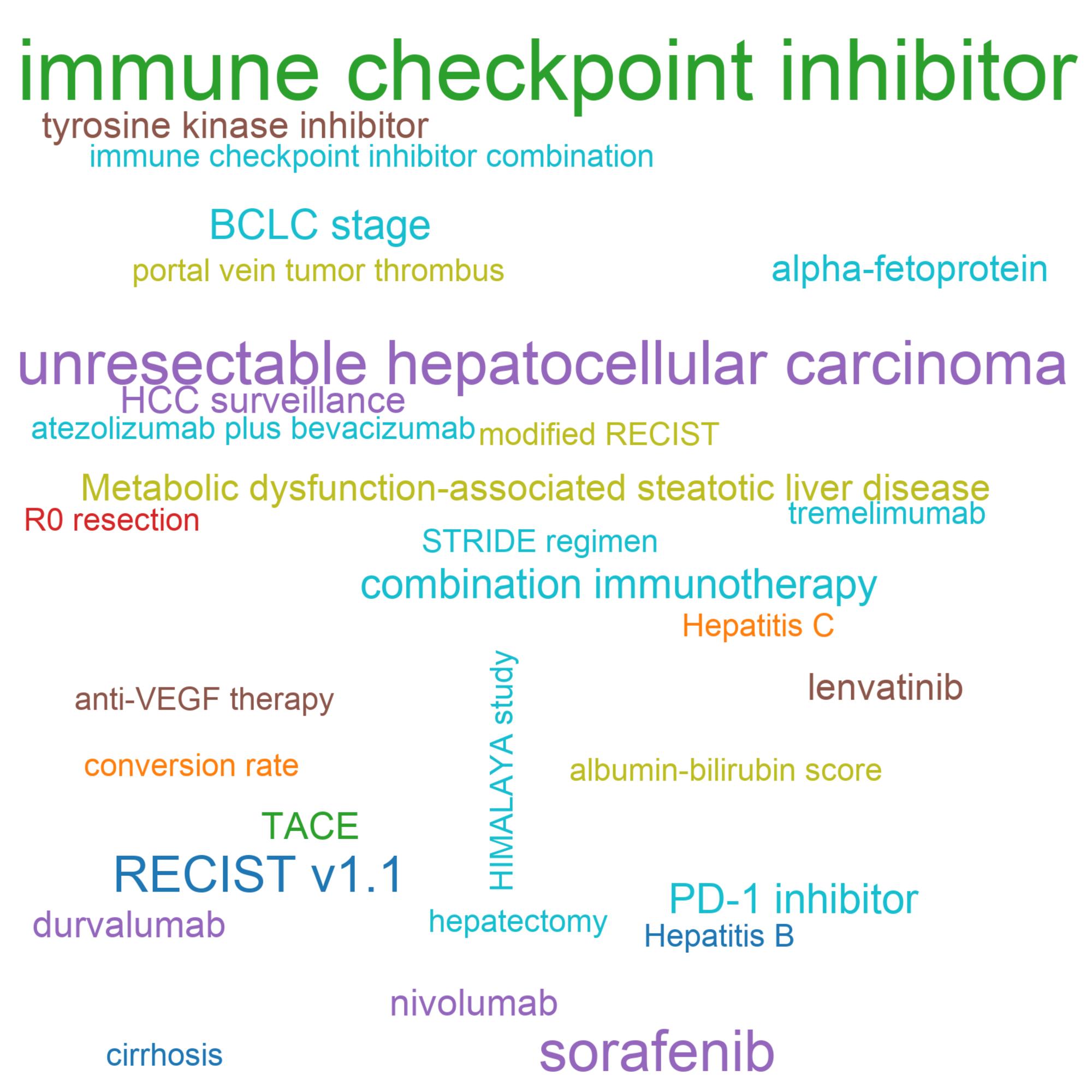
Among the highest 18-month-cited hepatocellular carcinoma treatment and prognosis papers, the informative topic landscape is heavily centered around advanced therapies and clinical trial structuring. Immune checkpoint inhibitors lead the cohort (normalized frequency 0.30), reflecting the field's continuous focus on immunotherapies as standard-of-care frameworks. Unresectable hepatocellular carcinoma (0.20) and sorafenib (0.18) remain highly prominent, with sorafenib largely serving as the benchmark comparator in major systemic therapy trials. Important clinical trial criteria such as RECIST v1.1 (0.14) and staging frameworks like BCLC stage (0.10) highlight the rigorous methodological foundation of the top-cited literature. A second tier of concepts clusters around specific regimens and emerging topics, including PD-1 inhibitors (0.10), combination immunotherapy (0.10), HCC surveillance (0.08), and TACE (0.08). Notably, metabolic dysfunction-associated steatotic liver disease (0.08) has emerged strongly, pointing to a shifting etiology underlying HCC that researchers are actively investigating. Together, the pattern portrays a field where high-impact 2024 publications debate systemic immuno-oncology strategies for unresectable disease, refine trial response evaluations, and increasingly account for metabolic drivers in patient cohorts.
How Did Topics Shift from the Class of 2025 to the Class of 2026?
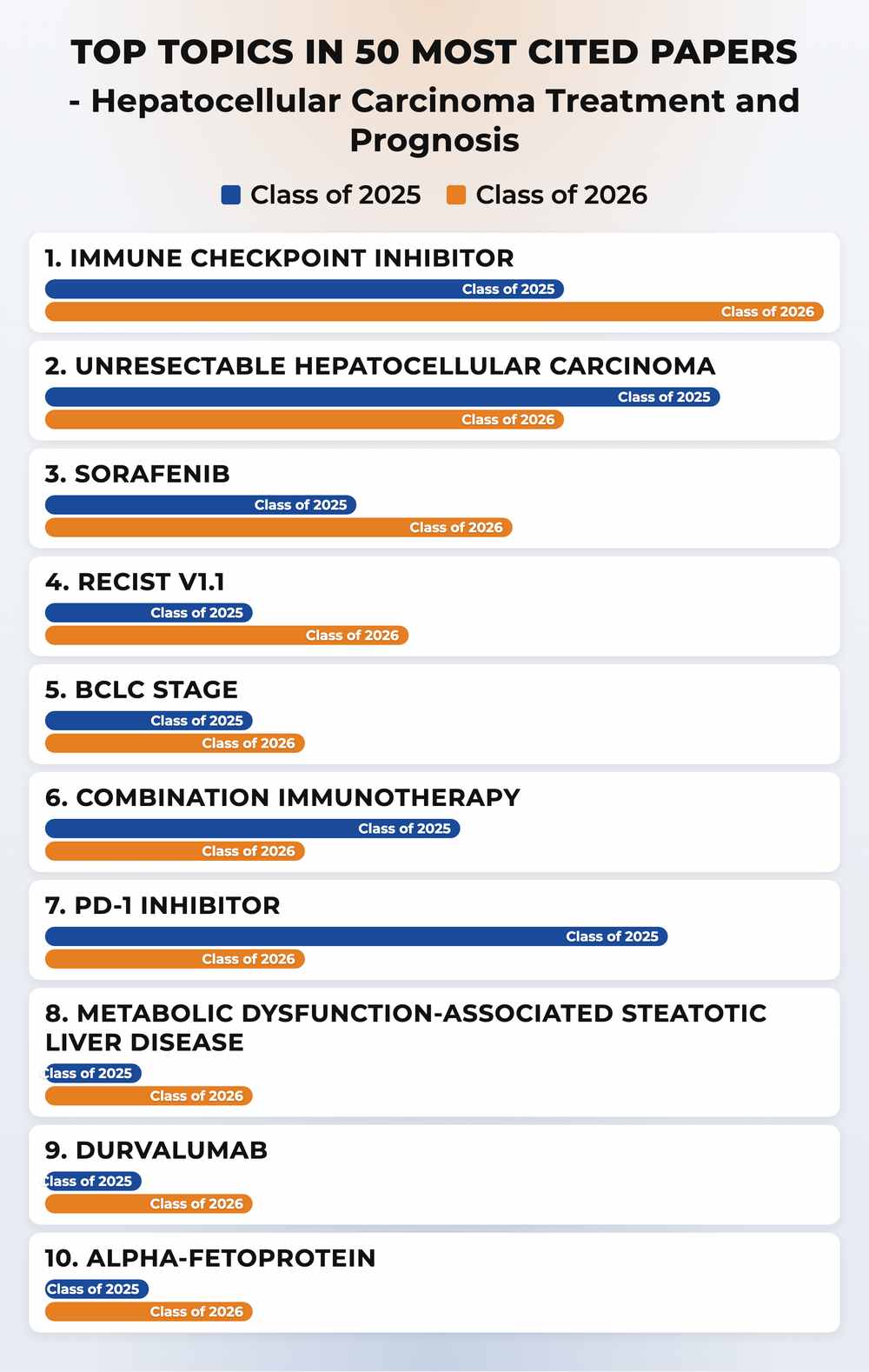
Comparing normalized concept frequencies between the Class of 2025 (2023 publications) and Class of 2026 (2024 publications) reveals a cohort pivoting toward broader immune checkpoint inhibitor strategies and metabolic etiologies, while certain specific inhibitors and regional therapies retreat. Immune checkpoint inhibitors showed the largest gain, rising from 0.20 to 0.30, underscoring the solidifying role of immunotherapy in advanced HCC. Interestingly, metabolic dysfunction-associated steatotic liver disease emerged from zero to a 0.08 normalized frequency, highlighting rapid recognition of metabolic drivers in recent highly cited studies. RECIST v1.1, sorafenib, and durvalumab also demonstrated notable gains (each +0.06), reinforcing a focus on structured trial evaluations and established comparators. Conversely, several targeted agents and locoregional therapies receded among the top-ranked concept set. Lenvatinib and PD-1 inhibitors both saw steep declines of -0.14, while transarterial chemoembolization (TACE) dropped by -0.10, and tyrosine kinase inhibitors declined by -0.08. Unresectable hepatocellular carcinoma also decreased slightly (-0.06). These shifts suggest that while the field's center of gravity remains rooted in systemic therapy for advanced disease, the emphasis is moving from specific older kinase inhibitors or standalone PD-1 blockade toward broader immunotherapy classes, emerging metabolic risk factors, and novel combination trial readouts.
Methodology
PRI identifies high-impact research using a transparent, topic-agnostic framework applied consistently across scientific domains. Bibliographic records are drawn from OpenAlex, including publication dates, citation relationships, and document types.
This ranking covers the Class of 2026 cohort: journal articles published in 2024. Reviews and other non-article document types are excluded to ensure comparability.
Research impact is quantified with an 18-month post-publication citation window—the number of citing works published within 18 months of each paper's publication date. This metric captures early impact while controlling for publication age.
An LLM-based relevance classifier then reviews each candidate's title and abstract to confirm substantive alignment with the target domain. Only papers classified as relevant appear in the final ranking.
Zheng Su, Tinsley Li, Thematic Shifts in Early-High-Impact Cancer Genomics and Diagnostics Research: A Bibliometric and Semantic Analysis. bioRxiv 2026.07.04.736459; doi: https://doi.org/10.64898/2026.07.04.736459
Cite this ranking
Pepkio Research Index (PRI). Topics and Trends in Most Cited Hepatocellular Carcinoma Treatment and Prognosis Papers, Class of 2026. https://pri.pepkio.com/top-papers/hepatocellular-carcinoma-treatment-and-prognosis/2026. Accessed 2026-10-14.

Methodology
Zheng Su, Tinsley Li, Thematic Shifts in Early-High-Impact Cancer Genomics and Diagnostics Research: A Bibliometric and Semantic Analysis. bioRxiv 2026.07.04.736459; doi: https://doi.org/10.64898/2026.07.04.736459
Source data
The full ranking corpus and analysis files are openly available on an external repository. Please cite the dataset below when reusing this data.
View source dataset →PRI Team (2026). PRI results: HCC Treatment and Prognosis (T10073) — Class of 2025 and Class of 2026 cohorts. Figshare. https://doi.org/10.6084/m9.figshare.32902769