
What topics and trends defined most-cited Cancer Genomics and Diagnostics research in the Class of 2026?
Among early-high-impact cancer genomics and diagnostics papers, tumor heterogeneity, tumor microenvironment, copy number variation, and immune cell infiltration dominate the Class of 2026 cohort. Spatial transcriptomics, copy number variation, and immune cell infiltration rose sharply versus Class of 2025, while circulating tumor DNA, cell-free DNA, and liquid biopsy-focused studies declined most.
At a glance
- Field
- Cancer Genomics and Diagnostics
- Cohort label
- Class of 2026 (2024 publications)
- Papers analyzed
- 10,175
- Papers ranked
- 20
- Top topics in ranked papers
- Tumor heterogeneity, tumor microenvironment, copy number variation, immune cell infiltration
- Publication window
- Jan 1, 2024 – Dec 31, 2024
- Eligibility
- Research articles; reviews excluded
- Citation window
- 18 months post-publication
- 18m citation range
- 81–412
- Data source
- OpenAlex · Retrieved Jul 2026
- License
- CC BY 4.0
Rankings
20 papers ranked by 18-month citation count
Genomic data in the All of Us Research Program
Nature202410.1038/s41586-023-06957-x
A foundation model for clinical-grade computational pathology and rare cancers detection
Nature Medicine202410.1038/s41591-024-03141-0
A Cell-free DNA Blood-Based Test for Colorectal Cancer Screening
New England Journal of Medicine202410.1056/nejmoa2304714
Precision treatment in advanced hepatocellular carcinoma
Cancer Cell202410.1016/j.ccell.2024.01.007
ctDNA-based molecular residual disease and survival in resectable colorectal cancer
Nature Medicine202410.1038/s41591-024-03254-6
Origins and impact of extrachromosomal DNA
Nature202410.1038/s41586-024-08107-3
Tumour evolution and microenvironment interactions in 2D and 3D space
Nature202410.1038/s41586-024-08087-4
A pan-cancer analysis of the microbiome in metastatic cancer
Cell202410.1016/j.cell.2024.03.021
The genomic landscape of 2,023 colorectal cancers
Nature202410.1038/s41586-024-07747-9
ClinVar: updates to support classifications of both germline and somatic variants
Nucleic Acids Research202410.1093/nar/gkae1090
Transient loss of Polycomb components induces an epigenetic cancer fate
Nature202410.1038/s41586-024-07328-w
Insights for precision oncology from the integration of genomic and clinical data of 13,880 tumors from the 100,000 Genomes Cancer Programme
Nature Medicine202410.1038/s41591-023-02682-0
Prognostic genome and transcriptome signatures in colorectal cancers
Nature202410.1038/s41586-024-07769-3
Single-cell and spatial transcriptomics analysis of non-small cell lung cancer
Nature Communications202410.1038/s41467-024-48700-8
Priming agents transiently reduce the clearance of cell-free DNA to improve liquid biopsies
Science202410.1126/science.adf2341
A deep-learning framework to predict cancer treatment response from histopathology images through imputed transcriptomics
Nature Cancer202410.1038/s43018-024-00793-2
Genetic expression in cancer research: Challenges and complexity
Gene Reports202410.1016/j.genrep.2024.102042
Mime: A flexible machine-learning framework to construct and visualize models for clinical characteristics prediction and feature selection
Computational and Structural Biotechnology Journal202410.1016/j.csbj.2024.06.035
Enhancing transcription–replication conflict targets ecDNA-positive cancers
Nature202410.1038/s41586-024-07802-5
Integrative single-cell analysis of human colorectal cancer reveals patient stratification with distinct immune evasion mechanisms
Nature Cancer202410.1038/s43018-024-00807-z
Topic trends
Dominant research themes and year-over-year shifts in Cancer Genomics and Diagnostics
What Topics Define the Class of 2026?
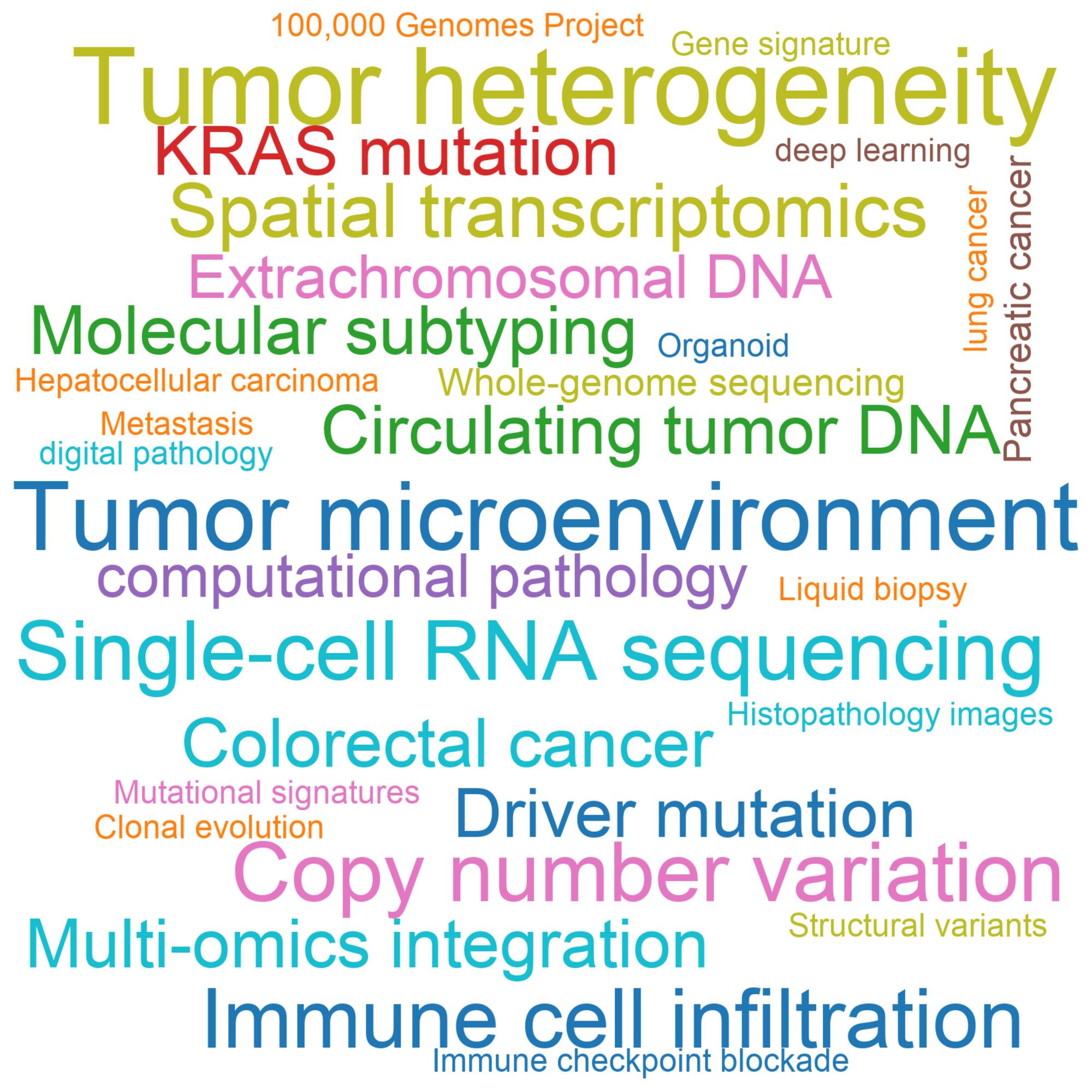
The word cloud of canonical topics across the 50 highest 18-month-cited papers in cancer genomics and diagnostics reveals a field oriented toward integrative, clinically actionable molecular characterization rather than single-modality assays. Tumor heterogeneity stands out as the most frequently mentioned canonical topic, appearing in 10 of 50 papers (normalized frequency 0.20), reflecting growing emphasis on tumor evolution and subclonal diversity. Tumor microenvironment (9 mentions), copy number variation (7), immune cell infiltration (7), and single-cell RNA sequencing (7) form a second tier of dominant themes, signaling convergence between tissue genomics, spatial profiling, and immune contexture. Larger type further highlights spatial transcriptomics, circulating tumor DNA, colorectal cancer, driver mutation, and KRAS mutation—topics that cluster around comprehensive profiling pipelines and targeted therapy selection. Smaller but visible terms—including molecular subtyping, multi-omics integration, and extrachromosomal DNA—suggest that influential 2024 publications increasingly frame cancer diagnostics as multi-layered data integration problems spanning DNA, RNA, imaging, and clinical outcome endpoints.
How Did Topics Shift from the Class of 2025 to the Class of 2026?
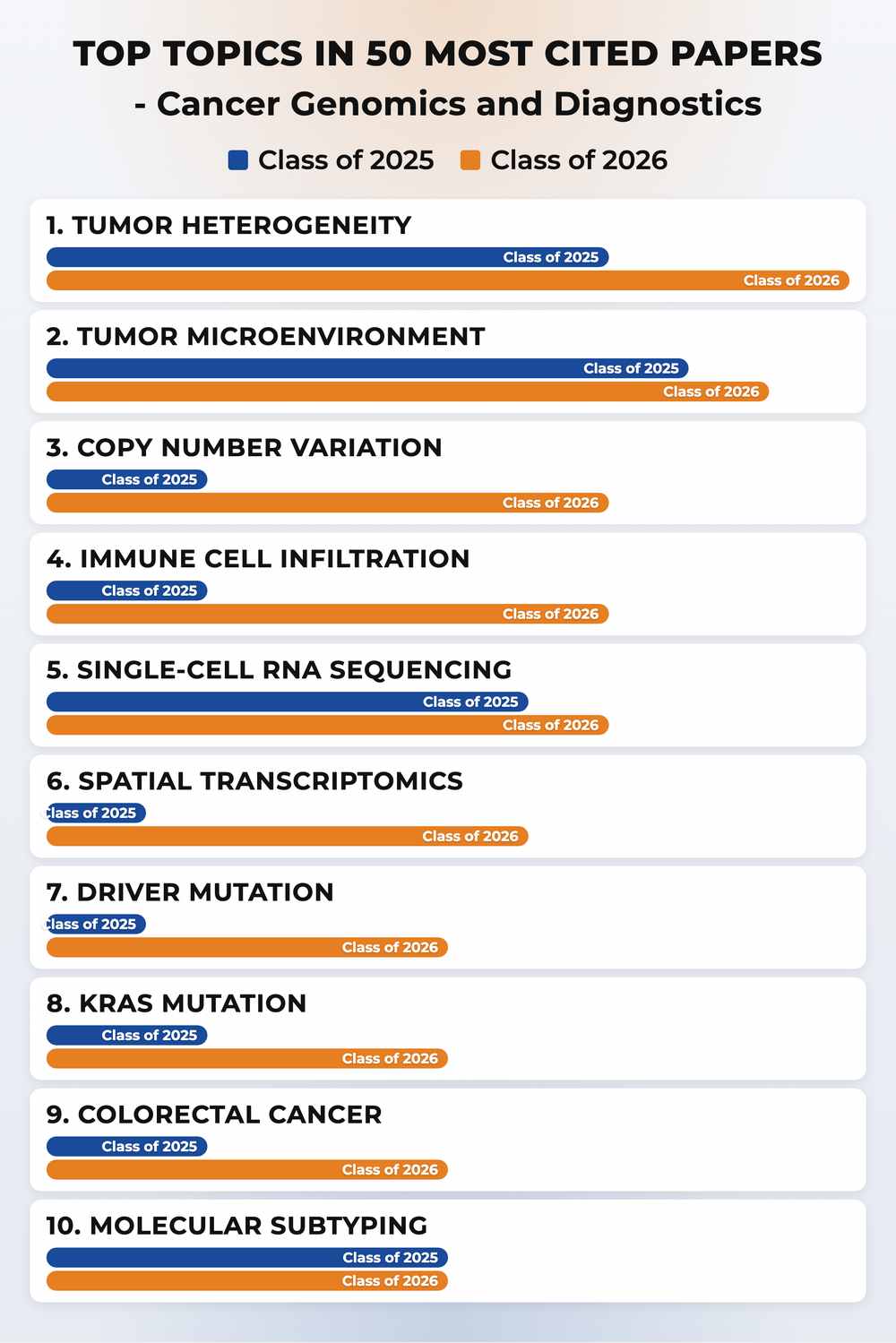
Comparing normalized concept frequencies between the Class of 2025 (2023 publications) and Class of 2026 (2024 publications) cohorts shows a clear reorientation of early-high-impact research priorities. Immune cell infiltration and copy number variation exhibited the largest gains (+0.10 normalized frequency; 2 versus 7 papers), followed by spatial transcriptomics (+0.10; 1 versus 6), and driver mutation (+0.08; 1 versus 5). The topic evolution card underscores that Class of 2026 bars extend furthest for tumor heterogeneity, tumor microenvironment, copy number variation, and immune cell infiltration—topics aligned with single-cell sequencing, spatial genomics, and precision oncology infrastructure. Conversely, several themes prominent in the Class of 2025 cohort receded: circulating tumor DNA (−0.12), cell-free DNA (-0.06), liquid biopsy (-0.04), and immune checkpoint blockade (-0.04). Together, these shifts suggest that the most-cited 2024 papers emphasize comprehensive spatial and single-cell platforms, tumor–immune biology, and disease-specific large-cohort studies, while some earlier liquid biopsy and prognostic framing lost ground among early-high-impact work.
Methodology
PRI identifies high-impact research using a transparent, topic-agnostic framework applied consistently across scientific domains. Bibliographic records are drawn from OpenAlex, including publication dates, citation relationships, and document types.
This ranking covers the Class of 2026 cohort: journal articles published in 2024. Reviews and other non-article document types are excluded to ensure comparability.
Research impact is quantified with an 18-month post-publication citation window—the number of citing works published within 18 months of each paper's publication date. This metric captures early impact while controlling for publication age.
An LLM-based relevance classifier then reviews each candidate's title and abstract to confirm substantive alignment with the target domain. Only papers classified as relevant appear in the final ranking.
Zheng Su, Tinsley Li, Thematic Shifts in Early-High-Impact Cancer Genomics and Diagnostics Research: A Bibliometric and Semantic Analysis. bioRxiv 2026.07.04.736459; doi: https://doi.org/10.64898/2026.07.04.736459
Cite this ranking
Pepkio Research Index (PRI). Topics and Trends in Most Cited Cancer Genomics and Diagnostics Papers, Class of 2026. https://pri.pepkio.com/top-papers/cancer-genomics-and-diagnostics/2026. Accessed 2026-10-14.

Methodology
Zheng Su, Tinsley Li, Thematic Shifts in Early-High-Impact Cancer Genomics and Diagnostics Research: A Bibliometric and Semantic Analysis. bioRxiv 2026.07.04.736459; doi: https://doi.org/10.64898/2026.07.04.736459
Source data
The full ranking corpus and analysis files are openly available on an external repository. Please cite the dataset below when reusing this data.
View source dataset →Pepkio Research Index (2026). Cancer Genomics and Diagnostics Top Papers, Class of 2026 [Data set]. Figshare. https://doi.org/10.6084/m9.figshare.32869871