
What topics and trends defined most-cited RNA modifications and cancer research in the Class of 2026?
The Class of 2026 highlights a strategic shift in cancer epitranscriptomics from global m6A cataloging toward non-m6A modifications like m5C and m7G. Research increasingly connects key regulatory machinery—notably FTO, METTL3, and NSUN2—to mRNA stability, ferroptosis resistance, lactylation, and metabolic vulnerabilities in gastrointestinal and liver cancers.
At a glance
- Field
- RNA modifications and cancer
- Cohort label
- Class of 2026 (2024 publications)
- Papers analyzed
- 13,650
- Papers ranked
- 20
- Top topics in ranked papers
- m6A modification, mRNA stability, 5-methylcytosine (m5C), MeRIP-seq, ferroptosis
- Publication window
- Jan 1, 2024 – Dec 31, 2024
- Eligibility
- Research articles; reviews excluded
- Citation window
- 18 months post-publication
- 18m citation range
- 47–128
- Data source
- OpenAlex · Retrieved Jul 2026
- License
- CC BY 4.0
Rankings
20 papers ranked by 18-month citation count
Histone lactylation-regulated METTL3 promotes ferroptosis via m6A-modification on ACSL4 in sepsis-associated lung injury
Redox Biology202410.1016/j.redox.2024.103194
Lactylation‐Driven IGF2BP3‐Mediated Serine Metabolism Reprogramming and RNA m6A—Modification Promotes Lenvatinib Resistance in HCC
Advanced Science202410.1002/advs.202401399
Methylation of GPRC5A promotes liver metastasis and docetaxel resistance through activating mTOR signaling pathway in triple negative breast cancer
Drug Resistance Updates202410.1016/j.drup.2024.101063
The modified RNA base acp3U is an attachment site for N-glycans in glycoRNA
Cell202410.1016/j.cell.2024.07.044
Metabolic Recoding of NSUN2‐Mediated m<sup>5</sup>C Modification Promotes the Progression of Colorectal Cancer via the NSUN2/YBX1/m<sup>5</sup>C‐ENO1 Positive Feedback Loop
Advanced Science202410.1002/advs.202309840
Prediction of m6A and m5C at single-molecule resolution reveals a transcriptome-wide co-occurrence of RNA modifications
Nature Communications202410.1038/s41467-024-47953-7
Ultrafast bisulfite sequencing detection of 5-methylcytosine in DNA and RNA
Nature Biotechnology202410.1038/s41587-023-02034-w
RNA m5C oxidation by TET2 regulates chromatin state and leukaemogenesis
Nature202410.1038/s41586-024-07969-x
YTHDF2 promotes ATP synthesis and immune evasion in B cell malignancies
Cell202410.1016/j.cell.2024.11.007
NSUN2 lactylation drives cancer cell resistance to ferroptosis through enhancing GCLC-dependent glutathione synthesis
Redox Biology202410.1016/j.redox.2024.103479
ALKBH5-mediated m6A modification of IL-11 drives macrophage-to-myofibroblast transition and pathological cardiac fibrosis in mice
Nature Communications202410.1038/s41467-024-46357-x
A non-canonical role for a small nucleolar RNA in ribosome biogenesis and senescence
Cell202410.1016/j.cell.2024.06.019
Lactylation-driven FTO targets CDK2 to aggravate microvascular anomalies in diabetic retinopathy
EMBO Molecular Medicine202410.1038/s44321-024-00025-1
5-methylcytosine methylation of MALAT1 promotes resistance to sorafenib in hepatocellular carcinoma through ELAVL1/SLC7A11-mediated ferroptosis
Drug Resistance Updates202410.1016/j.drup.2024.101181
tsRNA-GlyGCC promotes colorectal cancer progression and 5-FU resistance by regulating SPIB
Journal of Experimental & Clinical Cancer Research202410.1186/s13046-024-03132-6
Targeting the oncogenic m6A demethylase FTO suppresses tumourigenesis and potentiates immune response in hepatocellular carcinoma
Gut202410.1136/gutjnl-2024-331903
IGF2BP3 promotes mRNA degradation through internal m7G modification
Nature Communications202410.1038/s41467-024-51634-w
A hybrid residue based sequential encoding mechanism with XGBoost improved ensemble model for identifying 5-hydroxymethylcytosine modifications
Scientific Reports202410.1038/s41598-024-71568-z
DDX21 mediates co-transcriptional RNA m6A modification to promote transcription termination and genome stability
Molecular Cell202410.1016/j.molcel.2024.03.006
METTL16-SENP3-LTF axis confers ferroptosis resistance and facilitates tumorigenesis in hepatocellular carcinoma
Journal of Hematology & Oncology202410.1186/s13045-024-01599-6
Topic trends
Dominant research themes and year-over-year shifts in RNA modifications and cancer
What Topics Define the Class of 2026?
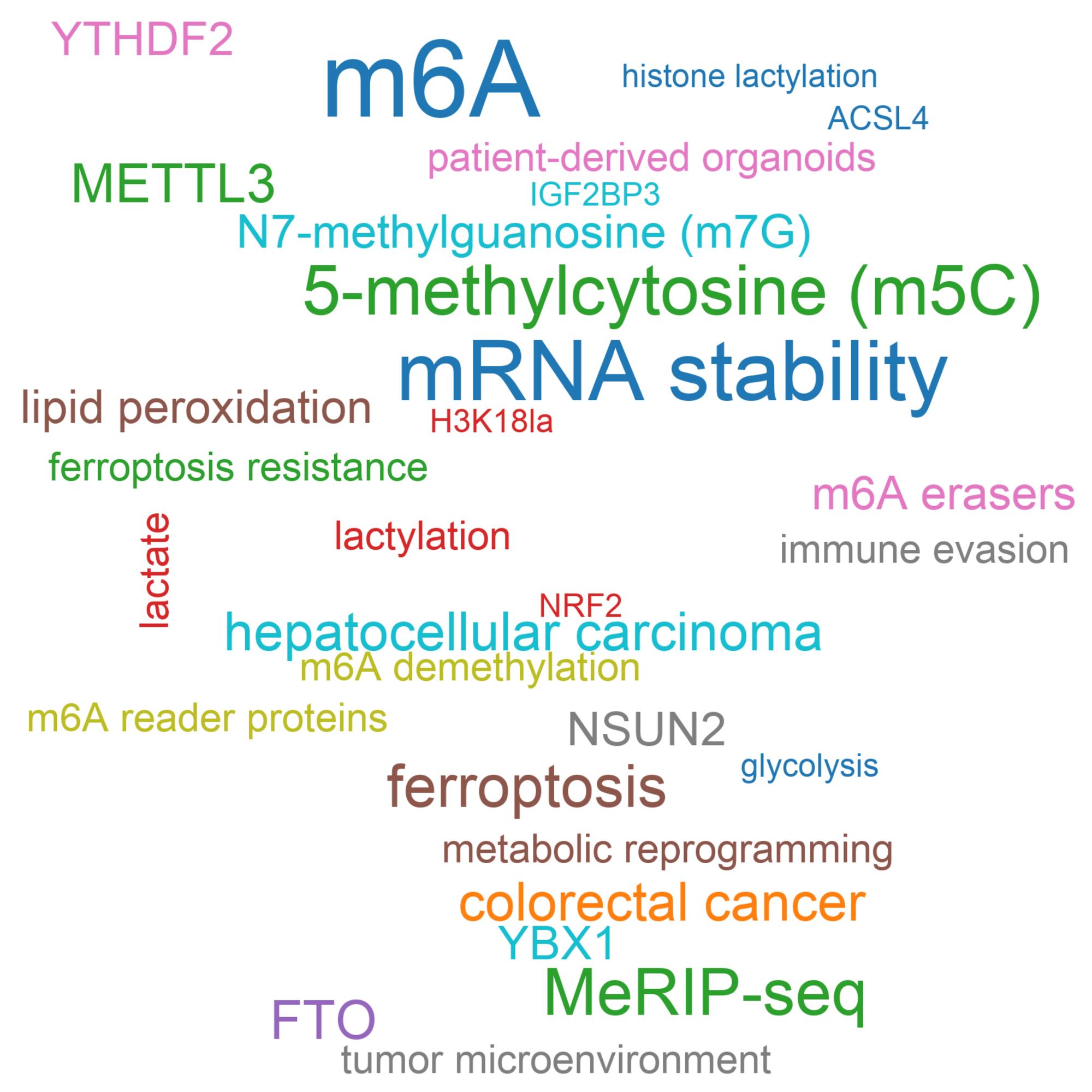
Epitranscriptomic modifications have emerged as pivotal regulators of oncogenesis, gene expression, and therapeutic response. In the Class of 2026 cohort, N6-methyladenosine (m6A) remains the cornerstone of RNA modification research, present in 50% of the top-ranked papers. However, the field has broadened substantially to encompass a sophisticated network of regulatory machinery and non-m6A epitranscriptomic marks. Key writers and erasers dominate current mechanistic investigations, led by the m6A demethylase FTO and writer enzyme METTL3 (each present in 14.7% of papers), alongside m6A readers YTHDF2 and YBX1 (11.8%). These regulators modulate post-transcriptional gene dynamics, with mRNA stability being the primary functional outcome investigated in 32.4% of top studies. Beyond m6A, non-m6A modifications are gaining major traction, particularly 5-methylcytosine (m5C, 23.5%) regulated by NSUN2, and N7-methylguanosine (m7G, 11.8%). High-throughput profiling via MeRIP-seq (20.6%) serves as the principal methodological backbone for mapping modification sites across transcripts. Pathologically, these modification cascades are heavily contextualized within gastrointestinal and hepatic malignancies, notably hepatocellular carcinoma (14.7%) and colorectal cancer (14.7%), where RNA modification machinery directly drives metabolic reprogramming and iron-dependent ferroptosis pathways.
How Did Topics Shift from the Class of 2025 to the Class of 2026?
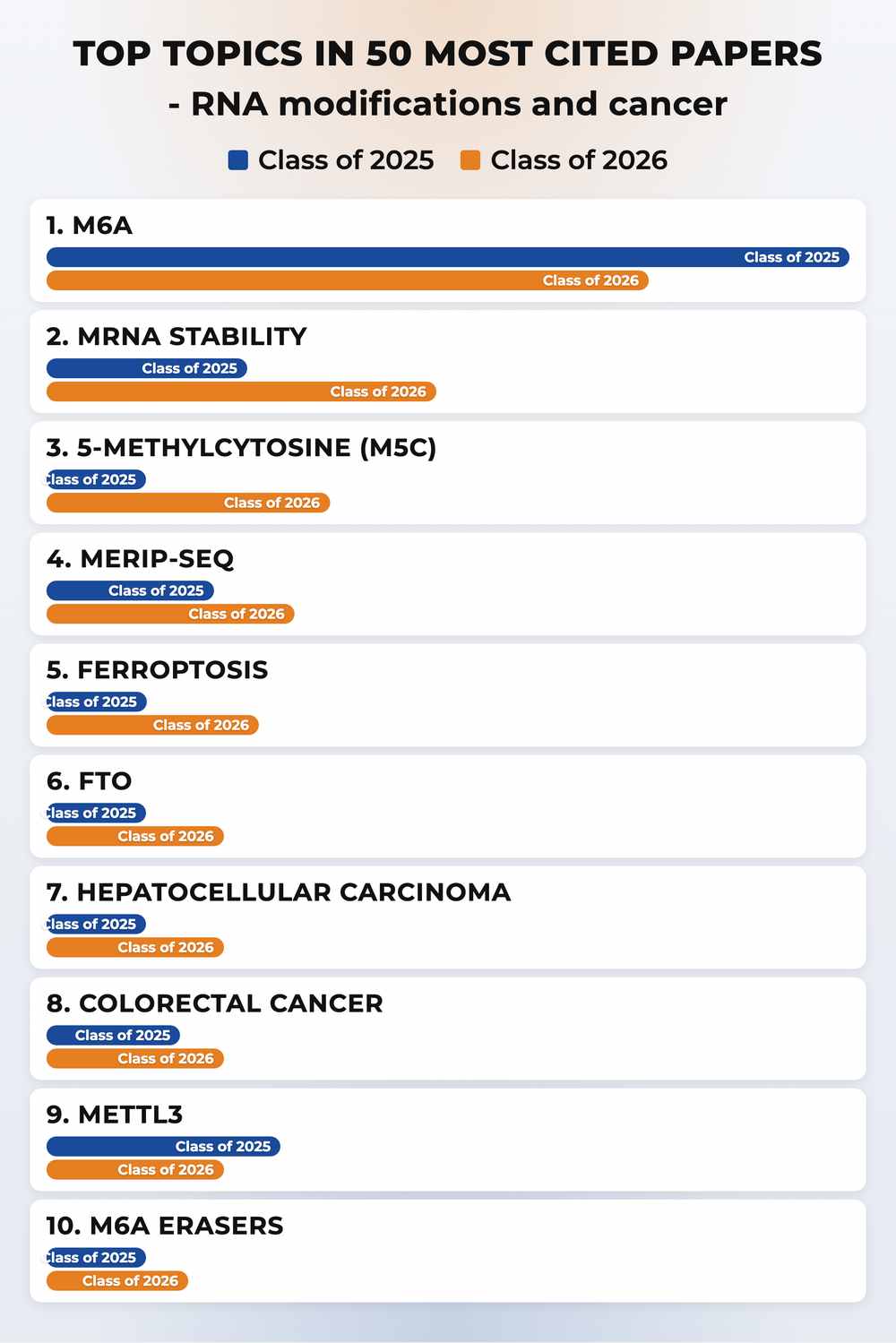
Comparing the Class of 2025 (2023 publications) to the Class of 2026 (2024 publications) reveals a clear maturation of the epitranscriptomics field. While broad m6A mentions normalized slightly from 66.7% to 50.0%, research sharply redirected toward specialized modification machinery, non-m6A marks, and metabolic cross-talk. The most prominent growth occurred in 5-methylcytosine (m5C) studies, surging over 4-fold from 5.6% to 23.5% of top publications. Similarly, targeted interest in the m6A eraser FTO jumped 5-fold from 2.8% to 14.7%. Functional investigations also expanded rapidly into ferroptosis and lipid peroxidation (rising to 17.6%), highlighting how RNA modifications alter cellular sensitivity to oxidative stress and iron-dependent cell death. Furthermore, 2024 introduced novel metabolic and epigenetic intersections, including histone lactylation (H3K18la), lactate signaling, and tRNA-derived fragments, alongside translational tools such as patient-derived organoids and single-cell RNA sequencing. Conversely, generic mentions of anti-PD-1 therapy and broader microenvironment terms saw relative declines as researchers prioritized granular molecular mechanisms over broad phenomenological descriptions. Overall, the cohort shift reflects a transition from global m6A cataloging toward multi-mark epitranscriptomics and metabolic tumor vulnerabilities.
Methodology
PRI identifies high-impact research using a transparent, topic-agnostic framework applied consistently across scientific domains. Bibliographic records are drawn from OpenAlex, including publication dates, citation relationships, and document types.
This ranking covers the Class of 2026 cohort: journal articles published in 2024. Reviews and other non-article document types are excluded to ensure comparability.
Research impact is quantified with an 18-month post-publication citation window—the number of citing works published within 18 months of each paper's publication date. This metric captures early impact while controlling for publication age.
An LLM-based relevance classifier then reviews each candidate's title and abstract to confirm substantive alignment with the target domain. Only papers classified as relevant appear in the final ranking.
Zheng Su, Tinsley Li, Thematic Shifts in Early-High-Impact Cancer Genomics and Diagnostics Research: A Bibliometric and Semantic Analysis. bioRxiv 2026.07.04.736459; doi: https://doi.org/10.64898/2026.07.04.736459
Cite this ranking
Pepkio Research Index (PRI). Topics and Trends in Most Cited RNA modifications and cancer Papers, Class of 2026. https://pri.pepkio.com/top-papers/rna-modifications-and-cancer/2026. Accessed 2026-10-16.

Methodology
Zheng Su, Tinsley Li, Thematic Shifts in Early-High-Impact Cancer Genomics and Diagnostics Research: A Bibliometric and Semantic Analysis. bioRxiv 2026.07.04.736459; doi: https://doi.org/10.64898/2026.07.04.736459