
What topics and trends defined most-cited Microbial Natural Products and Biosynthesis research in the Class of 2026?
The Class of 2026 in Microbial Natural Products and Biosynthesis reflects a shift from pure genome mining toward functional validation. While biosynthetic gene clusters remain foundational, research is increasingly focusing on heterologous expression, pathway engineering, and data-driven approaches using natural product databases.
At a glance
- Field
- Microbial Natural Products and Biosynthesis
- Cohort label
- Class of 2026 (2024 publications)
- Papers analyzed
- 4,273
- Papers ranked
- 20
- Top topics in ranked papers
- Biosynthetic gene clusters, heterologous expression, cytochrome P450, RiPPs
- Publication window
- Jan 1, 2024 – Dec 31, 2024
- Eligibility
- Research articles; reviews excluded
- Citation window
- 18 months post-publication
- 18m citation range
- 25–184
- Data source
- OpenAlex · Retrieved September 2026
- License
- CC BY 4.0
Rankings
20 papers ranked by 18-month citation count
MIBiG 4.0: advancing biosynthetic gene cluster curation through global collaboration
Nucleic Acids Research202410.1093/nar/gkae1115
COCONUT 2.0: a comprehensive overhaul and curation of the collection of open natural products database
Nucleic Acids Research202410.1093/nar/gkae1063
Characterization and heterologous reconstitution of Taxus biosynthetic enzymes leading to baccatin III
Science202410.1126/science.adj3484
Sophisticated natural products as antibiotics
Nature202410.1038/s41586-024-07530-w
The Natural Products Atlas 3.0: extending the database of microbially derived natural products
Nucleic Acids Research202410.1093/nar/gkae1093
Complete biosynthesis of QS-21 in engineered yeast
Nature202410.1038/s41586-024-07345-9
Complete biosynthesis of the potent vaccine adjuvant QS-21
Nature Chemical Biology202410.1038/s41589-023-01538-5
Natural Products Have Increased Rates of Clinical Trial Success throughout the Drug Development Process
Journal of Natural Products202410.1021/acs.jnatprod.4c00581
Evolution-inspired engineering of nonribosomal peptide synthetases
Science202410.1126/science.adg4320
Reconstitution of early paclitaxel biosynthetic network
Nature Communications202410.1038/s41467-024-45574-8
Evolution-guided engineering of trans -acyltransferase polyketide synthases
Science202410.1126/science.adj7621
Cell-free biosynthesis and engineering of ribosomally synthesized lanthipeptides
Nature Communications202410.1038/s41467-024-48726-y
Green synthesis of zinc oxide nanoparticles (ZnO-NPs) by Streptomyces baarnensis and its active metabolite (Ka): a promising combination against multidrug-resistant ESKAPE pathogens and cytotoxicity
BMC Microbiology202410.1186/s12866-024-03392-4
Effectiveness of molecular fingerprints for exploring the chemical space of natural products
Journal of Cheminformatics202410.1186/s13321-024-00830-3
BGC Atlas: a web resource for exploring the global chemical diversity encoded in bacterial genomes
Nucleic Acids Research202410.1093/nar/gkae953
Advanced technologies targeting isolation and characterization of natural products
TrAC Trends in Analytical Chemistry202410.1016/j.trac.2024.117711
A widespread family of ribosomal peptide metallophores involved in bacterial adaptation to metal stress
Proceedings of the National Academy of Sciences202410.1073/pnas.2408304121
Structures and mechanism of condensation in non-ribosomal peptide synthesis
Nature202410.1038/s41586-024-08417-6
MetOrigin 2.0: Advancing the discovery of microbial metabolites and their origins
iMeta202410.1002/imt2.246
A treasure trove of 1034 actinomycete genomes
Nucleic Acids Research202410.1093/nar/gkae523
Topic trends
Dominant research themes and year-over-year shifts in Microbial Natural Products and Biosynthesis
What Topics Define the Class of 2026?
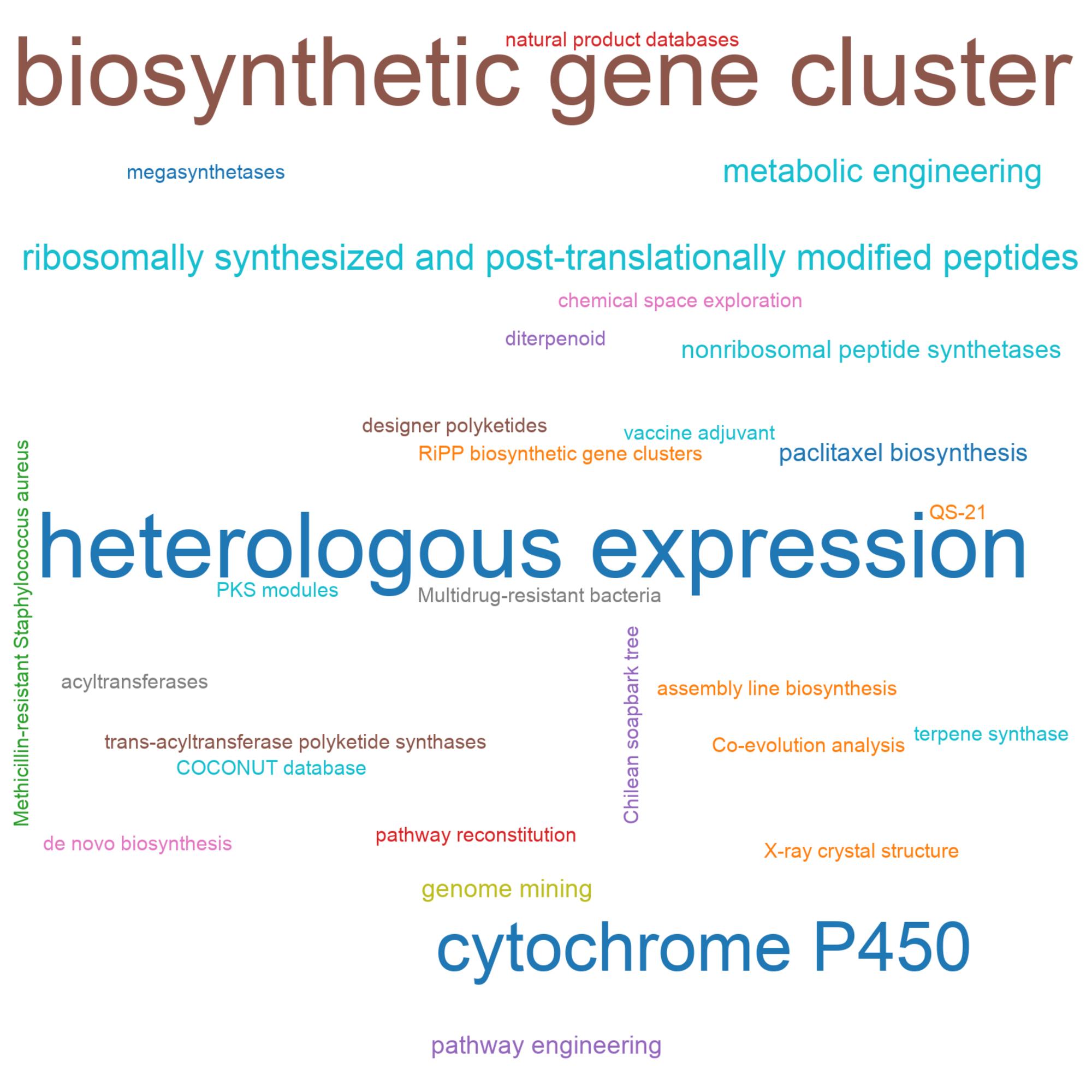
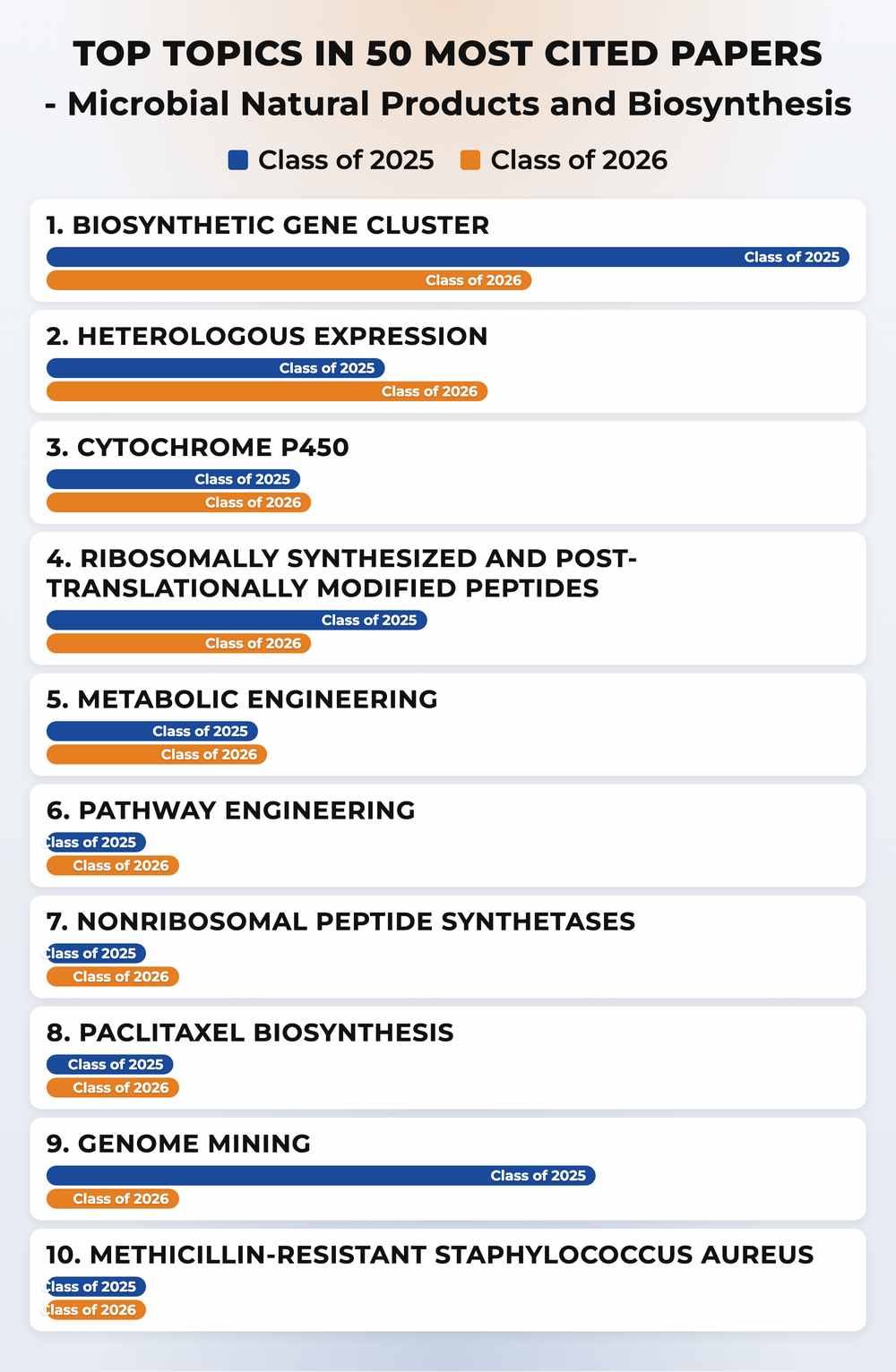
The Class of 2026 is characterized by a strong emphasis on the functional characterization and optimization of microbial natural products. The landscape is dominated by research on **biosynthetic gene clusters** (present in 23.9% of top papers) and **heterologous expression** (21.7%), underscoring the critical need to activate and produce cryptic metabolites. Enzymatic mechanisms and tailored modifications also feature prominently, with **cytochrome P450** enzymes (13.0%) and **ribosomally synthesized and post-translationally modified peptides (RiPPs)** (13.0%) representing key areas of structural diversification. Furthermore, the robust presence of **metabolic engineering** (10.9%) and **nonribosomal peptide synthetases** (6.5%) indicates a persistent focus on rewiring cellular metabolism and deciphering complex modular assembly lines to discover novel bioactive compounds.
How Did Topics Shift from the Class of 2025 to the Class of 2026?
A compelling shift is underway from initial computational discovery to active downstream biosynthesis. The most striking decline was observed in **genome mining**, which fell precipitously from 27.1% to just 6.5%. Similarly, mentions of **biosynthetic gene clusters** contracted from 39.6% to 23.9%. Conversely, researchers are increasingly prioritizing experimental validation and production. **Heterologous expression** expanded 1.3-fold to 21.7%, while **pathway engineering** jumped more than 3-fold to 6.5%. The data also highlights a surge in computational infrastructure supporting this work: topics such as **natural product databases**, the **COCONUT database**, and **co-evolution analysis** emerged strongly in 2024 after being absent among top papers in the previous cohort, reflecting a maturation of the field toward more integrated, data-driven synthetic biology.
Methodology
PRI identifies high-impact research using a transparent, topic-agnostic framework applied consistently across scientific domains. Bibliographic records are drawn from OpenAlex, including publication dates, citation relationships, and document types.
This ranking covers the Class of 2026 cohort: journal articles published in 2024. Reviews and other non-article document types are excluded to ensure comparability.
Research impact is quantified with an 18-month post-publication citation window—the number of citing works published within 18 months of each paper's publication date. This metric captures early impact while controlling for publication age.
An LLM-based relevance classifier then reviews each candidate's title and abstract to confirm substantive alignment with the target domain. Only papers classified as relevant appear in the final ranking.
Zheng Su, Tinsley Li, Thematic Shifts in Early-High-Impact Cancer Genomics and Diagnostics Research: A Bibliometric and Semantic Analysis. bioRxiv 2026.07.04.736459; doi: https://doi.org/10.64898/2026.07.04.736459
Cite this ranking
Pepkio Research Index (PRI). Topics and Trends in Most Cited Microbial Natural Products and Biosynthesis Papers, Class of 2026. https://pri.pepkio.com/top-papers/microbial-natural-products-and-biosynthesis/2026. Accessed 2026-10-24.

Methodology
Zheng Su, Tinsley Li, Thematic Shifts in Early-High-Impact Cancer Genomics and Diagnostics Research: A Bibliometric and Semantic Analysis. bioRxiv 2026.07.04.736459; doi: https://doi.org/10.64898/2026.07.04.736459