
What topics and trends defined most-cited Fungal Biology and Applications research in the Class of 2026?
The Class of 2026 is defined by expanding research in arbuscular mycorrhizal symbiosis and medicinal mushroom polysaccharides. Plant growth promotion and mycorrhizal colonization surged as major growth drivers, while generic antioxidant activity screening contracted sharply in favor of targeted immunomodulatory and structural bioactivity mechanisms.
At a glance
- Field
- Fungal Biology and Applications
- Cohort label
- Class of 2026 (2024 publications)
- Papers analyzed
- 5,662
- Papers ranked
- 20
- Top topics in ranked papers
- Arbuscular mycorrhizal fungi, mycorrhizal colonization, mushroom polysaccharides, plant growth promotion, immunomodulation
- Publication window
- Jan 1, 2024 – Dec 31, 2024
- Eligibility
- Research articles; reviews excluded
- Citation window
- 18 months post-publication
- 18m citation range
- 31–146
- Data source
- OpenAlex · Retrieved Jul 2026
- License
- CC BY 4.0
Rankings
20 papers ranked by 18-month citation count
Cross-kingdom nutrient exchange in the plant–arbuscular mycorrhizal fungus–bacterium continuum
Nature Reviews Microbiology202410.1038/s41579-024-01073-7
Fungal bioremediation approaches for the removal of toxic pollutants: Mechanistic understanding for biorefinery applications
Chemosphere202410.1016/j.chemosphere.2024.141123
The enzyme patterns of Ascomycota and Basidiomycota fungi reveal their different functions in soil
Applied Soil Ecology202410.1016/j.apsoil.2024.105323
A genomic compendium of cultivated human gut fungi characterizes the gut mycobiome and its relevance to common diseases
Cell202410.1016/j.cell.2024.04.043
Mechanisms for plant growth promotion activated by Trichoderma in natural and managed terrestrial ecosystems
Microbiological Research202410.1016/j.micres.2024.127621
Edible mycelium bioengineered for enhanced nutritional value and sensory appeal using a modular synthetic biology toolkit
Nature Communications202410.1038/s41467-024-46314-8
A re-evaluation of Diaporthe: refining the boundaries of species and species complexes
Fungal Diversity202410.1007/s13225-024-00538-7
Glucan polysaccharides isolated from Lactarius hatsudake Tanaka mushroom: Structural characterization and in vitro bioactivities
Carbohydrate Polymers202410.1016/j.carbpol.2024.122171
Structural characteristics and intestinal flora metabolism mediated immunoregulatory effects of Lactarius deliciosus polysaccharide
International Journal of Biological Macromolecules202410.1016/j.ijbiomac.2024.135063
Assessing the nutritional quality of Pleurotus ostreatus (oyster mushroom)
Frontiers in Nutrition202410.3389/fnut.2023.1279208
Meta‐analysis reveals globally sourced commercial mycorrhizal inoculants fall short
New Phytologist202410.1111/nph.20278
Biological Activities of Ethanol Extracts of Hericium erinaceus Obtained as a Result of Optimization Analysis
Foods202410.3390/foods13101560
The gut microbiota‐aromatic hydrocarbon receptor (AhR) axis mediates the anticolitic effect of polyphenol‐rich extracts from <i>Sanghuangporus</i>
iMeta202410.1002/imt2.180
Anti-inflammatory and immunomodulatory properties of polysaccharides in mushrooms
Current Opinion in Biotechnology202410.1016/j.copbio.2024.103076
<i>Ganoderma lucidum</i> Polysaccharide Supplementation Significantly Activates T-Cell-Mediated Antitumor Immunity and Enhances Anti-PD-1 Immunotherapy Efficacy in Colorectal Cancer
Journal of Agricultural and Food Chemistry202410.1021/acs.jafc.3c08385
Ganoderma lucidum polysaccharide hydrogel accelerates diabetic wound healing by regulating macrophage polarization
International Journal of Biological Macromolecules202410.1016/j.ijbiomac.2024.129682
Fungal diversity notes 1818–1918: taxonomic and phylogenetic contributions on genera and species of fungi
Fungal Diversity202410.1007/s13225-024-00541-y
A secondary mechanism of action for triazole antifungals in Aspergillus fumigatus mediated by hmg1
Nature Communications202410.1038/s41467-024-48029-2
Visualization and classification of mushroom species with multi-feature fusion of metaheuristics-based convolutional neural network model
Applied Soft Computing202410.1016/j.asoc.2024.111936
Structural characterization of polysaccharide from an edible fungus Dictyophora indusiata and the remodel function of gut microbiota in inflammatory mice
Carbohydrate Polymers202410.1016/j.carbpol.2024.123141
Topic trends
Dominant research themes and year-over-year shifts in Fungal Biology and Applications
What Topics Define the Class of 2026?
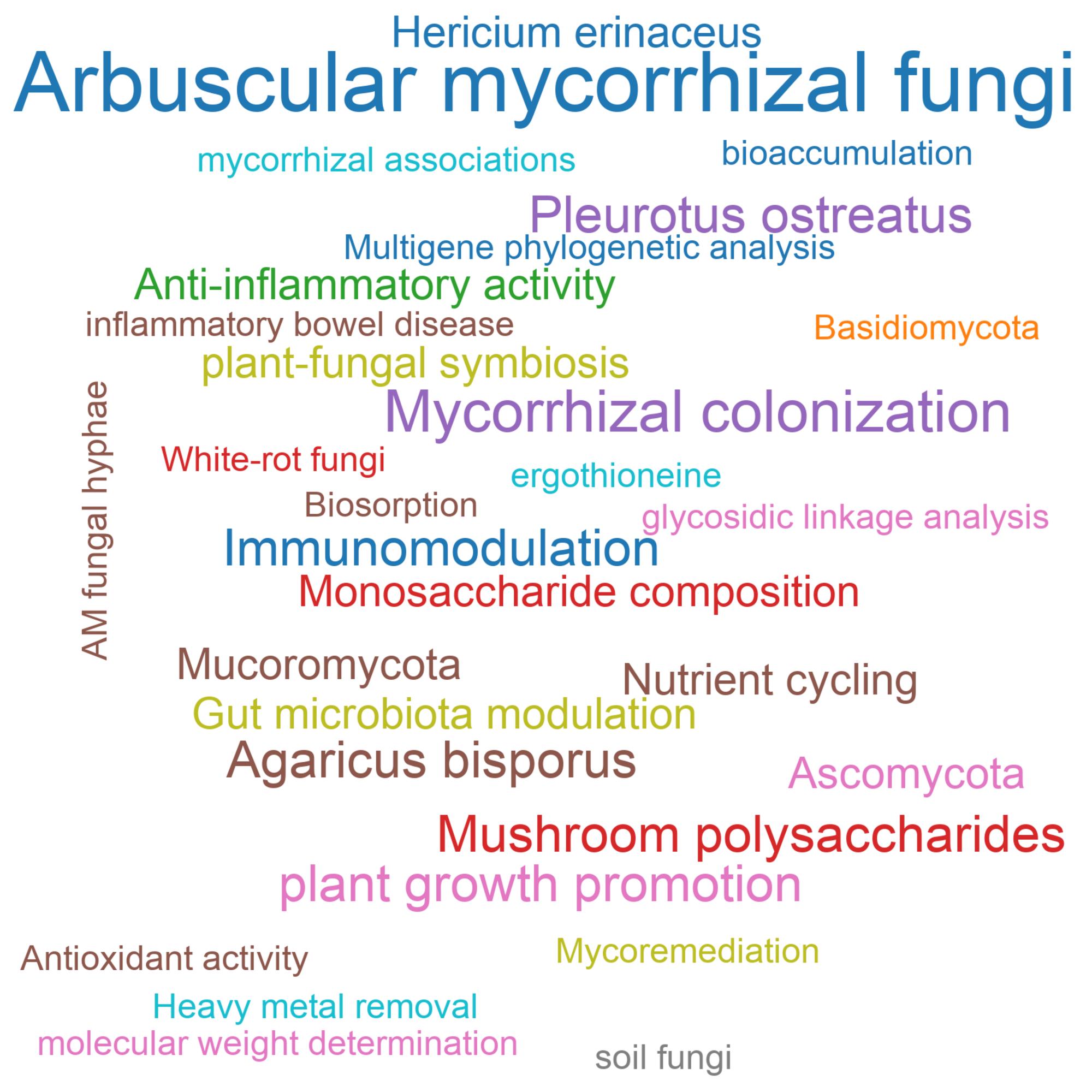
The Class of 2026 in fungal biology is anchored by two major research fronts: symbiotic mycorrhizal ecosystems and mushroom-derived bioactive compounds. Arbuscular mycorrhizal fungi (AMF) dominate the literature, appearing in 20% of top-ranked publications, supported by related investigations into mycorrhizal colonization (10%), plant growth promotion (8%), and soil nutrient cycling (6%). These studies emphasize cross-kingdom nutrient exchange, particularly nitrogen and phosphorus transfer, highlighting the crucial role of fungal-bacterial-plant continua in sustainable agriculture and soil health. Concurrently, applied mycology exhibits high concentration in medicinal mushroom polysaccharides (8%), immunomodulation (8%), and anti-inflammatory bioactivities (6%). Research centered on high-value species like Agaricus bisporus, Pleurotus ostreatus, and Hericium erinaceus underscores structural characterization and monosaccharide profiling to elucidate therapeutic mechanisms against chronic metabolic and inflammatory conditions. Additional clusters address environmental bioremediation, including heavy metal biosorption and industrial pollutant degradation, alongside emerging computational tools such as artificial neural networks and genetic algorithms for species identification and bio-process optimization.
How Did Topics Shift from the Class of 2025 to the Class of 2026?
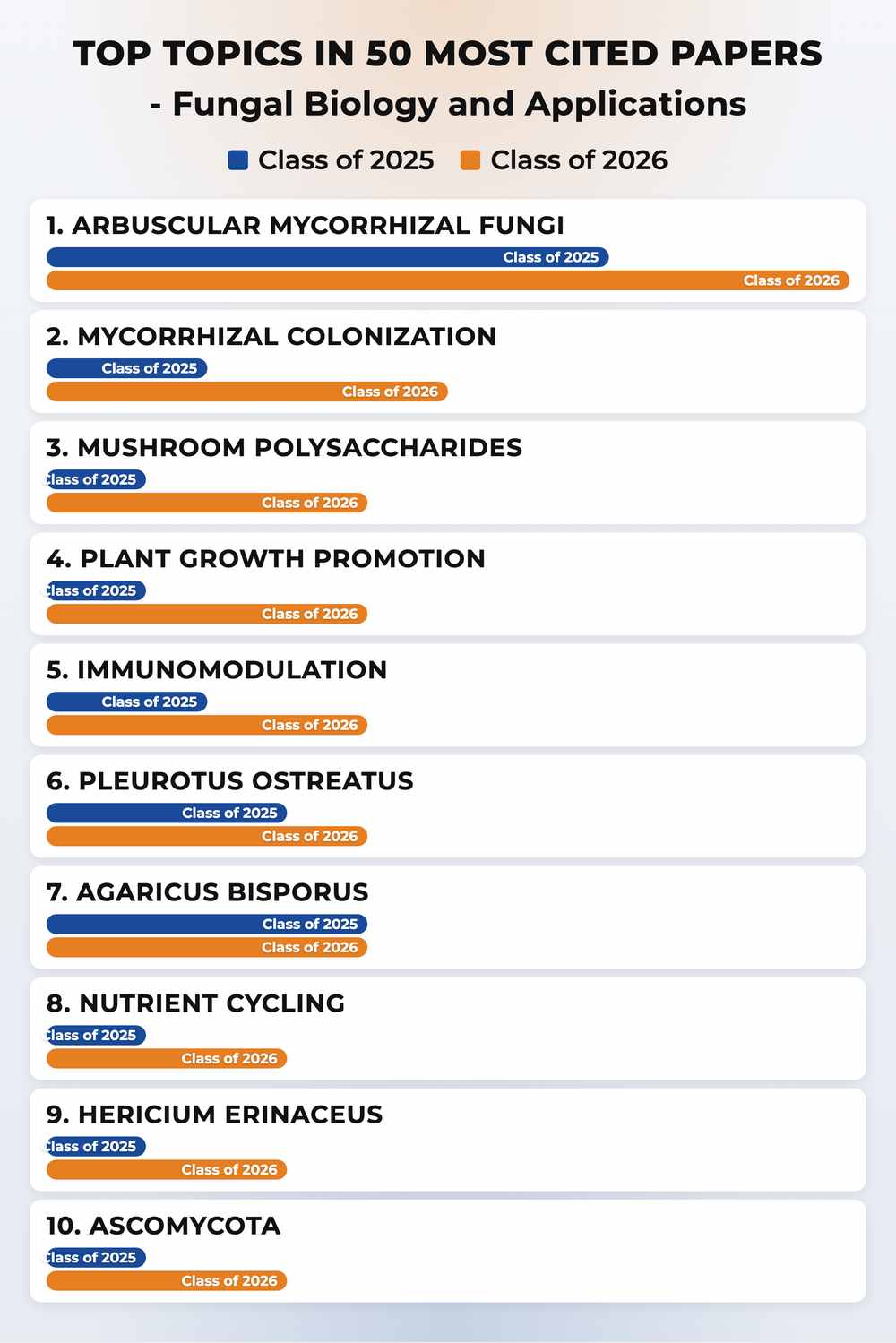
Comparing the Class of 2026 to the preceding Class of 2025 reveals a distinct shift from descriptive bioactivity screens toward targeted functional application and agricultural sustainability. The most prominent risers include mushroom polysaccharides (+8% share) and plant growth promotion (+8% share), both jumping from zero representation in 2023 to top-tier frequency in 2024. Mycorrhizal colonization also surged from 4% to 10% (a 2.5-fold increase), alongside new entries in nutrient cycling (6%) and environmental biosorption (4%), reflecting intensified focus on fungal involvement in climate resilience and agro-ecosystem productivity. Conversely, broad antioxidant activity screens experienced the largest contraction, dropping sharply from 12% in 2023 to 4% in 2024 (-8% net share). General gut microbiota modulation also contracted slightly from 8% to 6%, while traditional phylogenetic multigene analyses declined from 6% to 4%. This reallocation of research attention indicates a maturation of the field, as investigators pivot away from initial antioxidant capacity assays to interrogate specific molecular pathways, structural polysaccharide immunomodulation, and symbiotic bio-fertilization mechanisms.
Methodology
PRI identifies high-impact research using a transparent, topic-agnostic framework applied consistently across scientific domains. Bibliographic records are drawn from OpenAlex, including publication dates, citation relationships, and document types.
This ranking covers the Class of 2026 cohort: journal articles published in 2024. Reviews and other non-article document types are excluded to ensure comparability.
Research impact is quantified with an 18-month post-publication citation window—the number of citing works published within 18 months of each paper's publication date. This metric captures early impact while controlling for publication age.
An LLM-based relevance classifier then reviews each candidate's title and abstract to confirm substantive alignment with the target domain. Only papers classified as relevant appear in the final ranking.
Zheng Su, Tinsley Li, Thematic Shifts in Early-High-Impact Cancer Genomics and Diagnostics Research: A Bibliometric and Semantic Analysis. bioRxiv 2026.07.04.736459; doi: https://doi.org/10.64898/2026.07.04.736459
Cite this ranking
Pepkio Research Index (PRI). Topics and Trends in Most Cited Fungal Biology and Applications Papers, Class of 2026. https://pri.pepkio.com/top-papers/fungal-biology-and-applications/2026. Accessed 2026-10-16.

Methodology
Zheng Su, Tinsley Li, Thematic Shifts in Early-High-Impact Cancer Genomics and Diagnostics Research: A Bibliometric and Semantic Analysis. bioRxiv 2026.07.04.736459; doi: https://doi.org/10.64898/2026.07.04.736459