
What topics and trends defined most-cited Potato Plant Research research in the Class of 2026?
For the Class of 2026, potato plant research is heavily driven by molecular advances in post-harvest quality, with transcriptomics and enzymatic browning taking center stage. The field shows a dramatic shift toward climate resilience and shelf-life extension, as evidenced by surging interest in heat stress and browning inhibition.
At a glance
- Field
- Potato Plant Research
- Cohort label
- Class of 2026 (2024 publications)
- Papers analyzed
- 3,163
- Papers ranked
- 20
- Top topics in ranked papers
- Transcriptomics, Enzymatic browning, Fresh-cut potato, Polyphenol oxidase, Browning inhibition
- Publication window
- Jan 1, 2024 – Dec 31, 2024
- Eligibility
- Research articles; reviews excluded
- Citation window
- 18 months post-publication
- 18m citation range
- 17–67
- Data source
- OpenAlex · Retrieved September 2026
- License
- CC BY 4.0
Rankings
20 papers ranked by 18-month citation count
Predicting Potato Crop Yield with Machine Learning and Deep Learning for Sustainable Agriculture
Potato Research202410.1007/s11540-024-09753-w
Improving potato AGB estimation to mitigate phenological stage impacts through depth features from hyperspectral data
Computers and Electronics in Agriculture202410.1016/j.compag.2024.108808
A cellulose synthase–like protein governs the biosynthesis of Solanum alkaloids
Science202410.1126/science.adq5721
A model suitable for estimating above-ground biomass of potatoes at different regional levels
Computers and Electronics in Agriculture202410.1016/j.compag.2024.109081
Forecasting Production of Potato for a Sustainable Future: Global Market Analysis
Potato Research202410.1007/s11540-024-09717-0
Optimized Deep Learning for Potato Blight Detection Using the Waterwheel Plant Algorithm and Sine Cosine Algorithm
Potato Research202410.1007/s11540-024-09735-y
L-asparaginase-mediated pH shift and carbon dot fluorescence modulation: A sensitive ratiometric method for quantifying L-asparagine in diverse potato varieties under variable storage conditions
Food Chemistry202410.1016/j.foodchem.2024.141396
Molecular dissection of an intronic enhancer governing cold-induced expression of the vacuolar invertase gene in potato
The Plant Cell202410.1093/plcell/koae050
Exogenous chlorogenic acid inhibits quality deterioration in fresh-cut potato slices
Food Chemistry202410.1016/j.foodchem.2024.138866
Seed tuber microbiome can predict growth potential of potato varieties
Nature Microbiology202410.1038/s41564-024-01872-x
Estimation of potato yield using a semi-mechanistic model developed by proximal remote sensing and environmental variables
Computers and Electronics in Agriculture202410.1016/j.compag.2024.109117
Incorporation of nitrogen in antinutritional Solanum alkaloid biosynthesis
Nature Chemical Biology202410.1038/s41589-024-01735-w
Shortcutting Photorespiration Protects Potato Photosynthesis and Tuber Yield Against Heatwave Stress
Global Change Biology202410.1111/gcb.17595
Integrative multi-omics analysis reveals genetic and heterotic contributions to male fertility and yield in potato
Nature Communications202410.1038/s41467-024-53044-4
Early Blight and Late Blight Disease Detection in Potato Using Efficientnetb0
International Journal of experimental research and review202410.52756/ijerr.2024.v38.002
Effect of thermal and non-thermal processing on Technofunctional, nutritional, safety and sensorial attributes of potato powder
Food Chemistry X202410.1016/j.fochx.2024.101896
The Correct Combination and Balance of Macronutrients Nitrogen, Phosphorus and Potassium Promote Plant Yield and Quality Through Enzymatic and Antioxidant Activities in Potato
Journal of Plant Growth Regulation202410.1007/s00344-024-11428-2
Steroidal scaffold decorations in Solanum alkaloid biosynthesis
Molecular Plant202410.1016/j.molp.2024.06.013
Distinct effects of PTST2b and MRC on starch granule morphogenesis in potato tubers
Plant Biotechnology Journal202410.1111/pbi.14505
Application of novel blanching and drying technologies improves the potato drying kinetics and maintains its physicochemical attributes and flour functional properties
Innovative Food Science & Emerging Technologies202410.1016/j.ifset.2024.103648
Topic trends
Dominant research themes and year-over-year shifts in Potato Plant Research
What Topics Define the Class of 2026?
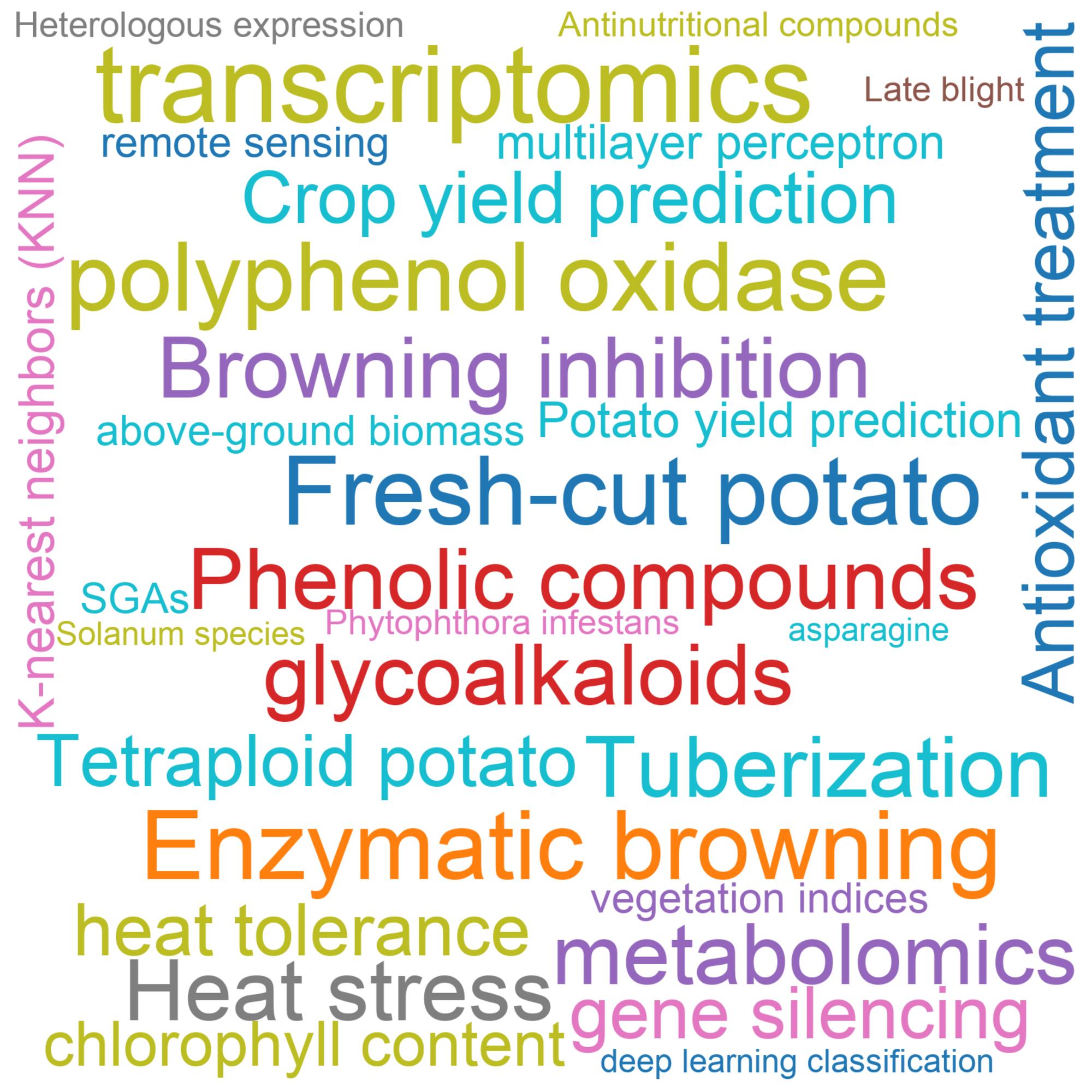
In the Class of 2026, the potato plant research landscape is strongly anchored in post-harvest quality and molecular studies. Transcriptomics and enzymatic browning are among the most prominent informative topics, indicating a significant focus on understanding the genetic basis of tuber quality and resilience. Research closely examines fresh-cut potato and polyphenol oxidase, emphasizing the industrys drive to extend shelf life and prevent discoloration. Furthermore, concepts like browning inhibition and phenolic compounds cluster heavily in the ranked papers, revealing that nutritional preservation and visual appeal remain paramount for both consumers and agricultural stakeholders. Together, these topics underscore a field increasingly shifting toward precision biology to enhance crop quality and marketability.
How Did Topics Shift from the Class of 2025 to the Class of 2026?
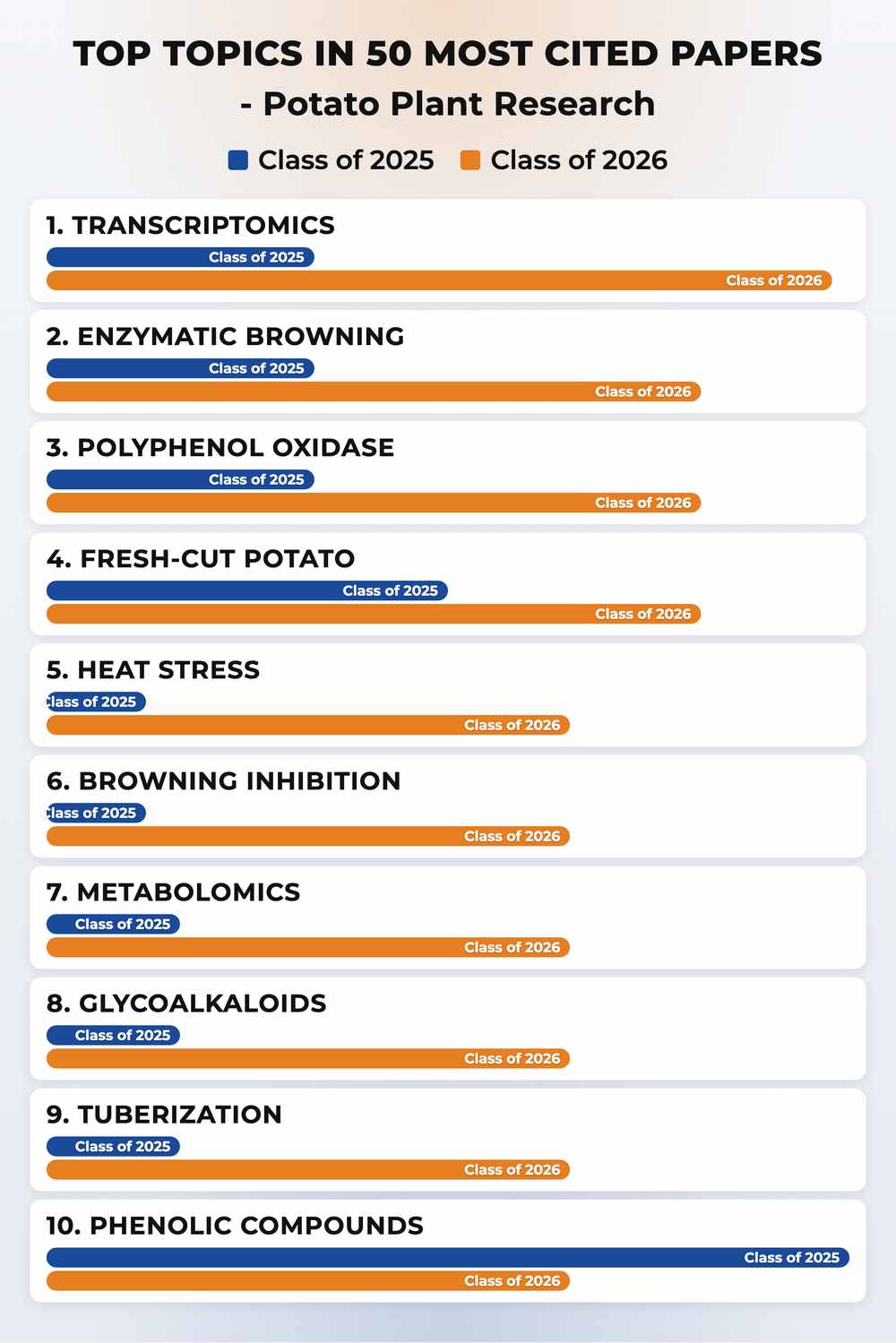
Between the Class of 2025 and 2026, the potato research community demonstrated a pronounced pivot toward stress resilience and targeted molecular interventions. The most striking increases were observed in topics like browning inhibition, heat stress, and antioxidant treatment—concepts that saw massive fold changes, reflecting an urgent prioritization of climate-adaptive agriculture and post-harvest stabilization. Similarly, transcriptomics and enzymatic browning more than doubled in normalized frequency. Conversely, broader agronomic concepts such as general potato studies and phenolic compounds saw a slight decline in relative prominence. This pattern suggests the field is rapidly moving away from general descriptive studies toward highly specialized, molecular solutions that address specific abiotic stresses and processing challenges.
Methodology
PRI identifies high-impact research using a transparent, topic-agnostic framework applied consistently across scientific domains. Bibliographic records are drawn from OpenAlex, including publication dates, citation relationships, and document types.
This ranking covers the Class of 2026 cohort: journal articles published in 2024. Reviews and other non-article document types are excluded to ensure comparability.
Research impact is quantified with an 18-month post-publication citation window—the number of citing works published within 18 months of each paper's publication date. This metric captures early impact while controlling for publication age.
An LLM-based relevance classifier then reviews each candidate's title and abstract to confirm substantive alignment with the target domain. Only papers classified as relevant appear in the final ranking.
Zheng Su, Tinsley Li, Thematic Shifts in Early-High-Impact Cancer Genomics and Diagnostics Research: A Bibliometric and Semantic Analysis. bioRxiv 2026.07.04.736459; doi: https://doi.org/10.64898/2026.07.04.736459
Cite this ranking
Pepkio Research Index (PRI). Topics and Trends in Most Cited Potato Plant Research Papers, Class of 2026. https://pri.pepkio.com/top-papers/potato-plant-research/2026. Accessed 2026-10-24.

Methodology
Zheng Su, Tinsley Li, Thematic Shifts in Early-High-Impact Cancer Genomics and Diagnostics Research: A Bibliometric and Semantic Analysis. bioRxiv 2026.07.04.736459; doi: https://doi.org/10.64898/2026.07.04.736459