
What topics and trends defined most-cited Mycorrhizal Fungi and Plant Interactions research in the Class of 2026?
Mycorrhizal research in the Class of 2026 highlights tripartite symbiosis, fungal hyphae networks, and ecological multifunctionality as key drivers of plant drought tolerance and nutrient cycling. Rapid growth in ecological restoration and root-derived carbon research marks a strategic pivot away from broad metagenomic cataloging toward functional plant-soil-microbe applications.
At a glance
- Field
- Mycorrhizal Fungi and Plant Interactions
- Cohort label
- Class of 2026 (2024 publications)
- Papers analyzed
- 5,906
- Papers ranked
- 20
- Top topics in ranked papers
- Ecosystem multifunctionality, Available phosphorus, Drought stress, Endophytic fungi, Tripartite symbiosis
- Publication window
- Jan 1, 2024 – Dec 31, 2024
- Eligibility
- Research articles; reviews excluded
- Citation window
- 18 months post-publication
- 18m citation range
- 42–146
- Data source
- OpenAlex · Retrieved July 2026
- License
- CC BY 4.0
Rankings
20 papers ranked by 18-month citation count
Cross-kingdom nutrient exchange in the plant–arbuscular mycorrhizal fungus–bacterium continuum
Nature Reviews Microbiology202410.1038/s41579-024-01073-7
Enhancing Soil Health and Plant Growth through Microbial Fertilizers: Mechanisms, Benefits, and Sustainable Agricultural Practices
Agronomy202410.3390/agronomy14030609
Nutrient-induced acidification modulates soil biodiversity-function relationships
Nature Communications202410.1038/s41467-024-47323-3
Superiority of native soil core microbiomes in supporting plant growth
Nature Communications202410.1038/s41467-024-50685-3
Community assembly of organisms regulates soil microbial functional potential through dual mechanisms
Global Change Biology202410.1111/gcb.17160
Revealing the hidden world of soil microbes: Metagenomic insights into plant, bacteria, and fungi interactions for sustainable agriculture and ecosystem restoration
Microbiological Research202410.1016/j.micres.2024.127764
Microbial biodiversity and plant functional trait interactions in multifunctional ecosystems
Applied Soil Ecology202410.1016/j.apsoil.2024.105515
Interactive Suitability of Rice Stubble Biochar and Arbuscular Mycorrhizal Fungi for Improving Wastewater-Polluted Soil Health and Reducing Heavy Metals in Peas
Sustainability202410.3390/su16020634
Microbial colonisation rewires the composition and content of poplar root exudates, root and shoot metabolomes
Microbiome202410.1186/s40168-024-01888-9
Fungal community composition predicts forest carbon storage at a continental scale
Nature Communications202410.1038/s41467-024-46792-w
Agricultural practices influence soil microbiome assembly and interactions at different depths identified by machine learning
Communications Biology202410.1038/s42003-024-07059-8
Soil microbial diversity plays an important role in resisting and restoring degraded ecosystems
Plant and Soil202410.1007/s11104-024-06489-x
Above-and below-ground feedback loop of maize is jointly enhanced by plant growth-promoting rhizobacteria and arbuscular mycorrhizal fungi in drier soil
The Science of The Total Environment202410.1016/j.scitotenv.2024.170417
Drought-Tolerant Bacteria and Arbuscular Mycorrhizal Fungi Mitigate the Detrimental Effects of Drought Stress Induced by Withholding Irrigation at Critical Growth Stages of Soybean (Glycine max, L.)
Microorganisms202410.3390/microorganisms12061123
The biology and chemistry of a mutualism between a soil bacterium and a mycorrhizal fungus
Current Biology202410.1016/j.cub.2024.09.019
Host genotype-specific rhizosphere fungus enhances drought resistance in wheat
Microbiome202410.1186/s40168-024-01770-8
Enhancing soil health and nutrient cycling through soil amendments: Improving the synergy of bacteria and fungi
The Science of The Total Environment202410.1016/j.scitotenv.2024.171332
A tripartite bacterial-fungal-plant symbiosis in the mycorrhiza-shaped microbiome drives plant growth and mycorrhization
Microbiome202410.1186/s40168-023-01726-4
Deforestation impacts soil biodiversity and ecosystem services worldwide
Proceedings of the National Academy of Sciences202410.1073/pnas.2318475121
Meta‐analysis reveals globally sourced commercial mycorrhizal inoculants fall short
New Phytologist202410.1111/nph.20278
Topic trends
Dominant research themes and year-over-year shifts in Mycorrhizal Fungi and Plant Interactions
What Topics Define the Class of 2026?
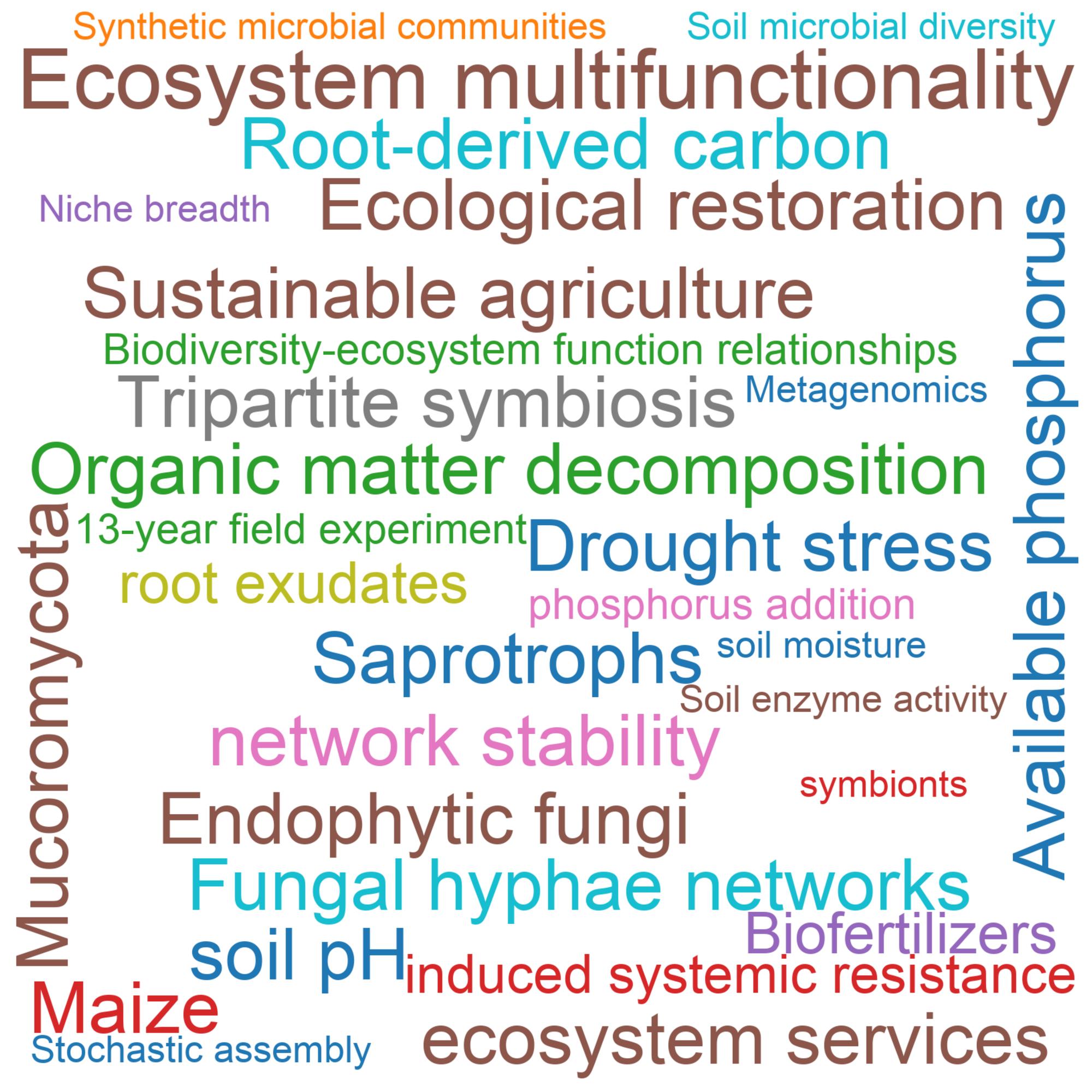
Research in the Class of 2026 on mycorrhizal fungi and plant interactions centers heavily on ecological multifunctionality and sustainable agricultural practices. A major focal point is the mechanistic role of mycorrhizal networks and endophytic fungi in enhancing plant resilience to abiotic stress, particularly drought stress and soil nutrient constraints like available phosphorus limitation. Studies emphasize tripartite symbiosis—the synergistic interactions among plants, mycorrhizal fungi, and helper bacterial communities—as a primary driver of nutrient cycling, organic matter decomposition, and soil network stability. Furthermore, practical applications in crop management, notably in maize cultivation, prominently feature biofertilizers, root-derived carbon allocations, and saprotrophic contributions to restore degraded ecosystems. Rather than isolating individual fungal taxa, high-impact literature prioritizes systemic ecosystem services, demonstrating how fungal hyphae networks facilitate nutrient transport, improve soil structure, and bolster overall ecosystem multifunctionality under environmental change.
How Did Topics Shift from the Class of 2025 to the Class of 2026?
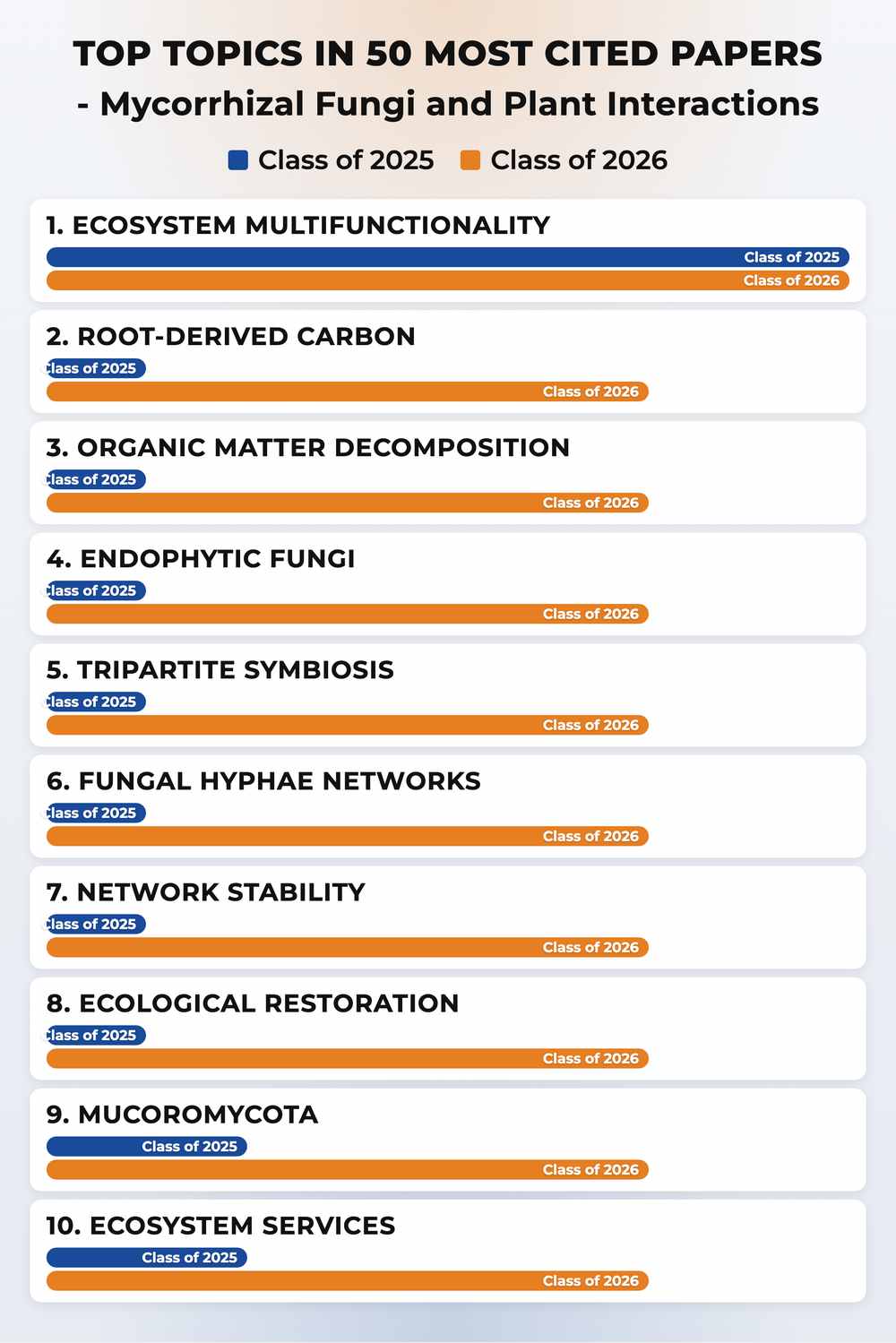
Comparing the Class of 2025 to the Class of 2026 reveals a distinct shift toward functional ecosystem processes and multi-partner biological interactions. Research attention increased rapidly for tripartite symbiosis, fungal hyphae networks, root-derived carbon dynamics, and organic matter decomposition—topics that were minimally represented in the 2025 cohort but expanded to 6% of top-cited publications in 2026. Substantial momentum was also gained by ecological restoration and network stability, reflecting heightened interest in applying mycorrhizal ecology to habitat recovery and climate resilience. Conversely, baseline characterization metrics such as general soil pH profiling, metagenomic survey broadness, and single-species focal studies (such as Rhizophagus irregularis or generic keystone taxa) experienced relative declines, dropping from 8–12% frequency down to 4%. Overall, the field is evolving from descriptive diversity cataloging toward integrative, process-oriented frameworks that harness fungal networks for sustainable agriculture and ecological restoration.
Methodology
PRI identifies high-impact research using a transparent, topic-agnostic framework applied consistently across scientific domains. Bibliographic records are drawn from OpenAlex, including publication dates, citation relationships, and document types.
This ranking covers the Class of 2026 cohort: journal articles published in 2024. Reviews and other non-article document types are excluded to ensure comparability.
Research impact is quantified with an 18-month post-publication citation window—the number of citing works published within 18 months of each paper's publication date. This metric captures early impact while controlling for publication age.
An LLM-based relevance classifier then reviews each candidate's title and abstract to confirm substantive alignment with the target domain. Only papers classified as relevant appear in the final ranking.
Zheng Su, Tinsley Li, Thematic Shifts in Early-High-Impact Cancer Genomics and Diagnostics Research: A Bibliometric and Semantic Analysis. bioRxiv 2026.07.04.736459; doi: https://doi.org/10.64898/2026.07.04.736459
Cite this ranking
Pepkio Research Index (PRI). Topics and Trends in Most Cited Mycorrhizal Fungi and Plant Interactions Papers, Class of 2026. https://pri.pepkio.com/top-papers/mycorrhizal-fungi-and-plant-interactions/2026. Accessed 2026-10-21.

Methodology
Zheng Su, Tinsley Li, Thematic Shifts in Early-High-Impact Cancer Genomics and Diagnostics Research: A Bibliometric and Semantic Analysis. bioRxiv 2026.07.04.736459; doi: https://doi.org/10.64898/2026.07.04.736459