
What topics and trends defined most-cited Nematode management and characterization studies research in the Class of 2026?
Nematode management research is shifting from chemical controls and symptom assessment toward biological control and soil food web resilience. Key 2024 trends highlight Meloidogyne incognita suppression, microbial consortia, and pine wilt disease management, while direct gall formation studies decline as broader agroecosystem and molecular signaling approaches expand.
At a glance
- Field
- Nematode management and characterization studies
- Cohort label
- Class of 2026 (2024 publications)
- Papers analyzed
- 3,432
- Papers ranked
- 20
- Top topics in ranked papers
- Root-knot nematode, biological control, soil food web, pine wilt disease, Meloidogyne incognita
- Publication window
- Jan 1, 2024 – Dec 31, 2024
- Eligibility
- Research articles; reviews excluded
- Citation window
- 18 months post-publication
- 18m citation range
- 16–123
- Data source
- OpenAlex · Retrieved Jul 2026
- License
- CC BY 4.0
Rankings
20 papers ranked by 18-month citation count
Nutrient-induced acidification modulates soil biodiversity-function relationships
Nature Communications202410.1038/s41467-024-47323-3
Phylogenomic Insights into the Evolution and Origin of Nematoda
Systematic Biology202410.1093/sysbio/syae073
Linking nematodes and ecosystem function: a trait-based framework
Trends in Ecology & Evolution202410.1016/j.tree.2024.02.002
Biomass-Based, Dual Enzyme-Responsive Nanopesticides: Eco-friendly and Efficient Control of Pine Wood Nematode Disease
ACS Nano202410.1021/acsnano.4c02031
Rhizosphere Engineering of Biocontrol Agents Enriches Soil Microbial Diversity and Effectively Controls Root-Knot Nematodes
Microbial Ecology202410.1007/s00248-024-02435-7
Cover crop rotation suppresses root‐knot nematode infection by shaping soil microbiota
New Phytologist202410.1111/nph.20220
Linking nematode trophic diversity to plantation identity and soil nutrient cycling
Geoderma202410.1016/j.geoderma.2024.116945
The nematode-trapping fungus Arthrobotrys oligospora detects prey pheromones via G protein-coupled receptors
Nature Microbiology202410.1038/s41564-024-01679-w
The origin, deployment, and evolution of a plant-parasitic nematode effectorome
PLoS Pathogens202410.1371/journal.ppat.1012395
Protective role of native root-associated bacterial consortium against root-knot nematode infection in susceptible plants
Nature Communications202410.1038/s41467-024-51073-7
Impact of sequential and concurrent inoculations of Meloidogyne incognita and Fusarium oxysporum f.sp. vasinfectum on the growth performance of diverse okra cultivars
Plant Protection202410.33804/pp.008.02.5186
Phytophagy impacts the quality and quantity of plant carbon resources acquired by mutualistic arbuscular mycorrhizal fungi
Nature Communications202410.1038/s41467-024-45026-3
Redundancy in microbiota-mediated suppression of the soybean cyst nematode
Microbiome202410.1186/s40168-024-01840-x
Green Carbon Dots/CaCO<sub>3</sub>/Abamectin Colloidal Pesticide Formulation for Safer and More Effective Pest Management
ACS Nano202410.1021/acsnano.4c12707
Utilizing bio-synthesis of nanomaterials as biological agents for controlling soil-borne diseases in pepper plants: root-knot nematodes and root rot fungus
BMC Plant Biology202410.1186/s12870-024-04760-y
Utilizing endophytic plant growth-promoting bacteria and the nematophagous fungus Purpureocillium lilacinum as biocontrol agents against the root-knot nematode (Meloidogyne incognita) on tomato plants
European Journal of Plant Pathology202410.1007/s10658-024-02907-z
Differential responses of Meloidogyne spp. to Pasteuria isolates over crop cycles
Plant Protection202410.33804/pp.008.02.5192
Continuous cropping obstacles: Insights from the community composition and the imbalance carbon fluxes within soil nematode food web
Geoderma202410.1016/j.geoderma.2024.117060
Soil enzyme profile analysis for indicating decomposer micro‐food web
iMeta202410.1002/imt2.161
Protorhabditis nematodes and pathogen-antagonistic bacteria interactively promote plant health
Microbiome202410.1186/s40168-024-01947-1
Topic trends
Dominant research themes and year-over-year shifts in Nematode management and characterization studies
What Topics Define the Class of 2026?
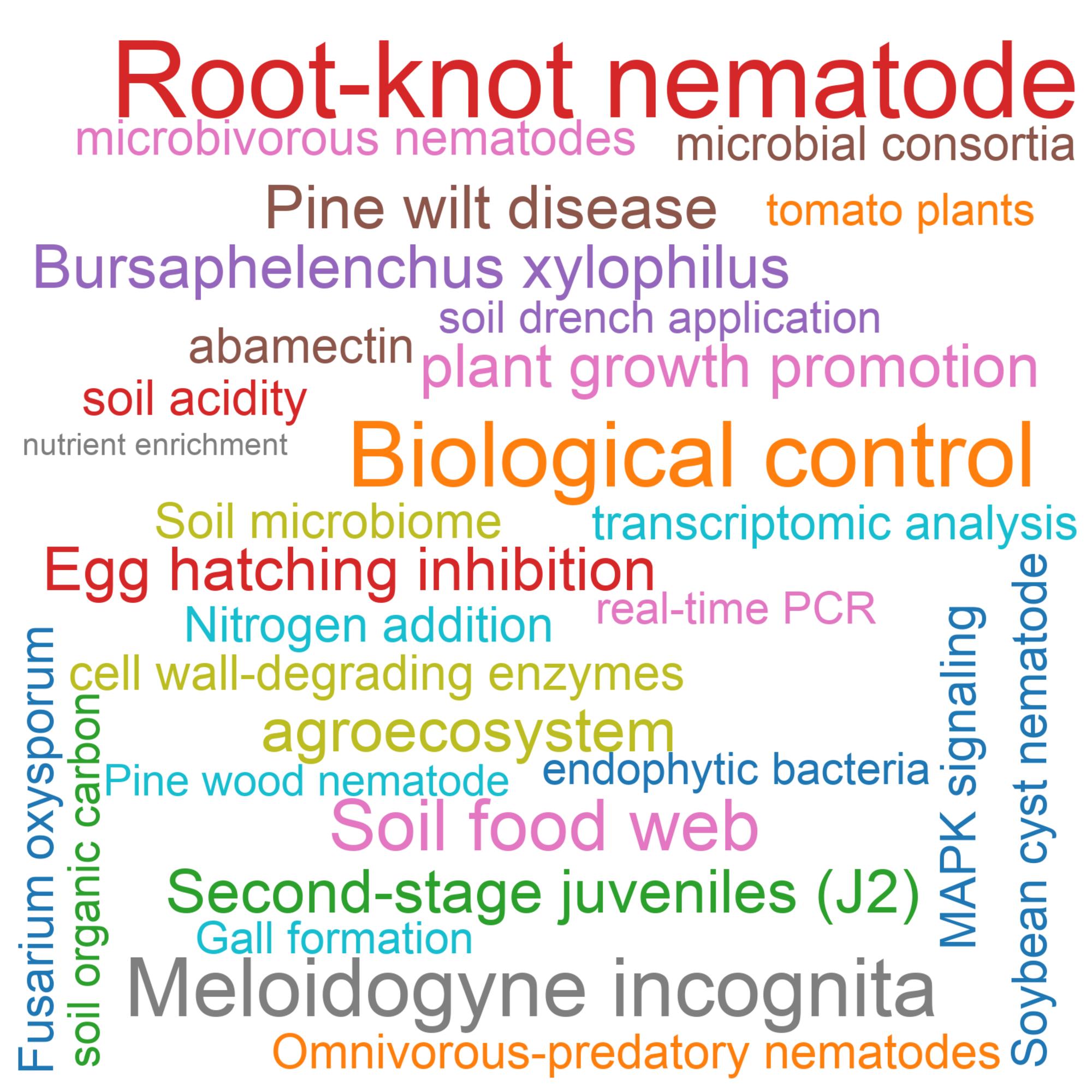
Research in nematode management and characterization is heavily centered on sustainable agricultural protection and ecological soil dynamics. The dominant topic in the 2024 cohort is the management of root-knot nematodes, led by Meloidogyne incognita (present in 27.6% and 17.2% of analyzed papers, respectively). Environmentally friendly intervention strategies form a primary pillar, with biological control (20.7%) and plant growth promotion (10.3%) emerging as core management paradigms alongside microbial consortia and egg hatching inhibition techniques. In parallel, attention has expanded toward soil food web structure (13.8%) and agroecosystem health (10.3%), emphasizing how nematode communities interface with soil organic carbon, nutrient cycling, and native microbial diversity. Beyond agricultural crops, forestry research focuses on Bursaphelenchus xylophilus and pine wilt disease (10.3% each), utilizing dual-action nanopesticides and bio-protective treatments. Methodologically, studies increasingly leverage transcriptomic analysis, cell wall-degrading enzymes, and MAPK signaling pathways to decipher host-parasite effector interactions. Together, these trends demonstrate a shift from conventional chemical nematicides toward holistic, microbial, and molecularly targeted nematode management.
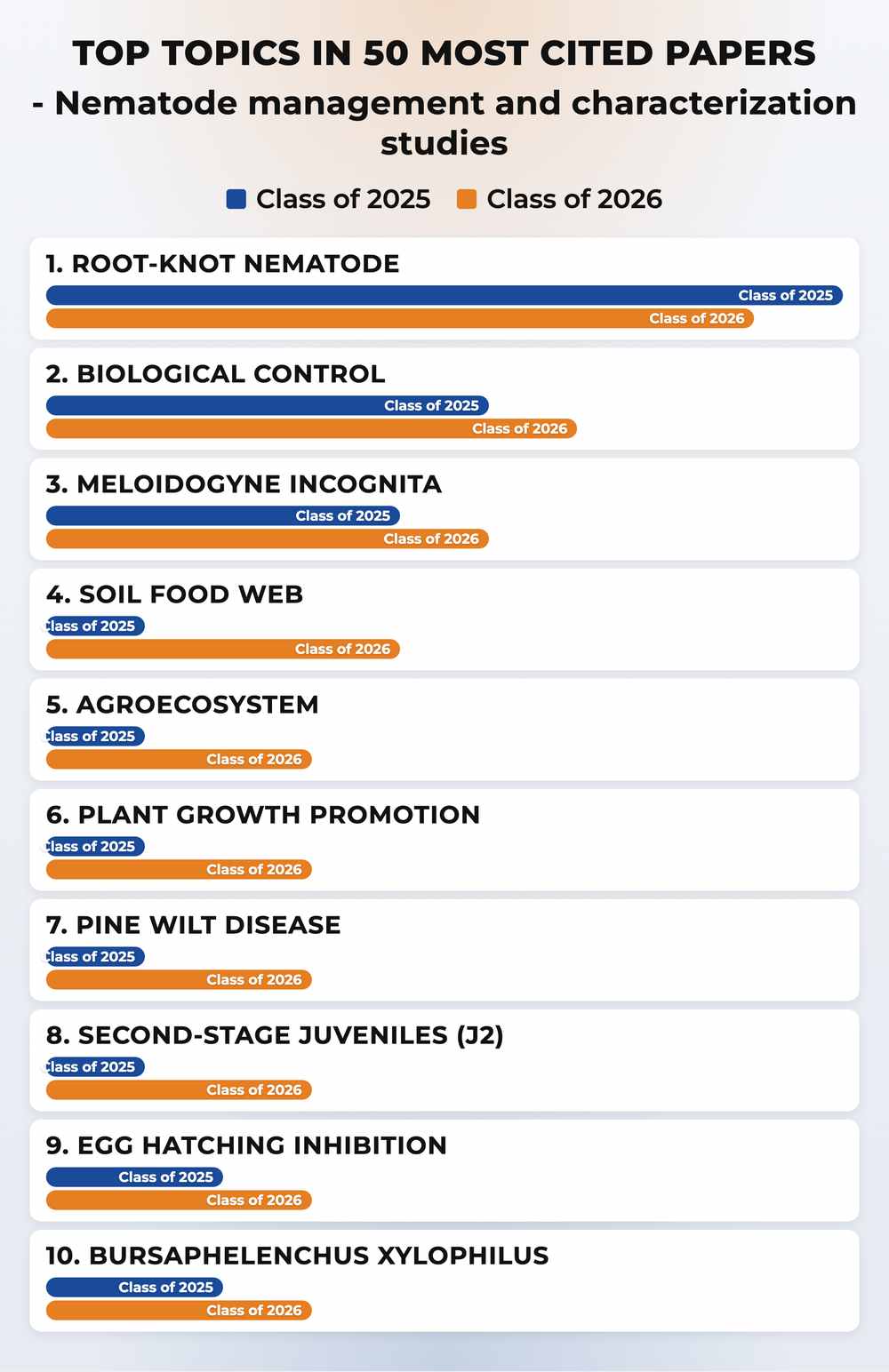
How Did Topics Shift from the Class of 2025 to the Class of 2026?
Comparing the 2023 and 2024 publication cohorts reveals a distinct transition from descriptive symptom characterization toward ecosystem-level intervention and bio-based pest suppression. The most pronounced expansion occurred in soil food web dynamics (+13.8 percentage points; entering 4 top papers in 2024) and agroecosystem analysis (+10.3 percentage points), signaling heightened interest in soil community resilience and trophic interactions. Biological control strategies also surged, driven by rising interest in microbial consortia (+6.9 percentage points), plant growth-promoting rhizobacteria (+6.9 percentage points), and real-time PCR diagnostics (+6.9 percentage points). Research on specific life stages and host mechanisms gained momentum as second-stage juveniles (J2) targeting and cell wall-degrading enzymes both grew by +6.9 percentage points, alongside pine wilt disease research (+6.9 percentage points). Conversely, studies focusing strictly on symptom-based gall formation declined (-6.9 percentage points; falling from 4 to 2 papers), while generic root-knot nematode reporting eased slightly (-3.4 percentage points). Overall, the field is evolving from reactive damage assessment to proactive, microbiome-mediated soil health management.
Methodology
PRI identifies high-impact research using a transparent, topic-agnostic framework applied consistently across scientific domains. Bibliographic records are drawn from OpenAlex, including publication dates, citation relationships, and document types.
This ranking covers the Class of 2026 cohort: journal articles published in 2024. Reviews and other non-article document types are excluded to ensure comparability.
Research impact is quantified with an 18-month post-publication citation window—the number of citing works published within 18 months of each paper's publication date. This metric captures early impact while controlling for publication age.
An LLM-based relevance classifier then reviews each candidate's title and abstract to confirm substantive alignment with the target domain. Only papers classified as relevant appear in the final ranking.
Zheng Su, Tinsley Li, Thematic Shifts in Early-High-Impact Cancer Genomics and Diagnostics Research: A Bibliometric and Semantic Analysis. bioRxiv 2026.07.04.736459; doi: https://doi.org/10.64898/2026.07.04.736459
Cite this ranking
Pepkio Research Index (PRI). Topics and Trends in Most Cited Nematode management and characterization studies Papers, Class of 2026. https://pri.pepkio.com/top-papers/nematode-management-and-characterization-studies/2026. Accessed 2026-10-16.

Methodology
Zheng Su, Tinsley Li, Thematic Shifts in Early-High-Impact Cancer Genomics and Diagnostics Research: A Bibliometric and Semantic Analysis. bioRxiv 2026.07.04.736459; doi: https://doi.org/10.64898/2026.07.04.736459