
What topics and trends defined most-cited Plant Pathogens and Fungal Diseases research in the Class of 2026?
Ascomycota, convolutional neural networks, and Basidiomycota anchor the Class of 2026 plant-pathogen cohort, alongside dermatophytosis, Trichophyton indotineae, and azole resistance. From Class of 2025 to 2026, fungal taxonomy and antifungal resistance rose sharply while deep-learning and data-augmentation themes receded among top-cited work.
At a glance
- Field
- Plant Pathogens and Fungal Diseases
- Cohort label
- Class of 2026 (2024 publications)
- Papers analyzed
- 11,441
- Papers ranked
- 20
- Top topics in ranked papers
- Ascomycota, convolutional neural network, Basidiomycota, dermatophytosis, Trichophyton indotineae
- Publication window
- Jan 1, 2024 – Dec 31, 2024
- Eligibility
- Research articles; reviews excluded
- Citation window
- 18 months post-publication
- 18m citation range
- 30–75
- Data source
- OpenAlex · Retrieved Jul 2026
- License
- CC BY 4.0
Rankings
20 papers ranked by 18-month citation count
Fusaric acid mediates the assembly of disease-suppressive rhizosphere microbiota via induced shifts in plant root exudates
Nature Communications202410.1038/s41467-024-49218-9
Phylogenomics, divergence times and notes of orders in Basidiomycota
Fungal Diversity202410.1007/s13225-024-00535-w
Phylogenomic analysis of the <i>Candida auris- Candida haemuli</i> clade and related taxa in the <i>Metschnikowiaceae,</i> and proposal of thirteen new genera, fifty-five new combinations and nine new species
Persoonia - Molecular Phylogeny and Evolution of Fungi202410.3767/persoonia.2024.52.02
Fungal diversity notes 1717–1817: taxonomic and phylogenetic contributions on genera and species of fungal taxa
Fungal Diversity202410.1007/s13225-023-00529-0
A re-evaluation of Diaporthe: refining the boundaries of species and species complexes
Fungal Diversity202410.1007/s13225-024-00538-7
Aspergillus cvjetkovicii protects against phytopathogens through interspecies chemical signalling in the phyllosphere
Nature Microbiology202410.1038/s41564-024-01781-z
Elevated mutation rates in multi-azole resistant Aspergillus fumigatus drive rapid evolution of antifungal resistance
Nature Communications202410.1038/s41467-024-54568-5
Detecting fungi-affected multi-crop disease on heterogeneous region dataset using modified ResNeXt approach
Environmental Monitoring and Assessment202410.1007/s10661-024-12790-0
Cucumber Downy Mildew Disease Prediction Using a CNN-LSTM Approach
Agriculture202410.3390/agriculture14071155
Polypore funga and species diversity in tropical forest ecosystems of Africa, America and Asia, and a comparison with temperate and boreal regions of the Northern Hemisphere
Forest Ecosystems202410.1016/j.fecs.2024.100200
Antifungal activity of copper oxide nanoparticles derived from Zizyphus spina leaf extract against Fusarium root rot disease in tomato plants
Journal of Nanobiotechnology202410.1186/s12951-023-02281-8
CNN Models Approaches for Robust Classification of Apple Diseases
Computer and decision making.202410.59543/comdem.v1i.10957
Potential Sexual Transmission of Antifungal-Resistant <i>Trichophyton indotineae</i>
Emerging infectious diseases202410.3201/eid3004.240115
Inducing novel endosymbioses by implanting bacteria in fungi
Nature202410.1038/s41586-024-08010-x
Comparative metabolome and transcriptome analyses reveal the role of MeJA in improving postharvest disease resistance and maintaining the quality of Rosa roxburghii fruit
Postharvest Biology and Technology202410.1016/j.postharvbio.2024.113314
Fungal diversity notes 1818–1918: taxonomic and phylogenetic contributions on genera and species of fungi
Fungal Diversity202410.1007/s13225-024-00541-y
Trichoderma afroharzianum TRI07 metabolites inhibit Alternaria alternata growth and induce tomato defense-related enzymes
Scientific Reports202410.1038/s41598-024-52301-2
MCDCNet: Multi-scale constrained deformable convolution network for apple leaf disease detection
Computers and Electronics in Agriculture202410.1016/j.compag.2024.109028
Enhanced surface colonisation and competition during bacterial adaptation to a fungus
Nature Communications202410.1038/s41467-024-48812-1
Drought increases Norway spruce susceptibility to the Eurasian spruce bark beetle and its associated fungi
New Phytologist202410.1111/nph.19635
Topic trends
Dominant research themes and year-over-year shifts in Plant Pathogens and Fungal Diseases
What Topics Define the Class of 2026?
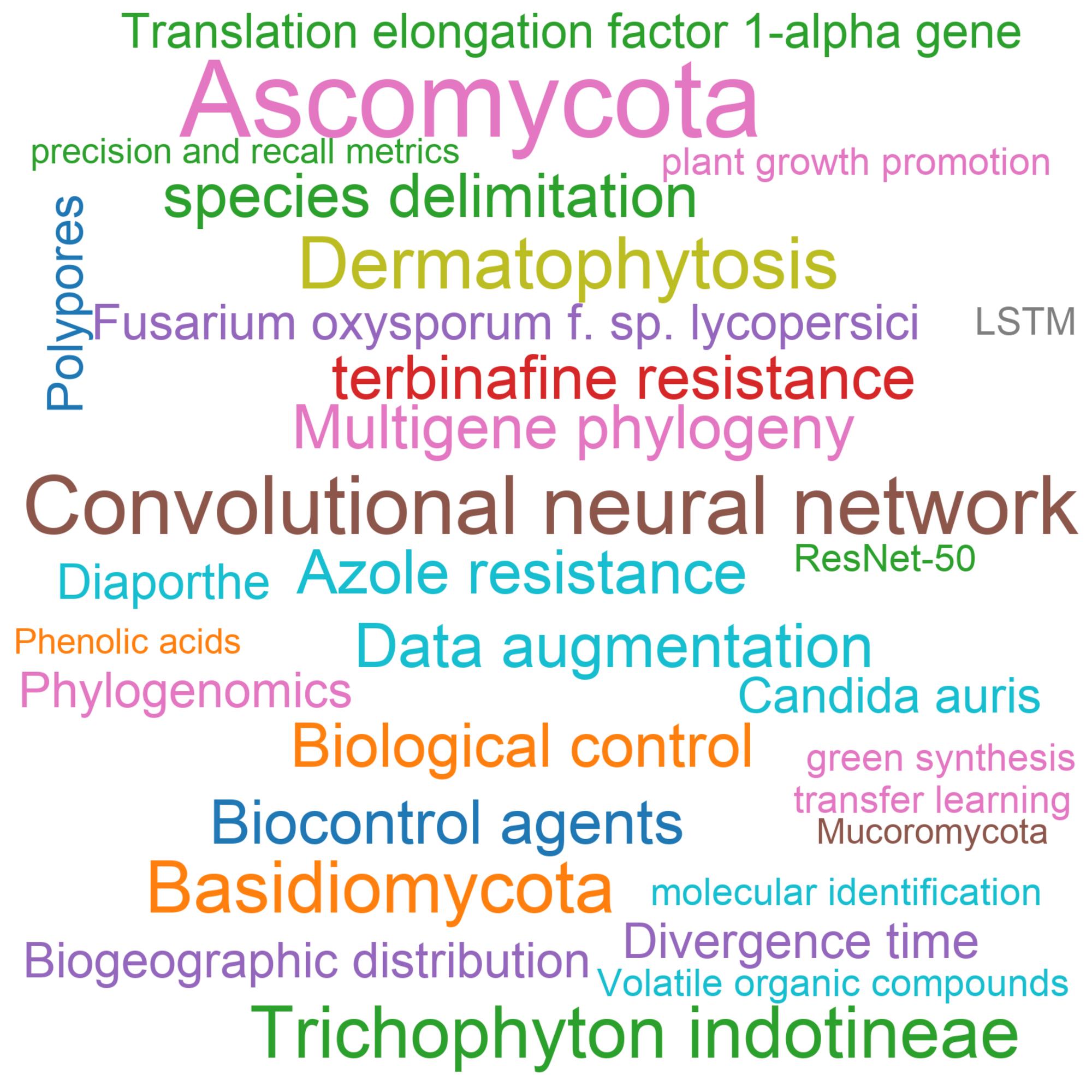
The informative word cloud across the 50 highest 18-month-cited plant pathogens and fungal diseases papers reveals a field split between fungal systematics and clinical mycology on one side and computer-vision disease diagnostics on the other. Ascomycota and convolutional neural network tie as the most frequently mentioned informative topics, each appearing in 5 of 50 papers (normalized frequency 0.10). A second tier clusters major fungal phyla and dermatophyte themes—Basidiomycota, dermatophytosis, and Trichophyton indotineae each appear in 4 papers (0.08)—alongside species delimitation, multigene phylogeny, biological control, azole resistance, and terbinafine resistance (3 papers each, 0.06). Larger type further highlights Phylogenomics, Fusarium oxysporum f. sp. lycopersici, Candida auris, ResNet-50, LSTM, and transfer learning, signaling that influential 2024 publications combine taxonomic revision and antifungal-resistance surveillance with deep-learning pipelines for leaf and pathogen image classification. Biocontrol agents, volatile organic compounds, and plant growth promotion appear alongside DNA barcoding and whole-genome sequencing, suggesting high-impact work spans molecular identification, biocontrol discovery, and AI-assisted plant disease diagnosis rather than a single methodological lane.
How Did Topics Shift from the Class of 2025 to the Class of 2026?
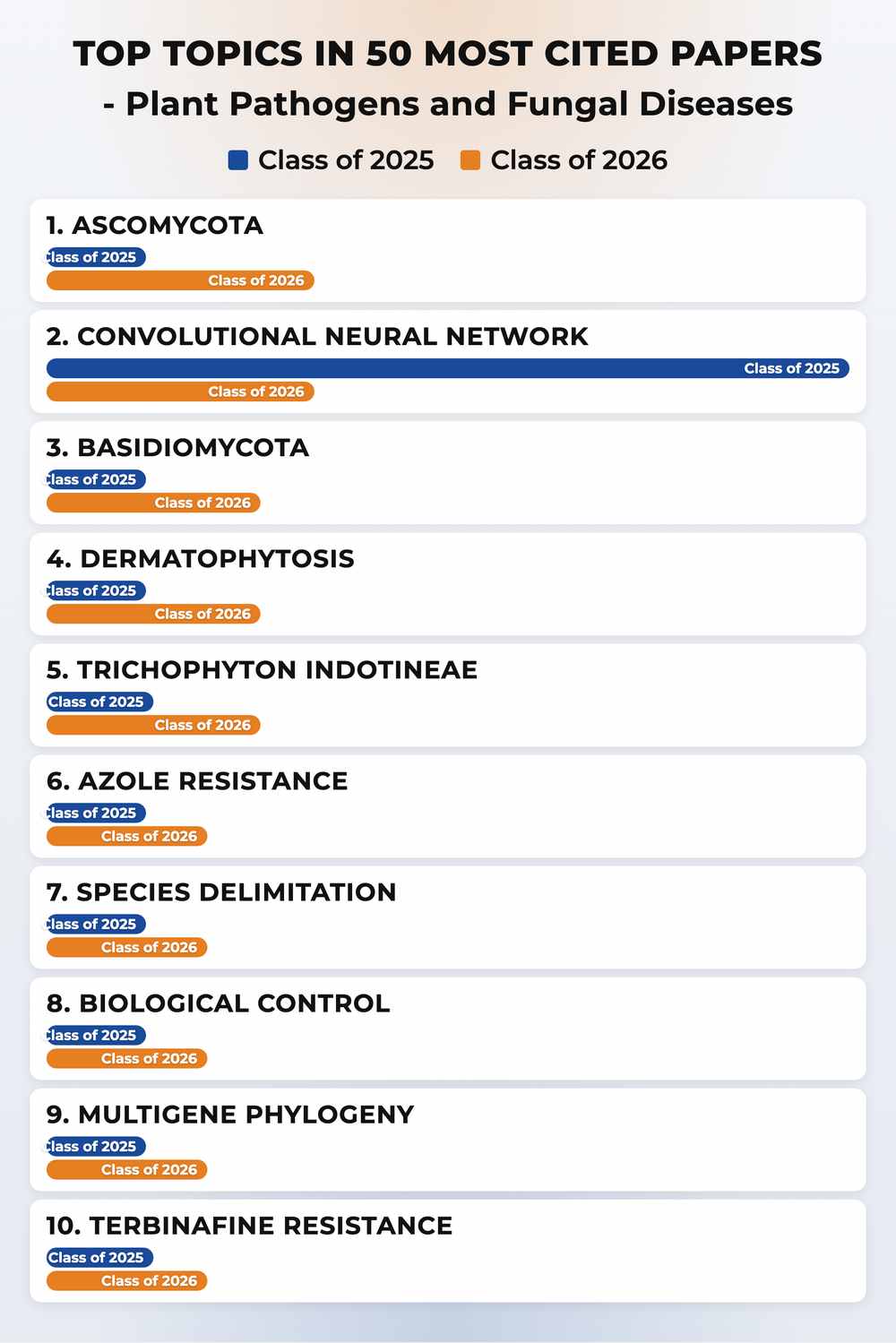
Comparing normalized concept frequencies between the Class of 2025 (2023 publications) and Class of 2026 (2024 publications) cohorts shows a rebalancing of early-high-impact plant pathogen and fungal disease research away from deep-learning dominance toward fungal taxonomy, clinical mycology, and biocontrol. Ascomycota exhibited the largest gain among leading themes (+0.08 normalized frequency; 1 versus 5 papers), followed by Basidiomycota and dermatophytosis (+0.06 each; 1 versus 4). Species delimitation and azole resistance each climbed +0.06 (from 0 to 3 papers), while Trichophyton indotineae rose +0.04 (2 versus 4) and multigene phylogeny and biological control each gained +0.04 (1 versus 3). The topic evolution card underscores that Class of 2026 bars extend furthest for Ascomycota, Basidiomycota, dermatophytosis, Trichophyton indotineae, azole resistance, species delimitation, and terbinafine resistance—topics aligned with phylogenetic revision, dermatophyte outbreaks, and antifungal resistance monitoring. Conversely, convolutional neural network (−0.20; 0.30 to 0.10) and data augmentation (−0.06; 0.12 to 0.06) receded sharply among the most-cited concept set, alongside modest declines in ResNet-50 (−0.04) and biocontrol agents (−0.02). Together, these shifts suggest that the most-cited 2024 papers emphasize fungal classification, drug-resistant dermatophytes, and biological control over the computer-vision-heavy profile that dominated the prior cohort.
Methodology
PRI identifies high-impact research using a transparent, topic-agnostic framework applied consistently across scientific domains. Bibliographic records are drawn from OpenAlex, including publication dates, citation relationships, and document types.
This ranking covers the Class of 2026 cohort: journal articles published in 2024. Reviews and other non-article document types are excluded to ensure comparability.
Research impact is quantified with an 18-month post-publication citation window—the number of citing works published within 18 months of each paper's publication date. This metric captures early impact while controlling for publication age.
An LLM-based relevance classifier then reviews each candidate's title and abstract to confirm substantive alignment with the target domain. Only papers classified as relevant appear in the final ranking.
Zheng Su, Tinsley Li, Thematic Shifts in Early-High-Impact Cancer Genomics and Diagnostics Research: A Bibliometric and Semantic Analysis. bioRxiv 2026.07.04.736459; doi: https://doi.org/10.64898/2026.07.04.736459
Cite this ranking
Pepkio Research Index (PRI). Topics and Trends in Most Cited Plant Pathogens and Fungal Diseases Papers, Class of 2026. https://pri.pepkio.com/top-papers/plant-pathogens-and-fungal-diseases/2026. Accessed 2026-10-14.

Methodology
Zheng Su, Tinsley Li, Thematic Shifts in Early-High-Impact Cancer Genomics and Diagnostics Research: A Bibliometric and Semantic Analysis. bioRxiv 2026.07.04.736459; doi: https://doi.org/10.64898/2026.07.04.736459