
What topics and trends defined most-cited Plant Virus Research Studies research in the Class of 2026?
The class of 2024 plant virus research is heavily defined by model organisms like Nicotiana benthamiana and the integration of CRISPR-Cas9 genome editing tools. A notable shift towards studying liquid-liquid phase separation and biomolecular condensates reflects a growing focus on precise subcellular viral-host interactions.
At a glance
- Field
- Plant Virus Research Studies
- Cohort label
- Class of 2026 (2024 publications)
- Papers analyzed
- 6200
- Papers ranked
- 20
- Top topics in ranked papers
- Nicotiana benthamiana, CRISPR-Cas9, Biomolecular condensates, Liquid-liquid phase separation
- Publication window
- Jan 1, 2024 – Dec 31, 2024
- Eligibility
- Research articles; reviews excluded
- Citation window
- 18 months post-publication
- 18m citation range
- 22–76
- Data source
- OpenAlex · Retrieved July 2026
- License
- CC BY 4.0
Rankings
20 papers ranked by 18-month citation count
Birth of protein folds and functions in the virome
Nature202410.1038/s41586-024-07809-y
TMV-CP based rational design and discovery of α-Amide phosphate derivatives as anti plant viral agents
Bioorganic Chemistry202410.1016/j.bioorg.2024.107415
Combating wheat yellow mosaic virus through microbial interactions and hormone pathway modulations
Microbiome202410.1186/s40168-024-01911-z
Synthesis of 4<i>H</i>-Pyrazolo[3,4-<i>d</i>]pyrimidin-4-one Hydrazine Derivatives as a Potential Inhibitor for the Self-Assembly of TMV Particles
Journal of Agricultural and Food Chemistry202410.1021/acs.jafc.3c05334
Heritable gene editing in tomato through viral delivery of isopentenyl transferase and single-guide RNAs to latent axillary meristematic cells
Proceedings of the National Academy of Sciences202410.1073/pnas.2406486121
Nanomaterial inactivates environmental virus and enhances plant immunity for controlling tobacco mosaic virus disease
Nature Communications202410.1038/s41467-024-52851-z
Integrating viruses into soil food web biogeochemistry
Nature Microbiology202410.1038/s41564-024-01767-x
Plants interfere with non-self recognition of a phytopathogenic fungus via proline accumulation to facilitate mycovirus transmission
Nature Communications202410.1038/s41467-024-49110-6
Activation of plant immunity through conversion of a helper NLR homodimer into a resistosome
PLoS Biology202410.1371/journal.pbio.3002868
Precision Agriculture Through Deep Learning: Tomato Plant Multiple Diseases Recognition With CNN and Improved YOLOv7
IEEE Access202410.1109/access.2024.3383154
Design, Synthesis, and Biological Activities of Novel Coumarin Derivatives as Pesticide Candidates
Journal of Agricultural and Food Chemistry202410.1021/acs.jafc.3c08161
The role of reactive oxygen species in plant-virus interactions
Plant Cell Reports202410.1007/s00299-024-03280-1
Advancing common bean (Phaseolus vulgaris L.) disease detection with YOLO driven deep learning to enhance agricultural AI
Scientific Reports202410.1038/s41598-024-66281-w
Rapid and efficient <i>in planta</i> genome editing in sorghum using foxtail mosaic virus‐mediated sgRNA delivery
The Plant Journal202410.1111/tpj.17196
Development of an efficient and heritable virus-induced genome editing system in <i>Solanum lycopersicum</i>
Horticulture Research202410.1093/hr/uhae364
A plant NLR receptor employs ABA central regulator PP2C-SnRK2 to activate antiviral immunity
Nature Communications202410.1038/s41467-024-47364-8
Identification of pathogenicity determinants in ToLCNDV and their RNAi-based knockdown for disease management in Nicotiana benthamiana and tomato plants
Frontiers in Microbiology202410.3389/fmicb.2024.1481523
A deep learning approach for Maize Lethal Necrosis and Maize Streak Virus disease detection
Machine Learning with Applications202410.1016/j.mlwa.2024.100556
Alleviating protein-condensation-associated damage at the endoplasmic reticulum enhances plant disease tolerance
Cell Host & Microbe202410.1016/j.chom.2024.07.013
A viral protein activates the MAPK pathway to promote viral infection by downregulating callose deposition in plants
Nature Communications202410.1038/s41467-024-54467-9
Topic trends
Dominant research themes and year-over-year shifts in Plant Virus Research Studies
What Topics Define the Class of 2026?
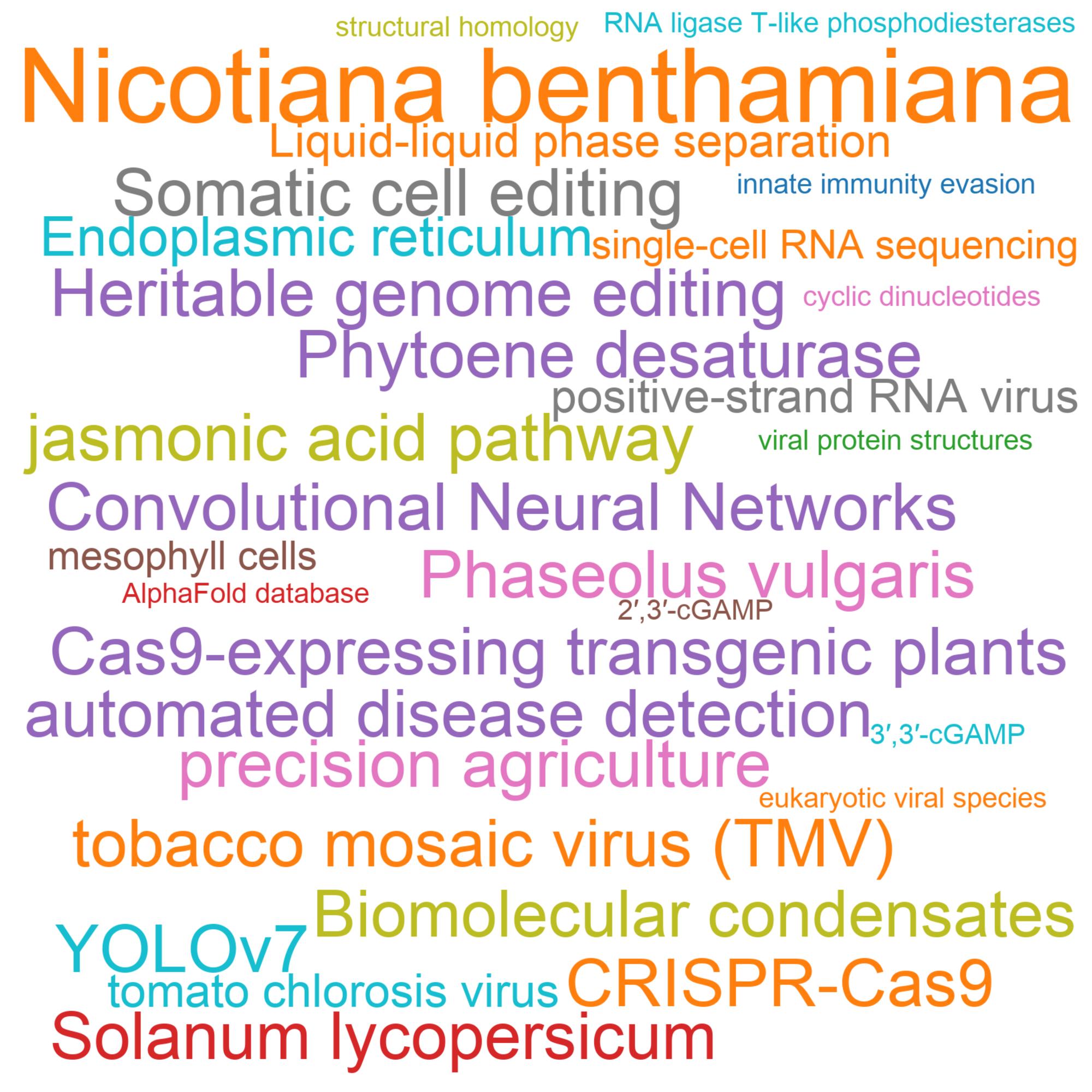
The Class of 2026 in plant virus research exhibits a strong emphasis on precise molecular mechanisms and advanced editing tools. Nicotiana benthamiana remains the dominant model organism for investigating viral processes. A key defining characteristic of this cohort is the rapid integration of CRISPR-Cas9 technologies, driving research into heritable genome editing, somatic cell modifications, and Cas9-expressing transgenic plants. Additionally, the exploration of biomolecular condensates and liquid-liquid phase separation within the endoplasmic reticulum points towards a deeper understanding of cellular environments and viral replication processes.
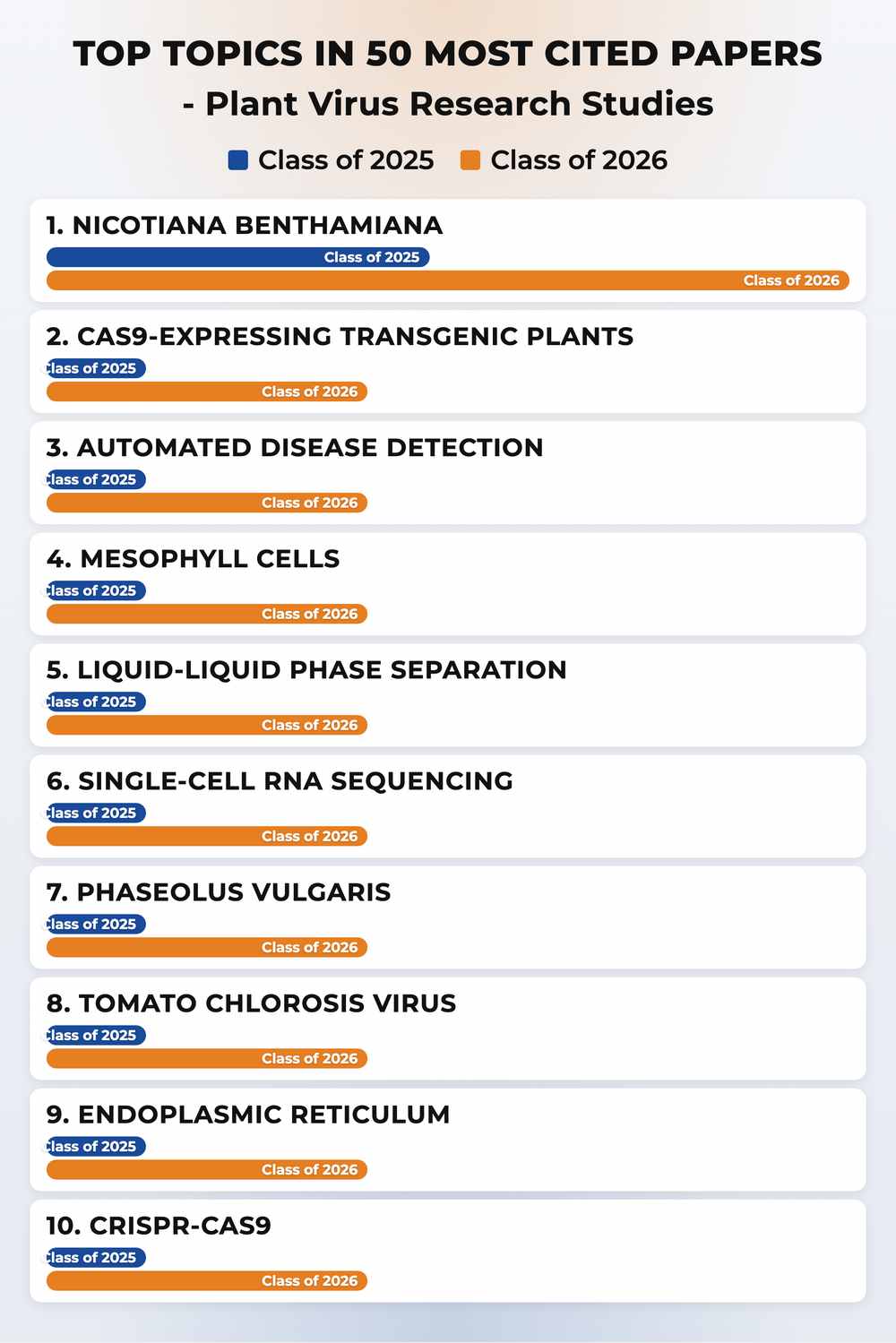
How Did Topics Shift from the Class of 2025 to the Class of 2026?
A distinct transition is occurring from traditional studies to highly targeted molecular interventions. The emergence of concepts like CRISPR-Cas9 and heritable genome editing indicates a massive surge in translational editing applications. Furthermore, the rapid rise of biomolecular condensates and liquid-liquid phase separation highlights a new frontier in understanding viral-host interactions at the subcellular level, marking a significant methodological evolution from the previous year's focus. The application of Convolutional Neural Networks also suggests a growing interdisciplinary approach to automated disease detection.
Methodology
PRI identifies high-impact research using a transparent, topic-agnostic framework applied consistently across scientific domains. Bibliographic records are drawn from OpenAlex, including publication dates, citation relationships, and document types.
This ranking covers the Class of 2026 cohort: journal articles published in 2024. Reviews and other non-article document types are excluded to ensure comparability.
Research impact is quantified with an 18-month post-publication citation window—the number of citing works published within 18 months of each paper's publication date. This metric captures early impact while controlling for publication age.
An LLM-based relevance classifier then reviews each candidate's title and abstract to confirm substantive alignment with the target domain. Only papers classified as relevant appear in the final ranking.
Zheng Su, Tinsley Li, Thematic Shifts in Early-High-Impact Cancer Genomics and Diagnostics Research: A Bibliometric and Semantic Analysis. bioRxiv 2026.07.04.736459; doi: https://doi.org/10.64898/2026.07.04.736459
Cite this ranking
Pepkio Research Index (PRI). Topics and Trends in Most Cited Plant Virus Research Studies Papers, Class of 2026. https://pri.pepkio.com/top-papers/plant-virus-research-studies/2026. Accessed 2026-10-14.

Methodology
Zheng Su, Tinsley Li, Thematic Shifts in Early-High-Impact Cancer Genomics and Diagnostics Research: A Bibliometric and Semantic Analysis. bioRxiv 2026.07.04.736459; doi: https://doi.org/10.64898/2026.07.04.736459
Source data
The full ranking corpus and analysis files are openly available on an external repository. Please cite the dataset below when reusing this data.
View source dataset →Pepkio Research Index (2026). Top Papers in Plant Virus Research Studies (2024). [Data set]. Figshare.