
What topics and trends defined most-cited Plant tissue culture and regeneration research in the Class of 2026?
CRISPR/Cas9 gene editing and hairy root transformation dominate the 2026 cohort, showing a clear shift towards precision genome engineering. Traditional tissue culture methods are declining, while rapid transformation techniques like RUBY reporters and Agrobacterium-mediated methods are surging.
At a glance
- Field
- Plant tissue culture and regeneration
- Cohort label
- Class of 2026 (2024 publications)
- Papers analyzed
- 6,609
- Papers ranked
- 20
- Top topics in ranked papers
- CRISPR/Cas9 gene editing, Hairy root transformation, Agrobacterium-mediated transformation
- Publication window
- Jan 1, 2024 – Dec 31, 2024
- Eligibility
- Research articles; reviews excluded
- Citation window
- 18 months post-publication
- 18m citation range
- 18–399
- Data source
- OpenAlex · Retrieved Jul 2026
- License
- CC BY 4.0
Rankings
20 papers ranked by 18-month citation count
High Efficiency In vitro Whole Plant Regeneration via Desiccated Callus in Oryza sativa cv. MTU1010
International Journal of Innovative Science and Research Technology (IJISRT)202410.38124/ijisrt/ijisrt24mar1492
An efficient genetic transformation system mediated by <i>Rhizobium rhizogenes</i> in fruit trees based on the transgenic hairy root to shoot conversion
Plant Biotechnology Journal202410.1111/pbi.14328
A simple and efficient in planta transformation method based on the active regeneration capacity of plants
Plant Communications202410.1016/j.xplc.2024.100822
A method of genetic transformation and gene editing of succulents without tissue culture
Plant Biotechnology Journal202410.1111/pbi.14318
Green synthesized iron oxide nanoparticles as a potential regulator of callus growth, plant physiology, antioxidative and microbial contamination in Oryza sativa L.
BMC Plant Biology202410.1186/s12870-024-05627-y
Binary vector copy number engineering improves Agrobacterium-mediated transformation
Nature Biotechnology202410.1038/s41587-024-02462-2
Enhancing Agrobacterium-mediated plant transformation efficiency through improved ternary vector systems and auxotrophic strains
Frontiers in Plant Science202410.3389/fpls.2024.1429353
<scp>PfGSTF2</scp> endows resistance to quizalofop‐p‐ethyl in <i>Polypogon fugax</i> by <scp>GSH</scp> conjugation
Plant Biotechnology Journal202410.1111/pbi.14491
Efficient and multiplex gene upregulation in plants through CRISPR-Cas-mediated knockin of enhancers
Molecular Plant202410.1016/j.molp.2024.07.009
Synergistic induction of fertilization-independent embryogenesis in rice egg cells by paternal-genome-expressed transcription factors
Nature Plants202410.1038/s41477-024-01848-z
A highly efficient soybean transformation system using GRF3‐GIF1 chimeric protein
Journal of Integrative Plant Biology202410.1111/jipb.13767
Advanced materials for intracellular delivery of plant cells: Strategies, mechanisms and applications
Materials Science and Engineering R Reports202410.1016/j.mser.2024.100821
Use of <scp>GRF</scp>‐<scp>GIF</scp> chimeras and a ternary vector system to improve maize (<i>Zea mays</i> L.) transformation frequency
The Plant Journal202410.1111/tpj.16880
Lignin reduction in sugarcane by performing CRISPR/Cas9 site-direct mutation of SoLIM transcription factor
Plant Science202410.1016/j.plantsci.2024.111987
Optimized dicot prime editing enables heritable desired edits in tomato and Arabidopsis
Nature Plants202410.1038/s41477-024-01786-w
Identification of pathogenicity determinants in ToLCNDV and their RNAi-based knockdown for disease management in Nicotiana benthamiana and tomato plants
Frontiers in Microbiology202410.3389/fmicb.2024.1481523
Elicitation strategies for enhanced secondary metabolite synthesis in plant cell cultures and its role in plant defense mechanism
Plant Gene202410.1016/j.plgene.2024.100485
Exploring an economic and highly efficient genetic transformation and genome‐editing system for radish through developmental regulators and visible reporter
The Plant Journal202410.1111/tpj.17068
An inducible CRISPR activation tool for accelerating plant regeneration
Plant Communications202410.1016/j.xplc.2024.100823
Developmental regulators in promoting genetic transformation efficiency in maize and other plants
Current Plant Biology202410.1016/j.cpb.2024.100383
Topic trends
Dominant research themes and year-over-year shifts in Plant tissue culture and regeneration
What Topics Define the Class of 2026?
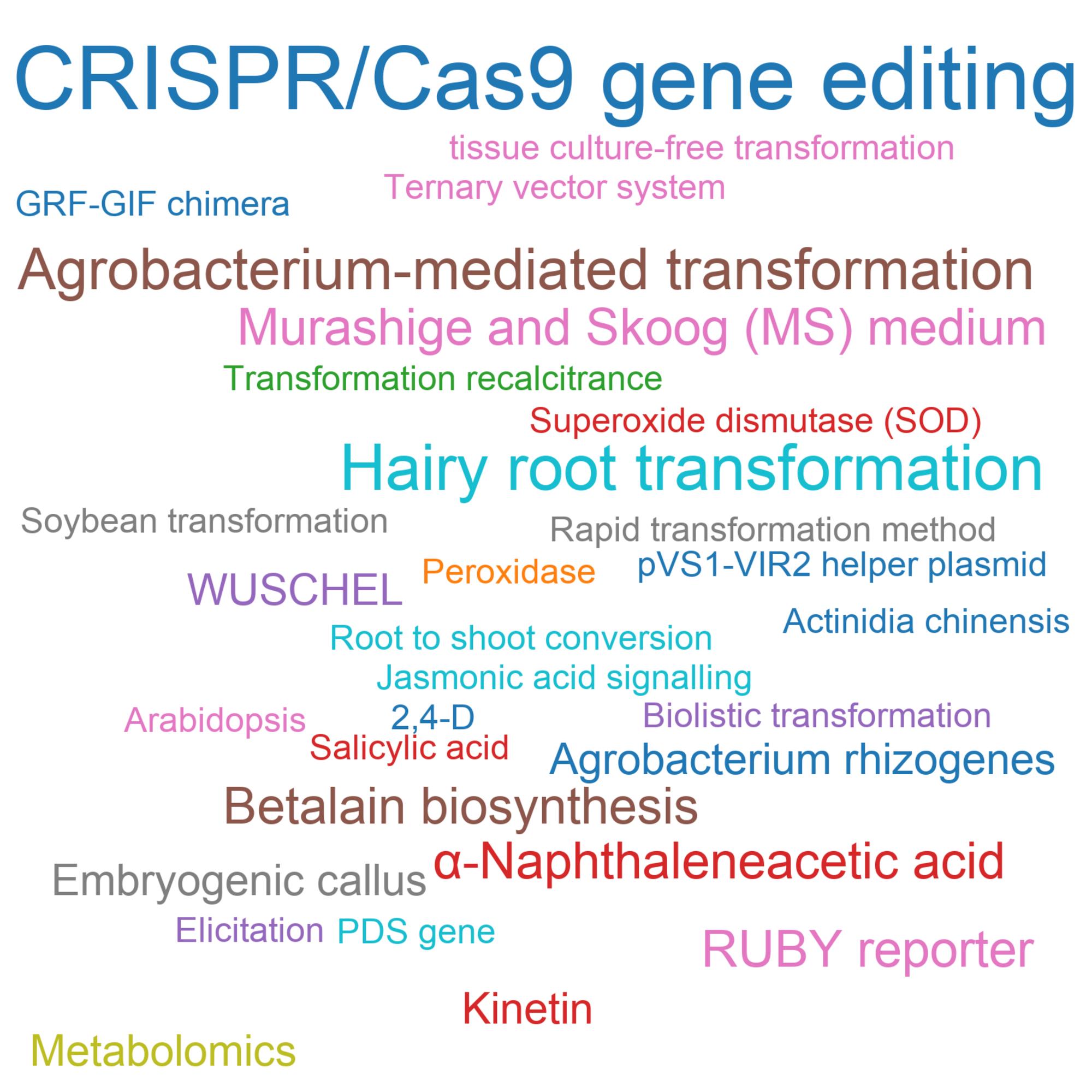
The Class of 2026 in plant tissue culture and regeneration is heavily dominated by precision genetic engineering and advanced transformation techniques. **CRISPR/Cas9 gene editing** leads as the most prominent topic, indicating its central role in modern plant biotechnology. This is closely supported by high frequencies of **hairy root transformation** and **Agrobacterium-mediated transformation**, highlighting a sustained focus on efficient gene delivery systems. Additionally, topics such as the **RUBY reporter** system and **betalain biosynthesis** reflect a growing interest in non-destructive, visually trackable markers and specialized secondary metabolites. The persistent reliance on fundamental media, such as **Murashige and Skoog (MS) medium**, underscores that while the field is advancing rapidly toward molecular breeding, it still fundamentally depends on robust in vitro propagation foundations.
How Did Topics Shift from the Class of 2025 to the Class of 2026?
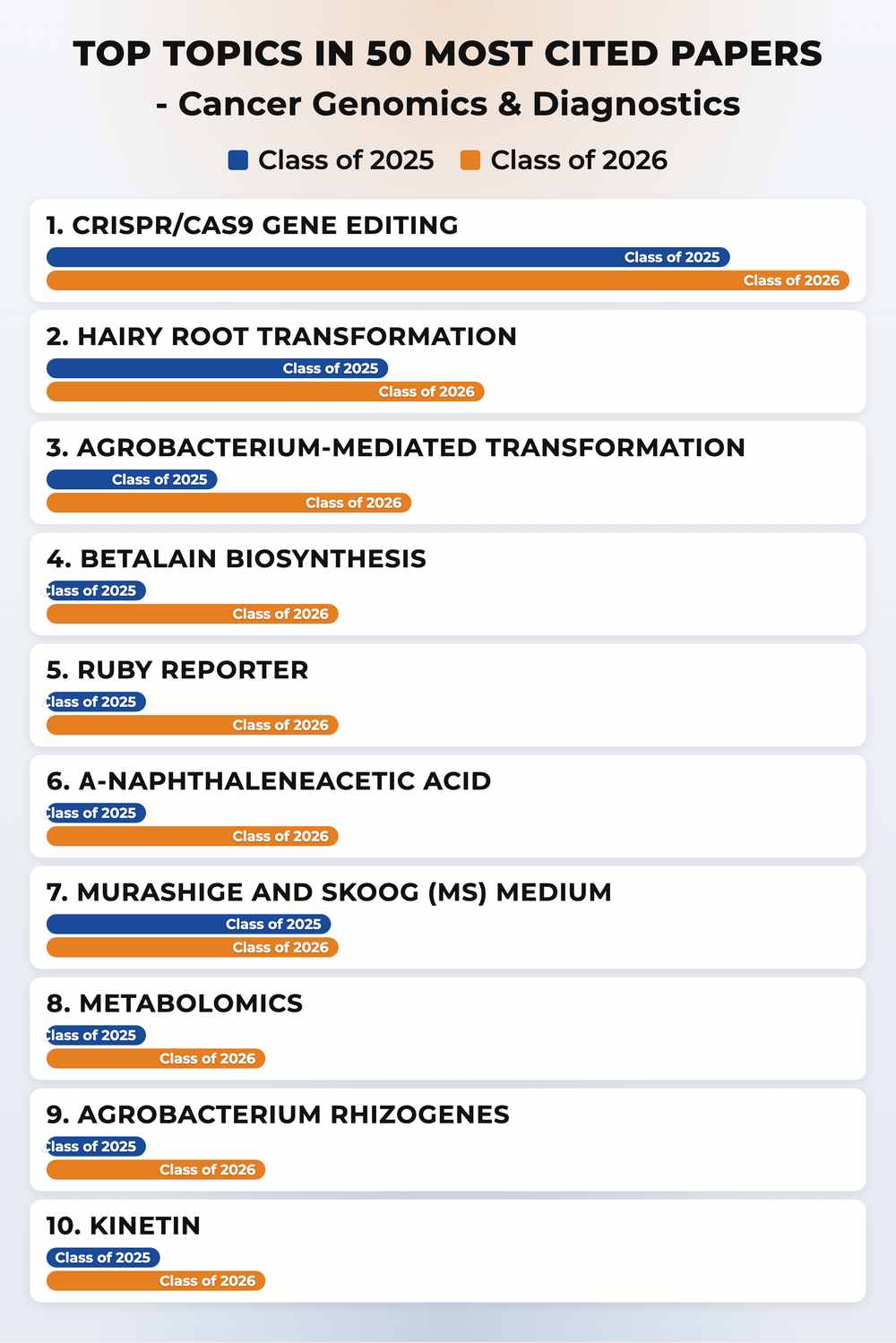
The transition from the Class of 2025 to the Class of 2026 reveals a significant shift away from traditional, descriptive tissue culture towards targeted genome modification. The most dramatic riser is **betalain biosynthesis**, which surged from almost no mentions to become a top topic, likely driven by its utility as a novel visual marker like the RUBY reporter. **CRISPR/Cas9 gene editing** and **Agrobacterium-mediated transformation** both saw marked increases in frequency, solidifying the field's trajectory toward functional genomics. Conversely, broader, more foundational concepts such as **embryogenic callus** and **micropropagation** experienced substantial declines, indicating that the frontier of high-impact research has moved beyond basic propagation protocols toward sophisticated genetic applications. This cohort shift highlights a rapidly maturing discipline that is increasingly integrating molecular tools directly into established regeneration workflows.
Methodology
PRI identifies high-impact research using a transparent, topic-agnostic framework applied consistently across scientific domains. Bibliographic records are drawn from OpenAlex, including publication dates, citation relationships, and document types.
This ranking covers the Class of 2026 cohort: journal articles published in 2024. Reviews and other non-article document types are excluded to ensure comparability.
Research impact is quantified with an 18-month post-publication citation window—the number of citing works published within 18 months of each paper's publication date. This metric captures early impact while controlling for publication age.
An LLM-based relevance classifier then reviews each candidate's title and abstract to confirm substantive alignment with the target domain. Only papers classified as relevant appear in the final ranking.
Zheng Su, Tinsley Li, Thematic Shifts in Early-High-Impact Cancer Genomics and Diagnostics Research: A Bibliometric and Semantic Analysis. bioRxiv 2026.07.04.736459; doi: https://doi.org/10.64898/2026.07.04.736459
Cite this ranking
Pepkio Research Index (PRI). Topics and Trends in Most Cited Plant tissue culture and regeneration Papers, Class of 2026. https://pri.pepkio.com/top-papers/plant-tissue-culture-and-regeneration/2026. Accessed 2026-10-14.

Methodology
Zheng Su, Tinsley Li, Thematic Shifts in Early-High-Impact Cancer Genomics and Diagnostics Research: A Bibliometric and Semantic Analysis. bioRxiv 2026.07.04.736459; doi: https://doi.org/10.64898/2026.07.04.736459