
What topics and trends defined most-cited Algal biology and biofuel production research in the Class of 2026?
Microalgae-bacteria consortia, lipid accumulation, and nutrient removal define the Class of 2026 algal biology cohort. Nutrient limitation strategies and lipid accumulation rose sharply from the Class of 2025, alongside growing multi-omics profiling, while broad wastewater treatment and general bioremediation topics receded among top-cited papers.
At a glance
- Field
- Algal biology and biofuel production
- Cohort label
- Class of 2026 (2024 publications)
- Papers analyzed
- 5,537
- Papers ranked
- 20
- Top topics in ranked papers
- Microalgae-bacteria consortium, Lipid accumulation, Phosphorus removal, Nitrogen removal, Nutrient limitation
- Publication window
- Jan 1, 2024 – Dec 31, 2024
- Eligibility
- Research articles; reviews excluded
- Citation window
- 18 months post-publication
- 18m citation range
- 35–102
- Data source
- OpenAlex · Retrieved Jul 2026
- License
- CC BY 4.0
Rankings
20 papers ranked by 18-month citation count
Removal of chemicals from effluent using photobioreactor technology to improve environmental and health impacts
Zeitschrift für Physikalische Chemie202410.1515/zpch-2023-0450
Microalgal extracellular polymeric substances (EPS) and their roles in cultivation, biomass harvesting, and bioproducts extraction
Bioresource Technology202410.1016/j.biortech.2024.131054
Antioxidants alleviated low-temperature stress in microalgae by modulating reactive oxygen species to improve lipid production and antioxidant defense
Bioresource Technology202410.1016/j.biortech.2024.131451
Combined transcriptomic and metabolomic analyses of temperature response of microalgae using waste activated sludge extracts for promising biodiesel production
Water Research202410.1016/j.watres.2024.121120
Carbon capture and utilization by algae with high concentration CO2 or bicarbonate as carbon source
The Science of The Total Environment202410.1016/j.scitotenv.2024.170325
Lipidomics analysis of microalgal lipid production and heavy metal adsorption under glycine betaine-mediated alleviation of low-temperature stress
Journal of Hazardous Materials202410.1016/j.jhazmat.2024.135831
Optimization of microalgae protein extraction from Scenedesmus obliquus and investigating its functional properties
LWT202410.1016/j.lwt.2024.116028
Cost breakdown indicates that biochar production from microalgae in Central Europe requires innovative cultivation procedures
Energy Nexus202410.1016/j.nexus.2024.100335
New insights into rare earth element-induced microalgae lipid accumulation: Implication for biodiesel production and adsorption mechanism
Water Research202410.1016/j.watres.2024.121134
Assessing global carbon sequestration and bioenergy potential from microalgae cultivation on marginal lands leveraging machine learning
The Science of The Total Environment202410.1016/j.scitotenv.2024.174462
The primary carbon metabolism in cyanobacteria and its regulation
Frontiers in Plant Science202410.3389/fpls.2024.1417680
Fueling sustainability: Co-pyrolysis of microalgae biomass and waste plastics for renewable energy and waste mitigation
Biomass and Bioenergy202410.1016/j.biombioe.2024.107303
The application of magical microalgae in carbon sequestration and emission reduction: Removal mechanisms and potential analysis
Renewable and Sustainable Energy Reviews202410.1016/j.rser.2024.114417
Microalgae stress sensing through oxidative phosphorylation drives bioenergy potential: Deciphering mechanisms and future opportunities
Journal of environmental chemical engineering202410.1016/j.jece.2024.114266
A growth phase analysis on the influence of light intensity on microalgal stress and potential biofuel production
Energy Conversion and Management202410.1016/j.enconman.2024.118511
Particle-attached bacteria act as gatekeepers in the decomposition of complex phytoplankton polysaccharides
Microbiome202410.1186/s40168-024-01757-5
Promoting symbiotic relationship between microalgae and bacteria in wastewater treatment processes: Technic comparison, microbial analysis, and future perspectives
Chemical Engineering Journal202410.1016/j.cej.2024.155703
Application of Artificial Intelligence and Image Processing for the Cultivation of <i>Chlorella</i> sp. Using Tubular Photobioreactors
ACS Omega202410.1021/acsomega.4c05971
Bidirectional Enhancement of Nitrogen Removal by Indigenous Synergetic Microalgal–Bacterial Consortia in Harsh Low-C/N Wastewater
Environmental Science & Technology202410.1021/acs.est.3c10322
Innovative microalgae technologies for mariculture wastewater treatment: Single and combined microalgae treatment mechanisms, challenges and future prospects
Environmental Research202410.1016/j.envres.2024.120560
Topic trends
Dominant research themes and year-over-year shifts in Algal biology and biofuel production
What Topics Define the Class of 2026?
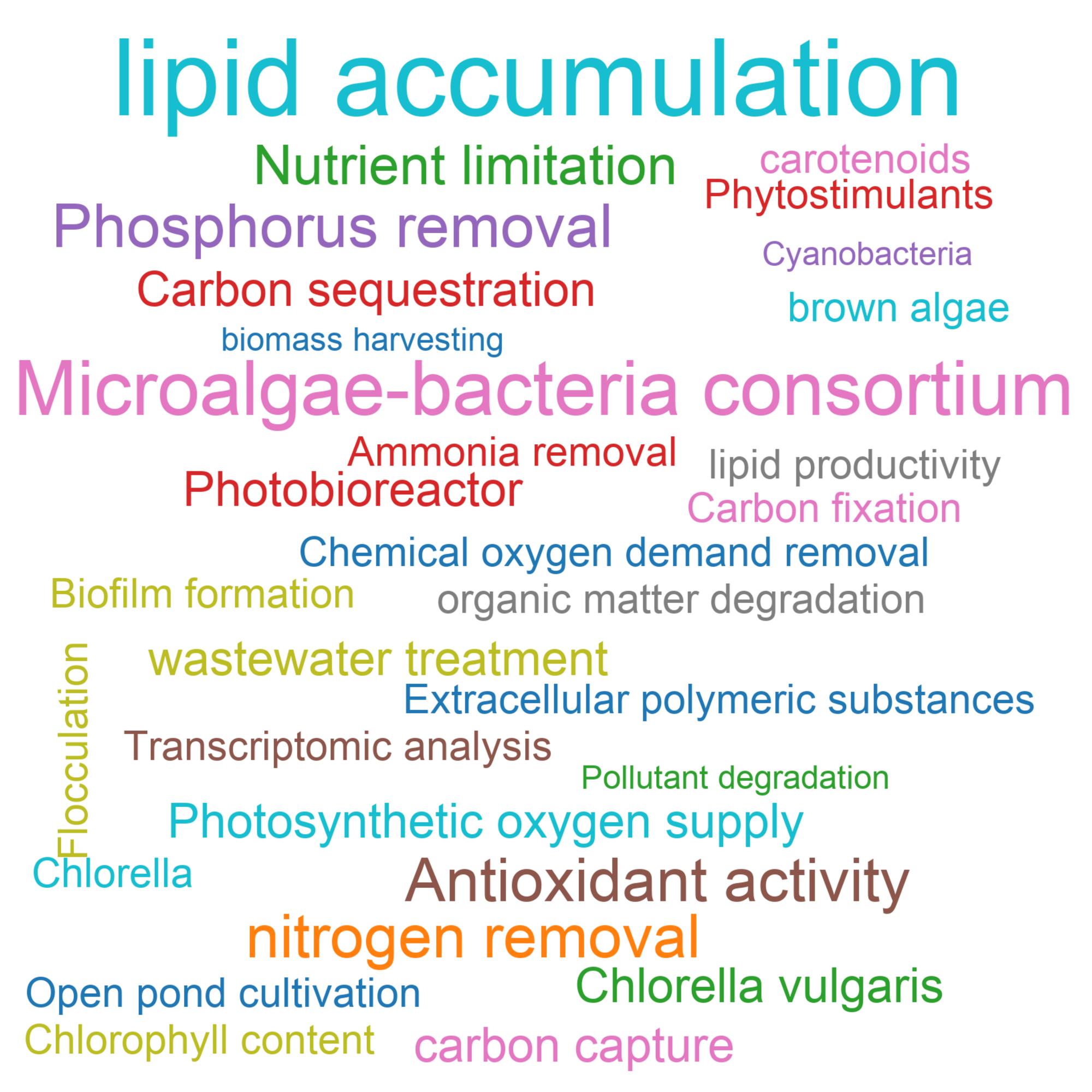
The informative word cloud across the 50 highest 18-month-cited algal biology and biofuel production papers reveals a field focused on microalgae-bacteria consortia, lipid accumulation pathways, and integrated bioprocess engineering for wastewater treatment. Microalgae-bacteria consortia lead the cohort at 9 of 50 papers (normalized frequency 0.18), reflecting widespread adoption of synergistic co-cultivation systems for enhanced biomass yield and oxygen transfer. Lipid accumulation also anchors 9 papers (0.18), driven by metabolic engineering and stress-induced triacylglycerol synthesis for biodiesel feedstocks. Environmental remediation and nutrient recycling form a prominent cluster, featuring phosphorus removal (6 papers, 0.12), nitrogen removal (6 papers, 0.12), and wastewater treatment (4 papers, 0.08). Nutrient limitation strategies (5 papers, 0.10) highlight operational controls used to trigger lipid and secondary metabolite synthesis. Carbon mitigation themes are well represented by carbon capture (4 papers, 0.08), carbon sequestration (4 papers, 0.08), and photosynthetic oxygen supply (4 papers, 0.08), demonstrating the dual utility of microalgal platforms in industrial decarbonization. Cultivation technology and model strains are marked by photobioreactors (4 papers, 0.08) and Chlorella vulgaris (4 papers, 0.08). Specialized downstream processes—including extracellular polymeric substances, flocculation, open pond cultivation, and carotenoid extraction—round out the top-cited literature, underscoring a shift toward circular bioeconomy approaches that couple biofuel feedstock generation with wastewater purification.
How Did Topics Shift from the Class of 2025 to the Class of 2026?
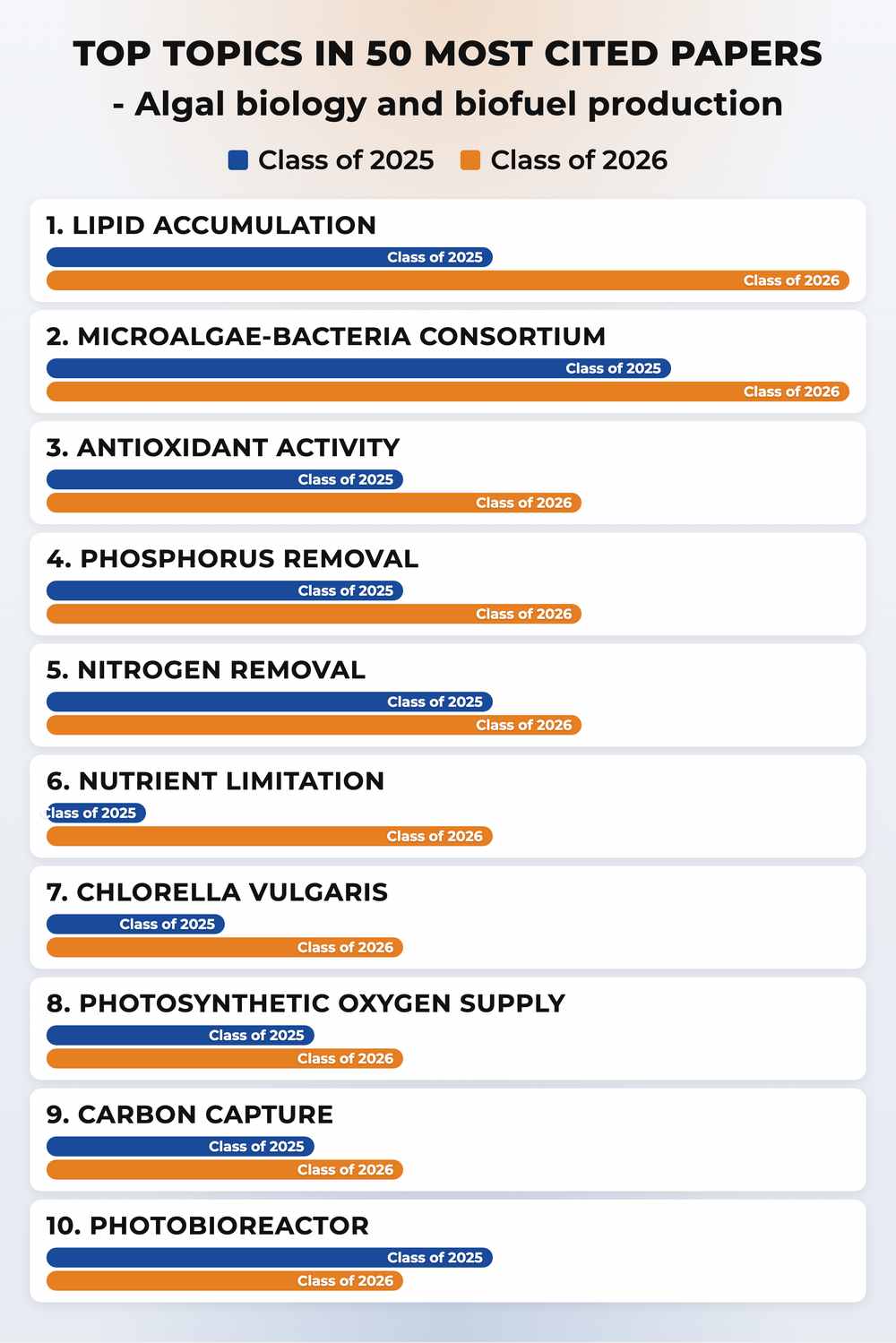
Comparing normalized concept frequencies between the Class of 2025 (2023 publications) and Class of 2026 (2024 publications) cohorts shows a clear reorientation toward targeted physiological induction, co-culture optimization, and detailed multi-omics characterization. Nutrient limitation exhibited the sharpest increase (+0.08 normalized frequency; 1 versus 5 papers), alongside lipid accumulation (+0.08; 5 versus 9 papers), signaling heightened research focus on metabolic stress triggers that maximize lipid productivity. Microalgae-bacteria consortia continued their upward trajectory (+0.04; 7 versus 9 papers), accompanied by gains in specific nutrient recovery mechanics like phosphorus removal (+0.04; 4 versus 6 papers) and model strain studies of Chlorella vulgaris (+0.04; 2 versus 4 papers). Emerging topics in the 2024 cohort include biofilm formation, ammonia removal, transcriptomic analysis, metabolomics, and lipid profiling, reflecting deeper mechanistic inquiry into algal syntrophy and metabolic pathways. Conversely, broad environmental application descriptors experienced notable declines. Wastewater treatment dropped most significantly (−0.12; 10 versus 4 papers), followed by bioremediation (−0.08; 6 versus 2 papers) and carbon sequestration (−0.06; 7 versus 4 papers), as high-impact literature shifted from general remediation reporting to specialized physiological and bio-based recovery mechanisms. Together, these shifts highlight an evolving domain prioritizing precise metabolic control, multi-species consortium engineering, and high-value co-product recovery over broad-brush bioremediation.
Methodology
PRI identifies high-impact research using a transparent, topic-agnostic framework applied consistently across scientific domains. Bibliographic records are drawn from OpenAlex, including publication dates, citation relationships, and document types.
This ranking covers the Class of 2026 cohort: journal articles published in 2024. Reviews and other non-article document types are excluded to ensure comparability.
Research impact is quantified with an 18-month post-publication citation window—the number of citing works published within 18 months of each paper's publication date. This metric captures early impact while controlling for publication age.
An LLM-based relevance classifier then reviews each candidate's title and abstract to confirm substantive alignment with the target domain. Only papers classified as relevant appear in the final ranking.
Zheng Su, Tinsley Li, Thematic Shifts in Early-High-Impact Cancer Genomics and Diagnostics Research: A Bibliometric and Semantic Analysis. bioRxiv 2026.07.04.736459; doi: https://doi.org/10.64898/2026.07.04.736459
Cite this ranking
Pepkio Research Index (PRI). Topics and Trends in Most Cited Algal biology and biofuel production Papers, Class of 2026. https://pri.pepkio.com/top-papers/algal-biology-and-biofuel-production/2026. Accessed 2026-10-16.

Methodology
Zheng Su, Tinsley Li, Thematic Shifts in Early-High-Impact Cancer Genomics and Diagnostics Research: A Bibliometric and Semantic Analysis. bioRxiv 2026.07.04.736459; doi: https://doi.org/10.64898/2026.07.04.736459