
What topics and trends defined most-cited Plant Molecular Biology Research research in the Class of 2026?
Plant molecular biology research in the Class of 2026 is driven by transcriptomic profiling of abiotic stress tolerance, with major surges in cold and drought responses. Abscisic acid (ABA) signaling and WRKY/ERF transcription factors lead regulatory insights in Arabidopsis, rice, and tomato, while CRISPR editing and long-read genomics emerge as key functional drivers.
At a glance
- Field
- Plant Molecular Biology Research
- Cohort label
- Class of 2026 (2024 publications)
- Papers analyzed
- 7,169
- Papers ranked
- 20
- Top topics in ranked papers
- Arabidopsis thaliana, transcriptomics, ABA signaling, WRKY transcription factors, abiotic stress tolerance
- Publication window
- Jan 1, 2024 – Dec 31, 2024
- Eligibility
- Research articles; reviews excluded
- Citation window
- 18 months post-publication
- 18m citation range
- 43–93
- Data source
- OpenAlex · Retrieved Jul 2026
- License
- CC BY 4.0
Rankings
20 papers ranked by 18-month citation count
Peptide REF1 is a local wound signal promoting plant regeneration
Cell202410.1016/j.cell.2024.04.040
MYB-related transcription factors control chloroplast biogenesis
Cell202410.1016/j.cell.2024.06.039
Exaptation of ancestral cell-identity networks enables C4 photosynthesis
Nature202410.1038/s41586-024-08204-3
Stress-induced nuclear translocation of ONAC023 improves drought and heat tolerance through multiple processes in rice
Nature Communications202410.1038/s41467-024-50229-9
The temperature sensor TWA1 is required for thermotolerance in Arabidopsis
Nature202410.1038/s41586-024-07424-x
An AP2/ERF transcription factor confers chilling tolerance in rice
Science Advances202410.1126/sciadv.ado4788
Transcriptome analysis of axillary buds in low phosphorus stress and functional analysis of TaWRKY74s in wheat
BMC Plant Biology202410.1186/s12870-023-04695-w
Structure and function of the <i>Arabidopsis</i> ABC transporter ABCB19 in brassinosteroid export
Science202410.1126/science.adj4591
Regulatory mechanisms of strigolactone perception in rice
Cell202410.1016/j.cell.2024.10.009
Microbial colonisation rewires the composition and content of poplar root exudates, root and shoot metabolomes
Microbiome202410.1186/s40168-024-01888-9
A cytoplasmic osmosensing mechanism mediated by molecular crowding–sensitive DCP5
Science202410.1126/science.adk9067
Light-induced remodeling of phytochrome B enables signal transduction by phytochrome-interacting factor
Cell202410.1016/j.cell.2024.09.005
The super-pangenome of Populus unveils genomic facets for its adaptation and diversification in widespread forest trees
Molecular Plant202410.1016/j.molp.2024.03.009
Differential phosphorylation of Ca2+-permeable channel CYCLIC NUCLEOTIDE–GATED CHANNEL20 modulates calcium-mediated freezing tolerance in Arabidopsis
The Plant Cell202410.1093/plcell/koae177
Two telomere-to-telomere gapless genomes reveal insights into Capsicum evolution and capsaicinoid biosynthesis
Nature Communications202410.1038/s41467-024-48643-0
A Zea genus-specific micropeptide controls kernel dehydration in maize
Cell202410.1016/j.cell.2024.10.030
Prediction of plant complex traits via integration of multi-omics data
Nature Communications202410.1038/s41467-024-50701-6
Identification of plant transcriptional activation domains
Nature202410.1038/s41586-024-07707-3
Adaptive roles of cytokinins in enhancing plant resilience and yield against environmental stressors
Chemosphere202410.1016/j.chemosphere.2024.143189
The OsNAC41-RoLe1-OsAGAP module promotes root development and drought resistance in upland rice
Molecular Plant202410.1016/j.molp.2024.09.002
Topic trends
Dominant research themes and year-over-year shifts in Plant Molecular Biology Research
What Topics Define the Class of 2026 in Plant Molecular Biology?
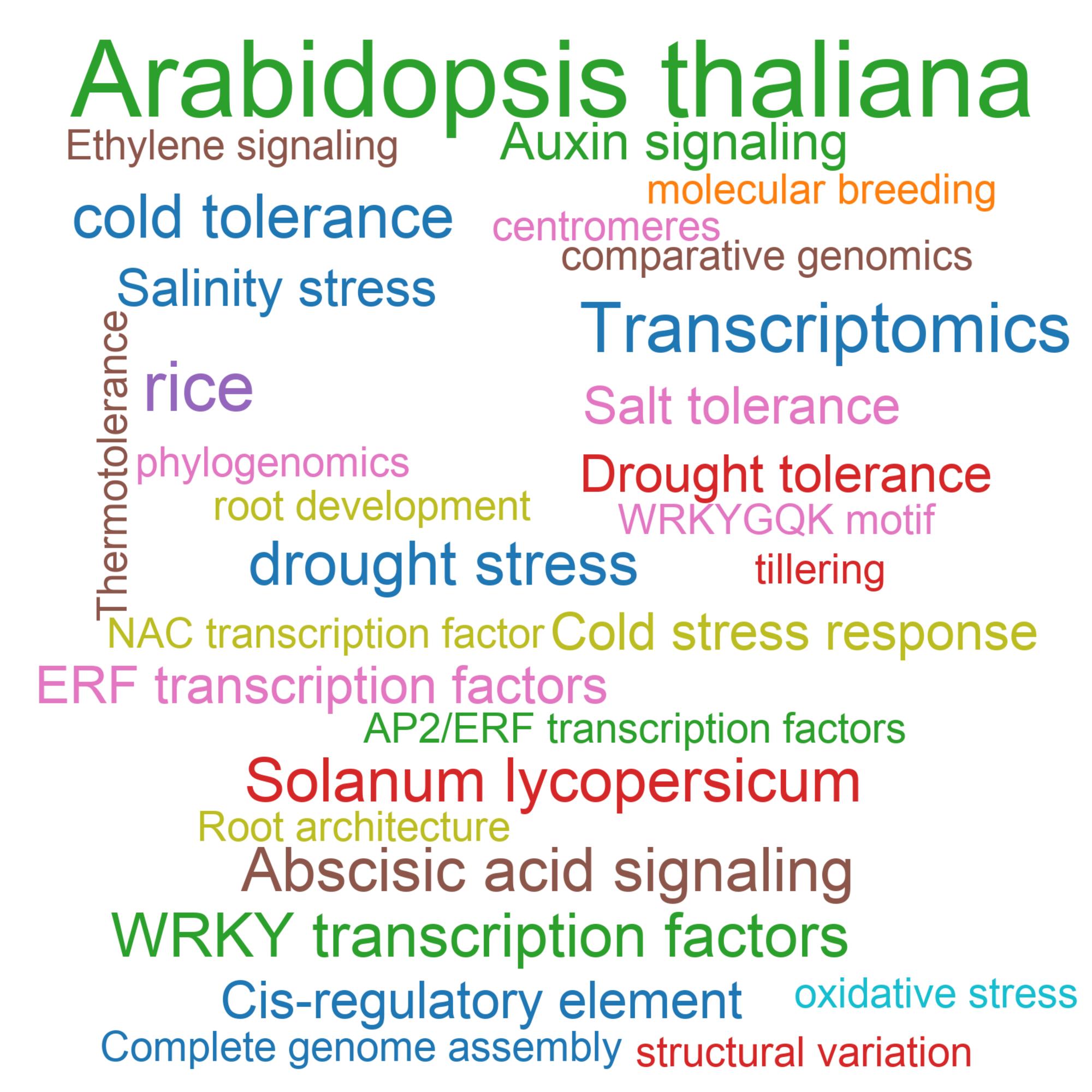
The Class of 2026 in plant molecular biology research is overwhelmingly centered on understanding environmental stress resilience and hormone-mediated regulatory networks in model and crop species. Arabidopsis thaliana remains the premier model system, appearing in 24% of top-ranked publications (12 papers), serving as the foundational platform for dissecting fundamental cellular mechanisms. Simultaneously, translation to key agronomic crops is evident through heavy representation of rice (Oryza sativa, 10% of papers) and tomato (Solanum lycopersicum, 8% of papers). Methodologically, transcriptomics has established itself as the primary engine for high-throughput discovery, representing 10% of high-impact works. At the mechanistic level, phytohormone signaling networks—most notably abscisic acid (ABA) signaling (8%) and auxin signaling (6%)—dominate current inquiries, underpinning plant responses to fluctuating environments. Downstream of hormone perception, specific transcriptional regulatory machinery commands significant attention, led by WRKY transcription factors (8%), ERF family regulators (6%), and cis-regulatory element architecture (6%). Environmental adaptation research is tightly clustered around abiotic stress resilience, particularly cold tolerance and drought stress responses. Together, these topics define a field focused on deciphering gene regulatory networks that orchestrate stress survival, developmental plasticity, and crop productivity.
How Did Topics Shift from the Class of 2025 to the Class of 2026?
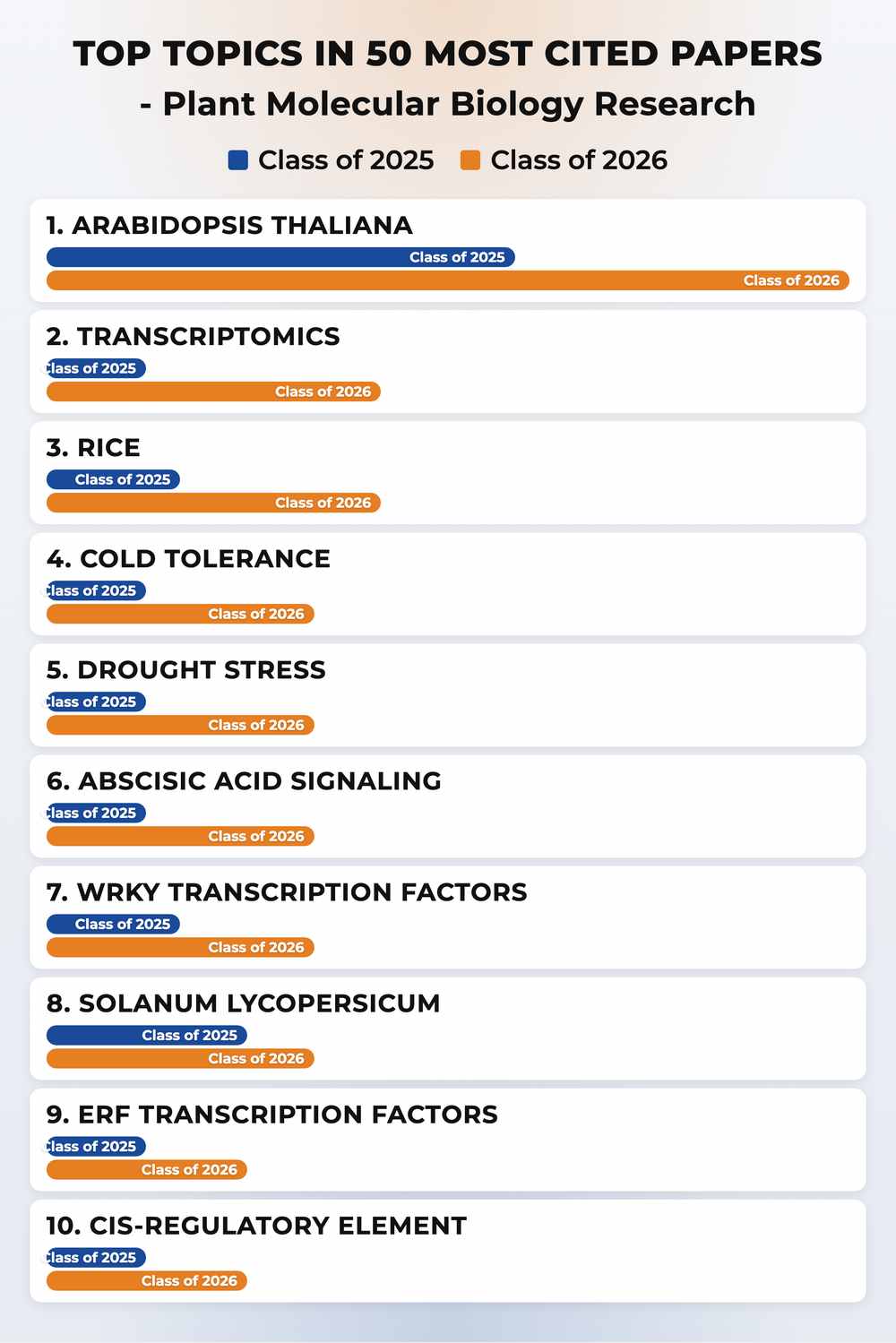
A comparison between the Class of 2025 and Class of 2026 highlights a decisive shift toward multi-stress climate adaptation mechanisms and functional genomics technologies. The most prominent surge occurred in cold tolerance and drought stress research, both expanding from zero top-ranked papers in the previous cohort to four papers each (0.08 normalized frequency) in the Class of 2026. This focus on environmental extremes was mirrored by a 4-fold increase in abscisic acid (ABA) signaling (growing from 2% to 8% frequency) and a 5-fold expansion in transcriptomic studies (from 2% to 10%), reflecting an emphasis on systems-level hormone dynamics under stress. Emerging transcription factor families also saw rapid adoption; ERF (ethylene response factor) transcription factors surged from zero to 6% frequency, working alongside WRKY regulators to coordinate stress defense. Additionally, next-generation functional tools—including CRISPR/Cas9 gene editing, complete long-read genome assemblies, and virus-induced gene silencing (VIGS)—entered the top-cited tier for the first time, alongside enzymatic ROS-scavenging markers like superoxide dismutase (SOD) and catalase (CAT). Conversely, general salt tolerance studies experienced a 50% relative decline (dropping from 12% to 6% frequency), indicating that research attention has broadened from isolated salinity responses toward integrative osmotic and temperature stress signaling.
Methodology
PRI identifies high-impact research using a transparent, topic-agnostic framework applied consistently across scientific domains. Bibliographic records are drawn from OpenAlex, including publication dates, citation relationships, and document types.
This ranking covers the Class of 2026 cohort: journal articles published in 2024. Reviews and other non-article document types are excluded to ensure comparability.
Research impact is quantified with an 18-month post-publication citation window—the number of citing works published within 18 months of each paper's publication date. This metric captures early impact while controlling for publication age.
An LLM-based relevance classifier then reviews each candidate's title and abstract to confirm substantive alignment with the target domain. Only papers classified as relevant appear in the final ranking.
Zheng Su, Tinsley Li, Thematic Shifts in Early-High-Impact Cancer Genomics and Diagnostics Research: A Bibliometric and Semantic Analysis. bioRxiv 2026.07.04.736459; doi: https://doi.org/10.64898/2026.07.04.736459
Cite this ranking
Pepkio Research Index (PRI). Topics and Trends in Most Cited Plant Molecular Biology Research Papers, Class of 2026. https://pri.pepkio.com/top-papers/plant-molecular-biology-research/2026. Accessed 2026-10-21.

Methodology
Zheng Su, Tinsley Li, Thematic Shifts in Early-High-Impact Cancer Genomics and Diagnostics Research: A Bibliometric and Semantic Analysis. bioRxiv 2026.07.04.736459; doi: https://doi.org/10.64898/2026.07.04.736459