
What topics and trends defined most-cited Plant Stress Responses and Tolerance research in the Class of 2026?
The Class of 2026 emphasizes fundamental mechanisms like ROS and salt/drought stress while showing a marked shift towards plant-microbe interactions, advanced metabolomics, and crop-specific models like tomato. Traditional descriptive studies are giving way to deep physiological profiling and microbiome-assisted stress resilience.
At a glance
- Field
- Plant Stress Responses and Tolerance
- Cohort label
- Class of 2026 (2024 publications)
- Papers analyzed
- 6,963
- Papers ranked
- 20
- Top topics in ranked papers
- Reactive oxygen species, salt stress, drought stress, Solanum lycopersicum
- Publication window
- Jan 1, 2024 – Dec 31, 2024
- Eligibility
- Research articles; reviews excluded
- Citation window
- 18 months post-publication
- 18m citation range
- 51–122
- Data source
- OpenAlex · Retrieved June 2026
- License
- CC BY 4.0
Rankings
20 papers ranked by 18-month citation count
Engineering source-sink relations by prime editing confers heat-stress resilience in tomato and rice
Cell202410.1016/j.cell.2024.11.005
Plant Adaptation to Drought Stress: The Role of Anatomical and Morphological Characteristics in Maintaining the Water Status
Journal of soil science and plant nutrition202410.1007/s42729-024-02141-w
Enhancing soil health to minimize cadmium accumulation in agro-products: the role of microorganisms, organic matter, and nutrients
Environmental Pollution202410.1016/j.envpol.2024.123890
The mechanisms of photoinhibition and repair in plants under high light conditions and interplay with abiotic stressors
Journal of Photochemistry and Photobiology B Biology202410.1016/j.jphotobiol.2024.113004
Metabolomics and transcriptomics analysis revealed the response mechanism of alfalfa to combined cold and saline‐alkali stress
The Plant Journal202410.1111/tpj.16896
Mechanisms of calcium homeostasis orchestrate plant growth and immunity
Nature202410.1038/s41586-024-07100-0
Silicon and iron nanoparticles protect rice against lead (Pb) stress by improving oxidative tolerance and minimizing Pb uptake
Scientific Reports202410.1038/s41598-024-55810-2
A glutathione S-transferase regulates lignin biosynthesis and enhances salt tolerance in tomato
PLANT PHYSIOLOGY202410.1093/plphys/kiae504
Stress-induced nuclear translocation of ONAC023 improves drought and heat tolerance through multiple processes in rice
Nature Communications202410.1038/s41467-024-50229-9
The temperature sensor TWA1 is required for thermotolerance in Arabidopsis
Nature202410.1038/s41586-024-07424-x
An AP2/ERF transcription factor confers chilling tolerance in rice
Science Advances202410.1126/sciadv.ado4788
Effects of abiotic stress on chlorophyll metabolism
Plant Science202410.1016/j.plantsci.2024.112030
Structure and function of the <i>Arabidopsis</i> ABC transporter ABCB19 in brassinosteroid export
Science202410.1126/science.adj4591
Dynamic interplay of reactive oxygen and nitrogen species (ROS and RNS) in plant resilience: unveiling the signaling pathways and metabolic responses to biotic and abiotic stresses
Plant Cell Reports202410.1007/s00299-024-03281-0
Integrated transcriptomic and metabolomic analyses uncover the key pathways of <i>Limonium bicolor</i> in response to salt stress
Plant Biotechnology Journal202410.1111/pbi.14534
Zinc oxide nanoparticles application alleviates salinity stress by modulating plant growth, biochemical attributes and nutrient homeostasis in Phaseolus vulgaris L
Frontiers in Plant Science202410.3389/fpls.2024.1432258
Impact of Heavy Metal Pollution in the Environment on the Metabolic Profile of Medicinal Plants and Their Therapeutic Potential
Plants202410.3390/plants13060913
A cytoplasmic osmosensing mechanism mediated by molecular crowding–sensitive DCP5
Science202410.1126/science.adk9067
Dual phosphorylation of DGK5-mediated PA burst regulates ROS in plant immunity
Cell202410.1016/j.cell.2023.12.030
<scp>CRISPR</scp>/Cas knockout of the <scp>NADPH</scp> oxidase gene <scp><i>OsRbohB</i></scp> reduces <scp>ROS</scp> overaccumulation and enhances heat stress tolerance in rice
Plant Biotechnology Journal202410.1111/pbi.14500
Topic trends
Dominant research themes and year-over-year shifts in Plant Stress Responses and Tolerance
What Topics Define the Class of 2026?
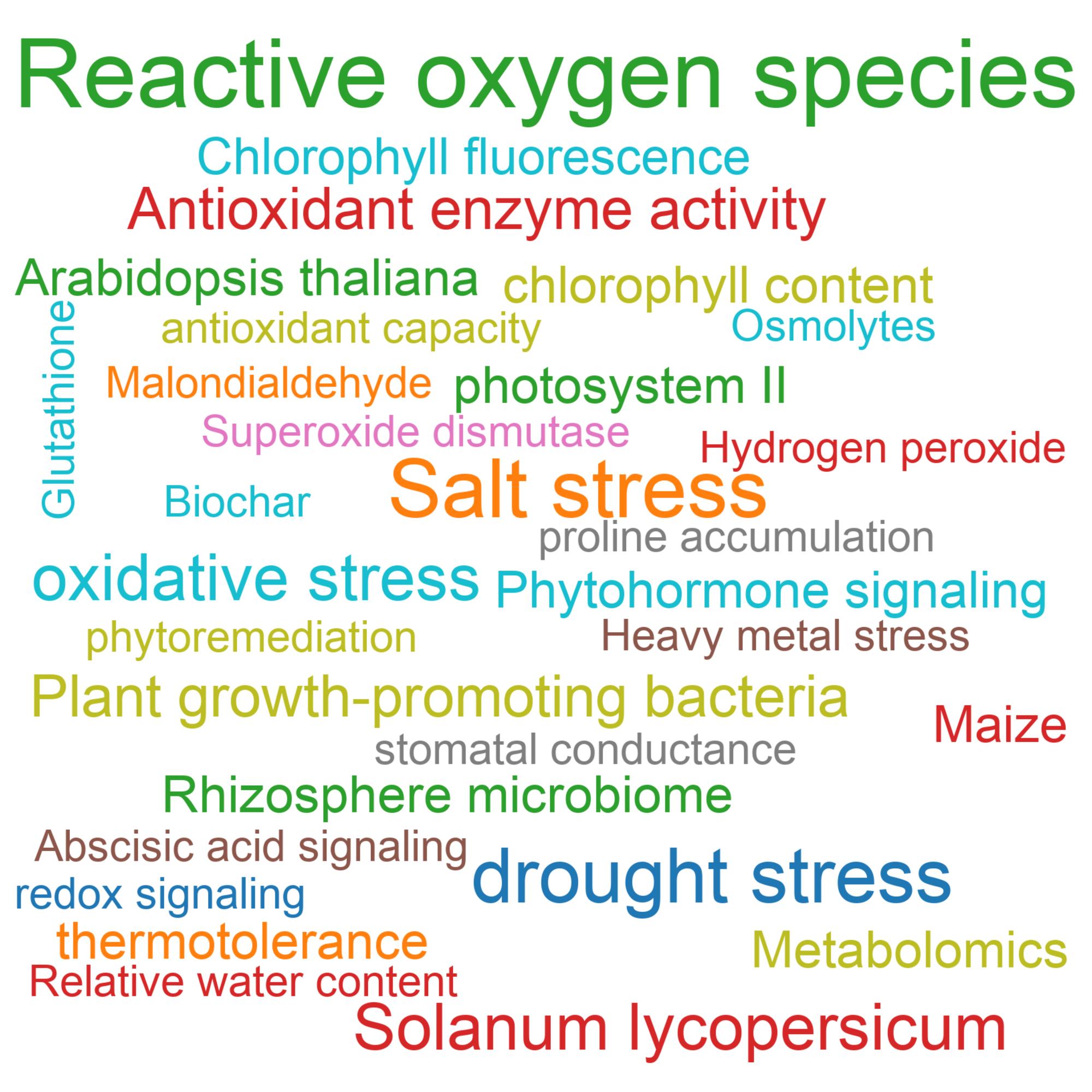
The literature on plant stress responses and tolerance for the Class of 2026 is heavily characterized by terms related to fundamental oxidative and osmotic stress management mechanisms. Leading concepts such as reactive oxygen species (ROS), salt stress, drought stress, and oxidative stress reflect a continued intense focus on how plants cope with harsh environmental conditions, particularly water deficit and salinity. Notably, model and crop species such as Arabidopsis thaliana, Solanum lycopersicum (tomato), and maize feature prominently, underscoring the balance between basic mechanistic research and translational applications for global food security. A growing emphasis on metabolic and physiological pathways is also apparent, with terms like antioxidant enzyme activity, metabolomics, chlorophyll fluorescence, and phytohormone signaling gaining traction. Additionally, the increasing presence of terms like plant growth-promoting bacteria and rhizosphere microbiome highlights a systemic shift towards understanding plant-microbe interactions as critical components of stress resilience. These findings collectively paint a picture of a field that is integrating molecular, physiological, and ecological perspectives to engineer and breed stress-tolerant crops.
How Did Topics Shift from the Class of 2025 to the Class of 2026?
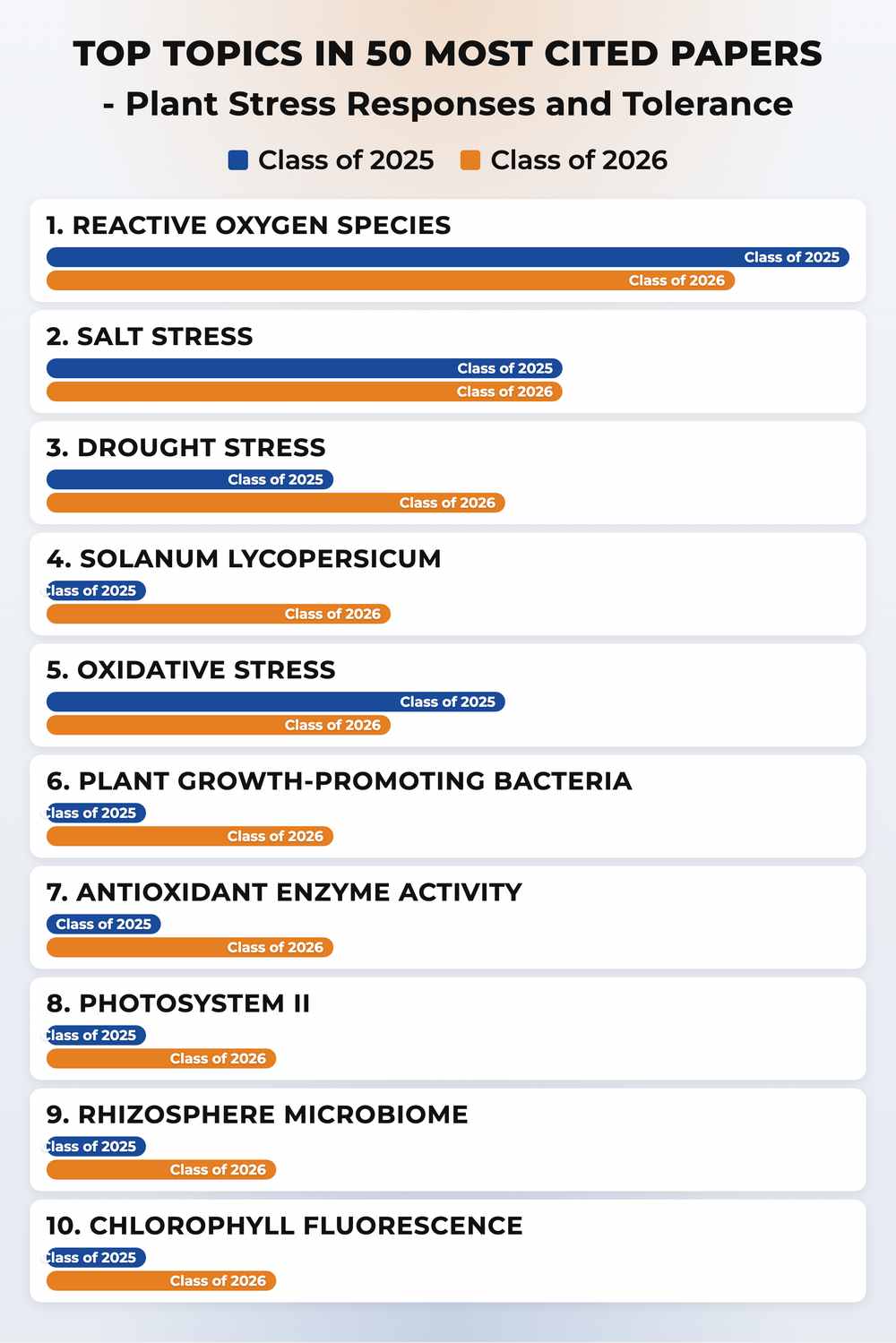
A comparative analysis of the concepts driving research reveals notable dynamic shifts between the Class of 2025 and the Class of 2026. The most striking increases are observed in specialized methodologies and specific plant interactions, such as chlorophyll fluorescence and rhizosphere microbiome research, which exhibited massive relative fold changes. The rapid rise of research on Solanum lycopersicum (tomato) highlights its growing role as a crucial crop model for stress tolerance. Furthermore, metabolic analysis approaches like metabolomics, and specific resilience traits like thermotolerance, have seen substantial upward trajectories, suggesting a shift from descriptive studies to deep metabolic profiling and extreme temperature adaptation. Conversely, some traditional broad topics like general oxidative stress and reactive oxygen species have shown slight relative declines or stabilization, indicating that the field is moving beyond identifying these phenomena towards dissecting specific stress signaling pathways. The prominent surge in plant growth-promoting bacteria indicates that leveraging the microbiome for stress mitigation is a rapidly accelerating frontier in agricultural biotechnology.
Methodology
PRI identifies high-impact research using a transparent, topic-agnostic framework applied consistently across scientific domains. Bibliographic records are drawn from OpenAlex, including publication dates, citation relationships, and document types.
This ranking covers the Class of 2026 cohort: journal articles published in 2024. Reviews and other non-article document types are excluded to ensure comparability.
Research impact is quantified with an 18-month post-publication citation window—the number of citing works published within 18 months of each paper's publication date. This metric captures early impact while controlling for publication age.
An LLM-based relevance classifier then reviews each candidate's title and abstract to confirm substantive alignment with the target domain. Only papers classified as relevant appear in the final ranking.
Zheng Su, Tinsley Li, Thematic Shifts in Early-High-Impact Cancer Genomics and Diagnostics Research: A Bibliometric and Semantic Analysis. bioRxiv 2026.07.04.736459; doi: https://doi.org/10.64898/2026.07.04.736459
Cite this ranking
Pepkio Research Index (PRI). Topics and Trends in Most Cited Plant Stress Responses and Tolerance Papers, Class of 2026. https://pri.pepkio.com/top-papers/plant-stress-responses-and-tolerance/2026. Accessed 2026-10-24.

Methodology
Zheng Su, Tinsley Li, Thematic Shifts in Early-High-Impact Cancer Genomics and Diagnostics Research: A Bibliometric and Semantic Analysis. bioRxiv 2026.07.04.736459; doi: https://doi.org/10.64898/2026.07.04.736459