
What topics and trends defined most-cited Legume Nitrogen Fixing Symbiosis research in the Class of 2026?
Research in legume nitrogen-fixing symbiosis is shifting rapidly from isolated microsymbionts toward complex rhizosphere community engineering. While core symbiosis themes maintain foundational dominance, studies on synthetic microbial communities, intercropping, and biofertilizers expanded significantly, whereas general diazotroph classifications experienced relative declines in high-impact publications.
At a glance
- Field
- Legume Nitrogen Fixing Symbiosis
- Cohort label
- Class of 2026 (2024 publications)
- Papers analyzed
- 5,425
- Papers ranked
- 20
- Top topics in ranked papers
- Rhizosphere microbial community, synthetic microbial communities, biofertilizers, intercropping, arbuscular mycorrhizal fungi
- Publication window
- Jan 1, 2024 – Dec 31, 2024
- Eligibility
- Research articles; reviews excluded
- Citation window
- 18 months post-publication
- 18m citation range
- 26–105
- Data source
- OpenAlex · Retrieved Jul 2026
- License
- CC BY 4.0
Rankings
20 papers ranked by 18-month citation count
Superiority of native soil core microbiomes in supporting plant growth
Nature Communications202410.1038/s41467-024-50685-3
Legume rhizodeposition promotes nitrogen fixation by soil microbiota under crop diversification
Nature Communications202410.1038/s41467-024-47159-x
Dynamic root microbiome sustains soybean productivity under unbalanced fertilization
Nature Communications202410.1038/s41467-024-45925-5
Genetically optimizing soybean nodulation improves yield and protein content
Nature Plants202410.1038/s41477-024-01696-x
Enhanced nitrogen fixation and Cd passivation in rhizosphere soil by biochar-loaded nitrogen-fixing bacteria: Chemisorption and microbial mechanism
Journal of Hazardous Materials202410.1016/j.jhazmat.2024.136588
Drought-Tolerant Bacteria and Arbuscular Mycorrhizal Fungi Mitigate the Detrimental Effects of Drought Stress Induced by Withholding Irrigation at Critical Growth Stages of Soybean (Glycine max, L.)
Microorganisms202410.3390/microorganisms12061123
Zinc mediates control of nitrogen fixation via transcription factor filamentation
Nature202410.1038/s41586-024-07607-6
Symbiotic Synergy: Unveiling Plant-Microbe Interactions in Stress Adaptation
Journal of Crop Health202410.1007/s10343-024-01070-z
Single-cell transcriptome atlases of soybean root and mature nodule reveal new regulatory programs that control the nodulation process
Plant Communications202410.1016/j.xplc.2024.100984
Root hair developmental regulators orchestrate drought triggered microbiome changes and the interaction with beneficial Rhizobiaceae
Nature Communications202410.1038/s41467-024-54417-5
Host-imposed control mechanisms in legume–rhizobia symbiosis
Nature Microbiology202410.1038/s41564-024-01762-2
European soybean to benefit people and the environment
Scientific Reports202410.1038/s41598-024-57522-z
Contrasting seasonal effects of legume and grass cover crops as living mulch on the soil microbial community and nutrient metabolic limitations
Agriculture Ecosystems & Environment202410.1016/j.agee.2024.109374
Root exudation drives abiotic stress tolerance in plants by recruiting beneficial microbes
Applied Soil Ecology202410.1016/j.apsoil.2024.105351
Inorganic nitrogen inhibits symbiotic nitrogen fixation through blocking NRAMP2-mediated iron delivery in soybean nodules
Nature Communications202410.1038/s41467-024-53325-y
Deciphering Microbial Community and Nitrogen Fixation in the Legume Rhizosphere
Journal of Agricultural and Food Chemistry202410.1021/acs.jafc.3c09160
Leguminous green manure intercropping changes the soil microbial community and increases soil nutrients and key quality components of tea leaves
Horticulture Research202410.1093/hr/uhae018
Biochar relieves the toxic effects of microplastics on the root-rhizosphere soil system by altering root expression profiles and microbial diversity and functions
Ecotoxicology and Environmental Safety202410.1016/j.ecoenv.2024.115935
Comparative genomics analysis reveals genetic characteristics and nitrogen fixation profile of Bradyrhizobium
iScience202410.1016/j.isci.2024.108948
A receptor required for chitin perception facilitates arbuscular mycorrhizal associations and distinguishes root symbiosis from immunity
Current Biology202410.1016/j.cub.2024.03.015
Topic trends
Dominant research themes and year-over-year shifts in Legume Nitrogen Fixing Symbiosis
What Topics Define the Class of 2026?
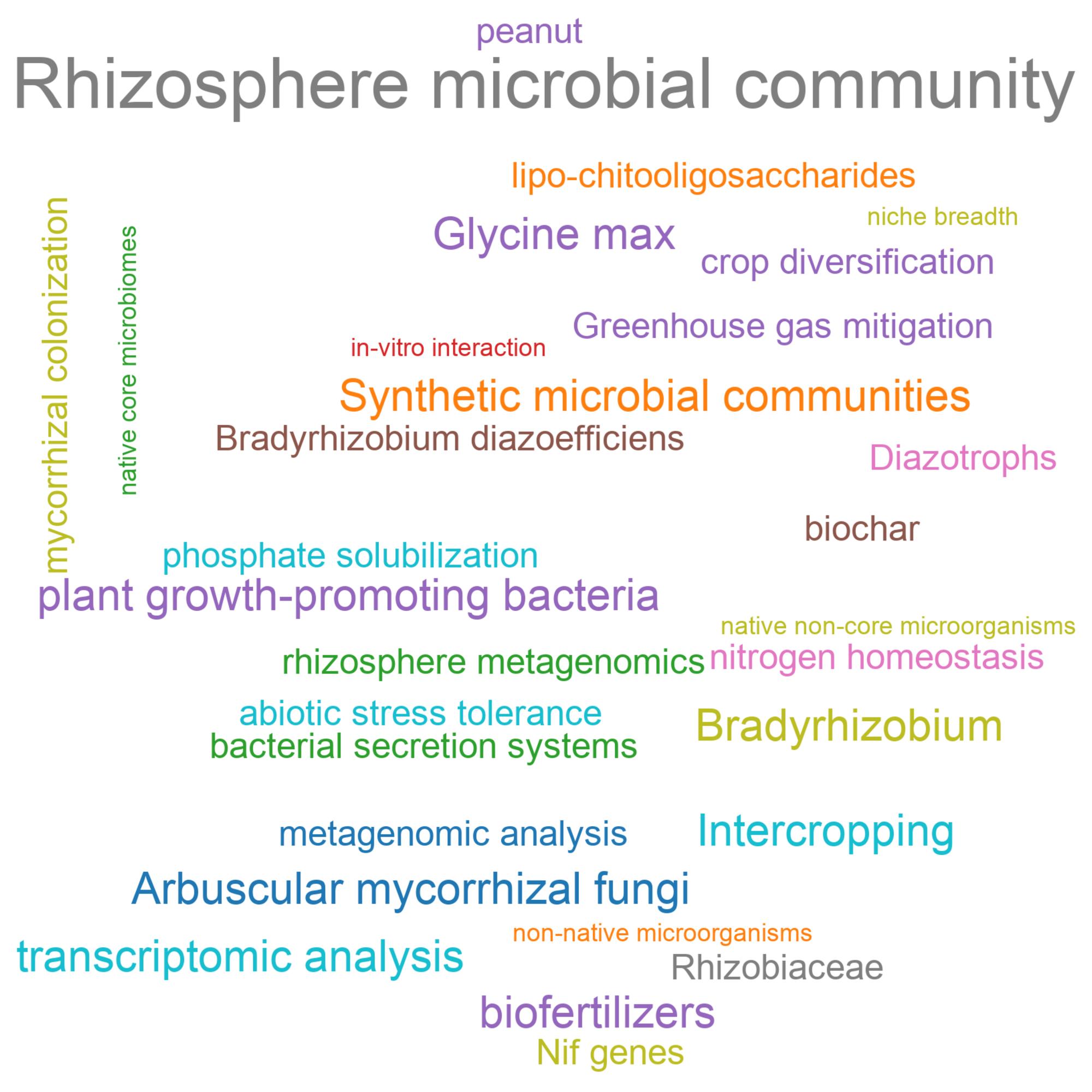
The Class of 2026 research landscape in legume nitrogen-fixing symbiosis is overwhelmingly anchor-driven by core biological processes and rhizosphere community mechanics. Biological nitrogen fixation and legume-rhizobia symbiosis represent the foundation of the corpus, present across more than 30% to 40% of key studies. However, the most pronounced research density centers on rhizosphere microbial communities, which experienced a 2.48-fold frequency surge in top-ranked publications. Rather than examining isolated microsymbionts in sterile conditions, recent high-impact work prioritizes multi-species soil ecosystems and synthetic microbial communities (SynComs) to enhance symbiotic efficacy. Complementing microbial community dynamics, practical agricultural interventions feature prominently. Intercropping systems, biofertilizer formulations, and plant growth-promoting bacteria (PGPB) have emerged as core focal points for optimizing nodulation and nutrient acquisition. Methodologically, transcriptomic analysis serves as the primary molecular lens for dissecting host-microbe cross-talk, while model and crop species like Glycine max (soybean) dominate experimental validation. Overall, the current cohort reflects a major shift toward engineering complex holobiont interactions and applying symbiotic mechanisms to sustainable crop production.
How Did Topics Shift from the Class of 2025 to the Class of 2026?
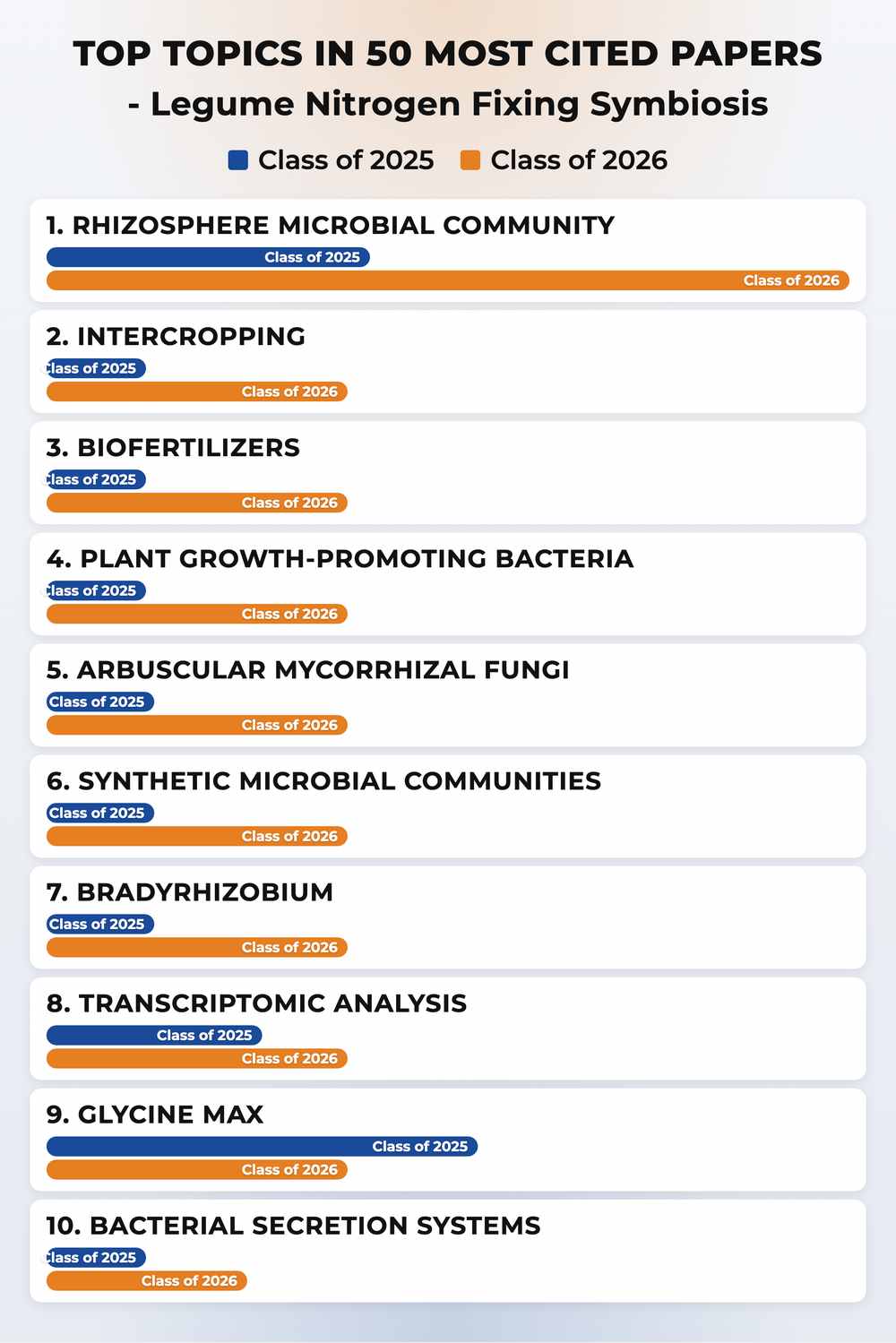
Comparing the Class of 2025 and Class of 2026 cohorts reveals a clear transition from descriptive single-organism studies toward integrative agro-ecosystem engineering. The most prominent expansion occurred in rhizosphere microbial community research, which rose from 11.1% normalized frequency in 2023 to 27.6% in 2024 (a 2.48-fold increase). Concurrently, specialized bio-inputs and agronomic strategies—specifically intercropping, biofertilizer carrier systems, and plant growth-promoting bacteria—recorded dramatic emergence, appearing in multiple high-impact 2024 publications after zero representation in the previous cohort's top tier. In contrast, traditional broad classifications saw relative declines. General diazotroph studies experienced the sharpest decline, dropping from 18.5% normalized frequency (5 papers) in 2023 down to 6.9% (2 papers) in 2024. Specific host models like Glycine max also saw a minor contraction from 4 to 3 papers (0.70-fold relative change). Overall, these trajectory shifts signal that the legume nitrogen fixation field is rapidly pivoting from classical characterizations of isolated microsymbionts toward applied microbiome assembly, molecular signaling pathways (such as lipo-chitooligosaccharides), and soil-health management.
Methodology
PRI identifies high-impact research using a transparent, topic-agnostic framework applied consistently across scientific domains. Bibliographic records are drawn from OpenAlex, including publication dates, citation relationships, and document types.
This ranking covers the Class of 2026 cohort: journal articles published in 2024. Reviews and other non-article document types are excluded to ensure comparability.
Research impact is quantified with an 18-month post-publication citation window—the number of citing works published within 18 months of each paper's publication date. This metric captures early impact while controlling for publication age.
An LLM-based relevance classifier then reviews each candidate's title and abstract to confirm substantive alignment with the target domain. Only papers classified as relevant appear in the final ranking.
Zheng Su, Tinsley Li, Thematic Shifts in Early-High-Impact Cancer Genomics and Diagnostics Research: A Bibliometric and Semantic Analysis. bioRxiv 2026.07.04.736459; doi: https://doi.org/10.64898/2026.07.04.736459
Cite this ranking
Pepkio Research Index (PRI). Topics and Trends in Most Cited Legume Nitrogen Fixing Symbiosis Papers, Class of 2026. https://pri.pepkio.com/top-papers/legume-nitrogen-fixing-symbiosis/2026. Accessed 2026-10-24.

Methodology
Zheng Su, Tinsley Li, Thematic Shifts in Early-High-Impact Cancer Genomics and Diagnostics Research: A Bibliometric and Semantic Analysis. bioRxiv 2026.07.04.736459; doi: https://doi.org/10.64898/2026.07.04.736459