
What topics and trends defined most-cited Molecular Biology Techniques and Applications research in the Class of 2026?
The Class of 2026 highlights a four-fold rise in genome assembly research and the emergence of direct RNA sequencing, CRISPR-Cas12a diagnostics, and extrachromosomal DNA (ecDNA) structural studies. While spatial transcriptomics remains the leading individual concept despite consolidating from earlier peaks, the field shows accelerating adoption of point-of-care nucleic acid detection.
At a glance
- Field
- Molecular Biology Techniques and Applications
- Cohort label
- Class of 2026 (2024 publications)
- Papers analyzed
- 3,522
- Papers ranked
- 20
- Top topics in ranked papers
- Spatial transcriptomics, genome assembly, CRISPR-Cas12a, direct RNA sequencing
- Publication window
- Jan 1, 2024 – Dec 31, 2024
- Eligibility
- Research articles; reviews excluded
- Citation window
- 18 months post-publication
- 18m citation range
- 30–239
- Data source
- OpenAlex · Retrieved July 2026
- License
- CC BY 4.0
Rankings
20 papers ranked by 18-month citation count
NCBI RefSeq: reference sequence standards through 25 years of curation and annotation
Nucleic Acids Research202410.1093/nar/gkae1038
Rapid and sensitive detection of genome contamination at scale with FCS-GX
Genome biology202410.1186/s13059-024-03198-7
Systematic assessment of long-read RNA-seq methods for transcript identification and quantification
Nature Methods202410.1038/s41592-024-02298-3
Inferring super-resolution tissue architecture by integrating spatial transcriptomics with histology
Nature Biotechnology202410.1038/s41587-023-02019-9
Spatially exploring RNA biology in archival formalin-fixed paraffin-embedded tissues
Cell202410.1016/j.cell.2024.09.001
Global impact of unproductive splicing on human gene expression
Nature Genetics202410.1038/s41588-024-01872-x
Prediction of plasma ctDNA fraction and prognostic implications of liquid biopsy in advanced prostate cancer
Nature Communications202410.1038/s41467-024-45475-w
Inferring histology-associated gene expression gradients in spatial transcriptomic studies
Nature Communications202410.1038/s41467-024-50904-x
Whole-brain spatial transcriptional analysis at cellular resolution
Science202410.1126/science.adn9947
Mapping extrachromosomal DNA amplifications during cancer progression
Nature Genetics202410.1038/s41588-024-01949-7
High resolution long-read telomere sequencing reveals dynamic mechanisms in aging and cancer
Nature Communications202410.1038/s41467-024-48917-7
Phantasus, a web application for visual and interactive gene expression analysis
eLife202410.7554/elife.85722
Extrachromosomal DNA in cancer
Nature reviews. Cancer202410.1038/s41568-024-00669-8
Virtual formalin-fixed and paraffin-embedded staining of fresh brain tissue via stimulated Raman CycleGAN model
Science Advances202410.1126/sciadv.adn3426
Genetic architecture of telomere length in 462,666 UK Biobank whole-genome sequences
Nature Genetics202410.1038/s41588-024-01884-7
The European Reference Genome Atlas: piloting a decentralised approach to equitable biodiversity genomics
npj Biodiversity202410.1038/s44185-024-00054-6
Comprehensive Impurity Profiling of mRNA: Evaluating Current Technologies and Advanced Analytical Techniques
Analytical Chemistry202410.1021/acs.analchem.3c05539
Nanoparticle enrichment mass-spectrometry proteomics identifies protein-altering variants for precise pQTL mapping
Nature Communications202410.1038/s41467-024-45233-y
High-dimensional phenotyping to define the genetic basis of cellular morphology
Nature Communications202410.1038/s41467-023-44045-w
Single-shot 20-fold expansion microscopy
Nature Methods202410.1038/s41592-024-02454-9
Topic trends
Dominant research themes and year-over-year shifts in Molecular Biology Techniques and Applications
What Topics Define the Class of 2026?
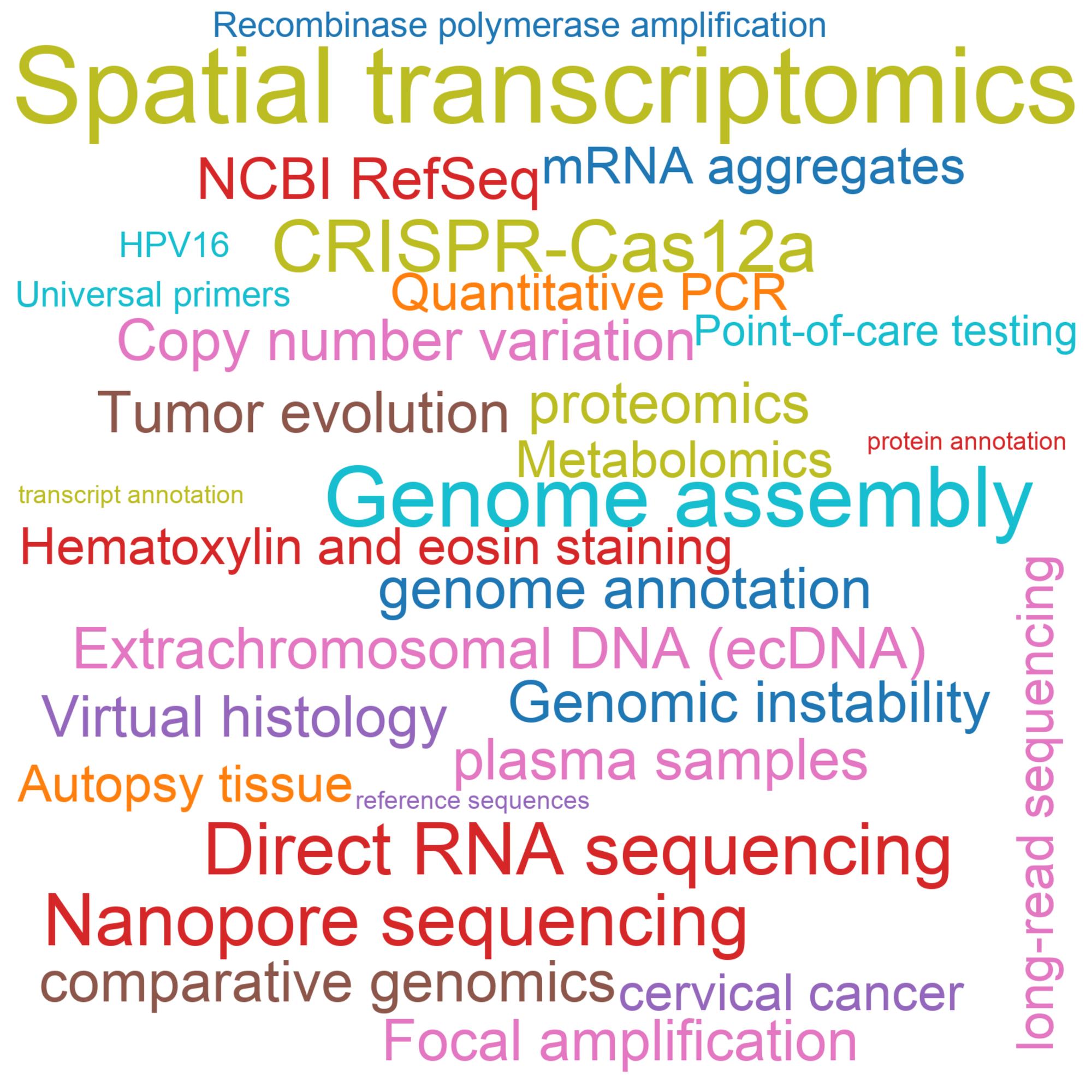
The Class of 2026 in Molecular Biology Techniques and Applications is led by spatial transcriptomics, which remains the single most prominent individual concept in high-impact molecular research, accounting for 12% of ranked publications. High-throughput genomic assembly and long-read sequencing technologies—most notably nanopore sequencing and direct RNA sequencing—form the foundational backbone for high-fidelity genome and epitranscriptome characterization. Concurrently, next-generation point-of-care nucleic acid diagnostic platforms feature heavily, driven by targeted CRISPR-Cas12a enzymatic assays and recombinase polymerase amplification (RPA) for rapid, field-deployable molecular detection. Methodological research also places strong emphasis on complex structural genome variations, particularly extrachromosomal DNA (ecDNA), focal gene amplifications, and genomic instability mechanisms in oncogenic contexts. Furthermore, multi-omics workflows incorporating proteomics, metabolomics, and digital pathology (such as quantitative hematoxylin and eosin staining) continue to expand across disease profiling studies. Collectively, these dominant themes demonstrate a field rapidly converging toward high-resolution spatial single-cell profiling, direct RNA sequencing, and decentralized CRISPR-powered diagnostic tools.
How Did Topics Shift from the Class of 2025 to the Class of 2026?
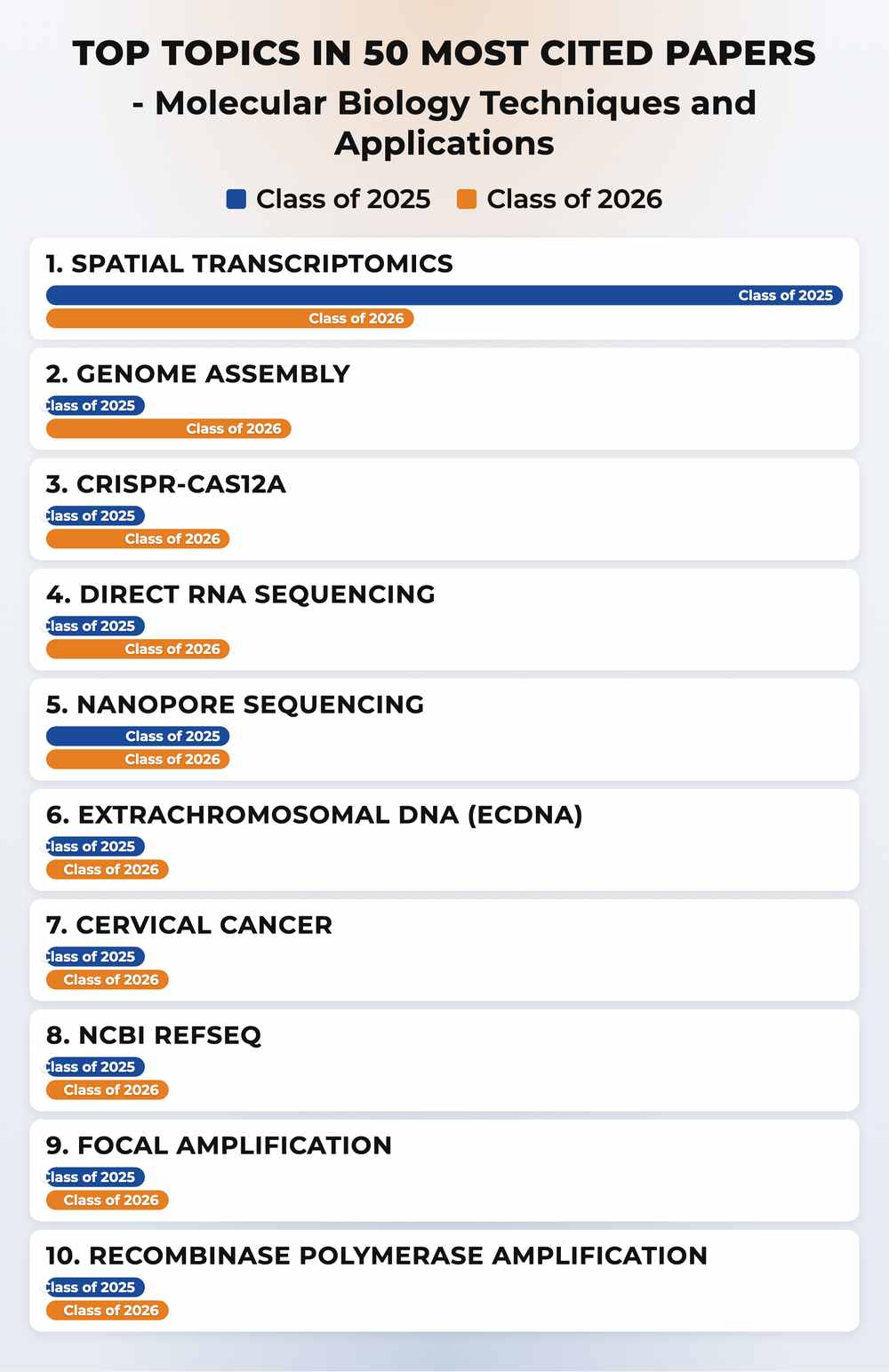
Comparison between cohorts reveals notable shifts in research momentum across molecular biology methodologies. Direct RNA sequencing and CRISPR-Cas12a diagnostics emerged as major new focal points, surging from zero representation in the Class of 2025 to top-tier frequency in the Class of 2026. Genome assembly methodologies also experienced a four-fold increase in paper frequency, reflecting growing reliance on telomere-to-telomere reference assemblies and pan-genomic tools. Similarly, structural cancer genomics saw sharp rises in extrachromosomal DNA (ecDNA), focal amplification, and genomic instability studies, none of which appeared among top ranked papers in the previous cohort. Point-of-care testing and recombinase polymerase amplification likewise surged from zero to 4% representation. Conversely, while spatial transcriptomics remains the most frequent single concept overall, its relative frequency declined from 26% in 2023 to 12% in 2024, indicating a transition from initial technology demonstration to broader, standardized application across subdisciplines. General long-read sequencing also saw minor consolidation as researchers shifted focus toward specialized direct RNA sequencing workflows. Overall, the cohort transition highlights rapid diversification into targeted RNA modifications, ecDNA structural biology, and field-ready enzymatic detection systems.
Methodology
PRI identifies high-impact research using a transparent, topic-agnostic framework applied consistently across scientific domains. Bibliographic records are drawn from OpenAlex, including publication dates, citation relationships, and document types.
This ranking covers the Class of 2026 cohort: journal articles published in 2024. Reviews and other non-article document types are excluded to ensure comparability.
Research impact is quantified with an 18-month post-publication citation window—the number of citing works published within 18 months of each paper's publication date. This metric captures early impact while controlling for publication age.
An LLM-based relevance classifier then reviews each candidate's title and abstract to confirm substantive alignment with the target domain. Only papers classified as relevant appear in the final ranking.
Zheng Su, Tinsley Li, Thematic Shifts in Early-High-Impact Cancer Genomics and Diagnostics Research: A Bibliometric and Semantic Analysis. bioRxiv 2026.07.04.736459; doi: https://doi.org/10.64898/2026.07.04.736459
Cite this ranking
Pepkio Research Index (PRI). Topics and Trends in Most Cited Molecular Biology Techniques and Applications Papers, Class of 2026. https://pri.pepkio.com/top-papers/molecular-biology-techniques-and-applications/2026. Accessed 2026-10-21.

Methodology
Zheng Su, Tinsley Li, Thematic Shifts in Early-High-Impact Cancer Genomics and Diagnostics Research: A Bibliometric and Semantic Analysis. bioRxiv 2026.07.04.736459; doi: https://doi.org/10.64898/2026.07.04.736459