
What topics and trends defined most-cited Vector-borne infectious diseases research in the Class of 2026?
Research in vector-borne infectious diseases is transitioning from broad Lyme disease surveillance toward spatial epidemiology and multi-pathogen risk assessment. Species distribution modeling and tick-borne encephalitis saw substantial gains in top-cited literature, alongside rising focus on vector ticks like Ixodes ricinus and emerging hemotropic pathogens.
At a glance
- Field
- Vector-borne infectious diseases
- Cohort label
- Class of 2026 (2024 publications)
- Papers analyzed
- 4,259
- Papers ranked
- 20
- Top topics in ranked papers
- Lyme disease, Ixodes ricinus, Borrelia burgdorferi, species distribution modeling, tick-borne encephalitis
- Publication window
- Jan 1, 2024 – Dec 31, 2024
- Eligibility
- Research articles; reviews excluded
- Citation window
- 18 months post-publication
- 18m citation range
- 18–65
- Data source
- OpenAlex · Retrieved Jul 2026
- License
- CC BY 4.0
Rankings
20 papers ranked by 18-month citation count
The Rhipicephalus sanguineus group: updated list of species, geographical distribution, and vector competence
Parasites & Vectors202410.1186/s13071-024-06572-3
Surveillance for Lyme Disease After Implementation of a Revised Case Definition — United States, 2022
MMWR Morbidity and Mortality Weekly Report202410.15585/mmwr.mm7306a1
Autoantibodies neutralizing type I IFNs underlie severe tick-borne encephalitis in ∼10% of patients
The Journal of Experimental Medicine202410.1084/jem.20240637
Role of vector phenotypic plasticity in disease transmission as illustrated by the spread of dengue virus by Aedes albopictus
Nature Communications202410.1038/s41467-024-52144-5
Tafenoquine-Atovaquone Combination Achieves Radical Cure and Confers Sterile Immunity in Experimental Models of Human Babesiosis
The Journal of Infectious Diseases202410.1093/infdis/jiad315
The roles of habitat isolation, landscape connectivity and host community in tick-borne pathogen ecology
Royal Society Open Science202410.1098/rsos.240837
A series of patients infected with the emerging tick-borne Yezo virus in China: an active surveillance and genomic analysis
The Lancet Infectious Diseases202410.1016/s1473-3099(24)00616-9
Rapid single-tier serodiagnosis of Lyme disease
Nature Communications202410.1038/s41467-024-51067-5
Molecular Epidemiology of Western Equine Encephalitis Virus, South America, 2023–2024
Emerging infectious diseases202410.3201/eid3009.240530
Optimisation of dose level and vaccination schedule for the VLA15 Lyme borreliosis vaccine candidate among healthy adults: two randomised, observer-blind, placebo-controlled, multicentre, phase 2 studies
The Lancet Infectious Diseases202410.1016/s1473-3099(24)00175-0
MOIRE: a software package for the estimation of allele frequencies and effective multiplicity of infection from polyallelic data
Bioinformatics202410.1093/bioinformatics/btae619
Neuroinvasive West Nile Virus Infection in Immunosuppressed and Immunocompetent Adults
JAMA Network Open202410.1001/jamanetworkopen.2024.4294
Multiple factors affecting Ixodes ricinus ticks and associated pathogens in European temperate ecosystems (northeastern France)
Scientific Reports202410.1038/s41598-024-59867-x
Characterisation of a Japanese Encephalitis virus genotype 4 isolate from the 2022 Australian outbreak
npj Viruses202410.1038/s44298-024-00025-5
The global distribution and the risk prediction of relapsing fever group Borrelia: a data review with modelling analysis
The Lancet Microbe202410.1016/s2666-5247(23)00396-8
Discovery and characterization of potent broadly neutralizing antibodies from human survivors of severe fever with thrombocytopenia syndrome
EBioMedicine202410.1016/j.ebiom.2024.105481
Plasmodium falciparum infection in humans and mosquitoes influence natural Anopheline biting behavior and transmission
Nature Communications202410.1038/s41467-024-49080-9
Machine learning algorithms for the evaluation of risk by tick-borne pathogens in Europe
Annals of Medicine202410.1080/07853890.2024.2405074
Molecular and immunological studies on Theileria equi and its vector in Egypt
Experimental and Applied Acarology202410.1007/s10493-024-00933-4
Topic trends
Dominant research themes and year-over-year shifts in Vector-borne infectious diseases
What Topics Define the Class of 2026?
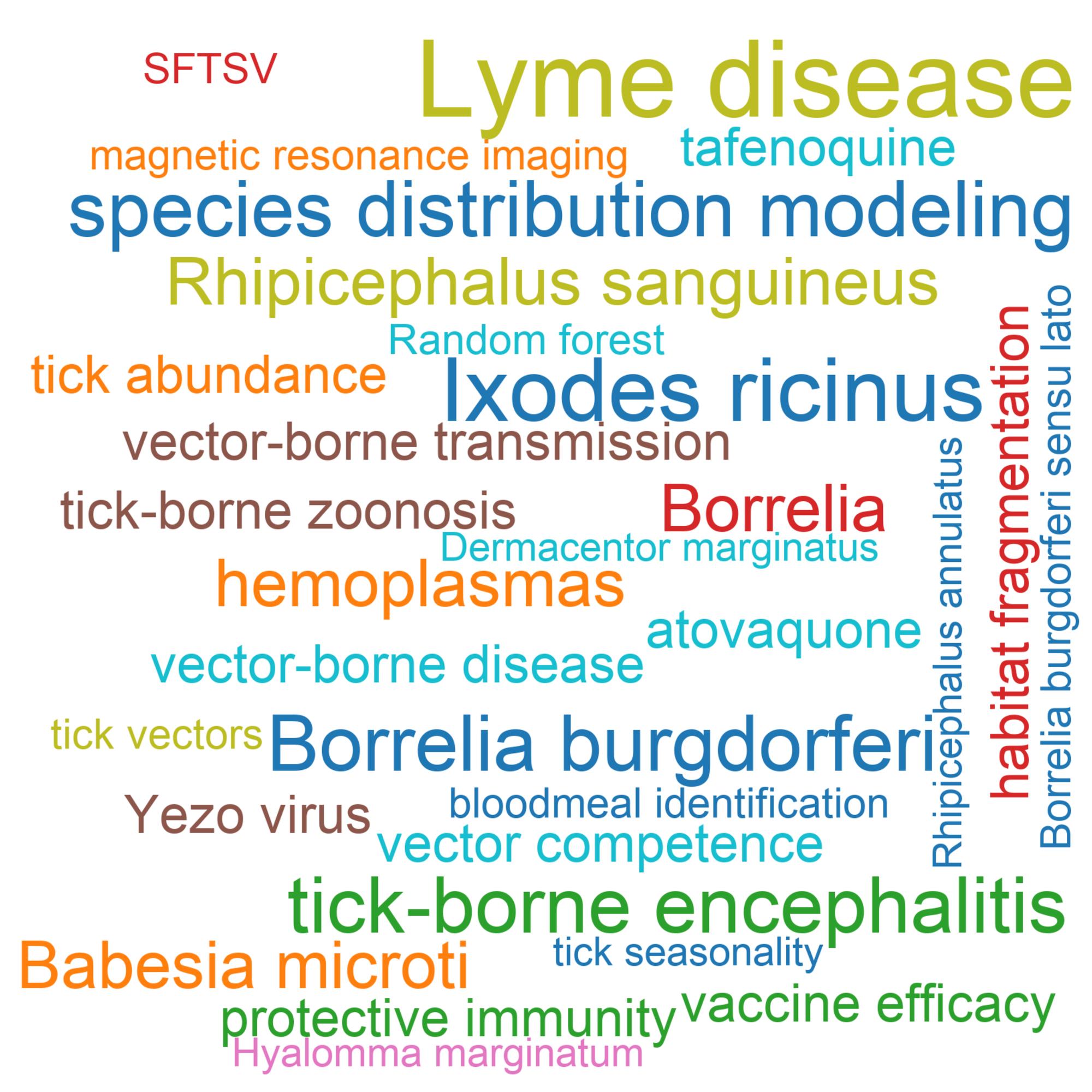
The Class of 2026 ranking for vector-borne infectious diseases highlights a heavily concentrated research ecosystem centered on tick-borne pathogen transmission, vector ecology, and spatial epidemiology. Lyme disease remains the focal clinical narrative, appearing in 14% of top-cited publications, closely paired with its primary etiological agent Borrelia burgdorferi (8%) and related Borrelia species. Vector biology research is overwhelmingly anchor-driven by Ixodes ricinus (10%), the principal hard tick vector in Europe, alongside expanding investigation into Rhipicephalus sanguineus (6%), reflecting heightened interest in canine and human vector-host dynamics. Beyond classical spirochete surveillance, the field demonstrates a pronounced shift toward predictive ecology and multi-pathogen profiling. Species distribution modeling (8%) emerges as a core computational tool, enabling researchers to map vector habitat suitability and climate-driven range shifts. Concurrently, viral and parasitic co-infections command significant attention, led by tick-borne encephalitis (8%), the intraerythrocytic parasite Babesia microti (6%), and emerging hemoplasmas (6%). Together, these dominant clusters underscore an integrated One Health paradigm that bridges molecular diagnostics, ecological forecasting, and vector management to mitigate rising tick-borne disease burdens globally.
How Did Topics Shift from the Class of 2025 to the Class of 2026?
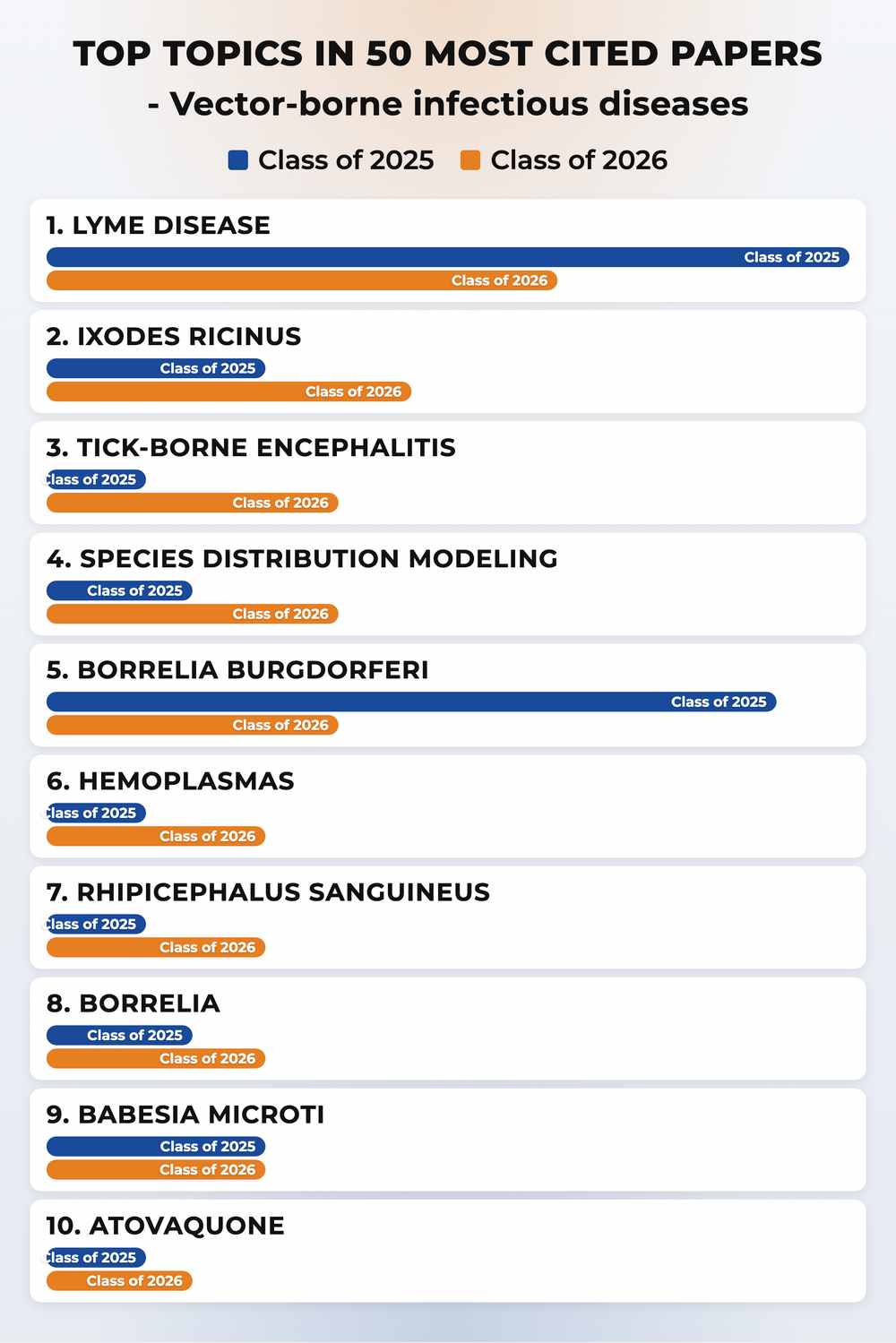
Comparison between the Class of 2025 and Class of 2026 cohorts reveals a marked evolution from descriptive Lyme disease reporting toward quantitative vector dynamics and emerging viral/bacterial co-pathogens. While Lyme disease (declining from 22% to 14% normalized frequency) and Borrelia burgdorferi (dropping from 20% to 8%) previously dominated the top-cited literature, the 2026 cohort reflects a rebalancing of research priorities toward a broader spectrum of tick-borne threats and analytical methodologies. The most prominent growth is led by tick-borne encephalitis, which experienced a four-fold rise in high-impact literature representation (2% to 8%), alongside a three-fold increase for Rhipicephalus sanguineus (2% to 6%). Species distribution modeling doubled in frequency (4% to 8%), highlighting growing reliance on geospatial modeling to predict vector proliferation. Furthermore, novel detection of hemoplasmas (rising from 0% to 6%) and emerging pathogens such as severe fever with thrombocytopenia syndrome virus (SFTSV), Ehrlichia canis, and Haemaphysalis longicornis underscores an expanding surveillance frontier. Conversely, broad observational concepts like general geographic range expansion experienced relative decline. This trajectory signals a field maturing from generalized risk awareness to precise, model-driven risk prediction and targeted pathogen intervention.
Methodology
PRI identifies high-impact research using a transparent, topic-agnostic framework applied consistently across scientific domains. Bibliographic records are drawn from OpenAlex, including publication dates, citation relationships, and document types.
This ranking covers the Class of 2026 cohort: journal articles published in 2024. Reviews and other non-article document types are excluded to ensure comparability.
Research impact is quantified with an 18-month post-publication citation window—the number of citing works published within 18 months of each paper's publication date. This metric captures early impact while controlling for publication age.
An LLM-based relevance classifier then reviews each candidate's title and abstract to confirm substantive alignment with the target domain. Only papers classified as relevant appear in the final ranking.
Zheng Su, Tinsley Li, Thematic Shifts in Early-High-Impact Cancer Genomics and Diagnostics Research: A Bibliometric and Semantic Analysis. bioRxiv 2026.07.04.736459; doi: https://doi.org/10.64898/2026.07.04.736459
Cite this ranking
Pepkio Research Index (PRI). Topics and Trends in Most Cited Vector-borne infectious diseases Papers, Class of 2026. https://pri.pepkio.com/top-papers/vector-borne-infectious-diseases/2026. Accessed 2026-09-13.

Methodology
Zheng Su, Tinsley Li, Thematic Shifts in Early-High-Impact Cancer Genomics and Diagnostics Research: A Bibliometric and Semantic Analysis. bioRxiv 2026.07.04.736459; doi: https://doi.org/10.64898/2026.07.04.736459