
What topics and trends defined most-cited Malaria Research and Control research in the Class of 2026?
Malaria research in 2024 highlights urgent shifts toward antimalarial and insecticide resistance monitoring, paired with rapid momentum in novel immunization strategies. Key advancements include the roll-out of R21/Matrix-M vaccines, targeted monoclonal antibodies against circumsporozoite antigens, and expanded point-of-care genomic diagnostics to combat emerging drug-resistant Plasmodium falciparum strains.
At a glance
- Field
- Malaria Research and Control
- Cohort label
- Class of 2026 (2024 publications)
- Papers analyzed
- 4,778
- Papers ranked
- 20
- Top topics in ranked papers
- Plasmodium falciparum, antimalarial drug resistance, insecticide resistance, R21/Matrix-M vaccine, genomic surveillance
- Publication window
- Jan 1, 2024 – Dec 31, 2024
- Eligibility
- Research articles; reviews excluded
- Citation window
- 18 months post-publication
- 18m citation range
- 26–204
- Data source
- OpenAlex · Retrieved Jul 2026
- License
- CC BY 4.0
Rankings
20 papers ranked by 18-month citation count
Safety and efficacy of malaria vaccine candidate R21/Matrix-M in African children: a multicentre, double-blind, randomised, phase 3 trial
The Lancet202410.1016/s0140-6736(23)02511-4
Emergence, transmission dynamics and mechanisms of artemisinin partial resistance in malaria parasites in Africa
Nature Reviews Microbiology202410.1038/s41579-024-01008-2
Evidence of artemisinin partial resistance in northwestern Tanzania: clinical and molecular markers of resistance
The Lancet Infectious Diseases202410.1016/s1473-3099(24)00362-1
Subcutaneous Administration of a Monoclonal Antibody to Prevent Malaria
New England Journal of Medicine202410.1056/nejmoa2312775
Feasibility, safety, and impact of the RTS,S/AS01E malaria vaccine when implemented through national immunisation programmes: evaluation of cluster-randomised introduction of the vaccine in Ghana, Kenya, and Malawi
The Lancet202410.1016/s0140-6736(24)00004-7
Safety and efficacy of the blood-stage malaria vaccine RH5.1/Matrix-M in Burkina Faso: interim results of a double-blind, randomised, controlled, phase 2b trial in children
The Lancet Infectious Diseases202410.1016/s1473-3099(24)00752-7
Effect of a spatial repellent on malaria incidence in an area of western Kenya characterised by high malaria transmission, insecticide resistance, and universal coverage of insecticide treated nets (part of the AEGIS Consortium): a cluster-randomised, controlled trial
The Lancet202410.1016/s0140-6736(24)02253-0
Towards next-generation treatment options to combat Plasmodium falciparum malaria
Nature Reviews Microbiology202410.1038/s41579-024-01099-x
Influence of environmental, geographic, socio-demographic, and epidemiological factors on presence of malaria at the community level in two continents
Scientific Reports202410.1038/s41598-024-67452-5
Safety and Efficacy of Immunization with a Late-Liver-Stage Attenuated Malaria Parasite
New England Journal of Medicine202410.1056/nejmoa2313892
Blood-stage malaria vaccine candidate RH5.1/Matrix-M in healthy Tanzanian adults and children; an open-label, non-randomised, first-in-human, single-centre, phase 1b trial
The Lancet Infectious Diseases202410.1016/s1473-3099(24)00312-8
A single mutation G454A in the P450 <i>CYP9K1</i> drives pyrethroid resistance in the major malaria vector <i>Anopheles funestus</i> reducing bed net efficacy
Genetics202410.1093/genetics/iyae181
The potential of gene drives in malaria vector species to control malaria in African environments
Nature Communications202410.1038/s41467-024-53065-z
Discovery of Knock‐Down Resistance in the Major African Malaria Vector <i>Anopheles funestus</i>
Molecular Ecology202410.1111/mec.17542
Early morning anopheline mosquito biting, a potential driver of malaria transmission in Busia County, western Kenya
Malaria Journal202410.1186/s12936-024-04893-3
Prevalence of mutations associated with artemisinin partial resistance and sulfadoxine–pyrimethamine resistance in 13 regions in Tanzania in 2021: a cross-sectional survey
The Lancet Microbe202410.1016/s2666-5247(24)00160-5
Alarming Plasmodium falciparum resistance to artemisinin-based combination therapy in Africa: the critical role of the partner drug
The Lancet Infectious Diseases202410.1016/s1473-3099(24)00427-4
Policy uptake and implementation of the RTS,S/AS01 malaria vaccine in sub-Saharan African countries: status 2 years following the WHO recommendation
BMJ Global Health202410.1136/bmjgh-2023-014719
The public health impact and cost-effectiveness of the R21/Matrix-M malaria vaccine: a mathematical modelling study
The Lancet Infectious Diseases202410.1016/s1473-3099(23)00816-2
Malaria in under-five children: prevalence and multi-factor analysis of high-risk African countries
BMC Public Health202410.1186/s12889-024-19206-1
Topic trends
Dominant research themes and year-over-year shifts in Malaria Research and Control
What Topics Define the Class of 2026 in Malaria Research and Control?
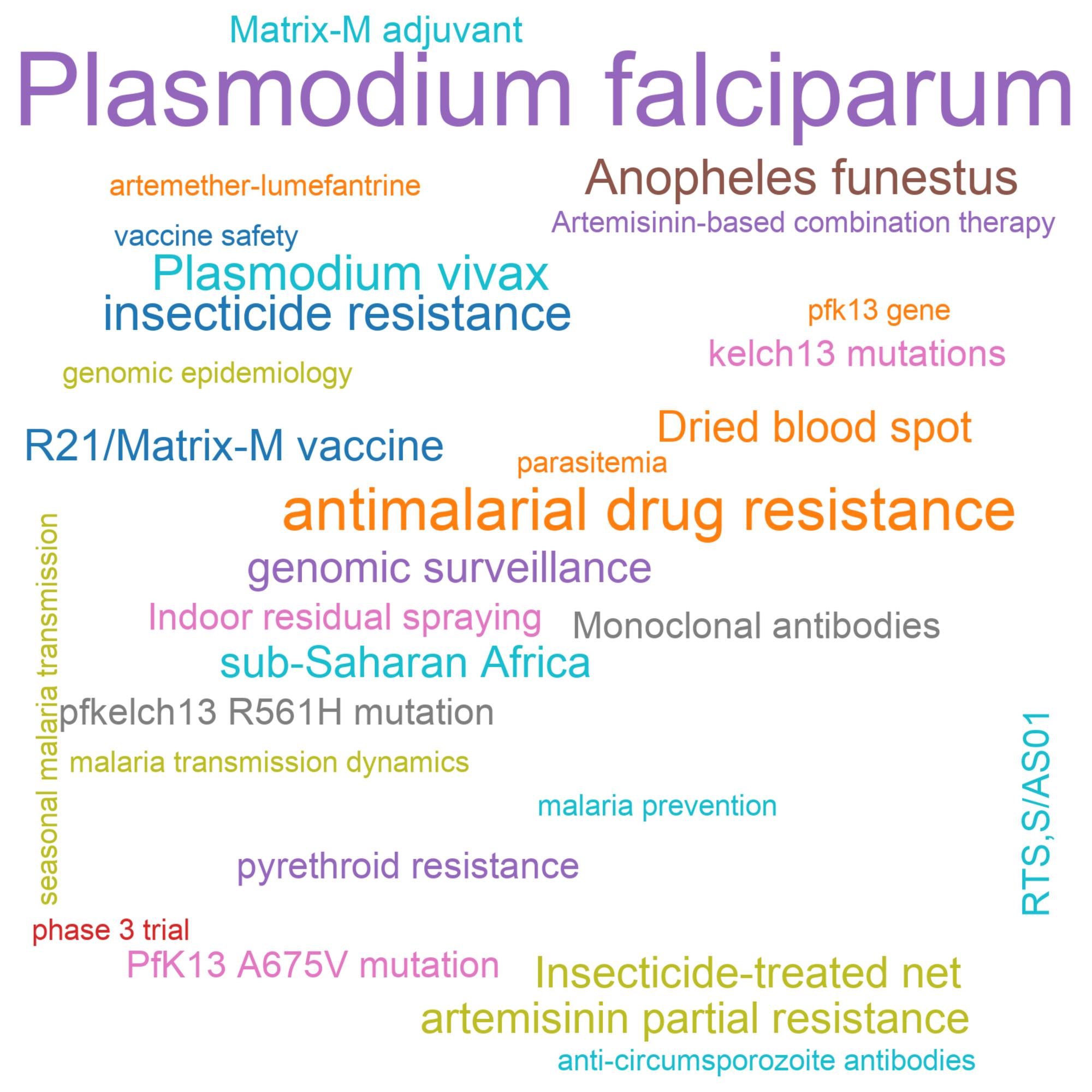
Malaria research in the Class of 2026 is heavily anchored by Plasmodium falciparum biology and therapeutic countermeasures, representing nearly half of all concept mentions (norm_freq 0.46). Crucially, the field is driving intensive investigation into antimalarial drug resistance (norm_freq 0.14) and artemisinin partial resistance, particularly tracking kelch13 mutations such as PfK13 A675V and R561H across endemic regions. In parallel, vector control and transmission intervention remain vital pillars, represented by vector species Anopheles funestus, Anopheles arabiensis, and Anopheles gambiae, alongside frontline physical barriers like insecticide-treated nets and indoor residual spraying. Surveillance methods are advancing rapidly with point-of-care testing, dried blood spot sampling, and genomic surveillance using pooled deep sequencing to map parasite genetic diversity and selective sweeps. Finally, immunization approaches demonstrate strong momentum, highlighted by the deployment of the R21/Matrix-M vaccine, RTS,S/AS01, Matrix-M adjuvant formulations, and anti-circumsporozoite monoclonal antibodies aimed at achieving durable protective immunity.
How Did Topics Shift from the Class of 2025 to the Class of 2026 in Malaria Research?
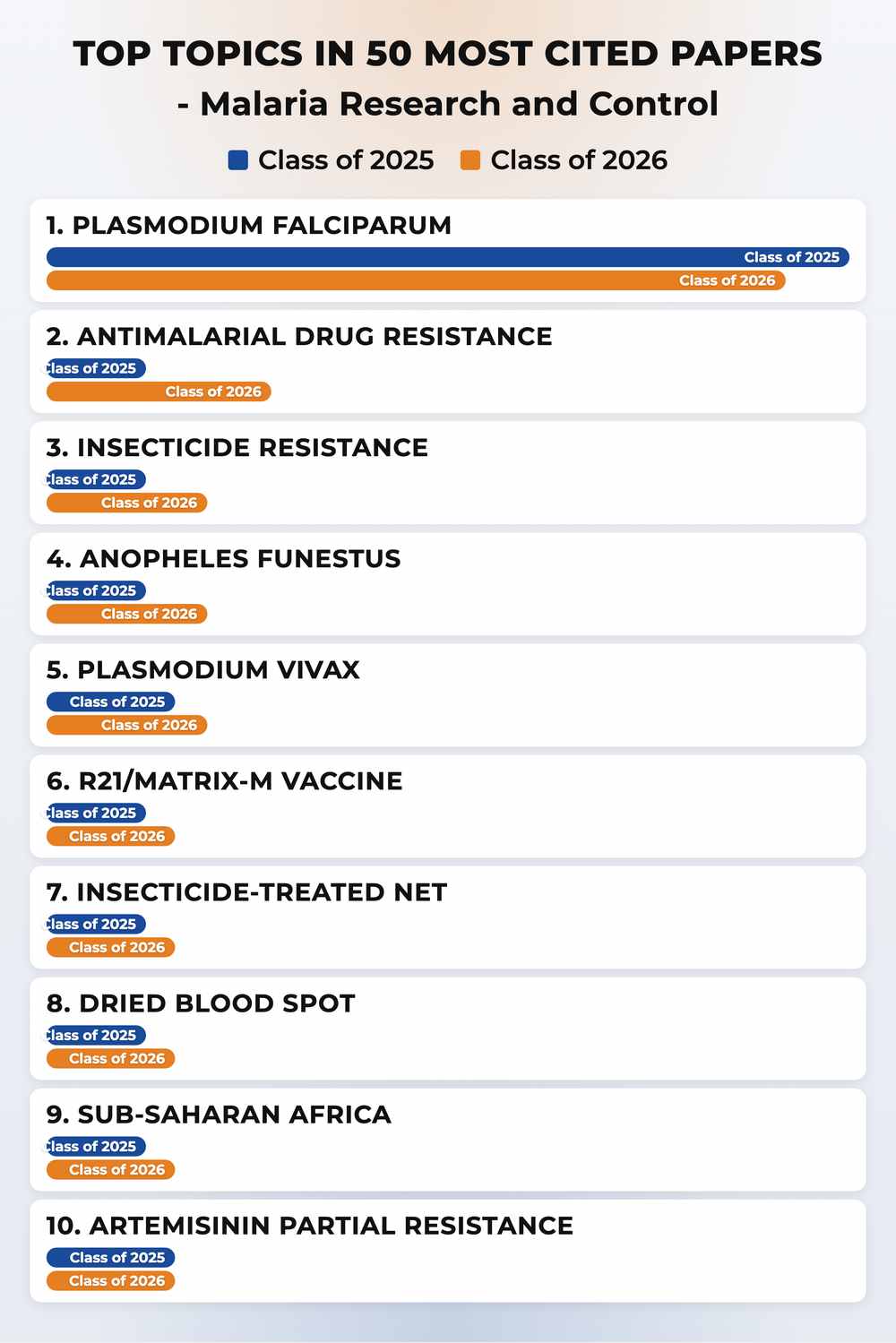
Comparing the Class of 2025 to the Class of 2026 reveals significant momentum toward operational resistance monitoring and novel intervention deployment. Research focusing on antimalarial drug resistance grew more than two-fold (normalized frequency rising from 0.06 to 0.14), while studies on insecticide resistance surged five-fold (0.02 to 0.10). Breakthrough vaccine developments saw dramatic uptake, with publications on the R21/Matrix-M vaccine increasing four-fold (0.02 to 0.08) alongside renewed focus on Matrix-M adjuvant technology and RTS,S/AS01 rollout schedules. Emerging cohorts introduced dedicated studies on monoclonal antibodies, anti-circumsporozoite antibodies, and blood-stage targets like RH5.1, reflecting a shift toward targeted biologics. Field diagnostics also saw major shifts with the arrival of HRP2-based rapid diagnostic tests to counter gene deletions. Conversely, while foundational parasite species work on Plasmodium falciparum remained dominant, general genomic surveillance and traditional pyrethroid resistance monitoring stabilized or slightly declined as focus pivoted toward targeted resistance mechanism profiling.
Methodology
PRI identifies high-impact research using a transparent, topic-agnostic framework applied consistently across scientific domains. Bibliographic records are drawn from OpenAlex, including publication dates, citation relationships, and document types.
This ranking covers the Class of 2026 cohort: journal articles published in 2024. Reviews and other non-article document types are excluded to ensure comparability.
Research impact is quantified with an 18-month post-publication citation window—the number of citing works published within 18 months of each paper's publication date. This metric captures early impact while controlling for publication age.
An LLM-based relevance classifier then reviews each candidate's title and abstract to confirm substantive alignment with the target domain. Only papers classified as relevant appear in the final ranking.
Zheng Su, Tinsley Li, Thematic Shifts in Early-High-Impact Cancer Genomics and Diagnostics Research: A Bibliometric and Semantic Analysis. bioRxiv 2026.07.04.736459; doi: https://doi.org/10.64898/2026.07.04.736459
Cite this ranking
Pepkio Research Index (PRI). Topics and Trends in Most Cited Malaria Research and Control Papers, Class of 2026. https://pri.pepkio.com/top-papers/malaria-research-and-control/2026. Accessed 2026-10-21.

Methodology
Zheng Su, Tinsley Li, Thematic Shifts in Early-High-Impact Cancer Genomics and Diagnostics Research: A Bibliometric and Semantic Analysis. bioRxiv 2026.07.04.736459; doi: https://doi.org/10.64898/2026.07.04.736459