
What topics and trends defined most-cited Mosquito-borne diseases and control research in the Class of 2026?
The Class of 2026 shows a pronounced shift toward emerging and re-emerging arboviruses, particularly highlighted by the dramatic rise in research on Oropouche virus, Chikungunya, and the Cuba outbreak. Concurrently, climate variables have become a critical focus for understanding geographic spread, while traditional mainstays like Dengue and Zika virus continue to define the field's core research on mosquito-borne diseases.
At a glance
- Field
- Mosquito-borne diseases and control
- Cohort label
- Class of 2026 (2024 publications)
- Papers analyzed
- 10,199
- Papers ranked
- 20
- Top topics in ranked papers
- Dengue virus, Oropouche virus, Zika virus, Aedes aegypti, Plasmodium falciparum
- Publication window
- Jan 1, 2024 – Dec 31, 2024
- Eligibility
- Research articles; reviews excluded
- Citation window
- 18 months post-publication
- 18m citation range
- 46–204
- Data source
- OpenAlex · Retrieved Jul 2026
- License
- CC BY 4.0
Rankings
20 papers ranked by 18-month citation count
Safety and efficacy of malaria vaccine candidate R21/Matrix-M in African children: a multicentre, double-blind, randomised, phase 3 trial
The Lancet202410.1016/s0140-6736(23)02511-4
Effects of climate change and human activities on vector-borne diseases
Nature Reviews Microbiology202410.1038/s41579-024-01026-0
Dengue
The Lancet202410.1016/s0140-6736(23)02576-x
Human outbreaks of a novel reassortant Oropouche virus in the Brazilian Amazon region
Nature Medicine202410.1038/s41591-024-03300-3
Long-term efficacy and safety of a tetravalent dengue vaccine (TAK-003): 4·5-year results from a phase 3, randomised, double-blind, placebo-controlled trial
The Lancet Global Health202410.1016/s2214-109x(23)00522-3
Re-emergence of Oropouche virus between 2023 and 2024 in Brazil: an observational epidemiological study
The Lancet Infectious Diseases202410.1016/s1473-3099(24)00619-4
Live, Attenuated, Tetravalent Butantan–Dengue Vaccine in Children and Adults
New England Journal of Medicine202410.1056/nejmoa2301790
Newborns with microcephaly in Brazil and potential vertical transmission of Oropouche virus: a case series
The Lancet Infectious Diseases202410.1016/s1473-3099(24)00617-0
Emergence, transmission dynamics and mechanisms of artemisinin partial resistance in malaria parasites in Africa
Nature Reviews Microbiology202410.1038/s41579-024-01008-2
Oropouche Virus Disease Among U.S. Travelers — United States, 2024
MMWR Morbidity and Mortality Weekly Report202410.15585/mmwr.mm7335e1
Contribution of climate change to the spatial expansion of West Nile virus in Europe
Nature Communications202410.1038/s41467-024-45290-3
Fatal Oropouche Virus Infections in Nonendemic Region, Brazil, 2024
Emerging infectious diseases202410.3201/eid3011.241132
Expansion of Oropouche virus in non-endemic Brazilian regions: analysis of genomic characterisation and ecological drivers
The Lancet Infectious Diseases202410.1016/s1473-3099(24)00687-x
The rising global economic costs of invasive Aedes mosquitoes and Aedes-borne diseases
The Science of The Total Environment202410.1016/j.scitotenv.2024.173054
Population at risk of dengue virus transmission has increased due to coupled climate factors and population growth
Communications Earth & Environment202410.1038/s43247-024-01639-6
A new lineage nomenclature to aid genomic surveillance of dengue virus
PLoS Biology202410.1371/journal.pbio.3002834
Global landmark: 2023 marks the worst year for dengue cases with millions infected and thousands of deaths reported
IJID Regions202410.1016/j.ijregi.2024.100459
Efficient deep learning-based approach for malaria detection using red blood cell smears
Scientific Reports202410.1038/s41598-024-63831-0
Mapping glycoprotein structure reveals Flaviviridae evolutionary history
Nature202410.1038/s41586-024-07899-8
West Nile virus spread in Europe: Phylogeographic pattern analysis and key drivers
PLoS Pathogens202410.1371/journal.ppat.1011880
Topic trends
Dominant research themes and year-over-year shifts in Mosquito-borne diseases and control
What Topics Define the Class of 2026?
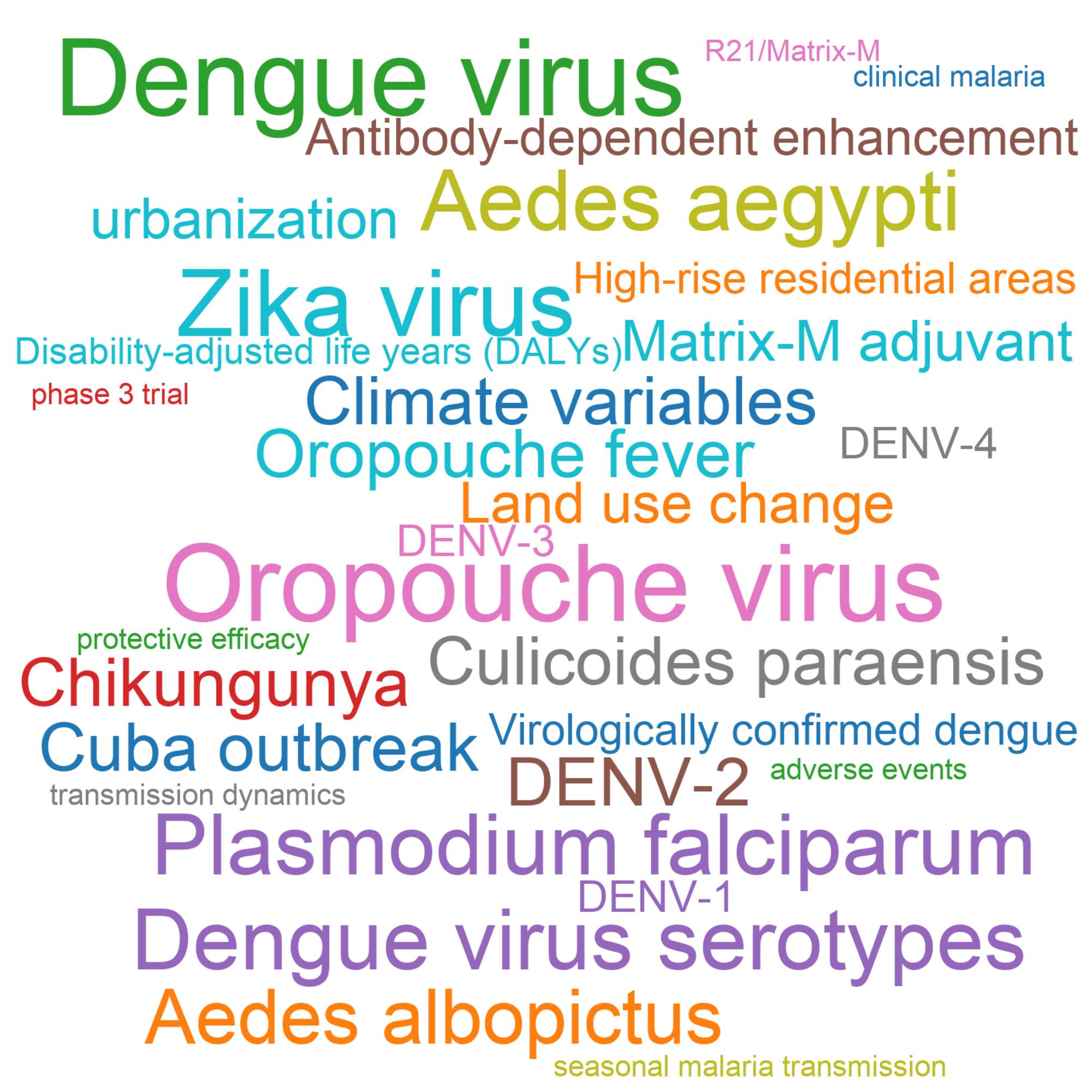
In the Class of 2026, research on mosquito-borne diseases is predominantly defined by major viral pathogens and their primary vectors. The most prominent topics include "Dengue virus" and "Zika virus," alongside critical vector species like "Aedes aegypti" and "Aedes albopictus." This highlights a sustained focus on understanding the transmission dynamics and viral pathogenesis of established global health threats. The strong presence of "Dengue virus serotypes" indicates an active interest in the complexities of cross-immunity and vaccine development. Additionally, "Plasmodium falciparum" remains a key focus, representing the continuing burden of malaria. Together, these topics reveal a field that is deeply engaged in tracking and characterizing major mosquito-borne pathogens, aiming to leverage these insights for more targeted interventions and vector control strategies.
How Did Topics Shift from the Class of 2025 to the Class of 2026?
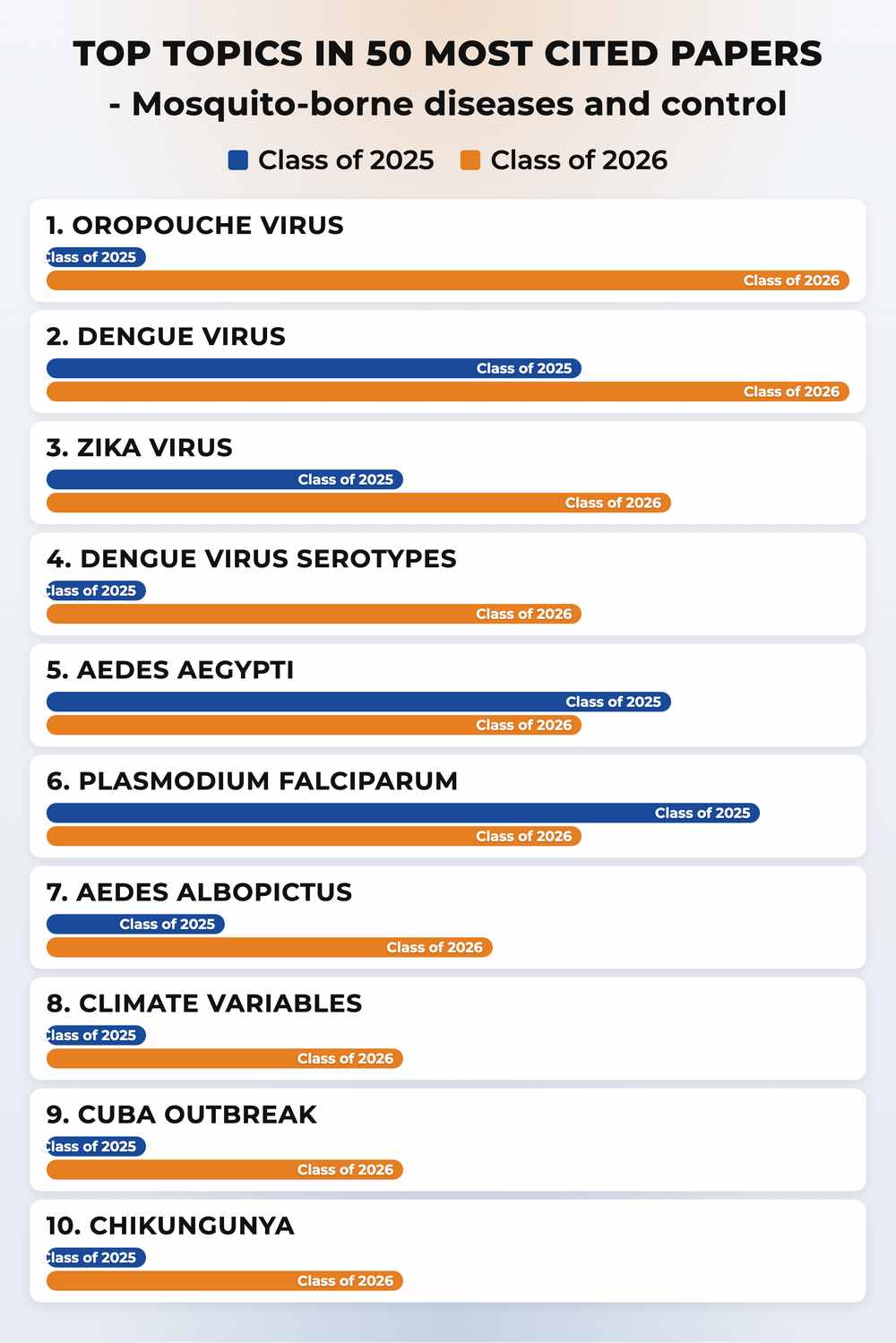
The transition from the Class of 2025 to the Class of 2026 reveals a notable shift toward emerging viral threats and the environmental factors driving their spread. Topics such as "Oropouche virus" and "Oropouche fever" emerged rapidly, exhibiting massive fold-change increases alongside specific vectors like "Culicoides paraensis." There was also a marked rise in focus on the "Cuba outbreak" and "Chikungunya." Furthermore, "Climate variables" has become a rapidly growing topic, indicating that researchers are increasingly interested in exploring how changing environmental conditions are facilitating the geographic expansion of these vectors and viruses. Conversely, traditionally heavily studied areas like "Dengue" and "Vector control" saw slower relative growth. This evolution underscores a broader trend in the field: a pivot toward rapid response and epidemiological tracking of emerging arboviruses, heavily influenced by shifting climate paradigms and regional outbreaks.
Methodology
PRI identifies high-impact research using a transparent, topic-agnostic framework applied consistently across scientific domains. Bibliographic records are drawn from OpenAlex, including publication dates, citation relationships, and document types.
This ranking covers the Class of 2026 cohort: journal articles published in 2024. Reviews and other non-article document types are excluded to ensure comparability.
Research impact is quantified with an 18-month post-publication citation window—the number of citing works published within 18 months of each paper's publication date. This metric captures early impact while controlling for publication age.
An LLM-based relevance classifier then reviews each candidate's title and abstract to confirm substantive alignment with the target domain. Only papers classified as relevant appear in the final ranking.
Zheng Su, Tinsley Li, Thematic Shifts in Early-High-Impact Cancer Genomics and Diagnostics Research: A Bibliometric and Semantic Analysis. bioRxiv 2026.07.04.736459; doi: https://doi.org/10.64898/2026.07.04.736459
Cite this ranking
Pepkio Research Index (PRI). Topics and Trends in Most Cited Mosquito-borne diseases and control Papers, Class of 2026. https://pri.pepkio.com/top-papers/mosquito-borne-diseases-and-control/2026. Accessed 2026-10-14.

Methodology
Zheng Su, Tinsley Li, Thematic Shifts in Early-High-Impact Cancer Genomics and Diagnostics Research: A Bibliometric and Semantic Analysis. bioRxiv 2026.07.04.736459; doi: https://doi.org/10.64898/2026.07.04.736459