
What topics and trends defined most-cited HIV Research and Treatment research in the Class of 2026?
High-impact HIV research in the Class of 2026 shifted decisively toward broadly neutralizing antibodies, germline-targeting immunogen design, and capsid inhibitors like lenacapavir. Extended-interval regimens with twice-yearly dosing gained rapid traction, while studies on traditional treatment interruption and legacy antiretrovirals saw declining relative representation among top-cited works.
At a glance
- Field
- HIV Research and Treatment
- Cohort label
- Class of 2026 (2024 publications)
- Papers analyzed
- 3,796
- Papers ranked
- 20
- Top topics in ranked papers
- Broadly neutralizing antibodies (bNAbs), Lenacapavir, HIV-1 capsid, Germline-targeting immunogens
- Publication window
- Jan 1, 2024 – Dec 31, 2024
- Eligibility
- Research articles; reviews excluded
- Citation window
- 18 months post-publication
- 18m citation range
- 32–334
- Data source
- OpenAlex · Retrieved Jul 2026
- License
- CC BY 4.0
Rankings
20 papers ranked by 18-month citation count
Twice-Yearly Lenacapavir or Daily F/TAF for HIV Prevention in Cisgender Women
New England Journal of Medicine202410.1056/nejmoa2407001
Global, regional, and national burden of HIV/AIDS, 1990–2021, and forecasts to 2050, for 204 countries and territories: the Global Burden of Disease Study 2021
The Lancet HIV202410.1016/s2352-3018(24)00212-1
Switch to long-acting cabotegravir and rilpivirine in virologically suppressed adults with HIV in Africa (CARES): week 48 results from a randomised, multicentre, open-label, non-inferiority trial
The Lancet Infectious Diseases202410.1016/s1473-3099(24)00289-5
The HIV capsid mimics karyopherin engagement of FG-nucleoporins
Nature202410.1038/s41586-023-06969-7
HIV-1 capsids enter the FG phase of nuclear pores like a transport receptor
Nature202410.1038/s41586-023-06966-w
mRNA-LNP HIV-1 trimer boosters elicit precursors to broad neutralizing antibodies
Science202410.1126/science.adk0582
DNA framework signal amplification platform-based high-throughput systemic immune monitoring
Signal Transduction and Targeted Therapy202410.1038/s41392-024-01736-0
Safety and antiviral effect of a triple combination of HIV-1 broadly neutralizing antibodies: a phase 1/2a trial
Nature Medicine202410.1038/s41591-024-03247-5
Vaccine priming of rare HIV broadly neutralizing antibody precursors in nonhuman primates
Science202410.1126/science.adj8321
Immune targeting of HIV-1 reservoir cells: a path to elimination strategies and cure
Nature Reviews Microbiology202410.1038/s41579-024-01010-8
HepB-CpG vs HepB-Alum Vaccine in People With HIV and Prior Vaccine Nonresponse
JAMA202410.1001/jama.2024.24490
Sustained HIV remission after allogeneic hematopoietic stem cell transplantation with wild-type CCR5 donor cells
Nature Medicine202410.1038/s41591-024-03277-z
Vaccination induces broadly neutralizing antibody precursors to HIV gp41
Nature Immunology202410.1038/s41590-024-01833-w
Viral Suppression Rates at 48 Weeks in People With HIV Starting Long-Acting Cabotegravir/Rilpivirine With Initial Viremia
Clinical Infectious Diseases202410.1093/cid/ciae500
Virological Failure After Switch to Long-Acting Cabotegravir and Rilpivirine Injectable Therapy: An In-depth Analysis
Clinical Infectious Diseases202410.1093/cid/ciae016
Vaccine induction of CD4-mimicking HIV-1 broadly neutralizing antibody precursors in macaques
Cell202410.1016/j.cell.2023.12.002
The CARD8 inflammasome dictates HIV/SIV pathogenesis and disease progression
Cell202410.1016/j.cell.2024.01.048
Vaccine induction of heterologous HIV-1-neutralizing antibody B cell lineages in humans
Cell202410.1016/j.cell.2024.04.033
Neuroinflammation generated by HIV-infected microglia promotes dysfunction and death of neurons in human brain organoids
PNAS Nexus202410.1093/pnasnexus/pgae179
Mosaic HIV-1 vaccine regimen in southern African women (Imbokodo/HVTN 705/HPX2008): a randomised, double-blind, placebo-controlled, phase 2b trial
The Lancet Infectious Diseases202410.1016/s1473-3099(24)00358-x
Topic trends
Dominant research themes and year-over-year shifts in HIV Research and Treatment
What Topics Define the Class of 2026?
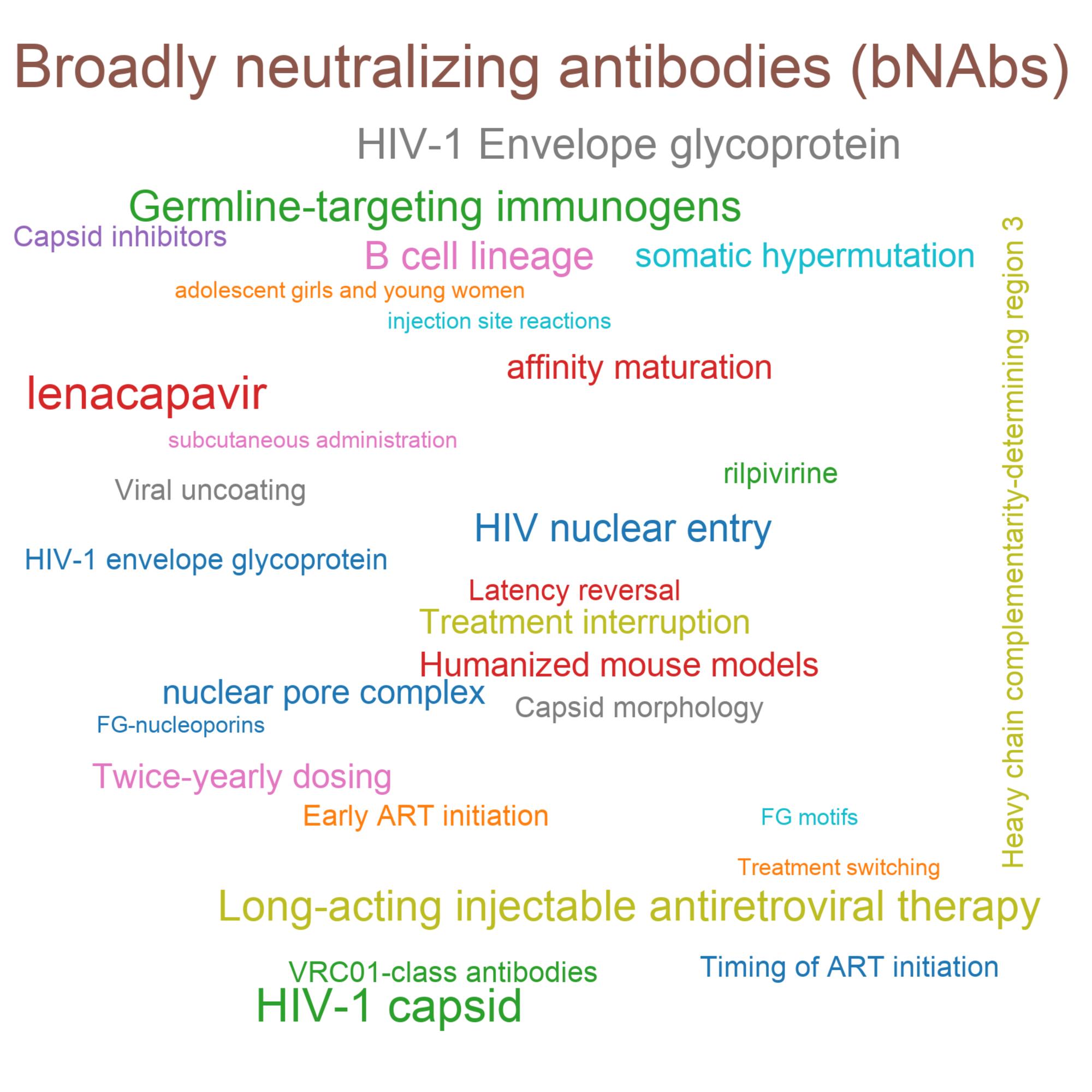
High-impact HIV research in the Class of 2026 centers on advanced biomedical interventions, structural virology, and next-generation vaccine design. Broadly neutralizing antibodies (bNAbs) dominate the field with a 22% presence among top-cited publications, reflecting intense focus on passive immunization and long-term viral suppression strategies. Parallel breakthroughs in capsid-targeted therapeutics, headlined by lenacapavir and investigations into HIV-1 capsid stability, highlight a pivotal shift toward ultra-long-acting regimens and novel viral entry inhibition mechanisms. Structural biology and immunology further shape the core landscape, with germline-targeting immunogens and HIV-1 Envelope glycoprotein dynamics driving rational HIV vaccine engineering. Researchers are increasingly dissecting B cell lineage development, affinity maturation, and somatic hypermutation to elicit potent neutralisers against viral diversity. Simultaneously, mechanistic insights into HIV nuclear entry and nuclear pore complex interactions illuminate early post-entry events critical for therapeutic targeting. Together, these thematic clusters demonstrate a dual focus: expanding real-world long-acting antiretroviral modalities while unraveling structural vulnerabilities to achieve durable HIV remission and preventive immunity.
How Did Topics Shift from the Class of 2025 to the Class of 2026?
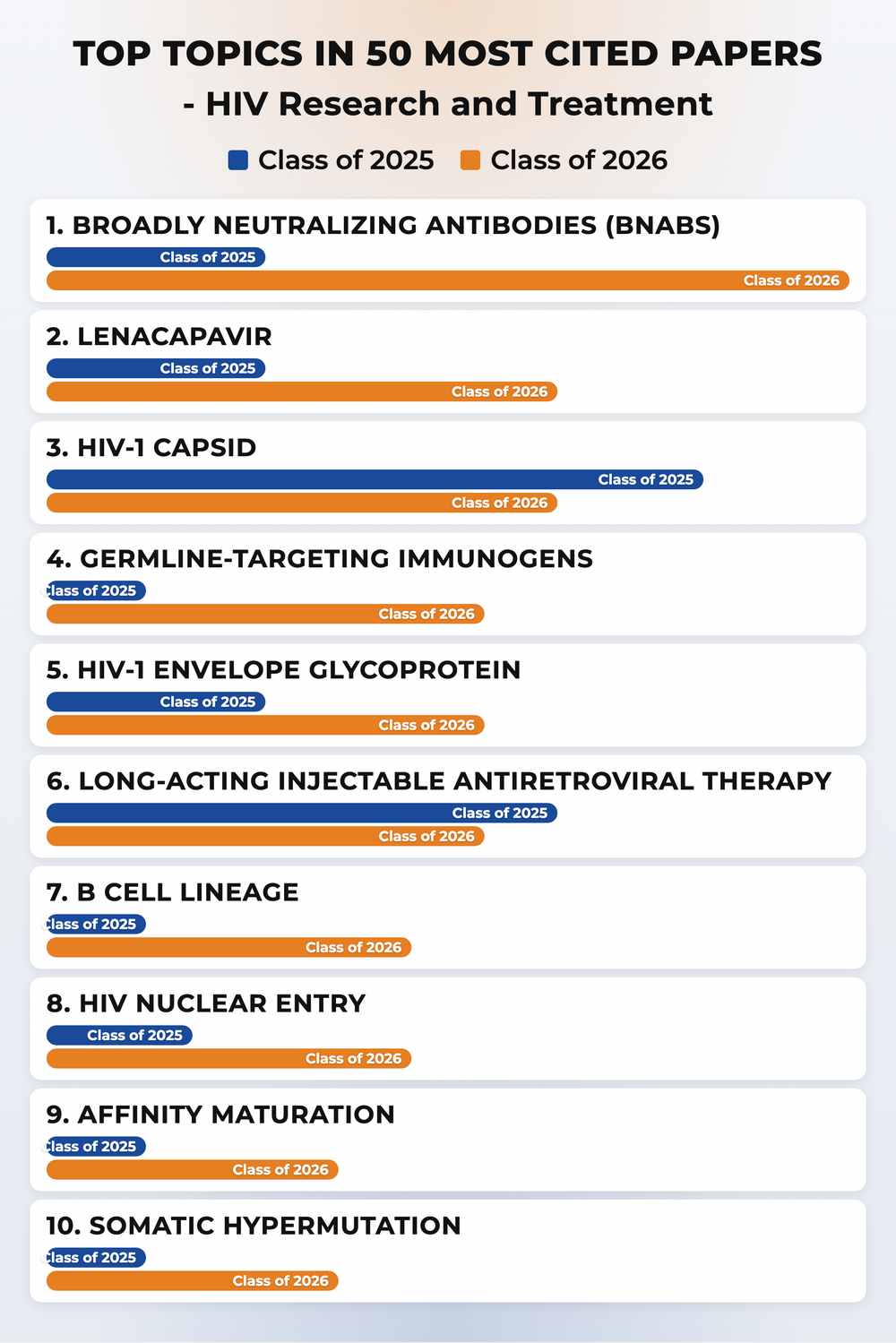
The transition from the Class of 2025 to the Class of 2026 reveals a significant pivot toward preventative immunogen engineering and ultra-long-acting therapeutic platforms. The most dramatic surge occurred in germline-targeting immunogens, ascending from zero mentions in the 2025 cohort to 12% in 2026, paired with rapid growth in affinity maturation and somatic hypermutation concepts. Broadly neutralizing antibodies (bNAbs) also experienced a nearly fourfold rise (6% to 22%), underscoring a major migration toward antibody-mediated prevention and cure strategies. In antiviral therapeutics, lenacapavir and twice-yearly dosing expanded substantially, establishing long-acting injectable regimens as dominant clinical translational themes. Conversely, conventional therapeutic categories saw waning attention among top-cited literature: interest in routine treatment interruption decreased (12% to 8%), while classical antiretrovirals like rilpivirine and CD8+ T cell response analyses contracted significantly. Overall, high-impact HIV research has reoriented away from legacy antiretroviral management toward precision immunogen design, capsid inhibition, and extended-interval dosing paradigms.
Methodology
PRI identifies high-impact research using a transparent, topic-agnostic framework applied consistently across scientific domains. Bibliographic records are drawn from OpenAlex, including publication dates, citation relationships, and document types.
This ranking covers the Class of 2026 cohort: journal articles published in 2024. Reviews and other non-article document types are excluded to ensure comparability.
Research impact is quantified with an 18-month post-publication citation window—the number of citing works published within 18 months of each paper's publication date. This metric captures early impact while controlling for publication age.
An LLM-based relevance classifier then reviews each candidate's title and abstract to confirm substantive alignment with the target domain. Only papers classified as relevant appear in the final ranking.
Zheng Su, Tinsley Li, Thematic Shifts in Early-High-Impact Cancer Genomics and Diagnostics Research: A Bibliometric and Semantic Analysis. bioRxiv 2026.07.04.736459; doi: https://doi.org/10.64898/2026.07.04.736459
Cite this ranking
Pepkio Research Index (PRI). Topics and Trends in Most Cited HIV Research and Treatment Papers, Class of 2026. https://pri.pepkio.com/top-papers/hiv-research-and-treatment/2026. Accessed 2026-10-16.

Methodology
Zheng Su, Tinsley Li, Thematic Shifts in Early-High-Impact Cancer Genomics and Diagnostics Research: A Bibliometric and Semantic Analysis. bioRxiv 2026.07.04.736459; doi: https://doi.org/10.64898/2026.07.04.736459