
What topics and trends defined most-cited Influenza Virus Research Studies research in the Class of 2026?
Highly pathogenic H5N1 avian influenza dominates the Class of 2026, driven by a rapid surge in research on dairy cattle outbreaks, bovine infection dynamics, and raw milk transmission. While studies on mammalian adaptation, genomic sequencing, and occupational exposure expanded significantly, traditional research on seasonal influenza strains like H3N2 and routine hospitalization metrics showed relative declines.
At a glance
- Field
- Influenza Virus Research Studies
- Cohort label
- Class of 2026 (2024 publications)
- Papers analyzed
- 4,940
- Papers ranked
- 20
- Top topics in ranked papers
- HPAI H5N1 virus, spillover, dairy cattle, clade 2.3.4.4b, cross-species transmission
- Publication window
- Jan 1, 2024 – Dec 31, 2024
- Eligibility
- Research articles; reviews excluded
- Citation window
- 18 months post-publication
- 18m citation range
- 59–398
- Data source
- OpenAlex · Retrieved July 2026
- License
- CC BY 4.0
Rankings
20 papers ranked by 18-month citation count
Highly Pathogenic Avian Influenza A(H5N1) Clade 2.3.4.4b Virus Infection in Domestic Dairy Cattle and Cats, United States, 2024
Emerging infectious diseases202410.3201/eid3007.240508
Spillover of highly pathogenic avian influenza H5N1 virus to dairy cattle
Nature202410.1038/s41586-024-07849-4
The global H5N1 influenza panzootic in mammals
Nature202410.1038/s41586-024-08054-z
Highly Pathogenic Avian Influenza A(H5N1) Virus Infection in a Dairy Farm Worker
New England Journal of Medicine202410.1056/nejmc2405371
Pathogenicity and transmissibility of bovine H5N1 influenza virus
Nature202410.1038/s41586-024-07766-6
Highly Pathogenic Avian Influenza A(H5N1) Virus Infections in Humans
New England Journal of Medicine202410.1056/nejmoa2414610
Detection and spread of high pathogenicity avian influenza virus H5N1 in the Antarctic Region
Nature Communications202410.1038/s41467-024-51490-8
A single mutation in bovine influenza H5N1 hemagglutinin switches specificity to human receptors
Science202410.1126/science.adt0180
Epidemiological data of an influenza A/H5N1 outbreak in elephant seals in Argentina indicates mammal-to-mammal transmission
Nature Communications202410.1038/s41467-024-53766-5
Critical Illness in an Adolescent with Influenza A(H5N1) Virus Infection
New England Journal of Medicine202410.1056/nejmc2415890
Dairy cows inoculated with highly pathogenic avian influenza virus H5N1
Nature202410.1038/s41586-024-08166-6
Outbreak of Highly Pathogenic Avian Influenza A(H5N1) Viruses in U.S. Dairy Cattle and Detection of Two Human Cases — United States, 2024
MMWR Morbidity and Mortality Weekly Report202410.15585/mmwr.mm7321e1
COVID-19 pandemic interventions reshaped the global dispersal of seasonal influenza viruses
Science202410.1126/science.adq3003
Sialic Acid Receptor Specificity in Mammary Gland of Dairy Cattle Infected with Highly Pathogenic Avian Influenza A(H5N1) Virus
Emerging infectious diseases202410.3201/eid3007.240689
Serologic Evidence of Recent Infection with Highly Pathogenic Avian Influenza A(H5) Virus Among Dairy Workers — Michigan and Colorado, June–August 2024
MMWR Morbidity and Mortality Weekly Report202410.15585/mmwr.mm7344a3
H19 influenza A virus exhibits species-specific MHC class II receptor usage
Cell Host & Microbe202410.1016/j.chom.2024.05.018
Characterization of highly pathogenic avian influenza virus in retail dairy products in the US
Journal of Virology202410.1128/jvi.00881-24
Deep mutational scanning of H5 hemagglutinin to inform influenza virus surveillance
PLoS Biology202410.1371/journal.pbio.3002916
Development of a nucleoside-modified mRNA vaccine against clade 2.3.4.4b H5 highly pathogenic avian influenza virus
Nature Communications202410.1038/s41467-024-48555-z
Highly pathogenic avian influenza A(H5N1) virus of clade 2.3.4.4b isolated from a human case in Chile causes fatal disease and transmits between co-housed ferrets
Emerging Microbes & Infections202410.1080/22221751.2024.2332667
Topic trends
Dominant research themes and year-over-year shifts in Influenza Virus Research Studies
What Topics Define the Class of 2026?
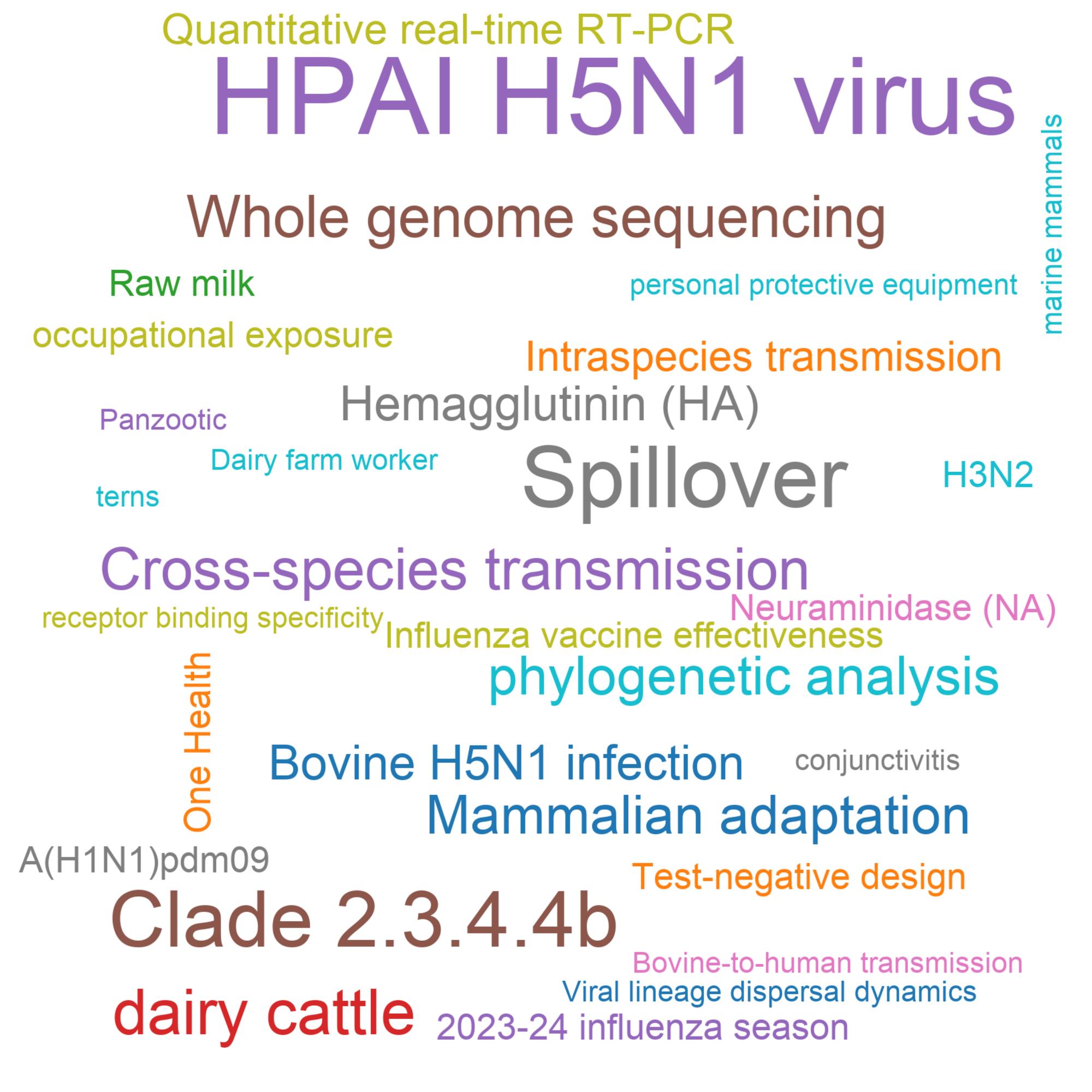
The research landscape for the Class of 2026 is defined by an overwhelming focus on highly pathogenic avian influenza (HPAI) H5N1 virus, which appears in 42% of the highest-impact literature. Investigation into viral spillover dynamics forms a second major pillar (28%), accompanied by continuous molecular tracking of the expanding clade 2.3.4.4b lineage (24%). Cross-species transmission mechanisms (14%) and whole genome sequencing (14%) serve as essential methodological foundations for mapping interspecies jumps and viral adaptation. Concurrently, studies evaluating mammalian adaptation (12%) and phylogenetic analysis (12%) underscore high concern regarding potential host range expansion. A significant cluster of research concentrates on unprecedented agricultural reservoirs, specifically H5N1 in dairy cattle (16%) and bovine infections (10%). Operational tools such as quantitative real-time RT-PCR (8%) and diagnostic hemagglutinin (10%) assays remain critical for rapid outbreak detection. Together, these thematic priorities highlight a fundamental shift in influenza research, moving from localized avian monitoring toward comprehensive One Health surveillance across livestock, wildlife, and potential human interfaces.
How Did Topics Shift from the Class of 2025 to the Class of 2026?
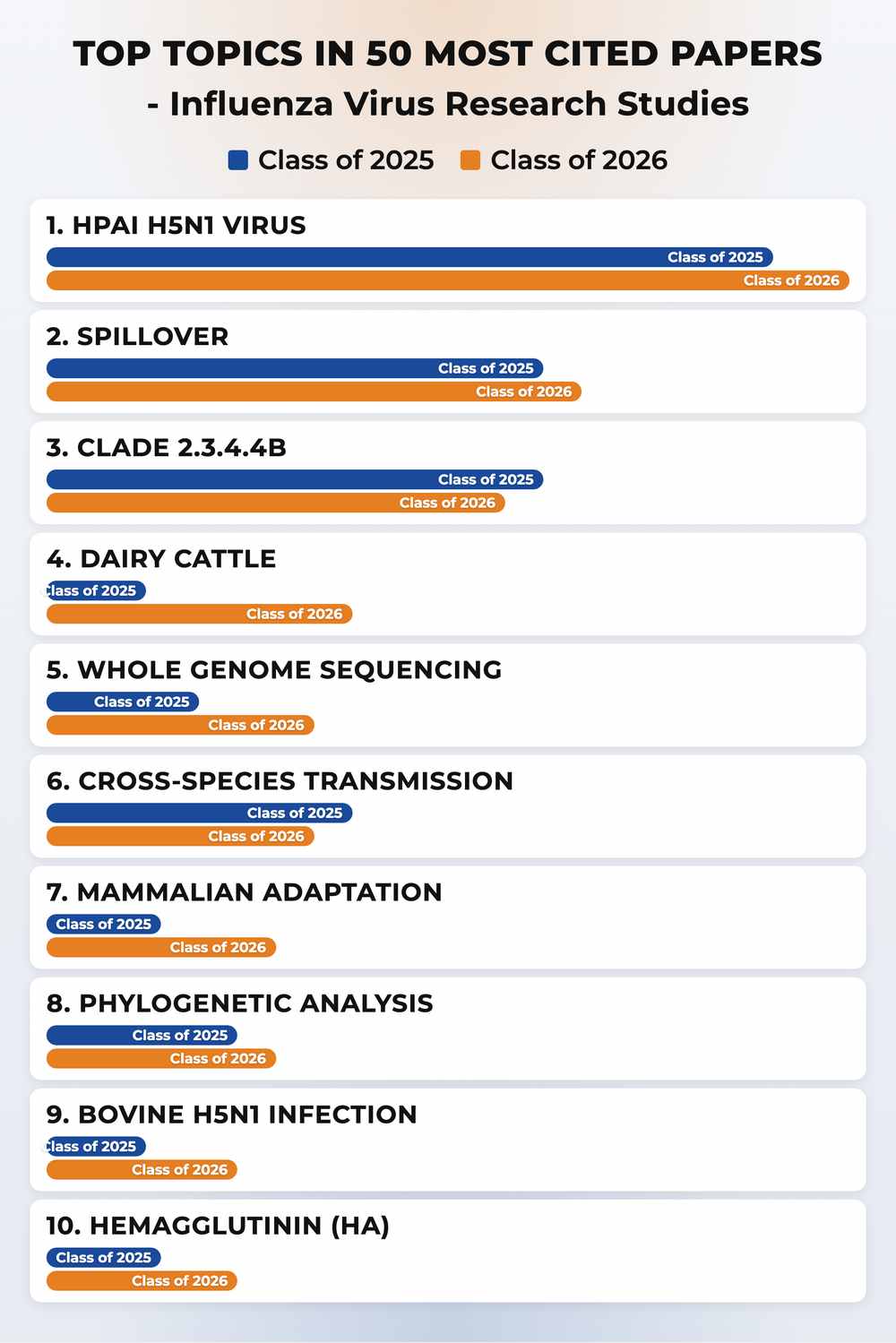
Comparison between the Class of 2025 and Class of 2026 reveals a dramatic pivot toward novel bovine and livestock transmission pathways. The most prominent surge involves H5N1 in dairy cattle, rising from 0% of top literature in 2023 to 16% in 2024 (+16 percentage points). Associated topics including bovine H5N1 infection (+10 percentage points to 10%), occupational exposure (+6 pp to 6%), raw milk contamination (+6 pp to 6%), and dairy farm worker monitoring (+4 pp to 4%) emerged as immediate research priorities. Whole genome sequencing expanded from 8% to 14% (+6 pp), while studies on mammalian adaptation doubled from 6% to 12% (+6 pp), driven by urgent efforts to track interspecies transmission during the United States multispecies outbreak. Conversely, focus on traditional seasonal influenza metrics declined. Studies centered on influenza-associated hospitalization fell from 8% to 4% (-4 pp), PB2 protein molecular studies decreased from 8% to 4% (-4 pp), and seasonal H3N2 research dropped from 10% to 6% (-4 pp). Overall, these shifts mark a decisive transition from standard seasonal disease surveillance to investigating unprecedented panzootic events across agricultural mammalian hosts.
Methodology
PRI identifies high-impact research using a transparent, topic-agnostic framework applied consistently across scientific domains. Bibliographic records are drawn from OpenAlex, including publication dates, citation relationships, and document types.
This ranking covers the Class of 2026 cohort: journal articles published in 2024. Reviews and other non-article document types are excluded to ensure comparability.
Research impact is quantified with an 18-month post-publication citation window—the number of citing works published within 18 months of each paper's publication date. This metric captures early impact while controlling for publication age.
An LLM-based relevance classifier then reviews each candidate's title and abstract to confirm substantive alignment with the target domain. Only papers classified as relevant appear in the final ranking.
Zheng Su, Tinsley Li, Thematic Shifts in Early-High-Impact Cancer Genomics and Diagnostics Research: A Bibliometric and Semantic Analysis. bioRxiv 2026.07.04.736459; doi: https://doi.org/10.64898/2026.07.04.736459
Cite this ranking
Pepkio Research Index (PRI). Topics and Trends in Most Cited Influenza Virus Research Studies Papers, Class of 2026. https://pri.pepkio.com/top-papers/influenza-virus-research-studies/2026. Accessed 2026-10-24.

Methodology
Zheng Su, Tinsley Li, Thematic Shifts in Early-High-Impact Cancer Genomics and Diagnostics Research: A Bibliometric and Semantic Analysis. bioRxiv 2026.07.04.736459; doi: https://doi.org/10.64898/2026.07.04.736459